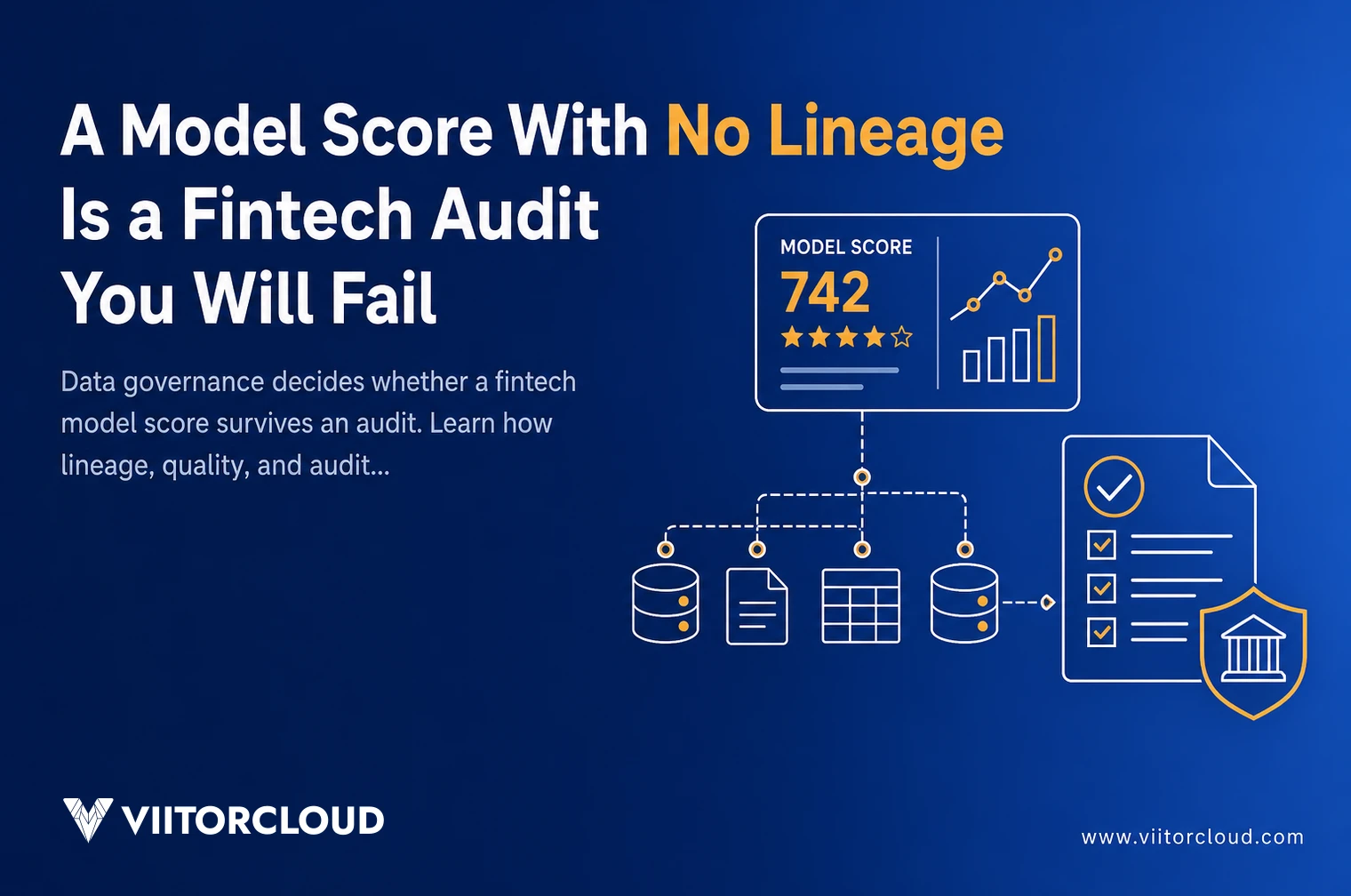
Fintech model decisions fail audits because the score cannot be reconstructed. An auditor does not ask whether your model is accurate. They ask which record, which version, and which transformation produced the number that denied a customer credit on a specific date. If your data governance cannot answer that from evidence rather than memory, the model is unexplainable by regulatory definition, no matter how well it performs.
I have sat in enough model reviews to know how this ends. The data science team walks in with validation metrics, drift charts, and a confusion matrix. The auditor asks one question about a single declined application from eleven months ago. Nobody can trace which version of the income table fed that inference. The meeting stops being about model performance and starts being about record-keeping.
This article covers what auditable data governance actually requires in a fintech environment, where lineage breaks in practice, and how to engineer the audit trail before a regulator asks for it.
Key Takeaways
- An auditor evaluates reconstructability, not model accuracy. A score without lineage is a decision no one can defend.
- The EU AI Act classifies creditworthiness assessment as high-risk AI and requires traceability plus automatic event logging. After the Digital Omnibus (Regulation 2026/1744), the high-risk obligations deadline moved from August 2026 to 2 December 2027, with penalties reaching 35 million euros or 7% of global turnover.
- Only 12% of organizations report data of sufficient quality and accessibility for AI, according to Informatica’s CDO Insights 2025 research. Lineage is the most common gap.
- Model traceability requires four linked artifacts: input snapshot, feature version, model version, and decision log. Break any one link and the chain fails.
- Master data management and a shared context layer turn scattered records into a single defensible version of a customer, which is what explainability depends on.
Why Fintech Model Decisions Collapse Under Audit Questions
The failure is almost never the model. It is the absence of a record connecting a decision to the exact data that produced it.
Most mid-market fintech platforms run inference against a feature store or a live database view. The score is written to a decisions table. The inputs are not. Six months later, the underlying customer record has been updated four times, the feature transformation logic has shipped three releases, and the model itself has been retrained twice. Reproducing that decision means reconstructing a state that no longer exists anywhere in the system.
Three specific gaps cause this:
- No input snapshot at inference time: The system stores what it decided, not what it saw.
- No versioned feature logic: Transformation code lives in a repository, but nothing binds a decision to a commit hash.
- No immutable decision log: Decisions are stored in mutable tables that later jobs overwrite or enrich.
Weak data governance is what allows all three to coexist unnoticed. The pipeline runs, the dashboards look healthy, and the gap only surfaces when someone external asks a question the system was never designed to answer.
What Regulators Actually Ask For
Auditors work backwards from an outcome. They pick a decision, then ask for the evidence chain behind it. Under the EU AI Act, AI systems used to evaluate creditworthiness or score natural persons for credit fall into the high-risk category, which carries explicit requirements for technical documentation, record-keeping, and automatically generated logs across the system lifecycle. The traceability and logging obligations in Article 12 are not satisfied by a model card or a validation report. They require operational logs that let a competent authority trace a specific output back through the system.
The Digital Omnibus package, Regulation 2026/1744, pushed the high-risk compliance deadline from August 2026 to 2 December 2027. That extra time is not slack. Building lineage retroactively across a live lending platform takes longer than most teams estimate, and penalties for non-compliance reach 35 million euros or 7% of global annual turnover.
Run a Reconstruction Audit on Your Pipeline
Pick one real credit or fraud decision from twelve months ago and try to rebuild it end to end. Our BFSI data team runs this as a two-week scoped assessment and returns the specific lineage gaps that would fail an audit.
What Data Lineage Means When a Credit Score Is on the Line
Data lineage is the recorded path a value travels from its source system to the model output that used it. In a fintech context, that means being able to state, with evidence, that the debt-to-income ratio used in a specific decision came from a specific bank feed pulled at a specific timestamp and transformed by a specific version of a specific function.
Most teams have column-level lineage in a catalog tool and assume they are covered. They are not. Catalog lineage describes how tables relate in general. Audit lineage describes what happened in one instance. Those are different artifacts.
The Four Artifacts That Make a Decision Reconstructable
- Input snapshot: The exact feature values passed to the model, stored immutably at inference time with the decision identifier.
- Feature version: A reference to the transformation logic version, ideally a commit hash or a feature store version identifier.
- Model version: The artifact identifier, training dataset reference, and deployment date.
- Decision log: The output, the threshold applied, the routing outcome, and any human override, all timestamped and append-only.
Four artifacts, one join key. That is the entire architecture of model traceability, and it is far simpler to build at design time than to retrofit under regulatory pressure.
A payments client I worked with discovered this the practical way. Their fraud model flagged a merchant in March, the merchant disputed it in September, and the team spent nine working days trying to rebuild the March feature vector from archived logs. They got close. Close is not evidence. After that engagement, we moved the input snapshot into the inference path itself, adding roughly 40 milliseconds of write latency and turning a nine-day archaeology exercise into a single indexed query.
Why Data Quality and Governance Fail Together in Financial Services
Only 12% of organizations report having data of sufficient quality and accessibility for AI, according to Informatica’s CDO Insights 2025 study. In financial services, the number is not better, and the failure mode is specific: data quality problems become audit problems because a bad input that produced a real decision still has to be explained.
Common quality failures that turn into governance failures:
- Silent schema drift: An upstream field changes type or meaning, the pipeline coerces it, and the model consumes a subtly different signal without any recorded event.
- Duplicate customer entities: The same person exists as three records across onboarding, KYC, and servicing, so the model scores an incomplete profile.
- Late-arriving data: A transaction posts after the scoring window, meaning the reconstructed dataset today does not match what the model saw then.
- Unlogged manual corrections: An operations team fixes a record directly in the database, and the correction has no audit entry.
Each of these is survivable in isolation. Together, they make reconstruction guesswork. This is the same class of infrastructure problem I see across regulated sectors, and it is worth reading alongside the broader view on AI implementation risks in healthcare and BFSI, where the compliance stakes follow an almost identical pattern.
Quality Gates That Produce Audit Evidence
The useful shift is treating every quality check as an evidence-producing event rather than a pass or fail alert.
Five gates I build into regulated pipelines:
- Ingestion validation with a recorded schema fingerprint per batch
- Transformation verification against expected distributions, logged per run
- Entity resolution confidence scores stored with the resolved record
- Feature distribution checks at inference, captured in the decision log
- Output monitoring with drift thresholds that trigger a documented review
Each gate writes a record. When an auditor asks whether the data was fit for purpose on a given date, the answer is a query result, not a recollection.
Engineer Lineage Into Your Inference Path
Inference-time input snapshots, versioned feature logic, and immutable decision logs, built into your existing platform without a rebuild. The same data foundations behind a platform processing $192.2M in healthcare revenue.
How Master Data Management Makes Explainability Defensible
Explainability in fintech is not only about which features drove a score. It is about proving that the entity being scored was correctly identified. A model can be perfectly interpretable and still indefensible if it scored a fragmented view of the customer.
This is where master data management stops being a data-team concern and becomes a compliance control. A single authoritative customer record, with recorded merge history and survivorship rules, means the explanation you give an auditor describes the actual person who received the decision.
The Context Layer Between Raw Data and Model Input
I recommend a distinct context layer sitting between operational systems and the model: the place where entity resolution, business definitions, and derived attributes are resolved once, versioned, and reused. Without it, the definition of an active account lives in seven different queries written by five different engineers, and no two agree at the edges.
The context layer does three things that matter under audit:
- Fixes one definition per business concept, with a version and an owner
- Records why an entity was resolved the way it was, not just the result
- Gives every downstream model the same input semantics, so explanations stay consistent across products
Getting this right is a system integration problem as much as a data problem, which is why it usually runs alongside work on system integration in finance for compliance and risk rather than after it.
Building the AI Audit Trail Before the Regulator Asks
An AI audit trail is the append-only record of everything that touched a decision: data arrival, quality outcomes, feature computation, model inference, threshold application, human review, and any subsequent correction. It is engineered, not documented.
Six practical rules I apply when building one for a lending or risk platform:
- Write the snapshot inline: Capture the feature vector in the same transaction as the decision, not in a downstream batch job that can fail silently.
- Make logs immutable: Append-only storage with retention aligned to the longest applicable regulatory window, not the shortest.
- Version everything with an identifier, not a date: Dates are ambiguous across deployments and time zones. Hashes are not.
- Log the human, too: Manual overrides are decisions. An unlogged override is the fastest way to lose an audit.
- Test reconstruction quarterly: Pick a random historical decision and rebuild it end to end. If it takes more than an hour, the design is wrong.
- Separate retention from operations: Audit storage should survive database migrations, vendor changes, and model retirement.
Rule five is the one teams skip and the one that matters most. A reconstruction drill is cheap to run and tells you the truth about your data governance posture in an afternoon. The governance principles behind this sit within a wider framework for responsible AI implementation in businesses, where accountability and traceability are treated as engineering requirements rather than policy statements.
Do’s and Don’ts for Fintech Data Governance
- Do store inputs at inference time. Don’t rely on rebuilding them from source systems later.
- Do version feature logic and model artifacts together. Don’t assume the repository history is sufficient evidence.
- Do resolve entities once in a context layer. Don’t let each model define a customer differently.
- Do log quality check outcomes as events. Don’t treat monitoring as an alerting tool only.
- Do run reconstruction drills on real historical decisions. Don’t wait for an external request to discover the gap.
Build an Auditable Data Foundation for Fintech AI
From master data management and entity resolution through to a versioned context layer your models can share. ViitorCloud has delivered record-accuracy platforms at 70M+ user scale for government and enterprise clients.
Where an Engineering Partner Changes the Outcome
Most mid-market fintech teams have the skill to build this. What they usually lack is the bandwidth to build it while shipping product, and the pattern library that comes from doing it repeatedly across regulated environments.
ViitorCloud builds the data foundations underneath AI decisions rather than the models alone. On the KPMG Tamil Nadu Makkal Number platform, we consolidated government records for over 70 million registered citizens, where record accuracy and identity resolution were the entire engineering problem. In healthcare revenue cycle work with LogixHealth, the platform processes $192.2M in healthcare revenue, and every transaction carries the traceability that regulated finance demands. That work is documented across our custom software delivery for KPMG and our wider data analytics capability.
If you are building or scoring credit, fraud, or risk models and cannot currently reconstruct a decision from twelve months ago in under an hour, that is the gap worth closing first. Our BFSI engineering team starts these engagements with a reconstruction audit on your existing pipeline, which usually tells you more in two weeks than a governance policy review does in two months. Talk to our data engineering team when you want that assessment scoped.
Conclusion
A model score with no lineage is not a model problem. It is a record-keeping failure that becomes a regulatory finding the moment someone external asks a specific question. Strong data governance in fintech means four linked artifacts behind every decision, quality checks that produce evidence rather than alerts, and a context layer that fixes what a customer means before any model reads it.
The December 2027 deadline for high-risk AI obligations sounds distant. Retrofitting lineage across a live lending platform does not fit in the last two quarters before it. Start with a reconstruction drill on one real historical decision this month. What that exercise reveals will set your roadmap more accurately than any compliance checklist.

Vishal Shukla
Vishal Shukla is Vice President of Technology at ViitorCloud Technologies.
Frequently Asked Questions
What is data governance in a fintech context
Data governance in fintech is the set of engineered controls that make every data-driven decision traceable, explainable, and defensible. It covers ownership, quality standards, lineage capture, retention, and access. In regulated lending or risk scoring, its practical test is whether you can reconstruct a specific past decision from recorded evidence.
How do you make AI decisions auditable
What does the EU AI Act require for credit scoring models
What is the difference between data lineage and model traceability
How long does it take to build an audit trail for existing models