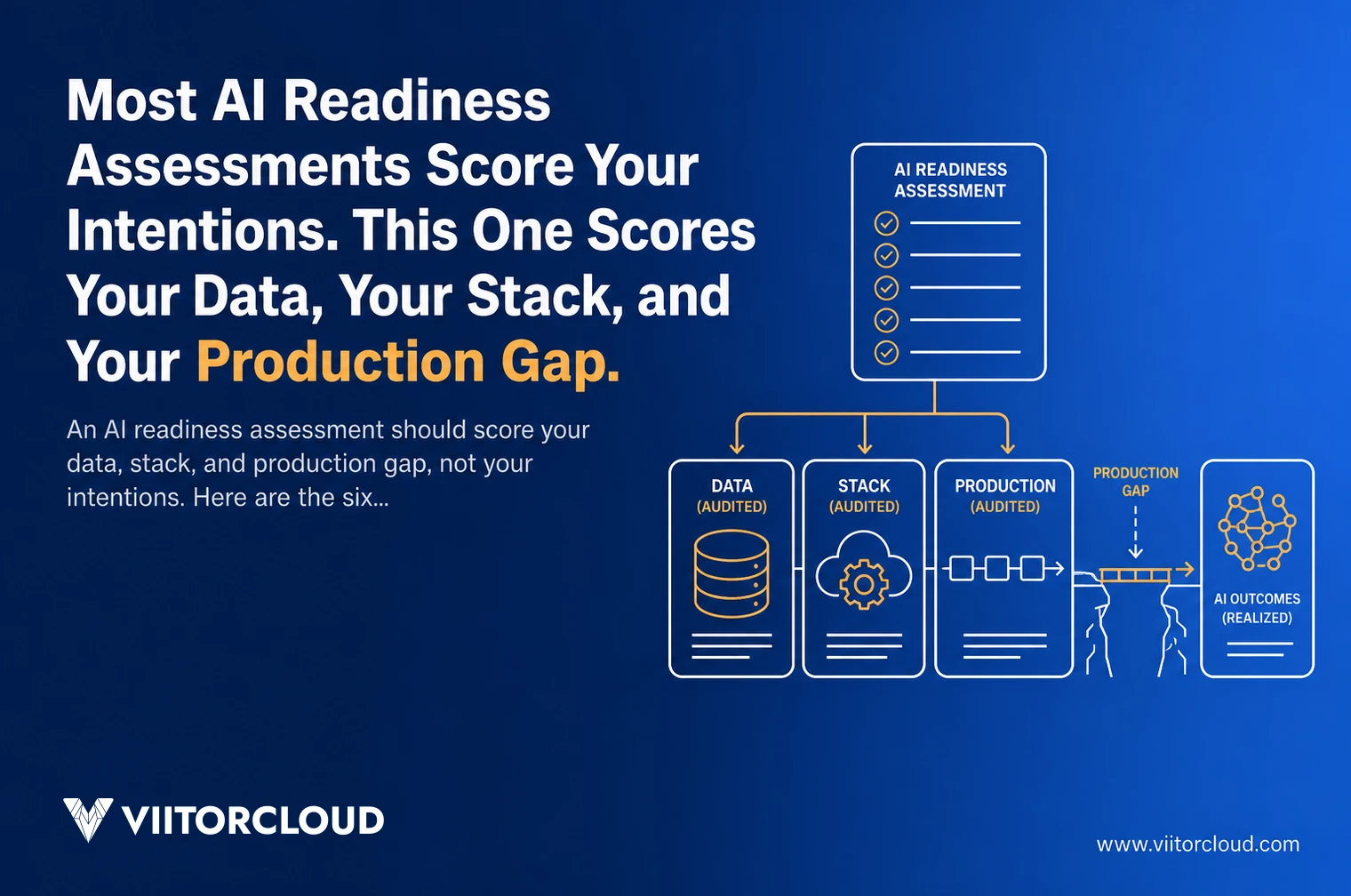
A real AI readiness assessment measures three things a questionnaire cannot reach. Whether your data can serve a model at production latency. Whether your platform can host, monitor, and roll back that model. And how far you sit from the day its output changes a business decision. Everything else is intent.
I have sat through a lot of readiness readouts. Most of them are honest work. They ask about strategy, sponsorship, data culture, and skills, then return a maturity band and a slide with four workstreams. Nothing in that output tells you whether your customer table refreshes hourly or nightly.
That gap is expensive. Gartner’s research on AI project failure has predicted that 60% of AI projects will be abandoned through 2026 without AI-ready data, and it puts the share of enterprise AI work that never reaches production near 70%. A 2026 survey of more than 1,500 IT leaders published by Harvard Business Review Analytic Services found only 7% describe their data as completely ready for AI. Boards are approving the next investment cycle on top of that.
So here is the six-dimension AI readiness framework I use, how to read the production gap it exposes, and what a decision-grade assessment should hand you at the end.
Key Takeaways
- An AI readiness assessment is a production feasibility test for one named use case, not a maturity band for the whole organization.
- Six dimensions decide the outcome. Data, platform, evaluation, integration, governance, and operating model.
- AI-ready data fails first. Field definitions, refresh frequency, lineage, and serving latency break more pilots than model choice does.
- The production gap is the distance between what your chosen use case requires and what each dimension delivers today. That number sets the budget, not a score out of five.
- A bounded assessment runs in two to four weeks and ends with a ranked use case list, a target architecture, and a proof of concept scope with agreed acceptance thresholds.
What a Real AI Readiness Assessment Actually Measures
An AI readiness assessment evaluates whether a specific AI use case can reach production in your environment. It scores data quality and latency, platform capability, model evaluation, integration points, governance, and post-launch ownership. It produces a build sequence, a proof of concept scope, and a cost range rather than a maturity band.
That is a different instrument from an AI maturity assessment. An AI maturity assessment places you on a stage curve against peers, which is useful for a board narrative. An AI readiness assessment tells you what breaks when you deploy, which is useful for an engineering plan. I run both, and I keep them separate, because the second one changes what gets funded.
The distinction shows up in the questions. Intent-based scoring asks whether leadership is committed to AI. Evidence-based scoring asks which system holds the record of truth for the field the model needs, when that field last changed shape without notice, and who was paged. If you want the wider view before you scope anything, I have covered how an AI readiness assessment is structured separately.
Score Your Data Before You Score Your Ambition
Our engineers run a bounded AI readiness assessment across data, stack, and production gap, using the same six dimensions behind a livestock platform that reached a 30% mortality reduction on 1 million daily data points.
Why Intent-Based Scoring Keeps Producing Failed Pilots
Questionnaires measure self-reported belief. Belief is not a constraint you can engineer against.
On a livestock health monitoring build, the model was never the problem. The system takes readings from more than 15,000 sensors and extracts over 1 million data points daily, and early prediction accuracy was poor because the ingestion path dropped and reordered readings under load. We rebuilt the pipeline before touching the algorithm. Accuracy improved on the same model, and the deployed system now contributes to a 30% reduction in cow mortality across more than 20 enterprise clients. A readiness questionnaire would have scored that client high on commitment and told them nothing about the ingestion path.
Logistics shows the same pattern. On a port management platform live across 14 active sites in more than 10 countries, cargo is tracked in both container and metric ton terms. Readiness there meant reconciling how each site defined a movement before any forecasting model could train on the combined set. That failure mode is the subject of a longer piece on why enterprise AI projects fail at the data layer. The infrastructure under the model decides the outcome more often than the model does.
The Six Dimensions of an AI Readiness Framework That Survives Production
Every dimension of the AI readiness framework below is scored against evidence rather than opinion. I ask for a query, a schema, a log, or a runbook. If nobody can produce the artifact, the dimension is not ready.
Data Readiness Decides Everything Downstream
AI-ready data is data the model can trust at the moment it is asked.
Five checks:
- Field definitions: Does customer mean the same thing in the ERP, the CRM, and the billing system?
- Refresh frequency: How current is the record when the model reads it?
- Lineage: Can you trace any value back to the system that produced it?
- Serving latency: Can the pipeline answer inside the time the workflow allows?
- Labels and ground truth: Is there enough correctly labeled history to evaluate anything?
Most teams discover they have a warehouse built for reporting and a use case that needs a serving layer. That work belongs in data pipeline development, and it is the largest line item in most readiness remediation plans I write.
Platform Readiness Sets the Ceiling on What You Can Host
Compute, environments, model registry, vector storage, feature reuse, and observability. Ask where a model version lives, how you promote it, and how you roll it back at 2 a.m. A stack with no rollback path will never be trusted with a production decision, whatever the strategy deck says.
Evaluation Readiness Defines What Good Actually Means
Before a build starts, there should be a held-out evaluation set, a documented baseline, and a numeric acceptance threshold. The current manual process counts as the baseline. Teams that skip this step cannot tell a working model from a plausible one, which is how a pilot ends in a debate instead of a decision.
Integration Readiness Answers Where the Output Lands
An inference nobody consumes has no value. Name the screen, queue, or API that receives the output, the person or system that acts on it, and the fallback when confidence is low. This is where technically successful pilots most often die.
Governance Readiness Keeps the System Auditable
Access control, retention, audit trails, model documentation, and a named accountable owner. In regulated work, this is a design input, not paperwork. Mapping controls against a recognized structure such as the NIST AI Risk Management Framework early costs days. Retrofitting them after a compliance review costs quarters.
Operating Model Readiness Covers the Day After Launch
AI production readiness includes the unglamorous part. Who owns the model in month seven, what triggers retraining, which alert fires on drift, and whose budget pays for inference. I ask for the on-call rotation. If the only answer is the vendor, the score drops.
Get Your Production Gap Quantified in Weeks
One named use case, six dimensions scored against evidence, and a remediation cost range separated from build cost. The output is an engineering plan you can budget, not a maturity band.
How to Read Your Production Gap Instead of Your Maturity Score
The production gap is the number an AI readiness assessment exists to produce, and it is a subtraction rather than a grade. Take the highest value use case, write down what each of the six dimensions must deliver for it to ship, then write down what they deliver today. The difference is your gap, expressed in weeks and cost.
Here is how that plays out. A use case needs a customer risk score inside a 100 millisecond request. Current state is a nightly batch into a reporting warehouse. Data readiness for that use case is not medium; it is a defined piece of engineering with a known duration. The same organization might be fully ready for a document classification use case running on a daily cycle. One environment, two very different answers, which is exactly why a single organizational maturity score misleads.
In healthcare, the gap is usually structural. On a revenue cycle platform that has processed $192.2M in healthcare revenue, AI production readiness meant claim data structure, access control, and audit trail long before automation entered the conversation. I go deeper on that sequence in healthcare AI data readiness.
Score the gap per use case, and the shortlist reorders itself. The ambitious project moves to phase two, and a smaller one that clears every threshold moves to the front. That reordering is what gets a first release live inside the same budget year.
How Long an AI Readiness Assessment Should Take and What It Should Produce
Two to four weeks. A readiness engagement that runs a full quarter has quietly become a strategy project, and by the time it reports, the stack it described has moved.
Six deliverables I expect from any AI readiness consulting engagement:
- A dimension-by-dimension scorecard with the supporting evidence attached to each score.
- A ranked list of use cases with the production gap quantified for each one.
- A target architecture for the top-ranked use case, including the serving path.
- A proof of concept scope with acceptance thresholds agreed before the build starts.
- A cost and duration range for remediation, kept separate from the cost of the build.
- A risk register covering data, compliance, and ownership.
An AI readiness assessment tool can speed up collection, and I use them for inventory and lineage discovery. What no AI readiness assessment tool can do is decide whether a nightly refresh is acceptable for your specific workflow. That call needs someone who has shipped the thing.
The output should feed straight into scoped AI proof of concept development services rather than into a second study. The route from a validated proof of concept to a production system follows a sequence I have mapped in this roadmap from proof of concept to production.
Turn the Assessment Into a Scoped Proof of Concept
ViitorCloud has delivered for 300+ clients since 2011, including a healthcare platform that has processed $192.2M in revenue. We validate the highest value use case first, with acceptance thresholds agreed before the build starts.
Where to Start Before Your Next AI Investment Cycle
ViitorCloud has delivered for 300+ clients since 2011, and the assessments that ended in shipped systems all started the same way. One named use case, six dimensions scored against evidence, and a gap quantified in weeks. That is the path behind a livestock platform reaching a 30% mortality reduction, a government records platform reaching 70M+ registered citizens, and a healthcare platform processing $192.2M.
If you are shaping a 2027 AI budget, run the readiness work before vendor selection rather than after it. Our custom AI solutions engagements open with this diagnosis, and the phased structure means the highest value use case gets validated through AI proof of concept development services before anyone commits to a full build. When you want the gap in your own environment quantified, our engineers will walk your stack with you. Talk to our AI engineers about scoping it.
The Bottom Line on AI Readiness
An AI readiness assessment is only worth running if it can be wrong. A score built from self-reported intent cannot be falsified, which is why it never stops a bad project. A score built from schemas, refresh intervals, rollback paths, and named owners can be checked, and it will occasionally tell you to wait.
Three things to take from this. Pick one use case and assess against it. Score AI-ready data first, because it fails first. Then measure the production gap in weeks and cost rather than in maturity levels. Do that, and the next AI investment cycle starts with an engineering plan instead of an aspiration.

Vishal Shukla
Vishal Shukla is Vice President of Technology at ViitorCloud Technologies.
Frequently Asked Questions
What is an AI readiness assessment?
An AI readiness assessment is a structured review of whether a specific AI use case can reach production in your environment. It scores data, platform, evaluation, integration, governance, and operating model against evidence, then quantifies the gap between what that use case needs and what you currently have.
How do you assess AI readiness?
How long does an AI readiness assessment take?
What is the difference between an AI readiness assessment and an AI maturity assessment?
What does AI-ready data mean in practice?