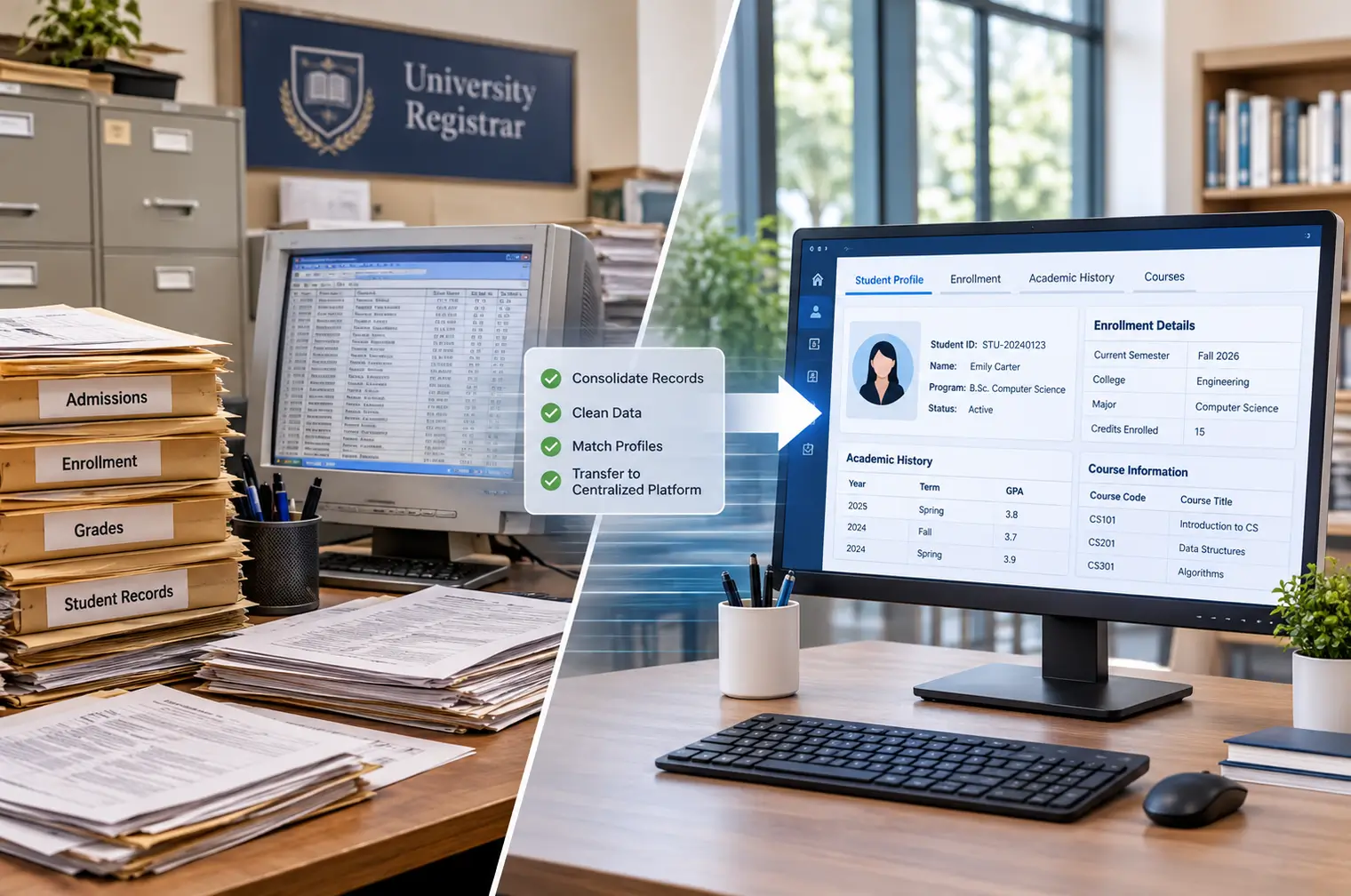
Data modernization services matter most at a very ordinary moment on campus: someone asks what a field like ENRL_FLG_3 means in the student system, and the only person who knew retired years ago. That’s where a lot of student data sits today. Records live in an ageing student information system (SIS), the software that holds admissions, enrollment, grades and graduation history. A good share of the code has no documentation, and staff rebuild key reports by hand every term.
If you’re a CIO or head of institutional data and you’ve been asked to put AI on top of records nobody fully understands, this one’s for you. Our view is simple. Start with the data dictionary, a plain list of what each field means and who owns it, and only then talk about models, dashboards or a new SIS.
Key takeaways
- Data modernization services for universities inventory every student record field, document its meaning, clean the values, move them to a governed platform and prove the numbers still match.
- An old SIS breaks under AI and new reporting because codes drift; one student ends up with three or four IDs, and meaning lives in staff memory.
- New federal reporting, such as the 2025-26 ACTS admissions supplement, asked for seven years of joined history, which exposed weak records fast.
- Data migration alone moves old problems into a new system unless definitions, quality checks and access rules are fixed on the way.
- Before signing, ask who writes the data dictionary, how FERPA access rules carry across, and how the vendor will prove reports reconcile.
What do data modernization services involve for a university?
For a university, data modernization services cover five jobs: list every field in the student system, document what each one means, clean and match the records, move them to a governed data platform, and prove the new numbers match the old reports. Replacing the SIS itself can be part of the work, though it doesn’t have to be.
In this context, an education data platform is a central store, often a cloud data warehouse, where student, course, financial aid and learning-system data sit together under one set of definitions and access rules. Your SIS keeps running day-to-day term operations, and the platform handles questions that cross systems.
Here’s how the work usually breaks down:
| Stage | What happens to student records | What you hold at the end |
| Field inventory | Every SIS table and column is listed with row counts and sample values | A field register |
| Meaning and ownership | Registrar, institutional research and IT agree what each field means and who owns it | A signed data dictionary |
| Cleanup and matching | Duplicate person records are merged, codes standardized, free-text notes parsed | A reconciled student master record |
| Migration | Records load into the new platform while the old system stays read-only or runs in parallel | A queryable platform with access rules |
| Reconciliation | Term headcounts, credit hours and degree counts are compared, old against new | A signed reconciliation report |
Look at where the effort sits. Stages one to three are mostly people’s work: sitting with the registrar and debating what “active” meant in 2016 versus today. Teams that rush at those stages pay for it later; usually in the week a board report is due.
Why do old student record systems fall apart once AI and new reporting arrive?
Old student systems were built to run a term: register for students, post grades, print transcripts. They were never set up to answer questions such as cross-admissions, aid, or advising. Over the years codes drift, one person collects more than one ID, and the meaning of key fields lives in staff memory. AI projects and new federal reporting expose all of it at once.
Age is part of it. ListEdTech’s 2024 analysis of about 2,627 North American institutions put the average life of an SIS implementation at just over 14 years. That’s fourteen years of patches, renamed codes and one-off fields added for a single grant report.
Confidence is the other part. In the 2026 State of Data Integrity and AI Readiness study from Precisely and Drexel LeBow (January 2026), 88% of data leaders said their data was ready for AI, yet 43% named data readiness as their biggest obstacle. That survey covered more than 500 leaders at large companies in the US and EMEA, not universities. Still, the pattern will feel familiar to any registrar.
Higher education’s own agenda points the same way. “Building a Data-Centric Culture Across the Institution” is one of the issues on the 2026 EDUCAUSE Top 10, next to data analytics for enrollment and cost decisions and clearer legacy systems assessments.
Here’s what a weak student record looks like in practice:
- One student, three IDs. An applicant record in the admissions CRM, a student record in the SIS and an alumni record in advancement, with no reliable key joining them.
- Codes that changed meaning. A status value meant “on leave” up to a certain year and “deferred” after it, with no date of flag to tell them apart.
- Transfer credit in a notes field. Course equivalencies typed as free text, so no report can count them.
- Grades stored as text. “A-“, “INC”, “W” and “AU” are mixed in one column, with local rules for which ones count toward GPA.
- Nightly CSV exports. Flat files feed the learning management system and the BI tool, and when one export fails, advising dashboards quietly show yesterday.
Our take is blunt. Putting a retention or advising model on top of records like these wastes a semester. Some of the patterns it finds will simply reflect how staff coded records in a given year, and nobody will be able to tell which ones.
Find Out What Your Student System Fields Really Mean
Book a data modernization assessment. We inventory your legacy SIS fields, flag duplicate student IDs and undocumented codes, and hand you a plain-language field register your registrar can sign off.
What did the 2025-26 ACTS admissions report reveal about university data?
A new IPEDS component, the Admissions and Consumer Transparency Supplement (ACTS), asked selective four-year US institutions for applicant, admit, enrollment and aid data broken down by race and sex, GPA, test scores and family income, going back seven academic years. For institutions with undocumented historical codes, meeting that request often meant rebuilding old records by hand.
According to AACRAO’s guide to the supplement (March 2026), ACTS covers 2019-20 through 2025-26, and collection opened on 18 December 2025. AACRAO also notes the Department of Education’s own burden estimate: 200 hours for this year’s ACTS collection, against 78.5 hours for every other IPEDS component combined.
Think about what seven years of history means inside an old SIS. Test-optional policies left score fields blank for some cohorts. Family income sits in the financial aid system, keyed differently from admissions. Applicant records may never have been linked to the student records they became. Every one of those joins is a student records migration problem, even when the task arrives labeled as compliance.
We see ACTS as a useful stress test, whatever your view of the policy. If your team pulled seven years of clean, join admissions data in a week, your foundations are in decent shape. If it took a task force and a long spreadsheet fight, you now know exactly where to start.
US rules aren’t the only pressure. UK providers file student data returns to HESA, and Indian universities report to AISHE and are linking learners to APAAR IDs. Each of these returns depends on historical student data your team can trust.
Pull Seven Years of Admissions Data Without a Task Force
Our student records migration team maps historical SIS codes, joins admissions, aid and enrollment data, and reconciles every term before your next federal or national return is due.
Data migration or data modernization: which one is your university buying?
Data migration copies records from one system to another. Data modernization changes how those records are defined, cleaned, governed and used, and migration is one step inside it. Universities that buy migration alone usually move their old problems into a new SIS, along with a bigger invoice.
| Question | Data migration | Data modernization |
| Goal | Move records into a new system | Make records trustworthy and usable across systems |
| Field meanings | Mapped column to column | Documented, agreed and owned by named staff |
| Duplicates and bad codes | Usually carried over | Matched, merged or retired before the move |
| Access rules | Rebuilt separately in each system | Defined once by role and applied in the platform |
| Finished when | Data loads without errors | Reports reconcile and staff can answer new questions |
A straight migration is fine in one situation: you’re moving between versions of the same SIS and your data dictionary is already current. Be honest about whether that describes you.
Our legacy application modernization work starts with that question, because the answer changes the scope and the budget.
Once the platform is live, ongoing data management services keep it from drifting back. That means someone owns definitions; quality checks run on every load, and access rules change when roles change. ViitorCloud’s data analytics and data management practice covers that layer, from data integration through reporting.
Questions to ask before you sign for data modernization services
Before signing, ask any vendor how they’ll document field meanings, carry FERPA access rules across, keep the old SIS safe during the move, prove that reports reconcile, and what your university owns at the end. Vague answers on any of these usually mean the vendor plans a migration and is calling it modernization.
Who writes down what each field means, and who signs it off?
Engineers can’t guess the meaning of data alone. A good vendor runs working sessions with the registrar, institutional research and financial aid, then writes each definition in plain language with an owner beside it. Ask to see one finished data dictionary entry from a past project. If they can’t show you one, that tells you plenty.
How do FERPA access rules move with the data?
FERPA, the US federal law on student education records, limits who can see what. UK GDPR and India’s Digital Personal Data Protection Act 2023 cover the same records elsewhere. Ask how role-based access, masking of sensitive fields such as national ID numbers, and audit logs will be rebuilt in the new platform before anyone runs a query. Access rules should be in place on the day the data arrives.
What happens to the old SIS while records move?
Nobody should switch off the student system during registration week. Safer plans move one domain at a time, often admissions first, then enrollment and grades, while the old SIS runs in parallel or stays read-only. That requires solid system integration services so the old and new systems stay in step until the last domain moves.
How will you prove the new numbers match the old ones?
Reconciliation is the test that matters. For every historical term, compare census-date headcount, credit hours and degrees conferred between the old system and the new platform, then explain each gap in writing. Ask for that report format before the project starts. A vendor that can’t describe this test isn’t ready to touch your records.
Which data modernization services deliverables does the university own?
You should own the field register, the data dictionary, every mapping rule, the pipeline code, the reconciliation report, and a runbook, all stored in your own repositories. Ask too about the automated checks that act as data quality services on every load. Avoid deals where the mapping logic lives only inside a licensed tool you can’t open.
Decide Who Owns Your Data Dictionary After Go-Live
Download the Building an AI-Native Team eBook to see which roles keep student data definitions, quality checks and access rules current once your new education data platform is live.
What education and public-record projects teach about student data
Projects outside the registrar’s office carry the same lessons, because enrollment, attendance and results data behave the same way wherever they live.
For an advisor to the Odisha government’s youth employment program, ViitorCloud built an MIS portal that tracks enrollment, training centers, attendance and assessment across four user roles. According to the case study, more than 5,000 students enrolled across Odisha, with each role recording enrollment and attendance through the same portal.
In schools, the Smart School platform gave parents, teachers and administrators one shared view of attendance and results on web and Android. A single view like that depends on every user group reading the same attendance and results fields.
On the public-data side, ViitorCloud supplied a dedicated team to KPMG India for the data ingestion module of the State Family Database, working alongside KPMG’s own people. Ingestion is where messy source records are either standardized or slip through, which is the same choke point a university faces when it consolidates student data.
ViitorCloud has built software for schools, public programs and data-heavy clients since 2011, and shares new data and AI delivery work as it happens.
Can your team explain every field in your student system today?
If the honest answer is no, don’t start with a new SIS or an AI pilot. Start with a field inventory and a data dictionary for one domain, usually admissions or enrollment, and let that tell you how big the rest of the job is. Good data modernization services make that first step small, visible and owned by your staff, and ongoing data management services keep it current after go-live.
Want a second pair of eyes on your student records before you commit to a budget? Talk to our data team about a scoped field inventory for your SIS.

Vishal Shukla
Vishal Shukla is Vice President of Technology at ViitorCloud Technologies.
Frequently Asked Questions
What are data modernization services for higher education?
Data modernization services in higher education move student, course and aid records out of ageing systems into a governed education data platform. That work includes a field inventory, a written data dictionary, cleanup and matching of duplicate records, migration, and a reconciliation that proves historical reports still match. Your goal is to record your staff can trust and query.
Do we need to replace our student information system first?
How long does a student record a modernization project take?
How do you keep student data FERPA compliant during data migration?
Is data modernization needed before using AI for retention or advising?