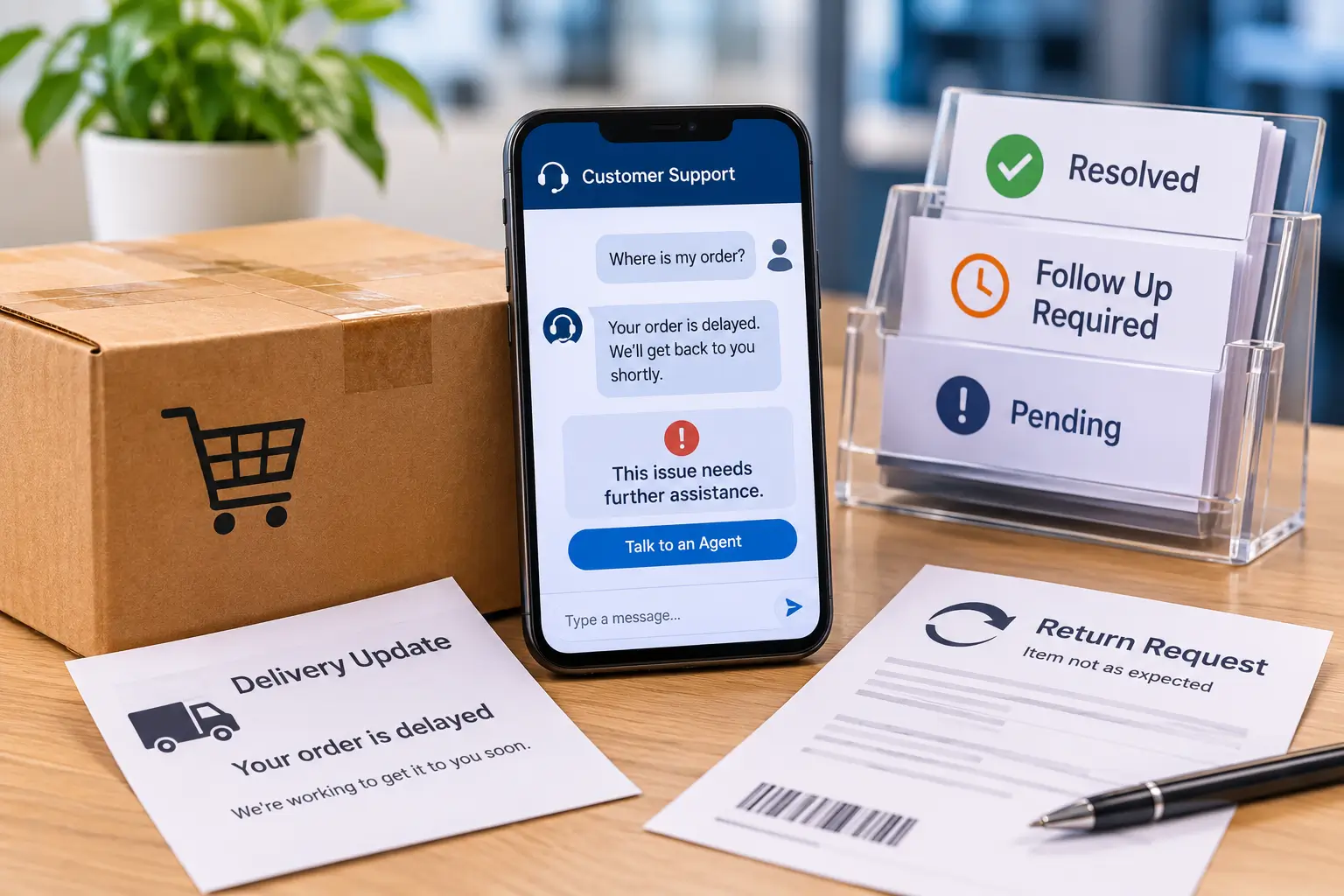
An enterprise chatbot almost always looks cheap on the invoice. A few cents per message. Well under a dollar per conversation. Put that next to what a support agent costs per ticket, and the decision seems to be made.
It isn’t, and the reason is one number most ecommerce teams never work out: cost per resolution. That’s your full chatbot running cost divided by the customer’s queries it truly solved, meaning the shopper didn’t come back by email, phone, or a second chat about the same order. A conversation with your dashboard marks resolved because someone closed the tab doesn’t count.
If you run customer experience or operations at a D2C brand or marketplace, here’s our view up front. A well-built chatbot is usually still cheaper than a person per solved query. It’s just nowhere near as cheap as the per-message price suggests, and on some query types it costs more than your agents do.
Key takeaways
- Cost per resolution is your total chatbot running cost divided by queries solved with no repeat contact, checked over a fixed window such as seven days.
- Gartner predicts the cost per resolution for generative AI in customer service will pass $3 by 2030, more than the cost of offshore human agents at a lot of B2C companies.
- Vendor “resolved” counts for an enterprise chatbot often include customers who simply left the chat. Check out a sample against your helpdesk before you trust them.
- Repeat contacts, handoffs that start from zero, and knowledge upkeep are real costs that never appear on the chatbot invoice.
- Let the bot handle order status, policy and return questions it can look up, and send damaged orders, refund disputes and payment problems to a person with the chat history attached.
What does an enterprise chatbot cost per resolution?
An enterprise chatbot’s cost per resolution is its full monthly running cost divided by the queries it solved without a repeat contact. Running cost covers platform or model fees, hosting, integration upkeep, content updates and staff time spent reviewing conversations. That figure is always higher than the per-message price, and often by a wide margin.
Two inputs decide the answer:
- Monthly running costs: usage fees for the platform or language model, hosting, upkeep of the connections to your order and helpdesk systems, knowledge base editing, and transcript review hours.
- Solved queries: chats where the issue ended in the chat, checked against repeat contacts on any channel within seven days about the same order or account.
Seven days is our working window for ecommerce. In our experience, a shopper who wasn’t helped comes back within days, and usually about the same order. Pick a window that fits your delivery and returns cycle, then keep it fixed, so each month’s number is comparable.
Watch how your vendor defines a resolution. Intercom help center, for example, counts an “assumed resolution” when a customer leaves the conversation without asking for more help, and bills $0.99 for it. That’s convenient for billing. It also counts a shopper who gave up and phoned you as a success.
Where does the real cost of a chatbot hide?
Much of the real cost sits outside the chatbot bill. It shows up in your helpdesk as repeat contacts, in agent to handle time when a handoff arrives without context, and in the hours, staff spend keeping answers current. Finance books these as general support costs, so they’re rarely charged back to the bot.
Repeat contacts from “resolved” chats
A shopper asks where their parcel is. Your bot replies with a generic delivery window because it can’t read the courier status. Your shopper closes the chat, your dashboard records a resolution, and an email lands in the support inbox an hour later.
You’ve paid for two contacts to solve one query.
When an enterprise chatbot hands over without context
If the bot hands a customer over without passing the order number, the question and what it already tried, your agent starts again. Your customer repeats it all, usually irritated by then. A handoff like that takes more agent time than a ticket that went straight to a person.
Customers expect that route to a person to exist. In Gartner’s August 2026 survey of 3,566 customers, 87% said it’s essential that companies using GenAI for service offer a way to reach a human agent. If your handoff is clumsy, they’ll still use it. You’ll just pay more each time.
Knowledge that goes stale
Return windows change for festive sales, and couriers and product lines come and go. Each change needs an update to the bot source content, and a quick test that it now answers correctly. Someone on your team owns that work every week, whether it sits in the chatbot budget.
Review time and wrong answers
Somebody must read transcripts, tag failures, and fix flows or prompts. For a busy store, that’s a part-time role at a minimum.
Wrong answers carry their own bill. A bot that promises a refund your policy doesn’t allow, or quotes last season’s return window, creates a cost no usage report will show you.
Find Out What Your Enterprise Chatbot Costs per Solved Query
We review a month of your chatbot transcripts and helpdesk tickets, match repeat contacts to “resolved” chats, and show your true cost per resolution for every query type.
Why does Gartner expect AI support to cost more than offshore agents?
Gartner predicts that by 2030 the cost per resolution for generative AI in customer service will exceed $3, more than the cost of offshore human agents at a lot of B2C companies. Its January 2026 forecast names three causes: rising data center costs, AI vendors moving from subsidized growth to profit, and harder use cases that burn more tokens and need costly specialists.
You can read the reasoning in Gartner’s January 2026 prediction on GenAI cost per resolution. Patrick Quinlan, a senior director analyst at Gartner, put it plainly: “Full automation will be prohibitively expensive for most organizations.”
Two earlier Gartner findings explain why the gap between invoice and outcome is so wide. In an August 2024 survey, only 14% of customer service issues were fully resolved in self-service. A June 2025 survey of 163 service leaders led Gartner to predict that, by 2027, half of the organizations planning big support staff cuts because AI would drop those plans.
Pricing is shifting, too. Large support platforms now sell AI per resolution instead of per seat. That sounds fair until you read the resolution definition, which is why your own definition matters more than the vendor’s.
There’s one more trend worth knowing. In Gartner’s August 2026 survey, customers were about three times more likely to use outside GenAI tools such as ChatGPT or Gemini than a company’s own chatbot in their latest service interaction. An enterprise chatbot that can’t check an order or start a return gives shoppers little reason to use it.
A worked example: one e-commerce queue, counted four ways
Here’s a simplified example with illustrative numbers. They aren’t benchmarks, so swap in your own.
Picture a D2C apparel brand whose enterprise chatbot handles 20,000 conversations a month. Platform and model fees come to $9,000. That’s the invoice view: $0.45 per conversation.
Its dashboard reports 12,000 resolved conversations, which moves the figure to $0.75 per resolution. Plenty of teams stop counting here.
Now match those 12,000 chats against the helpdesk. Say 3,000 of those shoppers contacted support again within seven days about the same order, which leaves 9,000 queries truly solved. Add two costs nobody put on the chatbot line: $5,000 a month for the person who updates content and reviews transcripts, and $1,500 for upkeep of the order system connection. Bot-side cost is now $15,500, or $1.72 per solved query.
One more step. Those 3,000 repeat contacts landed on human agents. At an illustrative $6 per agent-handled contact, that’s $18,000 of work for the bot created. Charge it back and the true figure reaches $3.72 per solved query.
| How you count | Monthly cost | Divided by | Cost per unit |
| Invoice view | $9,000 | 20,000 conversations | $0.45 |
| Dashboard view | $9,000 | 12,000 “resolved” chats | $0.75 |
| Full running cost | $15,500 | 9,000 solved queries | $1.72 |
| Including repeat contacts | $33,500 | 9,000 solved queries | $3.72 |
Is that chatbot still cheaper than a person? Probably, if a human-solved ticket costs more than $3.72 once you count repeat contacts on that side too. Even so, it’s more than eight times the invoice figure, and the repeat contacts alone cost twice the platform fee.
For ecommerce customer support AI, the biggest saving in this example comes from cutting repeat contacts. If half of them came from order-status questions, the bot couldn’t answer, connecting it to live order and courier data removes 1,500 repeat contacts and $9,000 a month of agent time. A cheaper model could only trim part of a $9,000 platform bill.
That kind of connection work is a big part of our retail and ecommerce software projects: order, inventory, returns and helpdesk systems that agree with each other.
Stop Your Support Bot From Creating Repeat Contacts
Download the AI Agents in Production eBook for the monitoring, evaluation and handoff practices that keep ecommerce customer support AI accurate and affordable once real shoppers arrive.
Which ecommerce queries should a chatbot solve, and which needs a person?
Give your enterprise chatbot queries with one correct answer it can look up or act on: order status, delivery dates, return windows, size guides and stock checks. Send queries that need judgment or a money decision to a person with the chat history attached, including damaged items, refund disputes, failed payments and repeat contacts about one order.
Good fits for ecommerce customer support AI
- Where is my order? Only when the bot reads live order and courier data. A bot that guesses a delivery window creates repeat contacts.
- Return and exchange policy. Clear rules, frequent questions, easy to keep current.
- Starting a return. When the bot can create the return in your order system and send the label itself.
- Product and size questions. Answered only from your own catalog data.
Send to a person
- Damaged or wrong items. These need photos, judgment, and often a goodwill gesture.
- Refund disputes and chargebacks. Money and policy exceptions belong to staff who can approve of them.
- Payment failures. Shoppers are anxious at this point, and a wrong answer can lose the sale.
- A second contact about one order. If they’re back, the bot already missed once.
Gartner’s August 2026 guidance points the same way: attempt resolution only when confidence is high and keep a clear path to a person. Our rule for ecommerce is stricter. If the bot can’t read or change the order, it shouldn’t try to resolve order questions at all.
That’s why building work matters more than platform choice. A good chatbot development company spends most of the project on connections to your order, returns, catalog and helpdesk systems, since those connections decide which queries the bot can solve on its own.
Our AI-driven automation projects follow the same pattern. Automate the steps with clear rules and live data and keep people on the steps that need judgment.
How do you work out your own cost per resolution?
Export one month of enterprise chatbot conversations and helpdesk tickets, match repeat contacts to “resolved” chats, add every hidden running cost, and divide by the queries truly solved. Then split the result by query type. A small team can do this in about a week using exports to the chatbot and helpdesk already produce.
- Export for one full month. Every chatbot conversation with its intent tag and outcome, and every ticket, call and email, each carrying an order number or customer ID.
- Match repeat contacts. Flag any “resolved” chat whose customer contacted you again about the same order inside your window.
- List all running costs. Platform and model fees, hosting, integration upkeep, content updates, and transcript review hours.
- Price the human side on equal terms. Agent cost per handled contact, including repeat contacts on tickets people handled.
- Split by query type. Work out cost per resolution for order status, returns, product questions, and each other’s intent. Some will be cheap. Some will cost more than a person.
- Decide per query type. Keep it, fix it (usually a missing integration), or route it to a person by default.
Step five is where your real answer comes from. One blended number hides the query types that lose money.
If you’re comparing chatbot development services, ask each vendor to run this calculation on your data before you sign. Ask them to show the resolution definition they’ll report against, too. If a vendor quotes only build cost and per-message fees, ask for a monthly running-cost estimate as well.
Build an Enterprise Chatbot Priced on Solved Queries
Our AI chatbot development team connects your bot to order, returns and helpdesk data, sets clear handoff rules, and reports cost per resolution by query type every month.
What our chatbot and ordering projects taught us
Two lessons come up again in our AI chatbot development and ordering work: give the bot real data to act on and give staff a clean way to take over.
For Mr. Blue, an SMS automation platform for car dealerships, ViitorCloud built an NLP-trained chatbot that answers customer queries and sends service reminders. Alongside it came consent capture before any outreach and a shared panel where dealership staff manage conversations. We’d build the staff side that way for any chatbot today, because customers need a person on the same thread when the bot reaches its limit.
Hensel’s distributors used to email purchase orders that staff then typed into the ERP by hand. ViitorCloud built a distributor ordering portal synced with Microsoft Dynamics NAV, so distributors check stock, place orders and download invoices themselves. Self-service works there because the portal reads and writes the real order records.
Buy Any Flowers, a gifting startup in the UAE, needed a custom store with order, inventory and payment modules on a short deadline. Clean order and inventory data like that is exactly what a support bot needs before it can answer order questions on its own.
ViitorCloud has built custom software for clients since 2011 and shares new AI and automation delivery work as it ships.
What would your chatbot cost if you counted only solved queries?
Run the numbers before you add more automation, switch platforms or sign up for new chatbot development services. If your enterprise chatbot is cheaper per solved query than a person on most query types, scale it. If it isn’t, the fix is usually a missing connection to order data or a weak handoff rule, and both cost less than a new platform.
Our AI chatbot development team can run a cost-per-resolution review on one month of your data and show which query types to fix first.
Want a second opinion on your numbers? Talk to us about your support queue and bring last month’s exports.

Vishal Shukla
Vishal Shukla is Vice President of Technology at ViitorCloud Technologies.
Frequently asked questions
What is the cost per resolution for an enterprise chatbot?
Cost per resolution for an enterprise chatbot is the full monthly running cost of the bot divided by the customer queries it solved without a repeat contact. Running costs include platform or model fees, hosting, integration upkeep, content updates, and review time. Count a query as solved only if the customer didn't come back about the same issue within a fixed window, such as seven days.
Is an AI chatbot cheaper than a human customer service agents?
How do chatbot vendors define a resolution?
What should an ecommerce chatbot hand off to a human agent?
How much does enterprise chatbot development cost to run each month?