A good chatbot to human handoff gives customers a clear way to reach a person at any point, passes the full conversation to that person, and hands over early when the bot is unsure. Most GenAI chatbots launch with a deflection target, meaning a goal for how many questions the bot answers without staff. Few launch with a designed escalation path, so customers ask for a human sooner and with more frustration than they did with the old contact form.
Key takeaways
- Gartner found that 87% of customers say a company using GenAI for service must offer a way to reach a human agent.
- Customers were about three times more likely to use outside tools such as ChatGPT than a company’s own chatbot in their latest service interaction.
- A poor chatbot to human handoff that loses the conversation history makes the customer explain the problem again, which feels worse than a plain form.
- Deflection rate alone can count frustrated customers who gave up as “deflected.”
- In California, health facilities sending GenAI patient messages about health status must include instructions for reaching a human provider.
Do customers want to start with chatbots?
The deflection pitch assumes customers will try the chatbot first. In practice, many customers distrust company chatbots before they type a word, and the top worry is losing access to a person.
A Gartner survey of 5,728 customers found that 64% would prefer companies did not use AI in customer service, and their top concern was that it would become harder to reach a person (Gartner, July 2024).
Customer views had changed by 2026, though not completely. In Gartner’s 2026 survey of 3,566 customers, half said interactions are easier when companies use GenAI. Yet customers were roughly three times more likely to use third-party GenAI tools than a company’s own chatbot (Gartner, August 2026).
Gartner analyst Eric Keller put the design lesson plainly: service leaders “should not use GenAI as a mandatory first step for every issue.” A bot that blocks the route to a person pushes customers to other channels.
Why customers still ask for a human agent
The same 2026 Gartner survey found that 87% of customers say it is essential for companies using GenAI to offer an option to reach a human agent. Demand for a person stayed high after chatbots arrived, and many customers now treat it as a condition for using a chatbot at all.
Regulation is moving the same way. Gartner predicts that rules require access to a human may increase assisted-service volume by 30% by 2028, and advises service leaders not to understaff on the assumption that AI will absorb demand (Gartner, January 2026).
Healthcare already has a specific rule. Since January 1, 2025, California’s AB 3030 has required covered health facilities and clinics that send GenAI-written patient messages about health status to include a disclaimer and clear instructions for contacting a human health care provider, as the California Department of Public Health guidance explains. Messages reviewed by a licensed provider are exempt.
Your Chatbot Hits Its Deflection Target. Are Customers Happy?
We review your GenAI support channel against what customers expect and design a chatbot to human handoff that keeps the route to a person clear.
What happens when the handoff loses the conversation
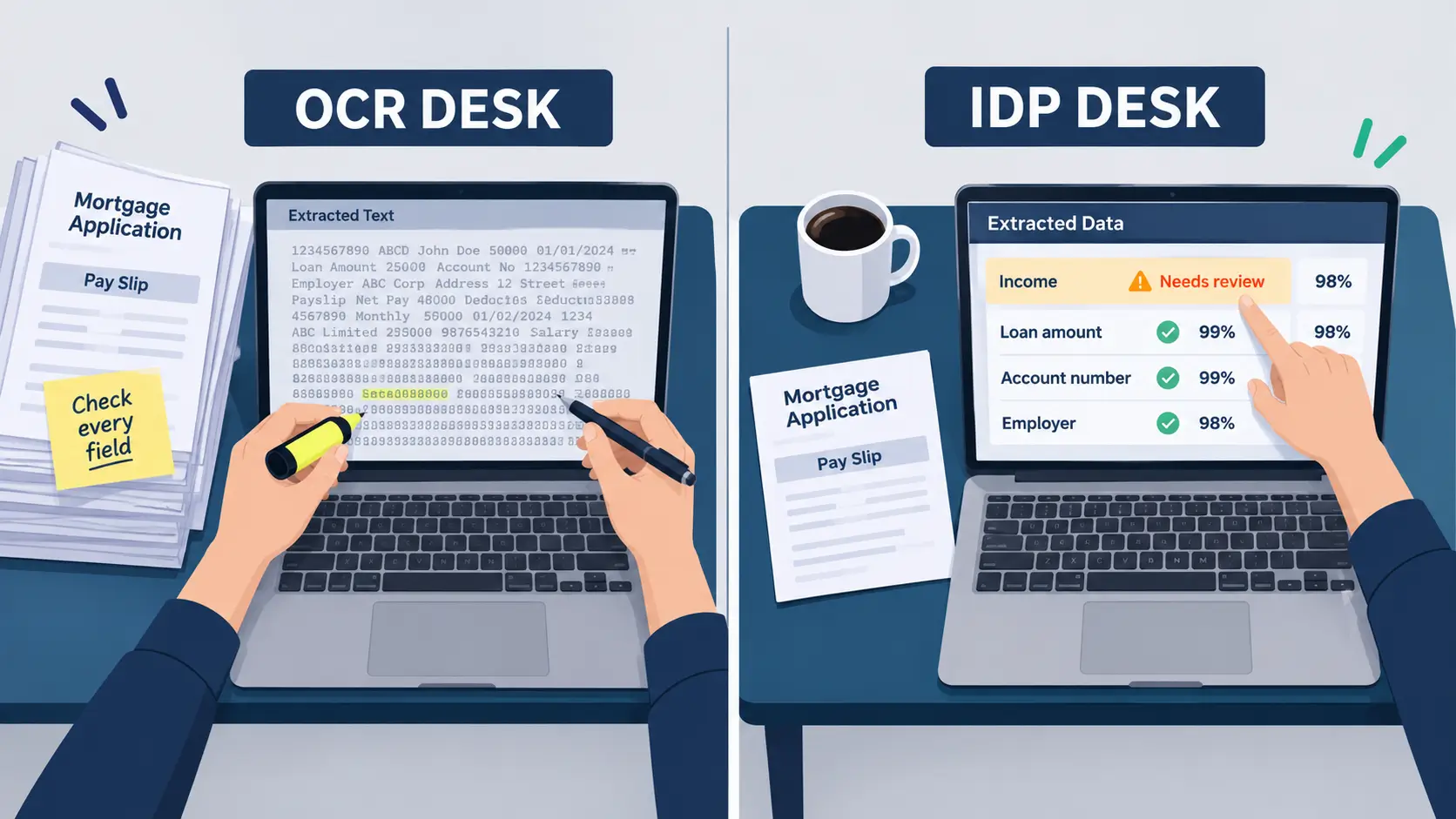
Many teams build the bot carefully and the chatbot to human handoff lasts. The escalation becomes a button that opens a new ticket, and the conversation history stays behind. The customer explains the problem again to a person who has none of the context.
This is where the bot can do worse than the old form, and where ai chatbot escalation design matters most. A form collected from the order number, account and issue type in one step. A chatbot that chats for five minutes and then sends a bare ticket costs the customer more time and gives the agent less to work with.
Gartner’s 2026 guidance points out the other way: use GenAI to collect context and identify what the customer needs, then hand over. A well-designed chatbot to agent transfer treats that collected context as the main output of the bot when it cannot resolve the issue. ViitorCloud has built similar escalation flows for support teams, and shares how it designs these handoffs as it ships new builds.
Why deflection rate hides unhappy customers
Deflection rate counts conversations that did not reach a person. It cannot tell the difference between a customer who received an answer and one who closed the window in frustration. Both count as deflected.
A more honest set of measures sits alongside it. Track how many deflected customers contact you again within a few days about the same issue. Track how long a customer waits from asking for a person to speak to one. Track how often agents ask the customer to repeat information the bot already collected. That repeat-information rate is really a proxy for chatbot to human handoff quality: when agents keep asking what the bot already knows, the handoff failed even if the deflection rate looked good.
These measures show whether ai chatbot escalation design and the genai customer service handoff are working. A rising deflection rate with rising repeat contacts usually means customers are giving up, which is the outcome the deflection target was meant to avoid.
Measure Resolution, Not Just Deflection
We set up tracking for repeat contacts, wait-to-agent time and context loss, so you can see whether your GenAI customer service handoff is helping customers.
Chatbot to human handoff requirements, written as a build list
The requirements below turn Gartner’s 2026 recommendations into items a product team can build and test. Each one answers a specific failure described above.
An always-visible human option
Show a clear ‘talk to a person’ choice from the first message and keep it visible. This is where chatbot to human handoff design earns its keep: Gartner advises against making customers go through several failed AI attempts before they can reach someone. Good human handoff GenAI design keeps this option on every screen.
A confidence threshold for handing over
The bot should try to resolve an issue itself only when it is confident it has the right answer. Below that level, it should be handed over quickly. This answers the common question of when a chatbot should escalate to a human: when confidence is low, when the customer asks, and when the topic is one, the business has marked for staff only.
A context packet that travels with the customer
When the handoff happens, the agent should receive a short summary along with the customer’s details. This packet is what makes a chatbot agent transfer feel like one conversation. The table shows what packets should be held.
| Field | Why the agent needs it |
| Customer identity and account | Avoids asking the customer to verify again where policy allows |
| Customer’s goal in one line | Let’s the agent start on the issue straight away |
| Steps the bot already tried | Prevents the agent repeating failed answers |
| Data already collected | Order number, appointment date, symptoms reported, attached files |
| Reason for the handoff | Customer request, low confidence or restricted topic |
A clear message while the customer waits
Tell the customer that a person is joining, roughly how long it will take, and that they will not need to repeat themselves. If no one is available, offer a callback or a ticket that carries the same context.
Automation behind the conversation
Gartner recommends pairing GenAI with transactional automation, so the bot can complete actions such as rescheduling or refunds through back-end systems. This reduces handoffs for routine tasks and keeps people free for complex ones. Our AI-driven automation work covers this connection between the chat layer and the systems behind it.
Build the Handoff Before You Launch the Bot
We design human handoff for GenAI support, including confidence thresholds, context packets and agent routing, so customers reach the right person without repeating themselves.
How a clinic network’s patient chatbot applies the list
Here is an illustrative example. The patient experience team at a multi-site clinic network runs a GenAI chatbot on its patient portal for appointment changes, billing questions and general health information.
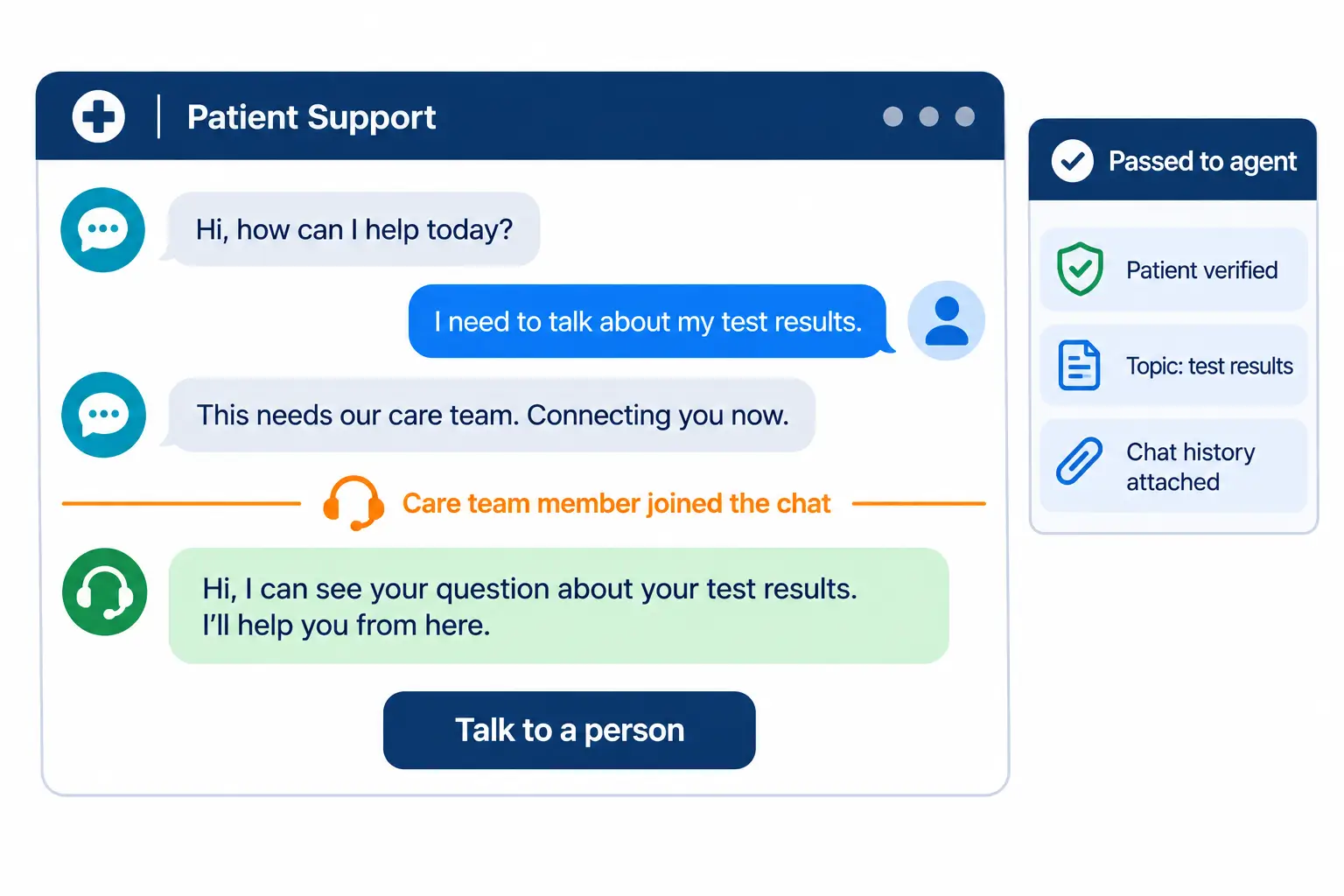
Appointments for changes and billing questions are administrative, and the bot completes most of them through the scheduling and billing systems. When a patient describes a symptom or asks about test results, the bot stops trying to answer. It collects the patient’s details and questions, then hands the conversation to a nurse in line with the full context. This is chatbot to human handoff done right: the nurse starts with what the patient already said, not a blank screen.
Every message about a patient’s health status that the bot writes without clinician review carries a GenAI disclaimer and instructions for reaching a human provider, in line with California’s AB 3030. A “talk to our care team” option stays visible on every screen. Our healthcare technology work covers patient-facing systems like this.
This design treats human handoff GenAI as part of patient safety as well as service quality. For a wider view of where chatbots fit compared with AI agents, see our guide to AI agents vs chatbots.
Plan the handoff before launch
A chatbot to human handoff decides whether customers trust your GenAI channel. ViitorCloud helps customer experience teams plan each genai customer service handoff, including the escalation rules, context transfer and measures before launch, and our post on AI automation for customer experience shows how this fits a wider service strategy. To review your current chatbot, talk to our team.

Vishal Shukla
Vishal Shukla is Vice President of Technology at ViitorCloud Technologies.
Frequently Asked Questions
What is a chatbot for human handoff?
A chatbot to human handoff is the point where a conversation moves from an automated chatbot to a human agent. A good handoff happens when the customer asks, when the bot is not confident, or when the topic needs a person, and it passes the full conversation and collected details, so the customer does not repeat themselves.
When should a chatbot escalate to a human?
What information should be passed to the agent during a handoff?
Do customers still want a human option with GenAI customer service?