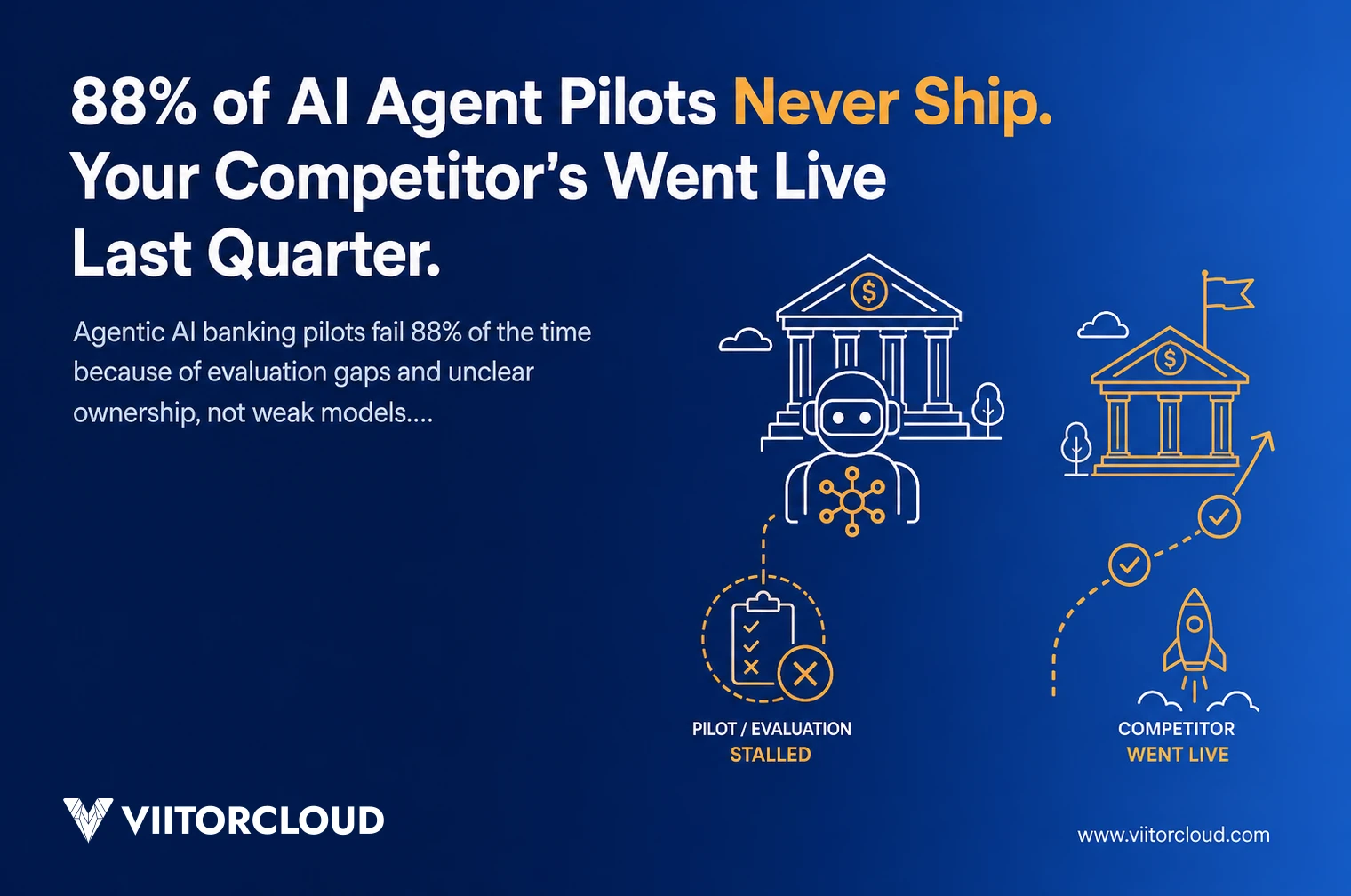
Agentic AI banking pilots fail at the operating-model layer, not the model layer. Roughly 88% of AI agent pilots never reach production, and the three blockers I see in every stalled program are the same: no evaluation harness, no named owner per agent action, and no guardrail definition that risk and compliance have actually signed off on. Model quality is almost never the reason.
I have sat in the review meeting where a bank’s fraud-triage agent demo works flawlessly on 40 curated cases, and the Chief Risk Officer asks one question that kills it: “What is the false-negative rate on the last 12 months of live disputes, broken out by channel?” Nobody has the number. The pilot goes into a holding pattern that becomes permanent.
Gartner expects over 40% of agentic AI projects to be cancelled by the end of 2027, mostly due to unclear business value and escalating cost. In BFSI, the cancellation reason is more specific: the program could never prove control coverage. This playbook covers what actually moves a banking agent from demo to production, and the 90-day sequence I use to get there.
Key Takeaways
- Around 88% of AI agent pilots never ship, and Gartner expects over 40% of agentic projects to be cancelled by end of 2027. Both failures trace to governance and evaluation gaps, not model performance.
- A production banking agent needs four artifacts before go-live: a versioned evaluation harness, a named human owner per action class, written escalation thresholds, and an immutable decision audit trail.
- Scope the first agent to one workflow with a measurable baseline, such as dispute triage or KYC document review, not a general-purpose assistant.
- A 90-day path is realistic: 30 days to build the evaluation harness and baseline, 30 days to run the agent in shadow mode against live traffic, 30 days for staged rollout behind approval gates.
- Agents inherit the quality of the data pipeline underneath them. If your core system cannot expose real-time state through an API, fix that first or the agent will fail in production regardless of the model.
Why Banking AI Agent Pilots Stall After a Successful Demo
A demo proves capability. Production requires proof of control. Those are different burdens of evidence, and most pilots are only built to carry the first one.
Here is what I mean in practice. A pilot is typically evaluated on a hand-picked test set, run by the team that built it, measured on task completion. A production banking agent is evaluated on live traffic distribution, run by operations staff who did not build it, and measured on worst-case behaviour under audit. The gap between those two standards is where 88% of pilots die.
The Four Gaps That Block Every Stalled Agent Program
- No evaluation coverage: The team can report accuracy on 50 cases but cannot report behaviour across the full distribution of live inputs, including the edge cases that generate regulatory exposure.
- No named ownership: When the agent takes an action that turns out to be wrong, no single person is accountable for that action class. Risk committees will not approve what nobody owns.
- No written guardrails: “The agent asks a human when it is unsure” is not a guardrail. A guardrail is a numeric confidence threshold, a hard action allowlist, and a defined escalation path with a response time.
- No audit trail: The agent cannot reconstruct why it took a specific action six months ago. In a regulated environment, that alone blocks deployment.
None of these are model problems. All four are operating-model problems, which is why swapping in a better model never unblocks a stalled pilot.
What Separates Agentic AI From the Automation Your Bank Already Runs
Traditional automation executes a fixed sequence. An agent decides the sequence at runtime based on what it observes. That distinction is the entire source of both the value and the governance burden.
A rules engine that routes a dispute to the correct queue is deterministic. You test every branch once. An agentic system that reads the dispute narrative, pulls transaction history, checks the merchant pattern, decides whether it is friendly fraud, and either resolves or escalates is making a judgment. You cannot test every path, so you have to test the distribution and constrain the action space.
Practical implications for banking AI automation programs:
- Test surface changes shape: You move from branch coverage to statistical evaluation against a labelled golden set plus adversarial cases.
- Action permissions become the primary control: What an agent is allowed to do matters more than how accurate it is. An agent with read-only access and a recommendation output carries a fraction of the risk of one with write access to a ledger.
- Failure modes are silent: Deterministic automation breaks loudly. An agent degrades quietly as input distribution drifts, which is why production monitoring is not optional.
- Integration depth determines usefulness: An agent that cannot read live account state through an API is limited to summarizing documents. That is why system integration and modernization work is usually the prerequisite, not the follow-up.
I worked with an insurer whose claims agent pilot scored 91% on their internal test set and then produced unusable output in week one of shadow mode. The cause was not the model. Their claims system exposed status through a nightly batch export, so the agent was reasoning on data up to 23 hours stale. We fixed the data access layer first, with our system integration and modernization. The same model, unchanged, then held above 88% on live traffic.
Find out which gap is blocking your agent pilot
A scoped assessment that identifies whether evaluation coverage, ownership, guardrails, or your data layer is holding the pilot in review, and what it takes to clear it.
The Evaluation Harness That Gets Risk Committees to Approve
The evaluation harness is the single artifact that converts a pilot into an approvable production candidate. Build it before you tune the agent, not after.
A harness that actually satisfies a banking risk committee has five components. I treat all five as mandatory.
- A labelled golden set drawn from live history: Minimum 500 real cases, sampled to match live channel and product mix, labelled by the operations staff who currently do the work. Not synthetic. Not curated for the demo.
- An adversarial set: The cases that broke your human process: ambiguous narratives, conflicting documents, prompt-injection attempts in customer free-text fields, and known fraud typologies.
- Asymmetric metrics: In banking, false negatives and false positives carry different costs. A missed suspicious-activity flag is a regulatory event. A false flag is a customer-experience cost. Report both separately with the business cost attached.
- Version pinning: Every evaluation run records model version, prompt version, tool definitions, and retrieval index snapshot. Without this, you cannot explain a behaviour change, and you will get behaviour changes.
- Continuous re-run in production: The harness runs on a schedule against live sampled traffic after go-live, not just once at approval. This is what catches drift.
Once this exists, the conversation with risk changes completely. You stop arguing about whether AI is trustworthy in the abstract and start reviewing a number against a threshold. That is a conversation banks already know how to have.
Set Guardrails as Numbers, Not Intentions
Write guardrails the way you would write a credit policy. Each agent action class gets an explicit confidence floor, an explicit value ceiling, and a named escalation owner. For example: auto-resolve disputes under a set value where confidence exceeds a defined threshold and no fraud typology matched; route everything else to the named operations lead with the agent’s reasoning attached. Specific, testable, auditable.
How to Move an AI Agent From Pilot to Production in 90 Days
Ninety days is achievable when the scope is one workflow, and the sequence is right. It is not achievable for a general-purpose assistant, which is the scope mistake that consumes most stalled budgets.
Days 1 to 30, build the measurement layer.
Pick one workflow with an existing measurable baseline: dispute triage, KYC document review, collections outreach prioritization, or loan file completeness checks. Instrument the current human process so you know today’s accuracy, cost per case, and cycle time. Build the golden set and the adversarial set. Define action permissions and escalation thresholds in writing and get risk to review the document, not the demo.
Days 31 to 60, run in shadow mode.
The agent processes live traffic in parallel with the human team and takes no action. You compare its output to human decisions daily. This phase surfaces every data-access problem, every drift issue, and every failure mode that a curated test set hides. Expect the first week to look worse than your pilot did. That is the point.
Days 61 to 90, staged rollout behind gates.
Start with the lowest-risk action class at a small traffic percentage with mandatory human review on every action. Expand only when the harness clears threshold for a full week. Keep a documented kill switch and make sure operations, not engineering, can trigger it.
A regional lender I advised tried to skip shadow mode to hit a board deadline. They went from pilot straight to a 20% traffic rollout on payment-exception handling. Within nine days, they had 340 mis-routed exceptions, a manual remediation effort that consumed three weeks of the operations team, and an internal audit finding. The rebuilt program with shadow mode took 11 weeks and shipped without an incident. Shadow mode is the cheapest four weeks in the entire sequence.
Build the evaluation harness first
We deliver the golden set, adversarial cases, asymmetric metrics, and version pinning your risk committee needs before it will approve an agent for live traffic.
Where Ownership Has to Sit for Agentic AI Banking Implementation to Survive
Every agent action class needs one named human owner with the authority to pause it. Not a committee, not a function, a person. This is the governance requirement most programs treat as a formality, and it is the one risk committees test hardest.
The ownership model I recommend for BFSI agent programs:
- Action owner: A business-side leader who owns the outcome of that action class and can trigger the kill switch without engineering approval.
- Evaluation owner: Whoever maintains the harness, the golden set, and the drift reports. This role is usually underfunded, and it should not be.
- Guardrail owner: Risk or compliance, holding sign-off on threshold changes. Any change to a confidence floor is a policy change, not a config change.
- Platform owner: Engineering, accountable for data access, latency, versioning, and the audit trail.
When those four roles are named on a page, agentic AI implementation reviews get faster because nobody is guessing who answers which question. When they are not named, every review restarts from zero.
One more constraint worth stating plainly: keep the model provider swappable. Any agent architecture that hard-codes a single provider’s API into business logic creates a dependency your procurement team will eventually object to. Abstract the model layer at the start when it costs nothing.
What a Production Ready Agent Program Actually Costs to Stand Up
Enterprise AI agents cost less than most banks assume when scoped to one workflow, and far more than assumed when scoped as a platform. Scope discipline is the cost lever.
The genuine cost drivers, in order of impact:
- Data access work: Usually the largest line. If the core system needs a new API surface or real-time event exposure, that is engineering effort before the agent delivers anything.
- Golden set labelling: Operations staff time to label 500 or more real cases. Real cost, and it is where quality is won.
- Evaluation and monitoring infrastructure: Build once, reuse across every subsequent agent. This is why the second agent in a program costs a fraction of the first.
- Model inference: Almost always the smallest line item and the one that gets the most attention in budget meetings.
This is the practical argument for the phased approach. Prove the workflow, prove the controls, then reuse the harness and the integration layer across the next three agents.
See how we ship AI in regulated environments
From a healthcare platform processing $192.2M in claims to a government identity system with 70M+ registered citizens, our production systems are built with audit and ownership designed in.
Turning a Stalled Pilot Into a Live Agent Program
The pattern across every stalled agentic program I have reviewed is the same: strong model work, thin operating model. ViitorCloud has spent 14+ years building production systems in regulated environments, including a healthcare revenue platform that processes $192.2M in claims and a government identity platform serving 70M+ registered citizens. Those systems shipped because the evaluation, audit, and ownership layers were designed alongside the intelligence, not bolted on for the approval meeting.
If you have a pilot sitting in review, the fastest useful step is an honest read on which of the four gaps is actually blocking it. Our custom AI solutions and AI-driven automation teams run that assessment as a scoped engagement that produces the evaluation harness, the guardrail document, and the named-owner map. If the answer is that your data layer has to move first, we will tell you that before anyone writes agent code. There is more detail on the sequencing in our breakdown of the AI/ML development roadmap from PoC to production and on AI and automation in BFSI operations.
Conclusion
Agentic AI banking programs do not fail because the technology is immature. They fail because the operating model around the agent is missing the four things a regulated institution requires: measurable evaluation coverage, named ownership per action, numeric guardrails, and a reconstructable audit trail. Build those four first and the model choice becomes a detail.
The immediate move is narrow and unglamorous. Pick one workflow with a baseline you can measure, build the evaluation harness before you tune anything, run four weeks of shadow mode against live traffic, and stage the rollout behind gates that operations controls. That sequence is why some banks shipped last quarter while their competitors are still presenting slides. The window on this is closing faster than most boards think, and the institutions building the harness now will ship their second and third agents in a fraction of the time.

Vishal Shukla
Vishal Shukla is Vice President of Technology at ViitorCloud Technologies.
Frequently Asked Questions
Why do AI agent pilots fail before reaching production?
Most fail on evaluation coverage, unclear ownership, and undefined guardrails. Model quality is rarely the actual blocker in regulated environments.
How long does agentic AI implementation take in a bank
What is the first agent a bank should build
Do AI agents in banking need human approval on every action
What blocks agentic AI more often, the model or the data