


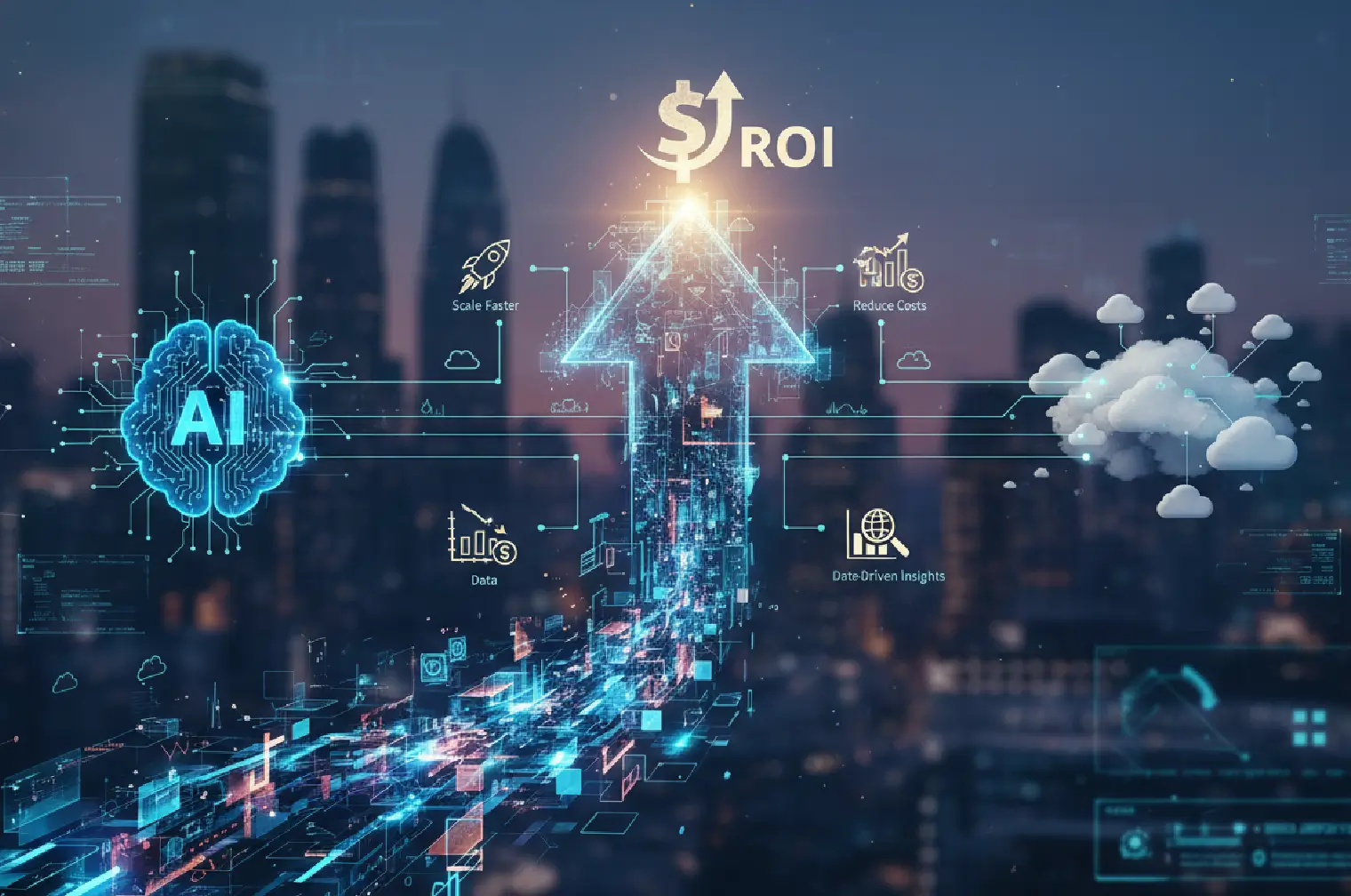
2026 is the year AI stops being “interesting” and starts being accountable—because leadership teams are demanding measurable P&L outcomes, not more pilots. Legacy system modernization is the prerequisite for AI ROI because agentic and ML systems need trusted, connected, real-time data plus modern APIs to take action inside your workflows; without that foundation, AI stays trapped in chat windows and slide decks.
Why is 2026 the “reality check” year for AI?
If your business invested in AI experimentation and didn’t see impact, you’re not alone—MIT SMR and BCG reported that seven out of 10 companies surveyed saw minimal or no impact from AI at the time of their study.
What’s changing now is the push toward production-grade delivery: Deloitte notes organizations are hitting obstacles translating agentic pilots into production-ready solutions, and it ties those obstacles directly to legacy integration and data architecture constraints.
For SMB and mid-market leaders, this is good news: once you treat modernization as a revenue program (not an IT cleanup), AI integration services and data engineering for SMBs become the shortest path from “AI curiosity” to “AI profit engine.”
Why do 70% of AI initiatives fail because of legacy data silos?
Because siloed systems block the one thing AI can’t fake: clean, connected context—so models and agents can’t reliably retrieve the right facts or execute the right action inside core applications. MIT SMR’s research highlights that many AI initiatives struggle to generate value, and it explicitly calls out the need to source and integrate AI-dependent data across organizational silos for many applications.
The practical shift to make is “Maintenance to Momentum.” Instead of spending your best people on patching brittle integrations and manual reconciliations, you modernize the foundation so your teams can ship improvements weekly—then AI/ML development compounds that delivery speed.
Deloitte also flags legacy system integration as a core obstacle for agentic AI, noting that traditional systems weren’t designed for agentic interactions and that legacy bottlenecks limit autonomy.
Drive ROI with Custom AI Development
Turn data into measurable growth using Custom AI Development designed to boost efficiency and profitability for SMBs.
How does cloud-native modernization unlock Agentic AI workflows?
Cloud-native modernization unlocks Agentic AI workflows by refactoring your systems so agents can safely call real tools—APIs, services, queues, data products—instead of only generating text.
Deloitte summarizes the core constraint plainly: legacy environments often lack the real-time execution capability, modern APIs, modular architectures, and identity controls needed for true agentic integration.
In real terms, refactoring turns “AI suggestions” into “AI execution.” A production agentic workflow can read an order exception, validate inventory, open a ticket, draft the customer message, and post updates back to ERP/CRM—with approvals and guardrails—because the architecture finally supports it.
Salesforce’s Connectivity Benchmark findings also reinforce the integration reality for agents: most respondents struggle to integrate data across systems, and disconnected applications reduce agent usefulness.
Is your data “AI-ready gold” or just digital clutter?
Your data is “AI-ready gold” when it’s governed, discoverable, and reusable—so AI can retrieve the right entity, at the right time, with the right permissions, and your business can trust the output. If data isn’t searchable, reusable, and positioned to be consumed by automation, Deloitte notes it becomes friction for agent deployment and a direct constraint on AI automation strategy.
Below is the difference data engineering for SMBs makes—especially when paired with legacy system modernization and cloud-native patterns.
| What you have today | Raw legacy data | AI-optimized data |
| Structure | Mixed formats across ERP/CRM/spreadsheets and PDFs, with inconsistent keys and duplicates. | Standardized entities, consistent IDs, and clear definitions (customer, SKU, shipment, invoice) across domains. |
| Availability | Hard to access in real time because apps aren’t connected and data is trapped in silos. | Connected via APIs/events and governed access, so systems and agents can retrieve what they need quickly. |
| Trust | Business teams debate “whose number is right,” slowing decisions and blocking automation. | Versioned metrics, lineage, and ownership so stakeholders can audit and trust outputs. |
| Agent readiness | Agents hallucinate or stall because they can’t reliably find authoritative context. | Agents can ground responses in approved sources and take action through approved tools and workflows. |
Scale Faster with Smart Cloud Solutions
Improve agility, control costs, and accelerate ROI with secure and scalable Cloud Solutions built for SMB growth.
What do real-world AI ROI results look like in 2026?
In 2026, the clearest AI ROI shows up when AI is embedded into revenue-critical workflows (not separated into a “cool AI app”) and when you measure outcomes like cycle time, exception rate, cost-to-serve, and conversion—not just model accuracy.
MIT SMR’s findings emphasize that many firms struggle to generate AI value, which is why tying AI to business impact and execution discipline matters. Deloitte also describes leading organizations pushing beyond pilots and focusing on ROI discipline for production deployments rather than “science projects.”
Here are three ROI-shaped use cases that map cleanly to mid-market priorities in 2026 (and that become dramatically easier after cloud-native legacy system modernization):
Logistics (route optimization): AI/ML development can reduce cost-to-serve by continuously re-optimizing routes based on constraints like delivery windows, capacity, traffic, and service-level penalties, while agents trigger replans automatically when exceptions occur (late pickup, missed scan, inventory mismatch).
Retail / SaaS (GenAI agents): Agentic AI workflows can handle high-volume, repeatable interactions—order status, returns, subscription changes, tier upgrades, invoice explanations—by grounding answers in connected systems and then executing approved actions via APIs. Salesforce’s research underscores why integration is central here: disconnected apps and data reduce the accuracy and usefulness of AI agents.
Finance (fraud detection): AI ML development can flag anomalous behavior in payments, refunds, account changes, or claims, while agents can automatically collect evidence, openFIs, and route cases to the right approver—so your team spends time on judgment, not data gathering.
How does ViitorCloud accelerate your transition from legacy debt to AI profit?
ViitorCloud accelerates your move from legacy debt to AI profit by treating legacy system modernization, AI integration services, and data engineering for SMBs as one connected delivery program—so every sprint produces something your business can measure (faster cycle time, fewer exceptions, higher throughput).
This matters even more in the agentic era: Deloitte warns that legacy system integration can prevent organizations from realizing agentic value, and it cites the execution demands, real-time capability, modular architecture, modern APIs, and secure identity that modernization must deliver.
In practice, ViitorCloud’s approach typically blends (1) cloud-native modernization (rehost where it makes sense, refactor where it counts, rebuild only where it pays), (2) data engineering that turns “digital clutter” into trusted data products, and (3) custom AI development that embeds models and agents directly into your operational workflows.
Unlock ROI with Data Analytics Services
Make confident business decisions using Data Analytics Services that transform insights into real revenue impact.
Case study: What happens when you modernize first (and then deploy AI)?
A mid-market distribution business (anonymized) had a classic constraint: order exceptions lived in email threads, ERP notes, and spreadsheets, so every “simple” delay turned into hours of manual coordination. After legacy system modernization (API-enablement, event-driven exception signals, and a cloud data layer), the business implemented AI integration services to
(a) summarize exceptions with grounded context
(b) recommend resolution steps
(c) trigger approvals and updates back into ERP/CRM
The measurable outcome wasn’t “better AI,” it was fewer escalations, faster resolution time, and a clear operational dashboard that leadership could tie to cost-to-serve.
Frequently Asked Questions
ROI varies widely by use case maturity and data readiness, and MIT SMR’s research shows many organizations have historically reported minimal or no AI impact—so ROI is rarely automatic. The most reliable ROI pattern is when custom AI development is attached to one measurable workflow (quote-to-cash, exception handling, support deflection, fraud ops) and supported by strong data foundations and integration.
It depends on whether you’re doing targeted modernization (API-enable and refactor a few workflows) or full platform re-architecture, but Deloitte’s analysis makes the dependency clear: agentic execution often fails when legacy systems can’t support modern AI execution demands. Many mid-market teams start with one “profit line” workflow, modernize just enough to connect data and actions, then expand once the first AI integration services deployment proves ROI.
Some AI can run on-prem, but agentic and integration-heavy systems still require connected data, strong identity controls, and reliable orchestration—capabilities that are often easier to implement with cloud-native architecture patterns. Salesforce’s findings also show how common cross-system integration struggles are, which is why architecture and connectivity decisions matter as much as model selection.

Vishal Shukla
Vishal Shukla is Vice President of Technology at ViitorCloud Technologies.