


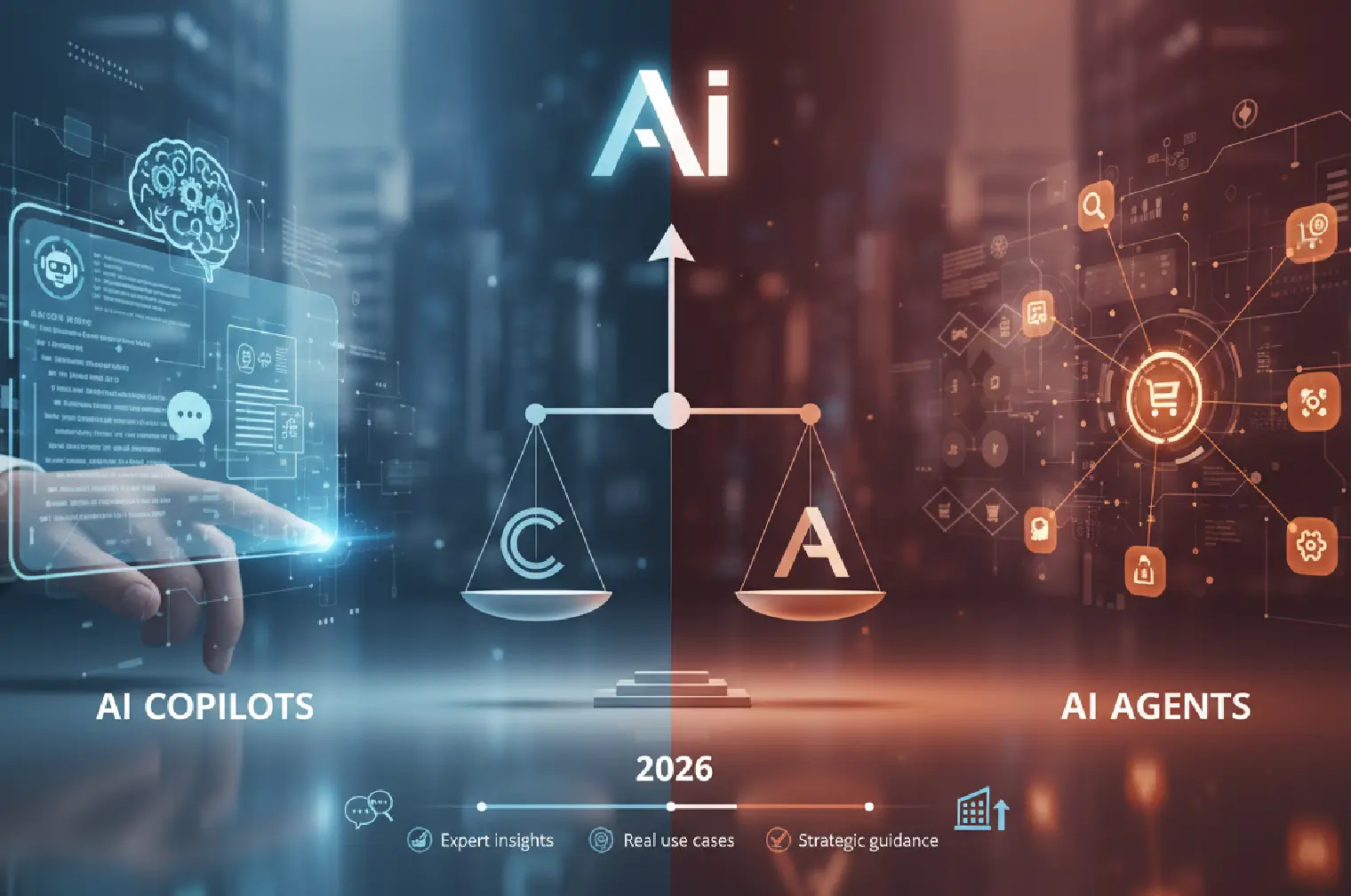
The new business world is defined by a transition from basic digital assistance to autonomous execution. Organizations now choose between AI copilots vs agents to handle workflows. While AI copilots provide real-time suggestions to human users, Agentic AI systems operate with a high degree of independence.
Businesses in the SaaS and SMB sectors must evaluate these technologies to determine which model supports their operational goals. AI automation has evolved from simple scripts to reasoning systems that manage multi-step processes.
Choosing the right architecture requires an understanding of how these systems interact with data. Many SMBs find that generic tools lack the necessary context for their specific industries.
This leads to the adoption of custom AI solutions that align with internal datasets. ViitorCloud provides custom AI solutions that help businesses bridge the gap between human-led tasks and autonomous workflows.
AI Copilots and Agents: What are these Technologies?
To understand the debate of AI copilots vs agents, one must look at the level of human intervention required. A copilot functions as a digital assistant. It summarizes documents, drafts emails, and assists with coding tasks.
However, it does not act without a human prompt. Agentic AI, conversely, takes a high-level goal and breaks it down into actionable steps. It uses reasoning loops to verify its own work and adjust its path if it encounters an error.
The following table compares the two systems based on the current 2026 business standards:
| Feature | AI Copilot | Autonomous Agent |
| User Role | Human-in-the-loop | Human-on-the-loop |
| Operation | Reactive (Triggered by prompts) | Proactive (Goal-oriented) |
| Complexity | Single-task focus | Multi-step workflow orchestration |
| Decision Making | Suggestions provided to human | Independent execution of actions |
| Integration | Limited to the specific app | Cross-platform and API-driven |
According to Gartner, by 2026, 40% of enterprise applications will include task-specific AI agents. This shift demonstrates that AI automation is moving toward full autonomy.
Choose the Right AI Copilots for Your Business
Identify where AI Copilots fit into your operations and build scalable Custom AI Solutions with ViitorCloud.
The Evolution of Agentic AI in 2026
In 2026, Agentic AI has moved beyond experimental phases into production environments. These agents are no longer just chatbots. They are digital coworkers capable of using external tools.
For example, an autonomous agent in a logistics firm can monitor weather patterns, communicate with carriers, and reroute shipments without human input. This level of AI automation reduces the time spent on administrative oversight.
For SaaS companies, the shift toward AI copilots vs agents means rethinking product architecture. Instead of just adding a “chat” button, developers are building AI-first software and platforms where agents handle backend logic.
This approach ensures that the software does not just wait for a command but actively works to achieve user objectives. Custom AI solutions are essential here, as they allow the agent to understand the unique business logic of the SaaS provider.
When to Deploy AI Copilots
Businesses should use AI copilots when a task requires creative input or high-stakes judgment. Copilots excel in areas where the “human touch” is non-negotiable.
- Content Creation: Copilots help writers overcome the blank page by suggesting outlines.
- Legal Review: A copilot can flag clauses in a contract, but a human lawyer makes the final decision.
- Strategic Planning: Executives use copilots to synthesize market data while retaining control over the final strategy.
For these scenarios, custom AI solutions provide the necessary guardrails. By training a copilot on your specific brand voice or compliance rules, you ensure the assistant provides relevant help. This integration is a core part of SaaS product engineering in 2026.
When to Transition to Autonomous Agents
The decision in AI copilots vs agents shifts toward agents when the workflow is repetitive and involves multiple systems. Agentic AI is the better choice for high-volume operations. Microsoft notes that agents are like “apps” for the AI era, functioning as independent units of work.
If your business manages complex data pipelines or 24/7 customer support, AI automation via agents is more efficient. These systems do not suffer from fatigue and maintain a consistent performance level. Implementing custom AI solutions for SMBs allows these agents to access private databases securely. This ensures the agent acts on facts rather than general internet data.
Deploy Autonomous Agents That Drive Results
Leverage Autonomous Agents to automate workflows and accelerate decision-making with Custom AI Solutions.
Industry Use Cases for 2026
Healthcare and Research
In the medical sector, Agentic AI manages patient scheduling and initial symptom triaging. Agents can pull data from Electronic Health Records (EHR) to provide doctors with a comprehensive summary before an appointment. This is a practical application of Generative AI in healthcare, where the goal is to reduce the administrative burden on clinical staff.
Fintech and Banking
Financial institutions use AI automation to detect fraud in real-time. Unlike traditional systems that flag transactions for human review, autonomous agents can temporarily freeze an account and contact the customer to verify the activity. The speed of Agentic AI prevents losses that occur during the delay of human intervention. You can read more about this in our analysis of Generative AI in banking.
SaaS and SMB Operations
For a small business, custom AI solutions are the most cost-effective way to scale. Instead of hiring a large team to manage lead generation, an agent can identify prospects, send personalized emails, and book meetings on a calendar. In the debate of AI copilots vs agents, the agent wins for SMBs looking for growth without proportional increases in headcount.
Implementation Strategy for Businesses
Adopting AI automation requires a structured approach. Businesses must first audit their existing workflows to identify bottlenecks.
- Identify Data Sources: Ensure your data is clean and accessible via APIs.
- Define Objectives: Set clear goals for what the AI should achieve.
- Choose the Model: Decide between AI copilots vs agents based on the level of required oversight.
- Develop Custom AI Solutions: Tailor the models to your specific industry requirements to ensure accuracy.
- Monitor and Iterate: Use “human-on-the-loop” governance to supervise the autonomous agents.
ViitorCloud specializes in developing custom AI solutions that fit into existing enterprise frameworks. By focusing on Agentic AI, we help businesses move beyond simple task completion to full-scale process automation.
Build Custom AI Solutions for 2026 and Beyond
Compare AI Copilots and Autonomous Agents to design intelligent systems tailored to your business goals.
What Should be the Strategic Choice for 2026
The year 2026 marks the end of “one-size-fits-all” AI. The choice between AI copilots vs agents depends on whether you need a tool to assist your team or a system to execute work independently. AI automation has now become a requirement for remaining competitive in the SaaS and SMB markets.
By investing in Agentic AI, organizations can automate entire departments, from customer service to supply chain management. However, the success of these systems relies on custom AI solutions that are grounded in real-time business data. ViitorCloud continues to lead in providing the infrastructure and expertise needed to deploy these advanced systems effectively.
Contact us at [email protected] and set a complimentary consultation call with our AI experts.

Vishal Shukla
Vishal Shukla is Vice President of Technology at ViitorCloud Technologies.