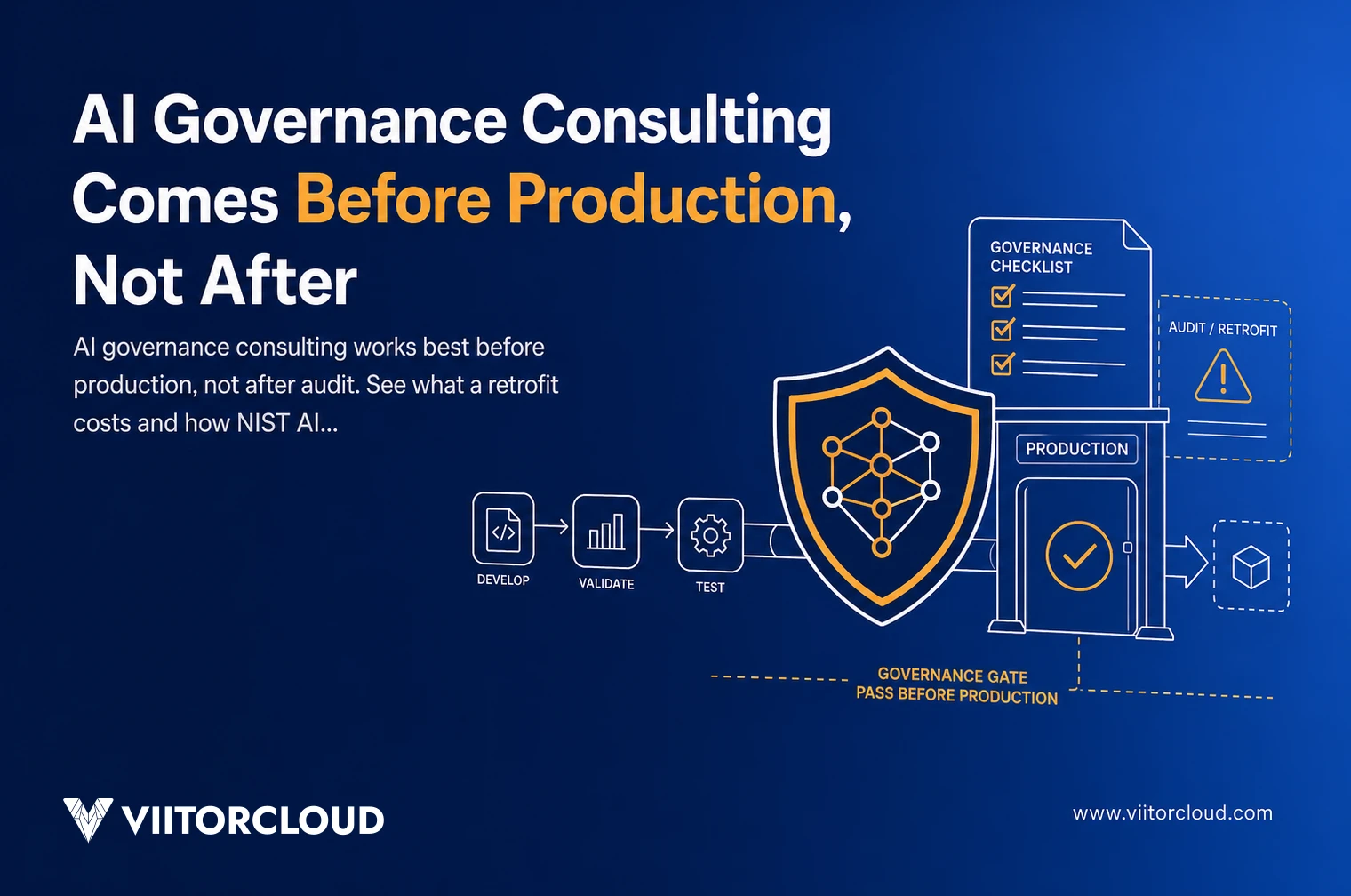
AI governance consulting works best before a model reaches production, not after an auditor asks who approved it. That sequence matters more than any individual control in the framework. Most mid-market financial firms I speak with already run three or more AI systems in production and cannot name a single model owner across any of them.
The systems themselves work. Underwriting decisions come back faster. Fraud alerts are sharper. Client onboarding takes days instead of weeks.
Then the board asks four questions, and the room goes quiet. Below I cover what AI governance consulting actually produces, why retrofitting controls costs several times more than scoping them upfront, and how NIST AI RMF, ISO 42001, and EU AI Act compliance run as one program instead of three.
Key Takeaways
- AI governance consulting delivers the most value before deployment. In the engagements I have worked on, retrofitting controls after go-live costs three to five times what scoping them during design would have cost.
- The EU AI Act carries penalties reaching EUR 35 million or 7% of global annual turnover for prohibited practices, and its high-risk obligations phase in through 2026 and 2027.
- NIST AI RMF gives you the risk vocabulary, ISO 42001 gives you the certifiable management system, and the EU AI Act gives you the legal deadline. All three point to one model inventory.
- Four AI governance roles must be named per model before go-live: owner, approver, tester, and monitor. Unnamed roles are the audit finding, not the model itself.
- Enterprise AI governance is a delivery requirement. If it does not appear in the sprint plan, it does not exist.
What AI Governance Consulting Is and Where It Usually Fails
AI governance consulting is the practice of defining ownership, approval, testing, and monitoring for every AI system a business runs, then building those controls into how the system is delivered and operated. It fails when it starts after deployment, because by then the evidence auditors ask for was never collected.
A real engagement produces artifacts, not a policy binder.
What comes out of the first eight weeks:
- A complete inventory of AI systems in production, including the ones no one told the risk function about.
- A risk classification per system, mapped to the tiering logic in the European Commission’s regulatory framework for AI.
- Named decision rights per model, with dates and signatures.
- Evidence collection wired into the training and deployment pipeline, so proof accumulates automatically.
- Monitoring thresholds, escalation paths, and a documented rollback procedure.
The failure mode is predictable. A governance policy gets written, circulated, and approved while the engineering team ships models against a separate backlog that never references it. Six months later, the policy is accurate, and the systems are undocumented. That gap is where every finding lands, and it is particularly expensive in regulated sectors where I work most often on BFSI technology delivery.
Scope Governance Before You Ship
We build model ownership, approval gates, evidence capture, and monitoring into the delivery plan for regulated AI systems, not into a compliance track that finishes after launch.
Why Retrofit Governance Costs Three to Five Times More
I have sat in this meeting more than once. A risk committee at a mid-market lender: three models live, all of them working. A credit decision assist, a transaction anomaly scorer, and a document classifier in onboarding. Not one had a retained test set, a documented approval, or a drift threshold.
Reconstructing that evidence took the better part of a quarter. The team pulled training data lineage out of commit history, re-derived fairness tests on data that had already shifted, and wrote approval memos for decisions made almost a year earlier by people who had since left. Scoping the same controls before the first model shipped would have added roughly three weeks to the delivery plan.
Retrofit is expensive for reasons that have nothing to do with effort:
- Evidence loses credibility when it is assembled backwards. A test run in month twelve does not prove the model was safe in month one.
- The data has already moved. You cannot recreate the distribution the model was trained against.
- Approvals cannot be backdated. No regulator accepts a signature applied after the fact.
- Remediation competes with the roadmap. Every week spent rebuilding history is a week not spent shipping.
- Change control appears late. Teams that shipped freely for a year now need a gate they never designed for, and velocity drops hard.
This is the same cost curve I see in AI security and risk management in banking. Controls designed into the architecture are cheap. Controls bolted on after an audit letter are not.
The Four Questions Your Board Will Ask About Every AI Model
Boards do not ask about model architecture. They ask about accountability, and they ask it in four parts.
These are the AI governance roles that need a name against them before anything reaches production:
- Who owns this model?
One accountable individual for the business outcome, not a department. - Who approved it for production?
A dated approval against defined criteria, held by someone with the authority to say no. - Who tests it, and against what?
A named tester, a retained baseline, and a documented threshold for pass and fail. - Who monitors it, and what triggers a rollback?
A named monitor, live thresholds, and an escalation path that has been rehearsed.
Committees cannot hold accountability. Individuals can. When I map AI governance roles for a client, the exercise usually surfaces two or three models with no plausible owner at all, which tells you more about the state of enterprise AI governance than any maturity score. Getting this right depends on the data layer underneath, which is why I treat it alongside the data governance framework for AI and ML development rather than as a separate workstream.
Bring Your Model Inventory to the First Call
Already running AI in production with no framework behind it? We will work through the classification, the four named roles, and the gaps against NIST AI RMF, ISO 42001, and the EU AI Act.
How NIST AI RMF, ISO 42001, and EU AI Act Compliance Fit Together
Three standards, one model inventory. Teams that treat them as three separate programs pay for the same work three times.
- NIST AI RMF is the voluntary framework published by the US National Institute of Standards and Technology. Its four functions, govern, map, measure, and manage, give your risk committee and your engineers a shared vocabulary for AI risk management. It has become the de facto reference in US financial services.
- ISO 42001 is the first certifiable AI management system standard. It converts intent into an auditable structure and maps cleanly onto an existing ISO 27001 program, which is why it is becoming the baseline expectation in vendor due diligence.
- The EU AI Act is law, with dates and financial consequences. Obligations are tiered by risk, and the high-risk requirements land through 2026 and 2027. EU AI Act compliance is where the deadline pressure comes from.
The efficient sequence is straightforward. Use NIST AI RMF to structure your AI risk management language, use ISO 42001 to make the system auditable, and use the EU AI Act to set the calendar. I go deeper on the legal mechanics in this EU AI Act guide for custom AI development.
What an AI Governance Framework Looks Like Before Production
An AI governance framework that works is short, specific, and embedded in the build.
Six steps, in this order:
- Inventory and classify. Every model, every vendor AI feature, every automation touching a regulated decision. Classify by risk tier and jurisdiction.
- Name the four roles. Owner, approver, tester, monitor. One name each, per model, recorded where the board can see it.
- Set the approval gate. Define what a model must demonstrate to pass, and make the gate a blocking step in the release process.
- Wire evidence collection into the pipeline. Data lineage, test results, fairness metrics, and approval records captured automatically at build time.
- Define monitoring and rollback. Drift thresholds, performance floors, an alert route, and a rollback procedure someone has actually run.
- Rehearse the audit. Pick one model and answer the four board questions with documents only. Whatever you cannot produce is your real gap.
That last step is the cheapest diagnostic available. A head of compliance I worked with ran it on a single fraud model on a Friday afternoon and found the approval trail stopped at a Slack thread. They fixed the gate for all nine models the following month rather than discovering the same gap under examination. If you have not yet mapped where you stand, an AI readiness assessment is a reasonable place to begin, because AI governance compliance depends on knowing what you already run.
Governance for Regulated AI Workloads
Explainable AI for regulated decisions, GDPR and HIPAA aligned data pipelines, and post-deployment model monitoring, delivered by a team with 14+ years in enterprise engineering.
Where AI Governance Consulting Belongs in the Delivery Plan
My position is that governance is a delivery discipline. At ViitorCloud, we scope model ownership, approval gates, evidence capture, and monitoring into the sprint plan itself, not into a parallel compliance track that finishes after launch. That approach comes from building systems where the regulatory constraint was never optional, including a healthcare revenue platform that has processed $192.2M under HIPAA constraints and a government records platform carrying 70M+ citizen records for a Big Four client.
The same discipline applies to explainable AI for regulated decisions, GDPR and HIPAA-aligned data pipelines, and post-deployment model monitoring. If you are running AI in a regulated business, our custom AI solutions practice scopes these controls before the first model ships.
If you already have systems live and no framework behind them, that is the more common starting point, and it is fixable. Bring your model inventory to a first conversation, and we will work through the classification and the gaps with you. Talk to our AI engineering team when you are ready to put dates against it.
The Order of Operations Is the Real Risk
Your AI is live. Your governance is not. That is the exposure, and it compounds every month the gap stays open.
Three things to take from this. Retrofitting controls costs several times more than designing them in, so the sequence is the decision. Four named AI governance roles per model answer almost every question a board or a regulator will ask. NIST AI RMF, ISO 42001, and EU AI Act compliance are one program pointed at one inventory, not three.
Start this quarter with an inventory and a single rehearsed audit on your highest-risk model. That exercise will tell you more than a policy review. AI governance consulting earns its value when it arrives before production, and the next model you ship is the cheapest place to prove it.

Vishal Shukla
Vishal Shukla is Vice President of Technology at ViitorCloud Technologies.
Frequently Asked Questions
What is AI governance?
AI governance is the set of named roles, approval gates, testing standards, and monitoring rules that control how an organization builds and runs AI systems. It answers who owns a model, who approved it, who tests it, and who watches it in production. Without those four answers you have documentation, not governance.
Who is responsible for AI governance?
When should you implement AI governance?
What is the difference between NIST AI RMF and ISO 42001?
Does the EU AI Act apply to a US financial firm?