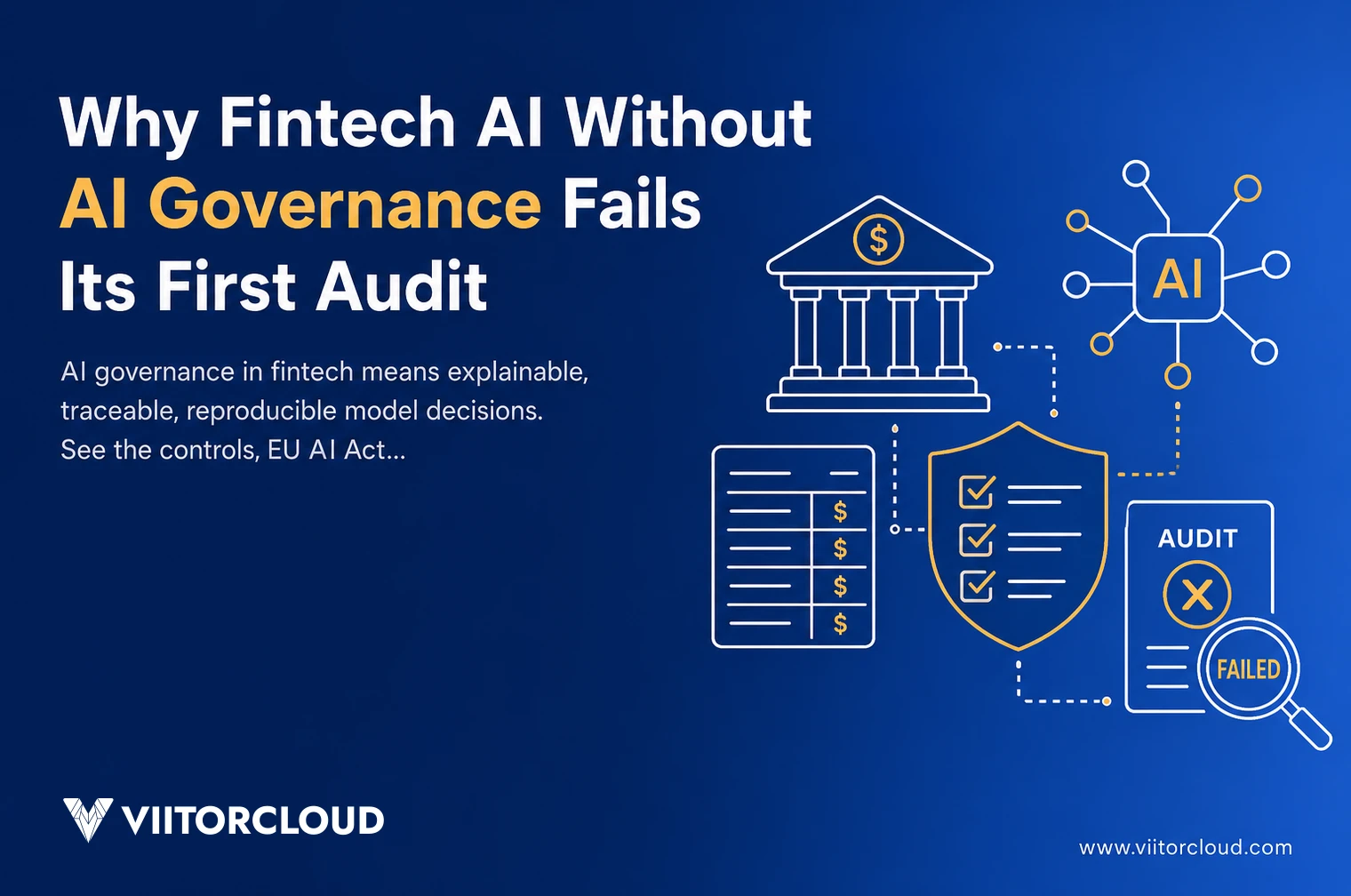
AI governance in fintech is the engineered set of controls that makes every model decision explainable, traceable, and reproducible for a regulator, an internal risk committee, or an external auditor. It covers data lineage, model versioning, approval gates, bias testing, human override, and immutable decision logs. If those controls do not exist in the pipeline and the code, the model is not compliant. It is only unexamined.
I have reviewed AI systems inside lenders, payment platforms, and BFSI software teams where the model performed well and the evidence behind it was missing. The engineering was competent. The audit trail did not exist. That gap is the most common reason a working model gets pulled out of production.
This guide covers what AI governance means at the code level, what a model audit actually asks for, how the EU AI Act changes the cost of getting it wrong, and the sequence I use to install controls without stalling delivery.
Key Takeaways
- AI governance is an engineering deliverable, not a policy document. The controls live in the data pipeline, the model registry, and the decision log.
- Under the EU AI Act, credit scoring for individuals and risk pricing for life and health insurance sit in the high-risk category, which carries the heaviest engineering burden.
- Explainable AI in finance is already mandatory in the United States through adverse action notice rules, regardless of how complex the model is.
- A model audit fails on missing evidence far more often than on weak model performance. Version, log, and time-stamp everything.
- Retrofitting AI model governance after deployment costs more than building it, because training snapshots and approval history cannot be reconstructed later.
What AI Governance Means Inside a Fintech Stack
Most fintech teams treat governance as documentation written after the build. That version fails the first serious review. Working AI governance operates across four planes, and each one is code, infrastructure, or a stored artifact.
- Data plane: Versioned datasets, feature definitions, and lineage from source system to model input.
- Model plane: A registry that records every trained version, its training snapshot, its validation results, and who approved it.
- Decision plane: An immutable log of each inference, holding the inputs, model version, score, reason codes, and any human override.
- Oversight plane: Independent validation, drift and fairness monitoring, escalation thresholds, and a documented rollback path.
AI model governance is what connects those four planes into one evidence chain. When a reviewer asks why an application was declined in March, the chain has to answer without an engineer rebuilding history from memory. This is the reason I treat governance as part of the architecture in custom AI solutions built for regulated workflows rather than a compliance task at the end.
Why a Model Audit Breaks Undocumented Fintech AI
A model audit rarely fails on accuracy. It fails on evidence you cannot produce. Every model audit I have supported asks for the same artifacts, in roughly the same order.
- The exact training data snapshot behind the version that was live on a given date
- Feature definitions, transformations, and the code that generated them
- Validation and back-testing results, with the thresholds that were used to pass the model
- Fairness and disparate impact testing across relevant applicant groups
- Written approval and sign-off, with names, roles, and dates
- Deployment and rollback history for every model version
- Per-decision reason codes for a sample of real customer outcomes
One pattern repeats across lending and payments teams. They can hand over the current model artifact in minutes and cannot reproduce the version that ran six months earlier, because the training data was overwritten and the approval happened in a chat thread. The model was fine. The record was gone. Fixing that after the fact takes far longer than building a data governance framework at the start of the project.
Review Your AI Governance Gaps Before an Auditor Does
Bring your model inventory and we will walk through lineage, explainability, and logging against the controls supervisors question most in regulated finance.
What the EU AI Act Changes for Lending and Insurance Models
The EU AI Act moved AI risk management from good practice to statutory obligation. Two fintech use cases are named directly in the high-risk category. Evaluating the creditworthiness of individuals and setting risk and pricing for life and health insurance both fall inside it, which means conformity assessment, technical documentation, logging, human oversight, and post-market monitoring apply to the system.
Scope is defined by where the system and its output land, not where the company is incorporated. A US lender or BFSI software vendor serving EU customers is in scope. The European Commission regulatory framework for AI sets out the risk tiers, and the penalty ceilings are severe. Prohibited practices carry fines up to EUR 35 million or 7% of global annual turnover. Most other breaches reach EUR 15 million or 3%.
Timelines for the high-risk obligations have been adjusted since the original text, so confirm the current dates for your specific use case with counsel before you plan a release. The classification itself is stable, and that is what drives the engineering work. Our EU AI Act guide for custom AI development breaks the obligations down by build phase.
Why Explainable AI in Finance Is Already a Legal Requirement
Teams often treat explainability as a research nicety. In consumer finance, it is a legal duty that predates the EU AI Act. Adverse action notice rules under the Equal Credit Opportunity Act and Regulation B require lenders to state the specific principal reasons for a denial. Regulators have made clear that model complexity is not an excuse for a vague reason. Explainable AI in finance therefore has to run at the level of the individual decision.
US banking supervisors have expected documented model risk management since the SR 11-7 guidance, which asks for conceptual soundness, independent validation, ongoing monitoring, and effective challenge. That expectation maps cleanly onto modern AI risk management work.
I have seen risk teams present a global feature importance chart and assume the explainability requirement was met. It was not. A chart explains the model. An auditor wants the reasons for one applicant on one date. Practical explainable AI in finance means computing reason codes at inference time, mapping them to plain language a customer can act on, and storing them with the decision. Reason codes calculated months later are a reconstruction, and a reviewer will treat them that way.
Build Governance Into Your Next Model Release
We engineer versioning, approval gates, reason codes, and decision logs into the first sprint, so the audit trail exists before the model goes live.
The MLOps Controls That Make AI Model Governance Provable
MLOps for fintech is where governance stops being a promise. These are the controls I build in, in the order they usually get implemented.
- Versioned data and features: Immutable dataset snapshots and a feature store with lineage back to source systems.
- Reproducible training: Pinned dependencies, fixed random seeds, and containerised pipelines so any version can be rebuilt on demand.
- Model registry with gates: No promotion to production without validation results, fairness testing, and a recorded approver.
- Pre-deployment validation suite: Performance, stability, and disparate impact checks that run automatically and block release on failure.
- Staged rollout: Shadow and canary deployment so a new version is measured against the incumbent before it decides anything real.
- Drift and fairness monitoring: Alert thresholds on input distributions, score distributions, and outcome gaps, with retraining triggers tied to them.
- Immutable decision logging: Inputs, model version, score, reason codes, and overrides written to append-only storage, with retention aligned to record-keeping rules.
Fintech MLOps built this way also makes the operational case easier. The same pipelines that satisfy an auditor support faster releases, because validation and approval stop being manual scrambles. That is the point where governance and AI-driven automation start reinforcing each other instead of competing for engineering time.
A Six-Step Sequence for AI Risk Management Controls
Teams stall because they try to govern everything at once. This sequence works because it front-loads classification and leaves the heavy instrumentation for the models that actually carry regulatory exposure.
- Inventory every model: Include vendor models, embedded scoring in third-party tools, and prompt-based systems in production.
- Classify by impact: Separate models that affect credit, pricing, onboarding, or fraud outcomes for individuals from internal efficiency models.
- Define a control baseline per tier: High-impact models get full lineage, explainability, and independent validation. Low-impact models get logging and monitoring.
- Instrument the pipeline: Add versioning, registry gates, and decision logging before you write another policy page.
- Run independent validation: A reviewer outside the build team challenges assumptions, data choices, and thresholds, and the challenge is documented.
- Rehearse the model audit: Pick a past decision at random and produce the full evidence chain within one working day.
The NIST framework is a useful structure for this work, and its four functions of govern, map, measure, and manage give risk and engineering a shared vocabulary. The NIST AI Risk Management Framework is voluntary, which makes it easier to adopt across jurisdictions than any single regional rule. For sector-specific detail, our analysis of AI security and risk management in banking covers the controls supervisors question most.
See How We Engineer Regulated AI Systems
ViitorCloud has delivered software for regulated clients since 2011 across 300+ engagements, including a healthcare platform processing $192.2M in revenue under HIPAA-aligned controls.
Where Governance Engineering Belongs in Your Build Plan
The cheapest AI governance is the kind written into the first sprint. I have delivered regulated platforms where the audit and record-keeping layer was part of the original architecture, and the difference at review time is significant. On one healthcare revenue platform, the system we engineered processes $192.2M in revenue under HIPAA-aligned controls. On a government identity programme delivered with KPMG, the platform consolidated records for 70M+ citizens, which is only possible when lineage and access control are designed in from day one.
ViitorCloud has delivered software for regulated clients since 2011, across 300+ engagements, with GDPR and HIPAA-compliant development practices as standard. If you are planning a model release into a supervised environment, the KPMG custom software engagement is worth reviewing before you lock your architecture. When you want a second opinion on your control baseline, talk to our AI engineering team and bring your model inventory.
Build the Audit Trail Before the Auditor Asks for It
Three points are worth carrying out of this guide. AI governance is code and stored evidence, not documentation written after release. Credit and insurance models already sit in the highest regulatory tier under the EU AI Act, and adverse action rules already demand per-decision explainability in the United States. A model audit is won or lost on lineage, versioning, and logging that were switched on before anyone asked for them.
Start with the inventory and the classification. Instrument the two or three models that carry real customer impact, then rehearse producing the evidence chain. AI model governance built this way protects the release schedule instead of blocking it.

Vishal Shukla
Vishal Shukla is Vice President of Technology at ViitorCloud Technologies.
Frequently Asked Questions
What is AI governance in fintech?
AI governance in fintech is the set of engineered controls that make model decisions explainable, traceable, and reproducible. It includes data lineage, versioned models, documented approval gates, bias testing, human override paths, and immutable decision logs. In regulated finance, governance is evidence you can produce on demand, not a written policy.
Does the EU AI Act apply to a US fintech company?
What does a model audit actually check?
Is explainable AI required for credit decisions?
How long does it take to retrofit AI governance on a live model?