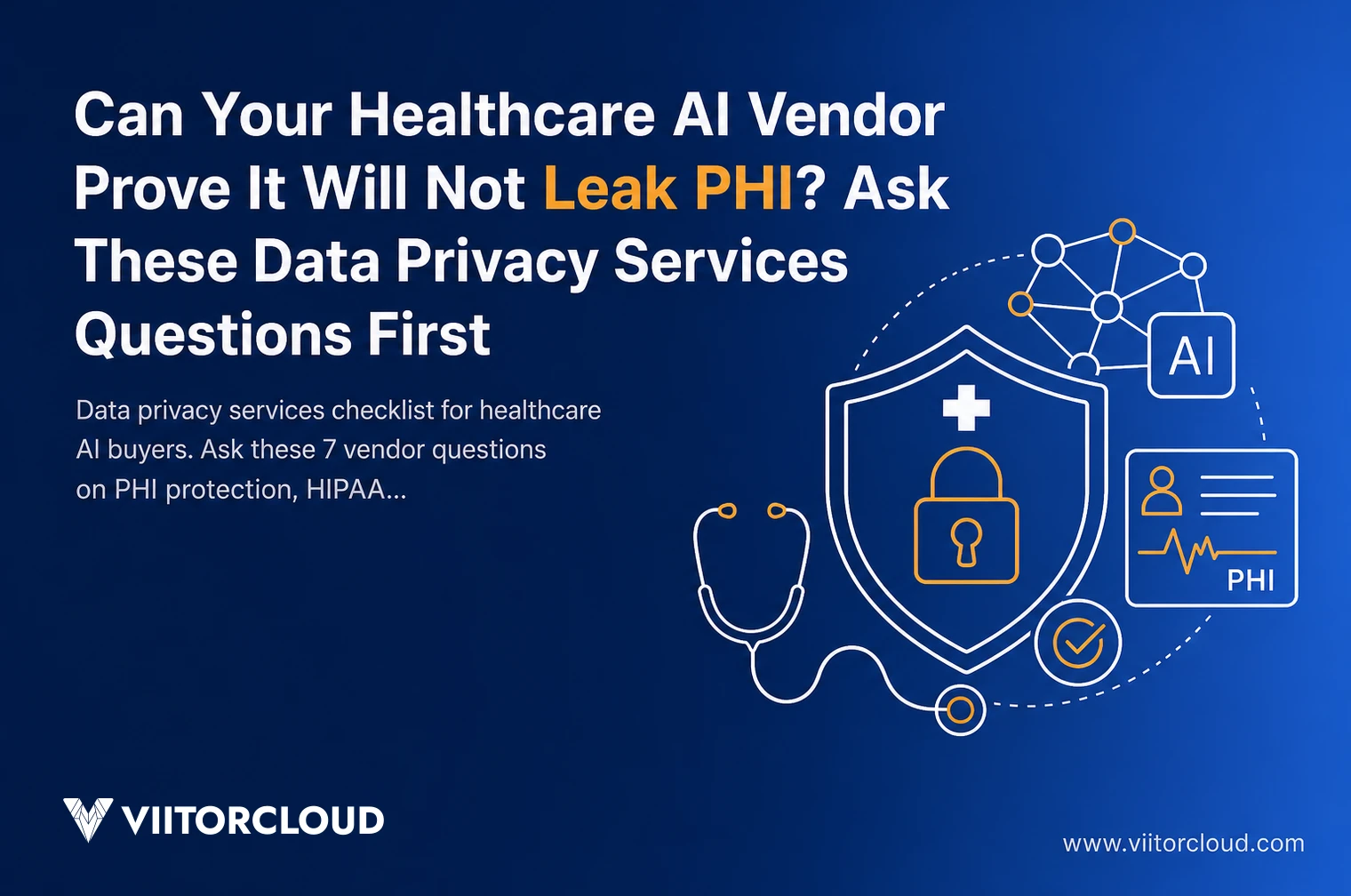
The fastest way to test a healthcare AI vendor is to demand evidence in seven areas before you sign. Ask for PHI data flow maps, model access controls, an AI audit trail, deployment isolation, HIPAA documentation, a training data policy, and ongoing data privacy services. A vendor who cannot produce that evidence is asking you to absorb the risk.
I have run these reviews from both sides for years, and the pattern repeats. Procurement checks certifications, signs the BAA, and skips the engineering questions. Then an ungoverned model exposes patient data, and the cost lands on the covered entity, not the vendor.
This guide gives you the exact questions, the evidence artifact to demand for each, and the red flags that should end a conversation early.
Key Takeaways
- Healthcare data breaches now average $6.64 million per incident, the costliest of any sector for 13 straight years, according to IBM.
- Working data privacy services produce evidence on demand, including data flow maps, model access controls, and an AI audit trail you can inspect.
- A signed BAA is the floor for HIPAA, not proof of PHI protection. Architecture decides whether PHI leaks.
- Ask whether PHI ever trains or fine-tunes a model. If the answer is vague, assume it does.
- A vendor who cannot produce audit logs or access policies within days is showing you the controls do not exist.
Why PHI Leakage Is Now a Procurement Problem
IBM’s Cost of a Data Breach research puts the average healthcare breach at $6.64 million, the costliest sector for the 13th year running. The same research tracks AI-driven attacks rising 56% year over year and adding about $1 million per incident. Regulators do not care whose model failed. The covered entity carries the exposure.
Late last year, I sat in a vendor review with the IT lead of a mid-market clinical documentation company. The demo was strong. Then she asked where inference logs lived and who could read them. The vendor had no answer, and the deal ended in that meeting.
Her instinct was right. Weak vendors survive checklist reviews and fail engineering questions. I have written about the broader AI implementation risks in healthcare and BFSI, but procurement needs sharper tools than a generic AI compliance checklist.
Pressure-Test Your AI Vendor Shortlist
Share the architecture and controls your shortlisted vendors claim, and our engineers will flag the PHI exposure points before you sign. ViitorCloud has built HIPAA-compliant systems since 2011.
What Data Privacy Services Mean in Healthcare AI
Data privacy services are the engineering and governance controls that protect regulated data across its full lifecycle. In healthcare AI, that covers PHI discovery and classification, de-identification, encryption, model access controls, monitoring, and the AI audit trail that proves each control works. The controls are built into the system, not attached after deployment.
The definition matters because vendors use the phrase loosely. Some mean a compliance PDF. Others mean a privacy officer you can email.
What you are buying is architecture. Demand proof that data privacy engineering runs through the product: how PHI enters, where it rests, what touches it during inference, and how every touch is logged. Secure AI deployment is a property of that architecture, not a line on a brochure.
Seven Questions That Separate Proof From Promises
Ask these in order, in writing. Each question has a right answer and an evidence artifact. Accept the artifact, not the assurance. A capable vendor will produce most of this within a week.
1. Where does PHI travel and who can see it at each step?
Ask for a data flow diagram covering ingestion, preprocessing, inference, storage, and logging. PHI protection starts with knowing every place patient data exists, including temporary copies in queues, caches, and vendor support tools.
Evidence to demand: a current data flow map, a data inventory, and retention rules for each store. If the vendor sketches it from memory, treat the diagram as missing.
2. What model access controls limit exposure inside the system?
Model access controls decide which people, services, and prompts can reach PHI during inference. Role-based access for staff is the easy part. The harder questions sit deeper. Can a support engineer replay your prompts, can one tenant’s context bleed into another session, and does the model hold least-privilege access to your source systems?
Evidence to demand: an access control matrix, the tenant isolation design, and the most recent access review report.
3. Can you produce an AI audit trail for every interaction?
An AI audit trail records who queried the system, what data the model saw, and what it returned. Without one, a breach investigation becomes guesswork and HIPAA accounting requirements become impossible to meet. Ask the vendor to pull the log for a specific test query during the demo. This is a core discipline of responsible AI implementation, and it is the question vendors fail most often.
Evidence to demand: sample log entries, retention periods, and tamper controls.
4. How does your secure AI deployment isolate PHI from public models?
One demo I reviewed sent transcript snippets, PHI intact, to a public model endpoint. The vendor called it a temporary setting. Temporary settings become production settings the day a contract is signed.
Secure AI deployment keeps PHI inside a controlled boundary: a private model, a dedicated cloud tenancy, or a zero-retention agreement with the model provider that you can read yourself. Platform products carry the same exposure, which I covered in AI security risks SaaS teams should prepare for.
Evidence to demand: the deployment architecture diagram and the model provider’s data handling terms.
5. Will you sign a BAA and show your HIPAA evidence?
A business associate agreement is mandatory, and any hesitation ends the process. Then go further. The HIPAA Security Rule requires risk analysis, workforce controls, and audit capability, so ask for the vendor’s latest risk assessment and the subcontractor list that inherits your PHI.
AI compliance also reaches beyond one law. Cross-border operations face GDPR and regional health data rules with stricter consent standards.
Evidence to demand: the BAA draft, a risk assessment summary, and subcontractor BAAs.
6. Does PHI ever train or fine-tune your models?
This is where quiet leakage happens. A model fine-tuned on identifiable records can reproduce fragments of them later, and no firewall stops an answer. The defensible pattern excludes PHI from training by default and uses de-identified data under a documented method with measured re-identification risk. Data privacy here is contractual and technical at the same time.
Evidence to demand: the training data policy, the de-identification method, and a contract clause banning training on your PHI without written approval.
7. Which data privacy services continue after go-live?
PHI protection decays without maintenance. Access lists go stale, models drift, and every new integration opens a new path. Ask which data privacy services the contract includes after launch: monitoring scope, quarterly access reviews, and incident response inside the notification windows regulators enforce. Mature healthcare technology partners treat this as part of the product, not an upsell.
Evidence to demand: the operations runbook and written incident response commitments.
Build Healthcare AI With PHI Protection by Design
We engineer custom AI with isolated deployments, model access controls, and full audit logging, the same discipline behind a platform that has processed $192.2M in healthcare revenue.
Red Flags That Should End the Conversation
Some answers tell you everything you need to know. Stop the evaluation when you hear them.
- The vendor resists a BAA or tries to narrow its scope.
- Security detail is refused for security reasons. Real controls survive description.
- PHI reaches a public model endpoint in any configuration, even in a pilot.
- No named security owner exists on the vendor side.
- The AI audit trail is promised repeatedly but never shown during the sales cycle.
- De-identification is described as removing names and nothing more.
A vendor is never more responsive than during the sales cycle. If evidence arrives slowly now, picture the response during an incident at 2 a.m.
Get a Data Privacy Review Before Go-Live
A short review of your data flows, access controls, and audit trails costs far less than a breach investigation. Bring us your hardest compliance questions.
How ViitorCloud Engineers PHI Protection Into Healthcare AI
I ask vendors these questions because my team answers them for a living. ViitorCloud builds custom AI solutions with AI compliance for HIPAA and GDPR engineered in from the data pipeline up. That means isolated deployments, model access controls, de-identification before any training use, audit logging on every interaction, and data privacy services that keep controls current after go-live.
The discipline shows in production. We engineered the platform behind LogixHealth, which has processed $192.2 million in healthcare revenue under controls that stand up to payer and regulator scrutiny. If you are shortlisting healthcare AI vendors, talk to our experts before you sign. A short architecture review now costs far less than an incident later.
The Bottom Line on Data Privacy Services for Healthcare AI
Three things decide whether healthcare AI protects patients or exposes them. Architecture that isolates PHI. Controls you can inspect, including model access controls and a working AI audit trail. And the data privacy services that keep both alive after launch.
The seven questions above turn claims into evidence. Send them in writing before the next demo, keep the answers, and score every shortlisted vendor against the same list. Secure AI deployment is never an accident. It is a set of decisions a vendor either made or skipped, and you now know exactly where to look. Treat AI compliance as evidence, not paperwork, and the strong vendors will stand out fast.

Vishal Shukla
Vishal Shukla is Vice President of Technology at ViitorCloud Technologies.
Frequently Asked Questions
How do you protect PHI in AI systems?
Protect PHI in AI systems by isolating the deployment, de-identifying data before any training use, enforcing model access controls, encrypting data in transit and at rest, and logging every interaction in an AI audit trail. Verify each control quarterly. PHI protection is an architecture decision first and a policy decision second.
What are data privacy services?
Does HIPAA apply to healthcare AI vendors?
What should an AI audit trail record?
Can a healthcare AI vendor train models on our patient data?