


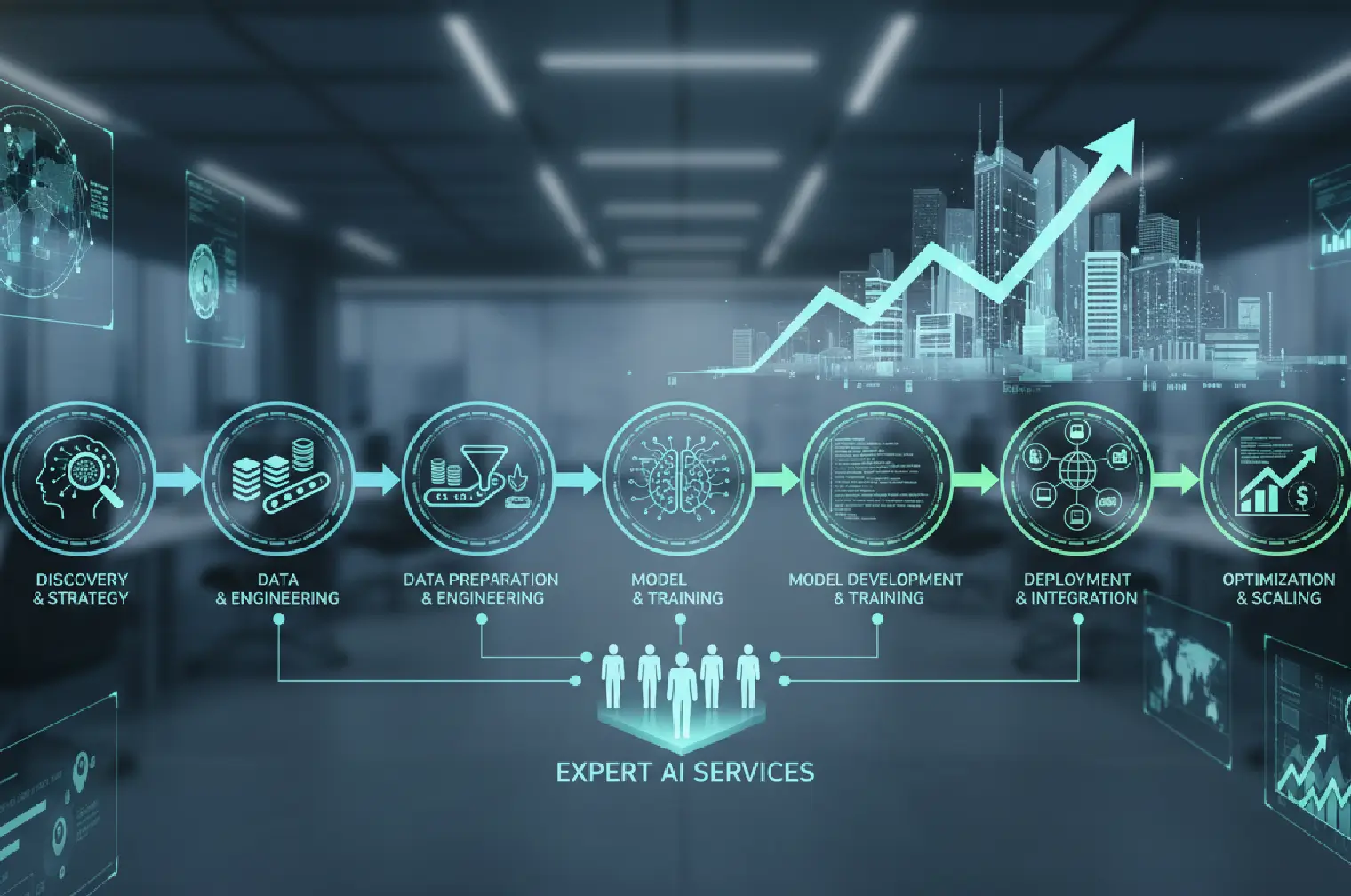
Implementing AI integration services requires a strict schedule and clear technical milestones. Enterprise CTOs often experience unclear expectations when planning an AI rollout. Here, we have discussed a realistic AI deployment timeline based on enterprise standards. It provides a structured approach to engineer and deploy AI integration solutions across global operations.
The Reality of AI Integration Services in the Enterprise
Enterprises operate with strict data governance requirements and complex legacy infrastructures. These variables add significant time to the AI deployment timeline. Many organizations rush the initial planning and data preparation phases. This leads to system incompatibilities and project delays.
Research from McKinsey & Company regarding AI adoption shows that redesigning core business workflows drives the highest bottom-line impact. Companies must align their technical deployment with these necessary workflow adjustments. Building scalable AI-first software and platforms establishes a reliable technical foundation. This architectural foundation prevents processing bottlenecks later in the project lifecycle.
Weeks 1 to 4: The AI Deployment Timeline Begins with Strategy
The first month centers on business alignment, technical feasibility, and data auditing. You must define exact use cases for the planned AI integration solutions. The IT department evaluates current system capabilities.
Core Actions in Month One
- Audit existing data warehouses, data lakes, and localized databases.
- Catalog structured and unstructured data sources available for model training.
- Draft security and compliance protocols to meet global data protection standards.
- Define technical key performance indicators (KPIs) for the AI deployment timeline.
- Determine the computing resources required for model training and inference.
Engineers map the existing IT infrastructure during this phase. They identify specific APIs and legacy systems that require modification.
Stop letting stalled tech projects drain your enterprise budget
Endless planning phases kill your competitive edge. We execute aggressive AI integration services that compress your AI deployment timeline into weeks, not years. Deploy robust, scalable AI integration solutions that drive immediate revenue and secure your market dominance right now.
Weeks 5 to 8: Structuring Data for AI Integration Solutions
Clean and accessible data is mandatory for effective AI integration services. Data engineers spend this four-week block organizing, sanitizing, and formatting data sets. Incomplete data directly degrades the output accuracy of machine learning models.
Data Preparation Steps
- Remove duplicate, outdated, and incomplete records from the primary databases.
- Establish automated Extract, Transform, Load (ETL) pipelines to feed the AI models.
- Configure vector databases to handle unstructured data like text and images.
- Implement strict role-based access controls to protect sensitive enterprise information.
- Set up AI in information technology monitoring tools to track data flow and system health.
The data team also creates isolated environments. These environments separate the training data from the live production data to maintain security.
Weeks 9 to 16: Engineering and Developing AI Integration Services
The engineering team builds and trains the specific AI integration solutions during this eight-week block. This phase consumes the most technical resources and computing power. Developers customize foundational models to meet specific enterprise requirements.
Model Development and Training Requirements
- Select appropriate machine learning frameworks or large language models (LLMs).
- Train the selected models using the sanitized, isolated enterprise data.
- Adjust model weights and parameters to improve specific output accuracy.
- Develop middleware to connect the AI models to existing enterprise resource planning (ERP) systems.
- Containerize the AI applications using tools like Docker and Kubernetes for scalable deployment.
Engineers focus heavily on integration during this phase. They write custom APIs to ensure the AI components communicate seamlessly with user-facing applications.
Weeks 17 to 20: Validation Secures the AI Deployment Timeline
Rigorous testing prevents costly errors in production environments. The quality assurance team evaluates the AI integration services against the initial key performance indicators defined in month one. Gartner’s action plan for IT leaders emphasizes that mitigating risk through early and continuous validation secures long-term operational success.
Enterprise Testing Protocols
- Conduct automated unit testing on all new code components and API endpoints.
- Run security penetration tests to identify vulnerabilities in the AI infrastructure.
- Perform user acceptance testing (UAT) with a closed, restricted group of employees.
- Measure response latency, API load limits, and overall system resource consumption.
- Evaluate the model for biased outputs or hallucinations.
Developers resolve the bugs identified during testing. They refine the system architecture to handle the anticipated enterprise workload without latency spikes.
Outpace your competitors with lightning-fast execution
A slow AI deployment timeline gives your rivals the upper hand. You need an expert partner that guarantees rapid implementation without breaking your core systems. We deliver flawless AI integration services and build scalable AI integration solutions that upgrade your infrastructure effortlessly.
Weeks 21 and Later: Activating AI Integration Solutions
The final phase of the AI deployment timeline involves pushing the validated system to the live environment. The enterprise transitions from isolated testing to daily, integrated operation. CTOs utilize a phased rollout approach to minimize workflow disruption.
Rollout and System Monitoring
- Execute a blue-green deployment strategy to transition users to the new system safely.
- Deploy the AI integration services to the main production servers.
- Monitor real-time system performance, error logs, and user adoption rates.
- Provide comprehensive technical documentation to the internal IT support staff.
- Track the impact of artificial intelligence in business processes to calculate the final ROI.
The engineering team establishes continuous integration and continuous deployment (CI/CD) pipelines. This allows them to push future model updates and security patches without taking the system offline.
ViitorCloud Delivers Scalable AI Integration Solutions
Enterprises require technical partners with proven implementation records. ViitorCloud engineers and deploys robust AI integration solutions for large-scale corporate operations. Our technical teams manage the entire AI deployment timeline, from the initial data infrastructure audit to the final production server deployment.
We utilize strict compliance frameworks designed for global operations. Our engineers specialize in integrating large language models, computer vision systems, and predictive analytics engines into complex, legacy enterprise infrastructures. We ensure high availability and low latency for all deployed models.
Contact ViitorCloud to schedule a technical assessment of your enterprise architecture and data readiness.
Turn your fragmented enterprise data into a fast revenue engine
Unpredictable project scopes burn your cash and frustrate your teams. We completely eliminate the guesswork from your AI deployment timeline. Rely on our elite AI integration services to connect your siloed data with powerful, scalable AI integration solutions that deliver massive ROI today.
Final Words
A structured AI deployment timeline removes ambiguity from complex enterprise technology upgrades. CTOs who follow a phased, highly technical approach deploy AI integration services with minimal system downtime. Thorough data preparation and rigorous testing ensure that the implemented AI integration solutions deliver measurable operational improvements and sustain high performance at scale.

Vishal Shukla
Vishal Shukla is Vice President of Technology at ViitorCloud Technologies.
Frequently Asked Questions
How long do AI integration services typically take?
A complete enterprise AI deployment timeline usually ranges from 12 to 24 weeks, depending entirely on initial data readiness.
What delays an AI deployment timeline the most?
Why do enterprises need custom AI integration solutions?
How do you measure success for AI integration services?