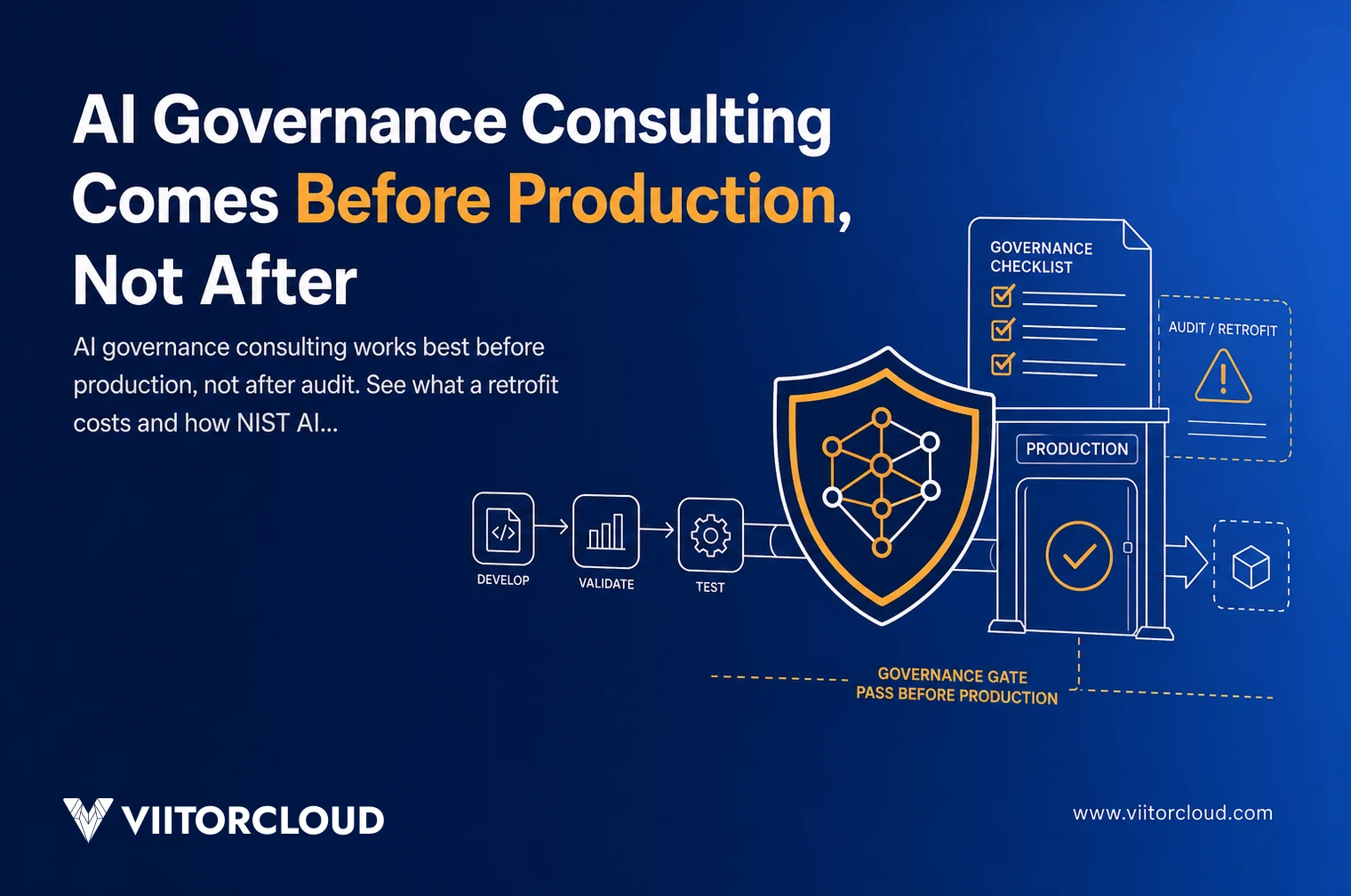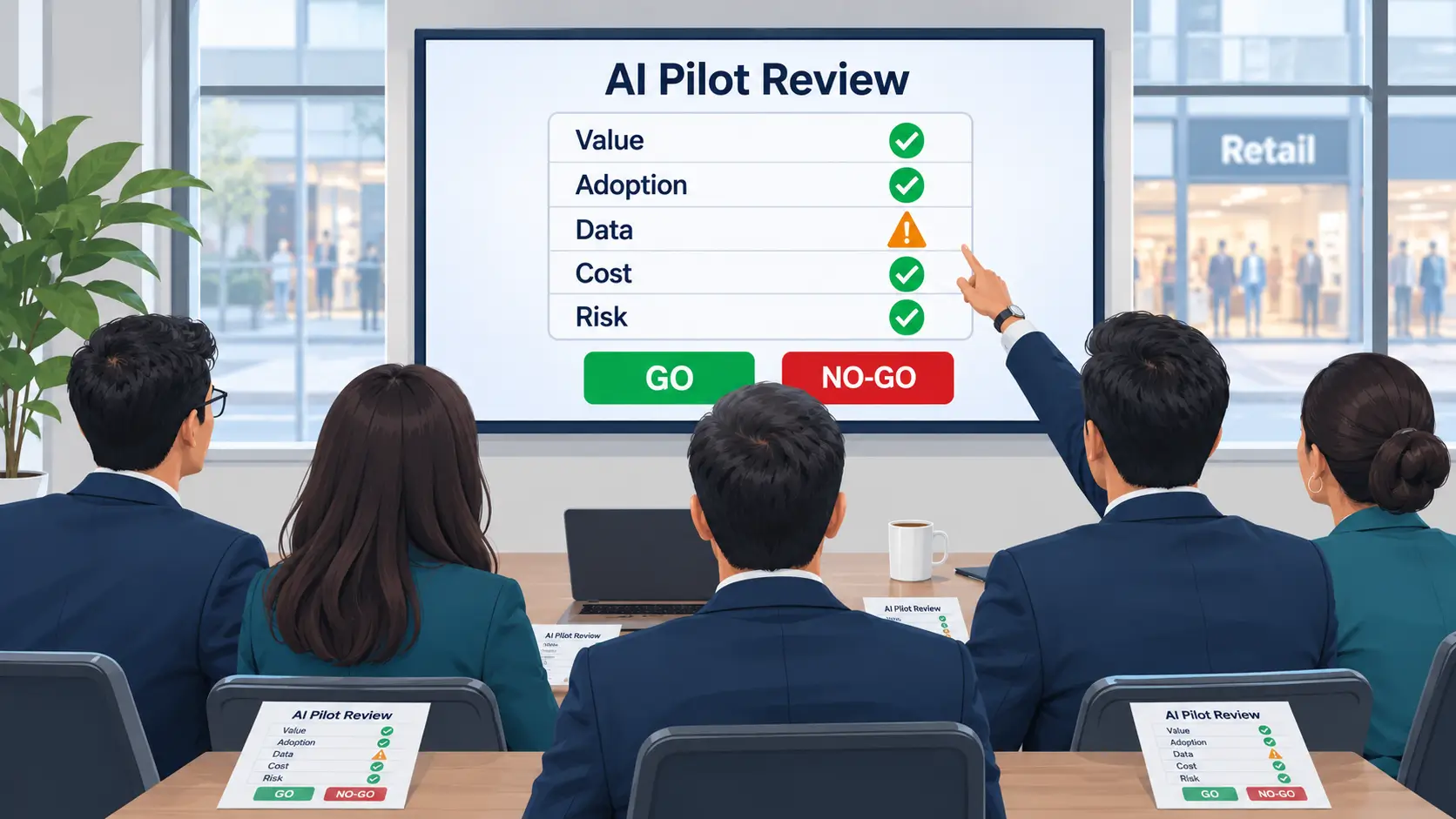
An AI pilot succeeded when it passes five checks your leadership team agreed on before the pilot started: it moved a business number, people kept using it, the data held up, the cost per result is falling, and the risks are under control. These five checks are your ai pilot success criteria. If they were never written down, the review meeting will have only the demo to go on.
This guide gives you five questions to ask, a one-page scorecard to fill in, and a retail example of how the review plays out.
Key takeaways
- Write the success criteria down before the pilot starts, with a baseline, a target, and an owner for each one.
- A pilot passes only if it moves a business number. Model accuracy and a good demo do not count on their own.
- Check out five areas: value, adoption, data, cost trend, and risk. Each has a clear pass line.
- MIT and Gartner research shows most GenAI pilots stall before production, usually for reasons a scorecard would have caught early.
- A “no-go” decision is a valid result. Narrowing or stopping a pilot early protects next year’s budget.
Why a working demo proves very little on its own
A demo shows that the model can do the task once, on chosen examples. To know whether the task now costs less, runs faster or earns more, you need numbers from live work. Most pilot reviews still lean on the demo, because nobody agreed on a number to check at the start. Written ai pilot success criteria fix that gap.
The pattern is common. MIT’s NANDA initiative studied more than 300 public AI initiatives for its 2025 report, The GenAI Divide, and found that for 95% of companies in its dataset, generative AI was falling short of measurable business return (MIT NANDA via Fortune, August 2025). The report’s lead explanation was a learning gap: most tools did not keep feedback or adapt to how the business works.
Gartner had warned of the same outcome a year earlier. It predicted that at least 30% of GenAI projects would be abandoned after proof of concept by the end of 2025, citing poor data quality, inadequate risk controls, escalating costs or unclear business value (Gartner, July 2024).
Each of those causes can be measured during a pilot, which is why written criteria are needed before it starts.
Your Pilot Review Is Coming Up. Do You Have a Criteria?
We help leadership teams set AI pilot success criteria with real baselines and targets, so the review date ends in a clear go or no-go decision.
What 2026 data says about pilots that reach scale
The gap between experimenting and scaling is still wide in 2026. A Gartner survey of 1,303 organizations, run from January to April 2026, found that only 22% have successfully scaled AI across multiple business units (Gartner, September 2026).
The same survey shows why measurement separates the groups. High performers reported positive returns on 81% of their AI initiatives. Low performers did not know the rate of return for 29% of theirs. Gartner adds that high performers track AI returns constantly and stop initiatives that underperform.
Finance leaders are hearing the same message. In May 2026, Gartner analyst Marco Steecker told CFOs that they “must not mistake activity for impact”, meaning pilot counts and tools rolled out are not proof of value.
For a CEO or founder, the trend is clear. Boards now expect measuring AI pilot ROI to be part of the plan from day one.
Know the Return Before Your Board Asks for It
We set up baselines and track for your AI pilot, so measuring AI pilot ROI uses real numbers from your own operations.
Five questions to settle before the review date
Each question below covers one area of ai pilot evaluation criteria. Agree on the pass line for each before the pilot starts and name the person who owns the number. Together, these ai pilots evaluation criteria give the review meeting a fixed test to apply.
1. Did it move a business number we care about?
This is the value check. Pick one number the business already tracks, such as cost per order, time to resolve a ticket or conversion rate, and record its value before the pilot begins. A pilot that improves model accuracy but leaves that number unchanged has not passed.
Pass if: the chosen number improves by the agreed amount, measured on live work, against the recorded baseline.
2. Do people keep using it without being pushed?
This is the adoption check. Usage often spikes in week one and fades once the novelty wears off. The MIT NANDA report linked this to tools that do not learn from user feedback, so staff return to their old way of working.
Pass if: the target group still uses the tool in the final weeks of the pilot at the agreed rate, and their corrections are being captured.
3. Did the data hold up outside the test set?
This is the data check. Pilots often run on a cleaned sample that does not match daily data. Gartner listed poor data quality as a leading reason for GenAI projects to drop after proof of concept. Our earlier guide to an AI readiness assessment covers how to check this before a pilot starts.
Pass if: results on real, unfiltered data stay within the agreed range of the test results.
4. Is the cost per result falling as volume grows?
This is the cost trend check. Gartner estimated that GenAI deployment costs can range from $5 million to $20 million depending on the approach and called those costs less predictable than other technologies. A pilot should show the cost of each useful output, such as each processed order or each resolved ticket, and how that cost changes as volume rises.
Pass if: cost per successful result is at or below the agreed target and trending down, with a clear estimate for full volume.
5. Can we explain, control and stop it?
This is the risk check. Someone must be able to see what the system did, correct it, and switch it off. The NIST AI Risk Management Framework gives a widely used structure for this under four functions: govern, map, measure and manage.
Pass if: high-impact actions are logged, a named person can override or stop the system, and no unacceptable incident occurred during the pilot.
Writing your ai pilot success criteria on one page
The five questions become a single page your leadership team signs before kickoff. Fill in the baseline and target columns with your own numbers. The example values here are placeholders only.
| Area | Question | Baseline (before pilot) | Target (by review date) | Owner |
| Value | Did it move a business number? | e.g. 6 min per order | e.g. 4 min per order | Operations head |
| Adoption | Do people keep using it? | 0% (new tool) | e.g. 70% of target users in final 2 weeks | Team lead |
| Data | Did data hold up? | Test-set result | Live result within agreed range | Data owner |
| Cost trend | Is cost per result falling? | Current cost per order | At or below agreed cost, trending down | Finance partner |
| Risk | Can we explain, control and stop it? | No controls | Logs, override and stop in place | Product or risk owner |
This page also works as an ai pilot to production checklist. If every row passes, the pilot moves to production design. If one or two rows are missing, the scope narrows. If the value row is missing, the pilot stops.
Two rules keep the page honest. Fix the review date at the start, so the pilot cannot run indefinitely. And do not change targets during the pilot unless the leadership team agrees and records the change.
Turn Your Pilot into a Production Plan
We use this one-page scorecard to review your AI pilot, then plan the build that takes a passing pilot into production.
A retail pilot, reviewed against the scorecard
Here is an illustrative example of how the scorecard works in practice. The e-commerce team at a mid-size apparel retailer runs an eight-week pilot in which AI drafts product descriptions for new arrivals. The demo is strong, and the drafts read well.
At the review, the team works through the page. Value: time to publish a new product fell from about two days to under one day, which met the target. Conversion on AI-drafted pages stayed level with the baseline, so the gain came from faster publishing only.
Adoption passed, because copywriters kept using the drafts, and their edits were saved for retraining. Data partly missed: drafts were weaker for products with incomplete size and fabric details in the product catalog. Cost passed at pilot volume, with a clear estimate for the full catalog. Risk passed, with every draft reviewed before it went live.
The decision was a narrowed go. The retailer moved the tool into production categories with complete product data and set up a separate task to fix catalog data for the rest. Without the scorecard, the strong demo would likely have led to a full rollout, and the data gap would have shown later on live product pages.
Retail teams looking at similar projects can see how ViitorCloud approaches retail technology work, and our guide to the AI and ML roadmap from proof of concept to production covers the steps after a pilot passes.
When the honest answer is no-go
A no-go based on evidence is still a useful decision, because it frees budget for the next use case. There are three possible outcomes at any review, and each needs a clear trigger.
Go to production when all five rows pass and the ai pilot to production checklist is complete. Narrow the scope when value passes, but one or two other rows are missing, as in the retail example. Stop when the value row misses, because better data or lower cost will not fix a use case that does not move the number.
One more option is sometimes justified: extend once. Use it only when a specific, named issue blocked the measurement, such as a data feed that arrived late. Set a new fixed date and do not extend a second time. This is where ai proof of concept criteria protects the business, because they stop a pilot from drifting for months with no decision.
Set your criteria before the next pilot starts
If a pilot is about to start or a review date is close, write your ai pilot success criteria down this week and agree with the people who own each number. ViitorCloud’s custom AI solutions team helps leadership teams define these criteria, run the pilot against them, and plan production for the pilots that pass. To review a pilot you are running now, talk to our team.

Vishal Shukla
Vishal Shukla is Vice President of Technology at ViitorCloud Technologies.
Frequently Asked Questions
What are pilot success criteria?
AI pilot success criteria are the measurable conditions a pilot must meet to move into production, agreed before the pilot starts. A practical set covers five areas: business value against a recorded baseline, continued user adoption, data quality on live inputs, cost per result as volume grows, and risk controls such as logging, override and a way to stop the system.
How do you measure an AI pilot's success?
What are good AI POC success metrics?
How long should an AI pilot run before the review?
What should happen if an AI pilot fails its review?