


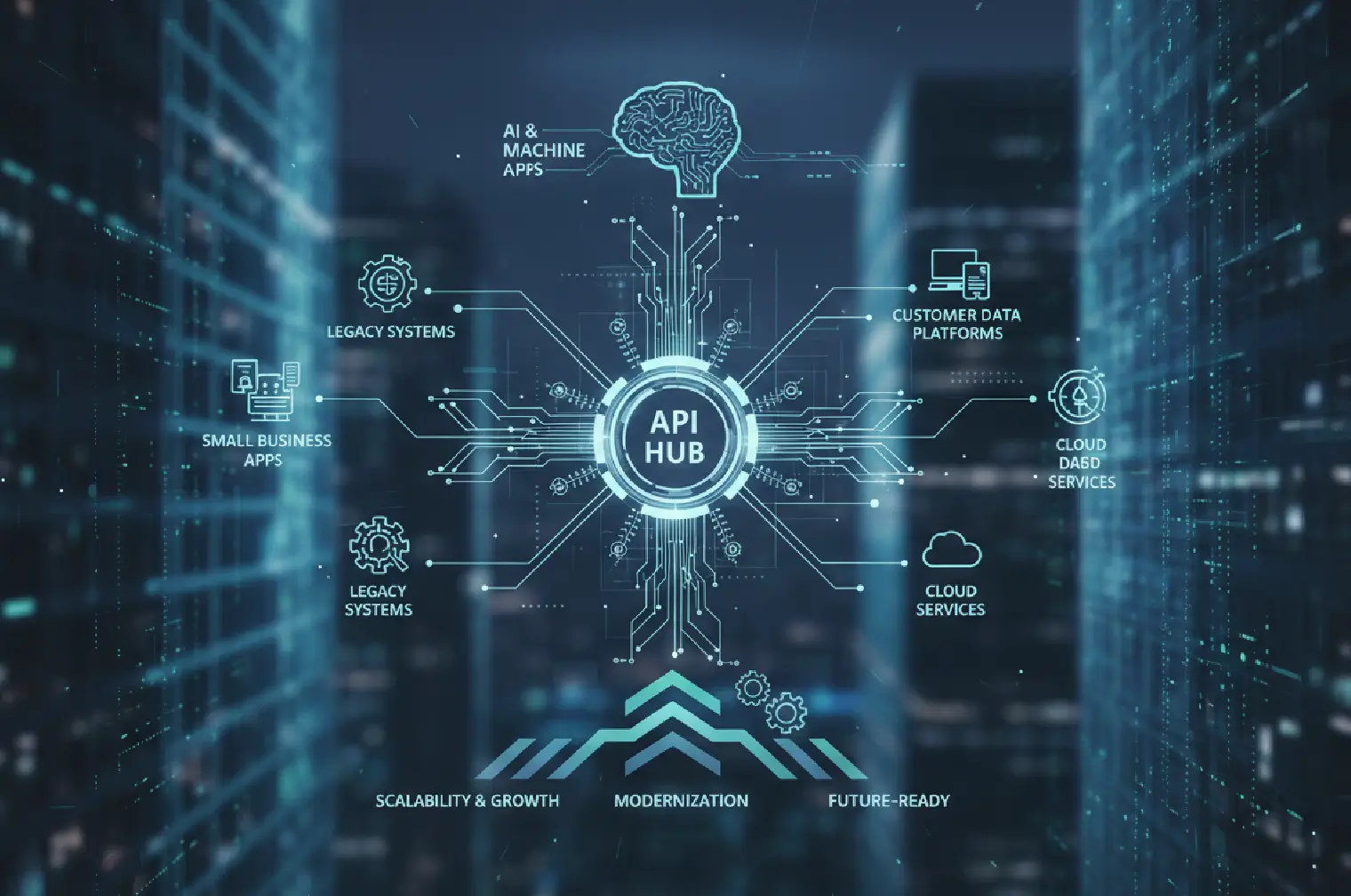
The rapid adoption of Artificial Intelligence (AI) requires a fundamental shift in how small and medium-sized businesses (SMBs) in the US and Europe structure their digital infrastructure. Traditional methods of connecting software often result in rigid, monolithic systems that hinder the deployment of intelligent features.
Transitioning to API-first system integration ensures that an organization’s data and logic remain accessible, modular, and ready for advanced automation. This approach treats Application Programming Interfaces (APIs) as the primary building blocks of software architecture rather than secondary connectors.
The Necessity of API-First Architecture for AI
For an SMB in the IT sector to remain competitive, the underlying technology must support rapid data exchange. AI integration depends on the ability of models to access high-quality, real-time data from various business functions.
When a company prioritizes API-first system integration, it creates a standardized environment where different platforms, such as CRM, ERP, and project management tools, communicate through well-documented endpoints. This standardization is critical because AI models require structured data to perform tasks like predictive analytics or natural language processing.
Small businesses often face the challenge of legacy debt. Many existing systems were not designed to share data outside of their own environment. Implementing system integration through an API-led strategy allows these businesses to wrap legacy functions in modern interfaces.
This modernization process is a core part of ViitorCloud’s system integration and modernization services, which focus on making older infrastructures compatible with modern cloud requirements. By establishing this foundation, businesses can deploy AI integration services to automate routine decision-making processes without rebuilding their entire software stack from scratch.
Build an API-First Foundation for AI Growth
Enable seamless System Integration that prepares your business for scalable AI Integration Services.
Strategic Benefits for SMBs in the US and Europe
The European and US markets are increasingly governed by strict data privacy and AI regulations. The EU AI Act, for instance, mandates specific levels of transparency and data governance.
An API-first system integration model supports compliance by providing a centralized layer where data access can be monitored, audited, and restricted. This architectural choice simplifies the task of ensuring that AI integration remains within legal boundaries while maintaining operational efficiency.
Furthermore, IT SMBs use these architectures to achieve faster time-to-market. According to a report by Postman on the State of the API, organizations that adopt API-first strategies recover from failures faster and deploy new features more frequently.
For a small business, this agility is the difference between leading a market segment and falling behind larger competitors. Professional AI integration services leverage these APIs to build “Agentic” workflows, where AI agents execute business logic directly through authenticated endpoints.
| Feature | Monolithic Integration | API-First Integration |
| Data Access | Hard-coded and siloed | Modular and accessible |
| AI Readiness | Low (requires custom builds) | High (connects via endpoints) |
| Scalability | Difficult to expand | Highly scalable |
| Maintenance | High risk of regression | Low risk due to decoupling |
Build a Scalable AI Strategy
Modern software engineering emphasizes the decoupling of the frontend, backend, and the intelligence layer. As discussed in the ViitorCloud blog on GenAI and software architecture, the rise of Generative AI has made rigid architectures obsolete. A successful system integration strategy involves identifying every business process that generates data and exposing it through an API.
This allows for the seamless application of AI integration across different departments, such as using AI to analyze customer support tickets or optimizing supply chain routes based on real-time inventory data.
SMBs must also consider the cost of implementation. While custom coding may seem cheaper initially, the long-term maintenance of point-to-point connections is high.
Utilizing specialized AI integration services ensures that the APIs are built to handle the high-concurrency demands of AI workloads. These services focus on creating an environment where data flows freely but securely, enabling a more cohesive system integration experience.
Technical Implementation Steps
Transitioning to an AI-ready state requires a systematic approach to infrastructure.
- API Audit and Standardization: Evaluate existing software to see which platforms offer accessible APIs and which require custom wrappers.
- Infrastructure Modernization: Move from local, fragmented servers to cloud-native environments that support API-first system integration.
- Deploying AI Integration Services: Choose specific AI models or agents that solve immediate business problems, such as automated invoicing or lead scoring.
- Security Layering: Implement OAuth 2.0 and encryption to protect data as it moves between the AI layer and the business logic layer.
As businesses move from AI experiments to concrete strategies, the focus shifts to reliability. A fragmented system integration leads to “hallucinations” in AI outputs because the model lacks a complete data picture. Standardized APIs provide the “ground truth” data that models need to be accurate.
Connect Systems. Activate Intelligence.
Unify your platforms with expert System Integration and deploy AI Integration Services that work across your stack.
Enhance Operational Efficiency through Integration
The ultimate goal of system integration is to reduce human intervention in repetitive tasks. In the IT sector, this might mean automating the deployment pipeline or using AI to monitor network security. By employing AI integration services, businesses can create self-healing systems that identify and fix bugs through API triggers. This level of automation is only possible when the underlying API-first system integration is robust enough to handle automated requests without crashing.
Research from McKinsey & Company indicates that applied AI is one of the most significant trends for business growth in 2026. However, the report highlights that the success of AI integration is directly tied to the maturity of a company’s data architecture. SMBs that invest in professional system integration now will find it significantly easier to adopt future technologies, such as Quantum Computing or Edge AI, because their core logic is already modularized.
Future-Proof with Modular SaaS
Many SMBs provide software as a service. To make these products attractive in 2026, they must include built-in intelligence. Learning how to build a scalable SaaS with embedded AI involves using APIs to connect the core product to LLM providers. This type of AI integration allows users to interact with software using natural language, improving the user experience and increasing the value of the service.
Effective AI integration services help bridge the gap between technical possibility and business reality. They ensure that system integration does not become a bottleneck for innovation. By adopting an API-first system integration mindset, IT businesses in the US and Europe can ensure their systems remain interoperable and their data remains a liquid asset.
Scale Faster with Custom AI Solutions
Design API-first System Integration and Custom AI Solutions tailored to your small business goals.
Conclusion
Achieving AI readiness is a structural challenge rather than a purely functional one. API-first system integration provides the necessary framework for SMBs to deploy and scale intelligence across their operations. Through consistent system integration practices and the use of expert AI integration services, businesses can transform from reactive organizations into proactive, AI-driven enterprises. The focus on modularity and accessibility ensures that AI integration is not a one-time project but a continuous capability that evolves with the business.
Connect ViitorCloud or contact us at [email protected] and set a complimentary consultation call with our AI experts.

Vishal Shukla
Vishal Shukla is Vice President of Technology at ViitorCloud Technologies.