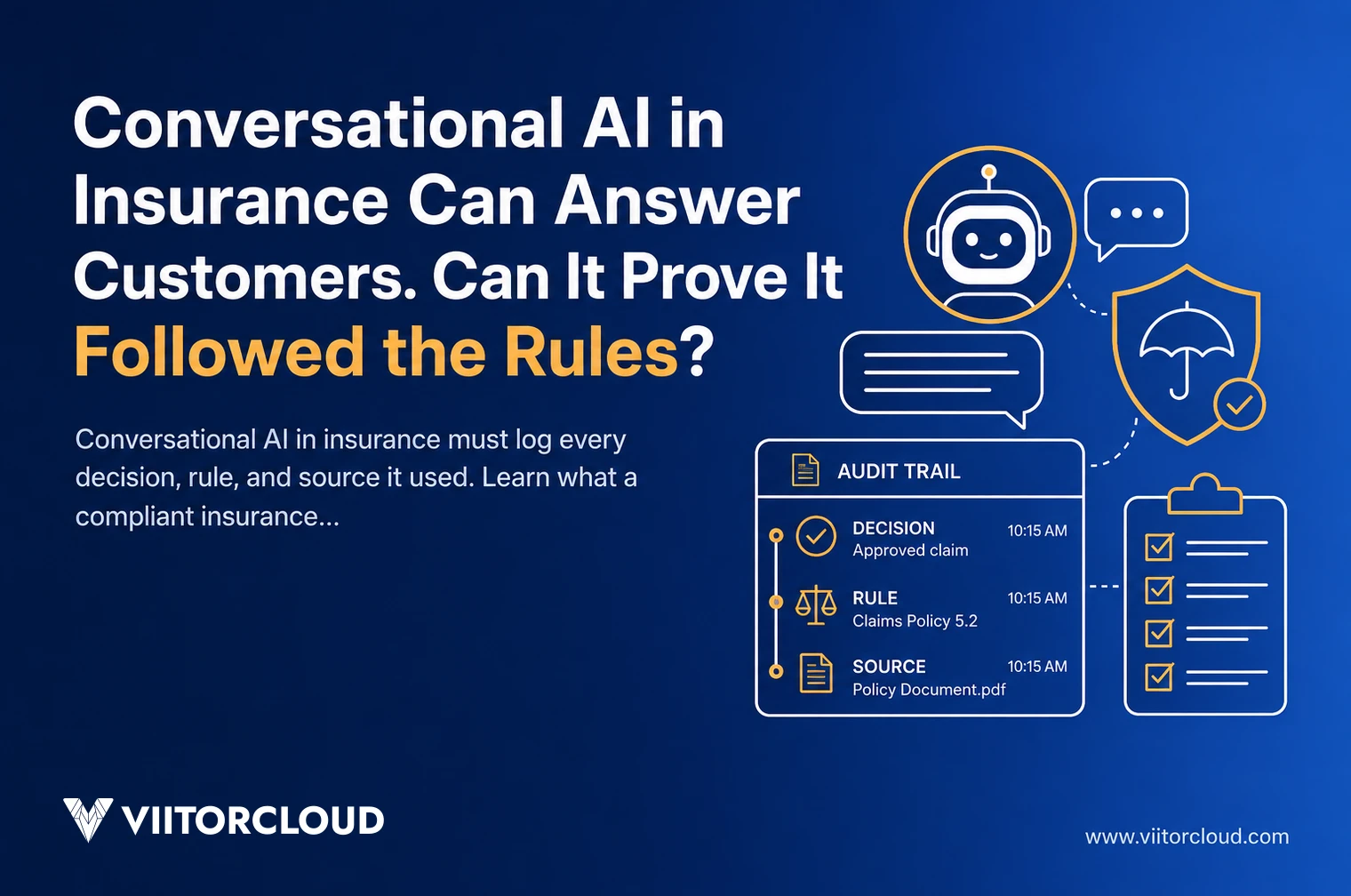
Conversational AI in insurance has two jobs. Answer the customer correctly and leave behind a record that shows how the answer was reached. Most deployments only do the first one well.
What rules does an insurance chatbot have to follow?
The same rules the people behind it follow. Fair treatment of customers, accurate disclosure, data protection and consent, complaint handling, and record retention. On top of that, it has to keep evidence. If the bot touches a quote or a claim, the insurer must be able to reconstruct that decision months later.
I have reviewed enough of these builds to know where the gap opens. Teams spend months on tone, intent coverage, and handoff rules. Almost nobody writes a specification for what the system records. That single omission turns a useful insurance chatbot into an exposure the moment it moves past general questions.
This article covers what a rule-following system logs, how risk changes between AI for policy questions and AI for claims, and the design decisions that produce AI that keeps an audit trail from the first release.
Key Takeaways
- A fluent insurance chatbot with no decision log cannot support a regulator request, a complaint review, or an internal audit.
- Conversational AI in insurance should record the retrieved source, the rule version, the model and prompt version, the consent state, and the escalation path on every turn that affects money.
- AI for policy questions carries disclosure risk. AI for claims carries decision risk and needs human review gates plus reason codes.
- Rebuilding logs after the fact does not work. AI that keeps an audit trail writes the record in the same call that produces the answer.
- Explainability, retention, and access control belong in the architecture, not in a policy document written after launch.
What a Regulator Actually Asks After the Bot Answers
Nobody asks whether the bot was polite. The question is narrower and harder. On this date, this customer asked this; your system said that, so show the basis for it.
Four things are requested in practice:
- The exchange itself: The customer input and system output, stored word for word, not summarised.
- The source of truth: Which policy wording, endorsement, or product rule the answer came from, and which version was live at that moment.
- The decision path: What the system did with the answer. Informed, quoted, triaged, escalated, or closed.
- The human checkpoint: Who reviewed it, when, and whether they agreed.
The NIST AI Risk Management Framework makes the same point in general terms. Documentation and traceability are treated as core functions of a trustworthy AI system, not as reporting bolted on afterwards. Insurance raises the stakes, because the output shapes a contract and a payment.
This is where conversational AI in insurance stops resembling a support tool. It is also where the difference between a chatbot and an AI agent stops being academic. A scripted bot follows a path you already documented. An agent chooses one, and the choice needs a record.
Put a Record Behind Every AI Answer
We build insurance chat and voice AI that logs the source, rule version, and human sign-off behind each response, so your team can show how a decision was reached months later.
Why a Fluent Insurance Chatbot Still Fails an Audit
Language models generate answers. They do not retrieve them by default. Ask the same coverage question twice with different wording, and you can get two different explanations, both confident, both plausible.
That behaviour is manageable. What is not manageable is conversational AI for insurance that cannot tell you which version of the policy document it read, or which prompt template was live that week.
On one review, the team produced a clean transcript of a customer exchange from four months earlier within minutes. They could not produce the wording document the answer had been drawn from, because the content library had been updated twice since. The transcript proved what was said. It proved nothing about whether the answer was correct at the time.
That is the insurance AI rules and records problem in one sentence. The conversation is evidence of the output. It is not evidence of compliance. Conversational AI in insurance has to carry both.
What Conversational AI in Insurance Should Record on Every Turn
Here is the insurance AI rules and records checklist I use when reviewing conversational AI for insurance carriers. If a system cannot produce all of this for any past interaction, it is not ready for quotes or claims.
- Identifiers: Conversation ID and turn ID, linked to the policy, quote, or claim reference.
- Verbatim input and output: Stored exactly as sent and received, including anything the customer corrected mid-conversation.
- Retrieved sources: Document identifiers, version numbers, and effective dates for every source the answer used.
- Model and prompt versions: Model name, model version, prompt or template version, and the retrieval settings that shaped the output.
- Rule references: The underwriting, product, or claims rule applied, with its version and owner.
- Consent and data basis: What the customer agreed to, what data was accessed, and under which lawful basis.
- Confidence and refusals: When the system declined, hedged, or scored low, and what happened next.
- Human actions: Who reviewed, approved, or overrode the outcome, with timestamps and a stated reason.
None of this is exotic. It is the discipline a well-built claims platform already applies to human decisions, extended to a machine participant. Building it into custom AI solutions from the start costs far less than retrofitting it after a complaint lands.
Review Your Design Before the Bot Touches a Claim
Our BFSI team runs a short review of your intended conversational AI design against your real claims and policy workflows, and reports what it would and would not be able to prove.
AI for Claims and AI for Policy Questions Carry Different Risk
Treating both as one project is the most common planning error I see in conversational AI for insurance programmes. They fail in different ways and need different controls.
AI for Policy Questions Needs a Single Source of Truth
AI for policy questions carries disclosure risk. A wrong explanation of an exclusion, a waiting period, or a deductible is a misstatement about a contract the customer already holds.
- Ground every answer in approved wording documents, with the retrieval logged per turn.
- Pin versions so the answer reflects the document that was live on that date.
- Build a hard refusal path for questions outside the approved content set.
AI for Claims Needs a Human Gate and Reason Codes
AI for claims carries decision risk. Triage, coverage indication, document checks, and settlement guidance all shape an outcome with money attached.
- Attach reason codes to every recommendation, written so a claims handler and a reviewer can both read them.
- Require a named human approval step before any adverse or financial outcome is communicated.
- Support an appeal path that can replay the original inputs and reproduce the same result.
The distance between these two use cases is where most programmes lose time. I have written before about the risks that surface when AI enters regulated workflows, and conversational AI in insurance follows the same pattern. Accuracy problems get caught in testing. Evidence problems get caught by an auditor.
How to Build Conversational AI in Insurance That Keeps an Audit Trail
Six design decisions separate conversational AI for insurance that survives scrutiny from a bot that only demos well.
- Retrieve before you generate: Anything factual comes from an approved document store, and the retrieval is logged alongside the answer.
- Pin every version to the conversation: Model, prompt, rules, and documents are stamped at the moment of the exchange.
- Write the record in the same call: If logging runs as a separate downstream job, it will drift, fail quietly, and leave gaps.
- Give the log its own access control: Role-based access, tamper-evident storage, and retention matched to the insurer’s existing schedule for that transaction type.
- Emit reason codes, not confidence alone: A score of 0.86 explains nothing to a reviewer. A reason code does.
- Test on real historical interactions: Replay past claims and policy queries, then check whether the record produced would satisfy a reviewer.
Point three is the one teams skip. On a project where logging ran as an asynchronous job, a queue failure lost several days of decision records while the customer-facing answers kept going out normally. The bot looked healthy. The evidence had a hole in it. AI that keeps an audit trail treats the record and the reply as one transaction.
Regulation is moving the same way. Risk-based rules such as the published regulatory framework for AI systems classify customer-facing decision support by potential harm, and higher-risk uses carry documentation, logging, and human oversight obligations. Insurance sits inside that scope. Insurance AI rules and records are an engineering requirement, not a policy exercise, which is why this build resembles system integration work with compliance and risk requirements more than a chatbot rollout.
Build Insurance AI That Can Be Audited
Explainable outputs, versioned retrieval, role-based access, and GDPR and HIPAA-aligned engineering are standard in how we deliver custom AI for regulated industries.
What I Would Check Before Your Bot Touches a Quote or a Claim
Teams that get this right treat the record as a product requirement, written before the first prompt is drafted. Teams that struggle treat it as logging, then discover the difference during a complaint review.
At ViitorCloud, we build AI inside regulated environments where the record matters as much as the result. The healthcare revenue platform we engineered for LogixHealth has processed $192.2M in healthcare revenue, with the access controls and traceability that kind of workload demands. That work is GDPR and HIPAA-aligned by design, and explainable AI is a standard part of how we build for regulated sectors rather than an optional extra.
If you are scoping conversational AI in insurance right now, the useful first step is a short review of what your intended design would be able to prove. Our BFSI technology solutions team runs that review against your actual claims and policy workflows, before any build commitment.
Fluency Is Not the Bar Anymore
Answering the customer is the easy half. Conversational AI in insurance earns its place when it can also show which rule, which document version, and which human sign-off stood behind the answer.
Three things to take away. Decide what the system records before you decide how it speaks. Separate AI for policy questions from AI for claims, because the controls differ. Write the record in the same call that writes the answer, so you end up with AI that keeps an audit trail rather than a transcript archive.
Start with one workflow, instrument it properly, and replay a month of real interactions against it. If the evidence holds up there, you have a pattern you can extend across the customer journey with confidence.

Vishal Shukla
Vishal Shukla is Vice President of Technology at ViitorCloud Technologies.
Frequently Asked Questions
What rules does an insurance chatbot have to follow?
An insurance chatbot carries the same obligations as the staff it supports. Fair customer treatment, accurate product disclosure, data protection and consent, complaint handling, and record retention. It also has to keep evidence. Once the bot influences a quote or a claim, the insurer must be able to reconstruct that decision on request.
Can an insurance chatbot decide a claim on its own?
What should conversational AI in insurance log for compliance?
How long should insurers keep AI chat records?
Is a generic chatbot platform enough for insurance?