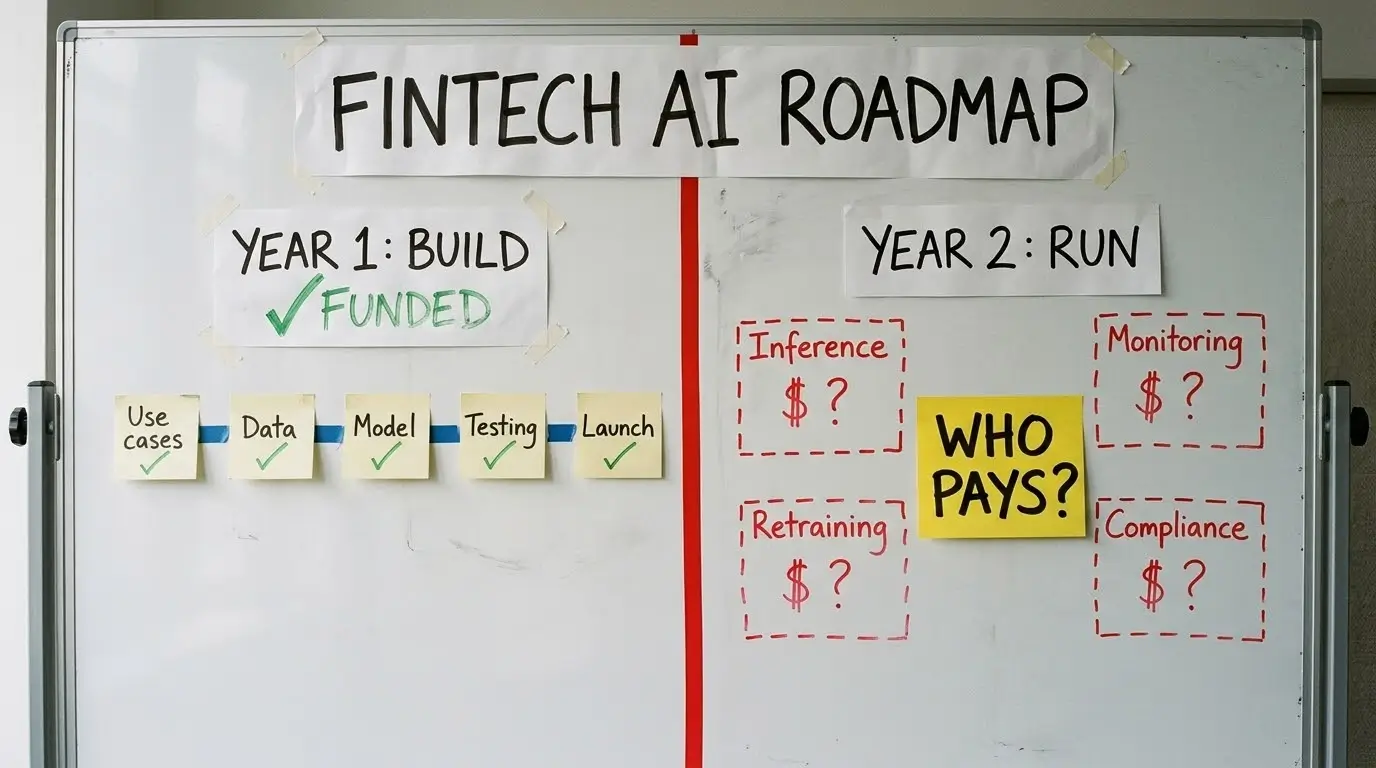
Fintech enterprise AI solutions need two budgets: one for the build and one for the year after launch. Roadmaps often describe the first in detail and leave the second as a single line with no owner. Year two is when a credit, fraud or onboarding model has to stay accurate on live data while volume grows, and reviewers ask for evidence, and that work has a monthly cost.
In fintech, enterprise AI solutions are AI systems that run inside core business processes, such as lending decisions and payment screening, across the whole firm. Once they are alive, they behave like any other critical system: they need running costs, owners and regular checks.
Year-two AI cost is the spending a live AI system needs after launch to keep working correctly: inference, monitoring, evaluation, retraining and the people who own each of them. For a CEO or COO answering a board request for an AI roadmap, that cost belongs in the strategy brief before any build is approved, whether the strategy is written in-house or with an outside partner.
Key takeaways
- About 20% of organizations say AI operating costs have already constrained their AI use, according to McKinsey’s State of AI 2026 survey.
- Only 25% of organizations have moved 40% or more of their AI pilots into production, according to Deloitte’s 2026 report.
- Gartner expects inference to make up at least 70% of a model’s lifetime costs, so the run budget outgrows the build budget over time.
- Fintech enterprise AI solutions need a named owner and funding source for each run-cost line before the first build starts.
- US banking agencies kept ongoing model monitoring as an expectation in SR 26-2 (April 2026) and producing that evidence takes staff time every month.
Why do fintech enterprise AI solutions stall after the build is funded?
Fintech enterprise AI solutions stall after funding when the budget covers the project and stops at launch. Build money sits on a project with an end date. Run costs such as inference, monitoring, and retraining arrive every month after that date and grow with transaction volume. If no team owns those costs, either the model drifts or the spend is cut.
Evidence from 2026 shows that the gap costs. McKinsey’s State of AI 2026 survey of 1,719 respondents in 97 countries, fielded in May and June 2026, found that about 20% of organizations say AI-related operating costs, including token costs, have constrained their AI use. Token costs are the charges of a model provider for bills for the text a model reads and writes on each request.
Production is the second gap. Deloitte’s State of AI in the Enterprise 2026 report, based on a survey of 3,235 business and IT leaders across 24 countries in August and September 2025, found that only 25% of organizations have moved 40% or more of their AI pilots into production. Another 54% expected to reach that level within three to six months, which puts a large group of models into their first year of live running costs.
For a lender with 200 to 2,000 staff, the pattern is easy to recognize. A fraud-screening or document-checking model launches on budget. Within six months of launch, three changes arrive:
- Application or transaction volume grows, and inference cost grows with it.
- Fraud patterns shift as fraudsters adapt, and accuracy starts to slip.
- Your model provider announces a new version and a retirement date for the old one.
That work was never in the build budget, so it competes with new projects for the same engineers. Model drift, the gradual fall in accuracy as live data moves away from the data a model learned from, is usually where the unfunded work shows up first.
Budget Your Enterprise AI Solutions for Year Two
Map inference, monitoring and retraining into your fintech AI strategy, with an owner and funding source named for every run-cost line before the board approves the build.
What should an AI strategy budget for after launch?
An AI strategy should budget for five run-cost lines after launch: inference, monitoring and evaluation, retraining and data refresh, model and vendor changes, and compliance evidence. Each line needs a forecast tied to business volume; a named owner and a funding source that continues after the project budget closes.
Use this as a starting checklist for a lending or payments business:
| Run-cost line | What drives it in fintech | Who should own it |
| Inference | Applications, payments or support requests processed each month | Business unit that uses the model |
| Monitoring and evaluation | Number of live models, review frequency and alert handling | Engineering lead for each model |
| Retraining and data refresh | Shifts in fraud patterns, credit conditions or customer mix | Data science or ML team |
| Model and vendor changes | Version retirements, price changes and new model releases | Platform or architecture lead |
| Compliance evidence | Audit requests, bank partner reviews and documentation updates | Risk and compliance lead |
Inference is the compute cost charged each time the model answers a request, for as long as the model is live. Gartner expects inference to account for at least 70% of a model’s lifetime costs, according to its 2026 research on optimizing generative and agentic AI costs, as reported by Campus Technology in June 2026. That same research forecasts that through 2028, at least half of generative AI projects will overrun their budgeted costs because of poor architectural choices and gaps in operational know-how. Both figures are Gartner forecasts.
How to size year-two AI costs from business volume
Start with the business forecast. Take expected monthly applications, payments or tickets, multiply by the cost per request measured in the pilot, and build a low and high case. Add monitoring hours per model per month, the expected retraining cycles per year, and a contingency for provider price or version changes.
If loan applications double in year two, inference cost roughly doubles with them unless the team changes models, shortens prompts or caches repeated requests. Caching means storing the answer to a repeated request, so the model is not called a second time.
Why do AI operating costs rise in year two when model prices keep falling?
AI operating costs rise in year two because usage grows faster than unit prices fall. Growth in customers and transactions adds requests, and multi-step tasks add more model calls per request. Lower per-token prices help, but they do not offset that growth on their own, so the monthly total still climbs.
In August 2026, Gartner predicted that AI inference costs per agentic workflow will rise more than fivefold through 2028. An agentic workflow is a task where an AI agent plans its own steps and calls tools or other models to finish the job. Each extra step is another billed call. Gartner senior director analyst Will Sommer, speaking to VentureBeat in October 2026, put the monitoring point simply: “Enterprises cannot optimize what they cannot observe.”
Fintech firms face four cost drivers that are easy to leave out of a launch budget:
- Volume-linked pricing. A model that reads every loan application or screens every payment scales its cost with the business, month by month.
- Drift in fraud and credit data. Fraudsters change tactics, and borrower behavior moves with interest rates and the wider economy, so models need retraining on a schedule.
- Provider version changes. Model providers retire older versions on published timetables, and each switch needs re-testing before customers see it.
- Review and sign-off work. Each model change creates documentation and approval of work for risk and compliance teams.
See Where Your AI Operating Costs Will Climb
Model inference, agent workflows and monitoring effort against your loan and payment volumes and put a year-two AI cost forecast in front of your CFO before launch.
Who should own and fund AI after go-live in a fintech firm?
Ownership after go-live works when the business unit that receives the benefit carries the run cost; an engineering lead owns model health, and a risk lead approves changes. Finance should see AI run costs as a forecast line in that unit’s budget from launch day, with a review each quarter.
Owners to name before the build starts
- Business owner. Holds the outcome the model was built for, such as approval time or fraud losses, and the run budget that pays for it.
- Model owner. An engineering or ML lead who watches accuracy, cost per request and alerts, and decides when to retrain.
- Risk owner. Signs off model changes and keeps the evidence that reviewers and bank partners ask for.
- Budget owner. A finance partner who tracks actual run costs against the forecast every month.
Which funding model fits a fintech AI roadmap?
- Central AI budget. One budget, usually held by the CTO, pays all run costs. It suits the pilot stage, while usage is small. Its weakness is that business units have no reason to control volume.
- Chargeback to the business unit. Run costs are billed to the unit that uses the model, based on measured usage. Cost stays visible to the team that drives volume; provided usage is tracked per model from the first day.
- Product cost of service. For a customer-facing AI feature, run cost sits inside the product’s cost of service, next to hosting and payment processing fees. It fits products where AI is part of what customers pay for.
A practical sequence is to fund run costs centrally during the pilot, then move each model to chargeback or to product cost of service before full production. Write that handover date into your fintech AI strategy, so the run budget changes hands on a known date.
What do regulators and bank partners expect once a fintech model is live?
Regulators and bank partners expect evidence that a live model still performs as intended. In the US, banking agencies replaced SR 11-7 with SR 26-2 in April 2026 and kept ongoing monitoring of model performance as an expectation. Producing that evidence on a regular cycle is a year-two cost that belongs to the plan.
SR 26-2 was issued on 17 April 2026 by the Federal Reserve, the Office of the Comptroller of the Currency, and the Federal Deposit Insurance Corporation. It supersedes the 2011 model of risk guidance and is expected to be most relevant to banks with more than $30 billion in assets. PwC’s April 2026 summary notes that it scopes out generative and agentic AI, leaving banks to apply their broader risk and governance practices to those tools. Model risk management is the set of controls a lender uses to check that its models are built, validated, and monitored properly.
For a fintech lender, the effect is mostly indirect. A bank partner that relies on your credit or fraud model has its own supervisory expectations, so plan requests for monitoring records, change logs and validation results. In India, the Reserve Bank of India’s FREE-AI committee report of August 2025 made 26 recommendations for AI in financial services, including governance, audit and incident reporting mechanisms. Each of these produces recurring work after launch.
What should you ask AI consulting firms to deliver for year two?
Ask AI consulting firms to deliver a year-two plan alongside the use case list: a run-cost forecast, an evaluation plan, a retraining trigger and a named owner for each cost line. Add these items to the statement of work before the engagement starts, so they are scoped, priced, and reviewed like the build plan.
This list is an editorial framework for this article, not an industry standard. Use it to brief an internal team or a partner for enterprise AI consulting, and to compare proposals from different AI consulting firms on the same terms.
- AI readiness assessment. A check that the data, systems and team can support each use case before the build is scoped, since weak data raises retraining costs later.
- Run-cost forecast. Inference tied to monthly applications, payments or tickets, with a low and high case and the cost per request measured in the pilot.
- Evaluation plan. Measures that show the model are still correct, who reviews them and how often. An evaluation set is a fixed group of test cases with known correct answers, used to score the model after every change.
- Retraining trigger. A written accuracy drop or data shift that starts a retraining cycle, with an expected number of cycles budgeted per year.
- Owner and funding map. A named owner and budget holder for each run-cost line, including the date the run budget moves from the central AI budget to the business unit.
- Vendor change contingency. Budget and test capacity for provider version retirements and price changes, plus a documented route to switch models.
- Review dates. Checkpoints at month six and month twelve to compare actual run cost and accuracy with the forecast, then decide to scale, change or retire from the model.
Worked example: a document-checking model at a mid-size lender
Here is how the list plays out for an operations team at a mid-size digital lender planning a document-checking model for loan applications. This is an illustrative example.
Build work is scoped for one quarter. Before approval, the strategy team forecasts monthly loan applications at current volume and at double volume, and prices inference for both cases using the per-request cost measured in the pilot. An engineering lead owns a weekly accuracy check against an evaluation set of past loan files, with the correct fields marked by the underwriting team.
A retraining cycle starts if extraction accuracy on that evaluation set falls below a threshold for the lending and risk leads agreed in advance. Ownership of the run budget moves to the lending business unit when the model reaches full production, and the risk leads signs off each model or prompt change. At month six, the team compares real cost and accuracy with the forecast and adjusts the year-two budget before it is locked.
Take Your Fintech AI Strategy Past Launch Day
Download the AI-Native Operating Model eBook for the ownership roles, funding patterns and review cadence that keep a live fintech model accurate after go-live.
How ViitorCloud supports enterprise AI solutions in fintech
ViitorCloud, established in 2011, has delivered software and AI work for more than 300 global customers. Our AI consulting services sit alongside custom AI development, AI integration and data pipeline work, so enterprise AI consulting and the build can run as one plan. Our technology consulting team helps map existing systems and data before a build is planned.
After launch, our managed software services cover ongoing maintenance and monitoring of the applications around a model. Our financial services work shows the banking and finance systems we support, including fraud detection and compliance automation.
Do your enterprise AI solutions have a budget for thirteen months?
In month thirteen of a fintech AI strategy, the build budget has usually closed, and the first retraining cycle is due. Before the board approves the build, check that the plan for your enterprise AI solutions gives each run-cost line to an owner, a funding source and a review date. Talk to our AI engineering team about pressure-testing your year-two budget before approval.

Vishal Shukla
Vishal Shukla is Vice President of Technology at ViitorCloud Technologies.
Frequently Asked Questions
What are enterprise AI solutions in fintech?
In fintech, enterprise AI solutions are AI systems built into core processes such as credit decisions, fraud screening and customer onboarding, running across the whole firm. A complete plan for them covers the build and the run cost after launch, and names who owns each live model, how its accuracy is checked and when it is retrained.
How much should a fintech firm budget for AI after launch?
What are AI operating costs?
Who should own an AI model after it goes live?
Should AI consulting services include an AI readiness assessment?