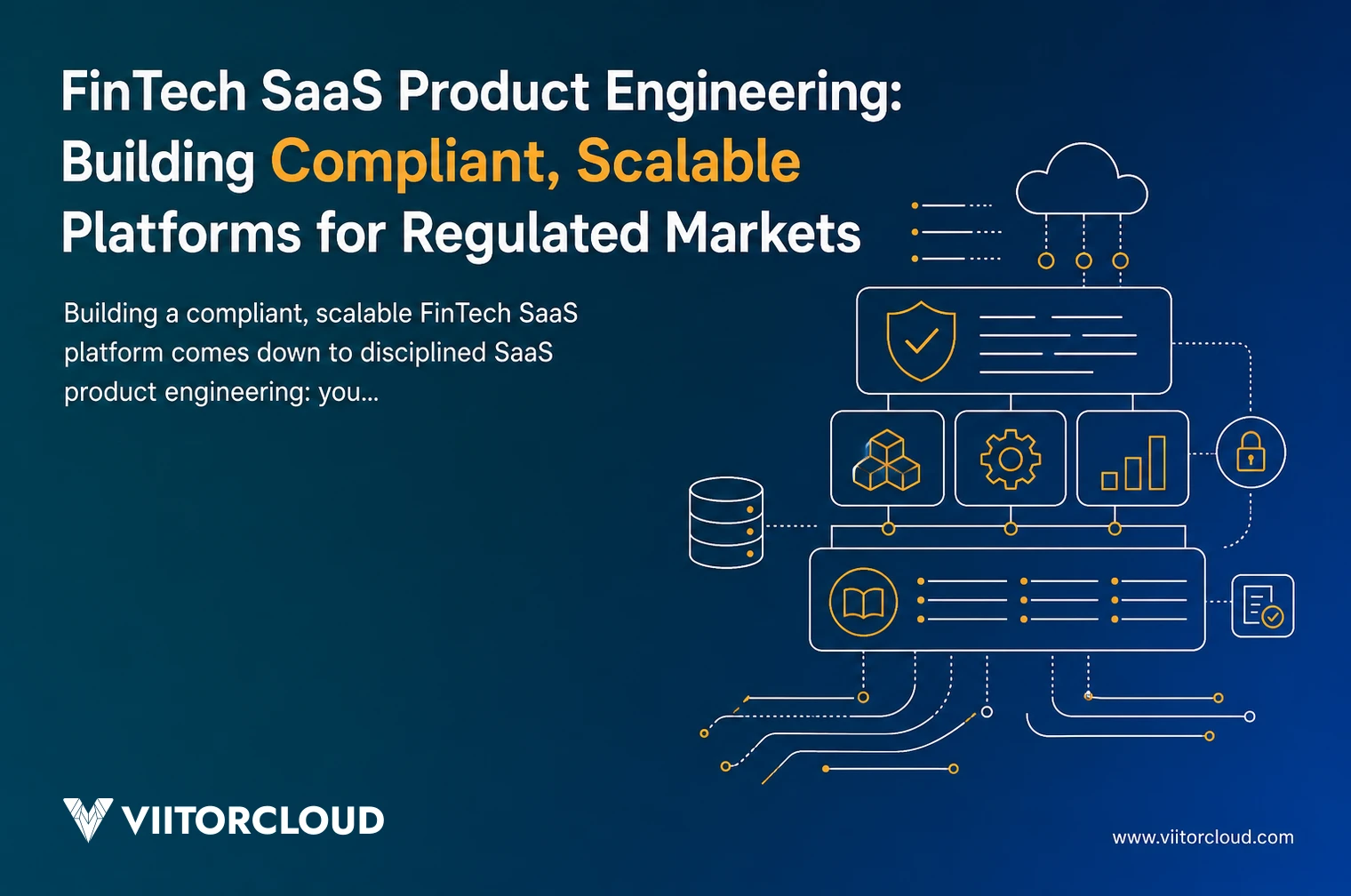
Building a compliant, scalable FinTech SaaS platform comes down to disciplined SaaS product engineering: you bake regulatory controls, data residency, and audit trails into the architecture from day one, then design an event-driven core that stays resilient under real-time transaction load.
Here is the uncomfortable truth most teams learn too late. The cheapest architecture decision in month one becomes the most expensive liability in month eighteen. A shortcut on audit logging or tenant isolation does not show up in your first demo. It shows up during your first SOC 2 audit, or worse, during your first incident.
If you are a founder, CTO, or head of engineering shipping financial software, you already feel the tension. Regulators want control and traceability. Your market wants speed and uptime. This guide shows you how to satisfy both, with an architecture blueprint for compliant, scalable platforms in regulated markets and the engineering practices that keep them auditable as you grow.
Key Takeaways
- Compliance is an architecture decision, not a feature bolted on later. Embed PCI DSS, SOC 2, and GDPR controls into your data model and infrastructure before the business logic.
- Data residency drives topology. A region-pinned, multi-region deployment keeps customer data in its required jurisdiction without forking your codebase.
- An event-driven core with idempotent transaction processing keeps the platform consistent and resilient when volume spikes 10x overnight.
- Immutable, append-only audit logs turn a dreaded audit into a database query and cut breach investigations from weeks to hours.
- Tenant isolation and a zero-trust security model are non-negotiable for any regulated SaaS that touches money.
What SaaS Product Engineering Means in Regulated Markets
SaaS product engineering is the discipline of designing, building, and operating a multi-tenant software product as a system, not a one-off project. In regulated markets, that definition gains a hard edge: every architectural choice has to answer to a regulator, an auditor, and a customer’s security team.
Standard SaaS optimizes for speed of iteration and user growth. FinTech SaaS optimizes for those too, but under constraints most product teams never face. You are handling money and identity. A bug is not a bad user experience; it can be a reportable incident. That changes how you engineer.
Three differences matter most:
- Provability over plausibility. It is not enough for the system to be secure. You must prove it was secure on a specific date, with evidence.
- Traceability by default. Every state change to a financial record needs a who, what, and when that no one can quietly edit.
- Failure is expensive. Downtime during settlement or a double-charged customer carries financial and regulatory cost, not just churn.
Get this framing right and the rest of the architecture follows. Treat it as paperwork to handle after launch and you will rebuild the foundation under load, which is the worst possible time. Our software product engineering services start every regulated build from this premise.
Mapping your compliance scope before you architect? See how we approach SaaS product engineering for regulated platforms.
See How We Engineer Compliant FinTech SaaS
Explore our approach to building audit-ready, scalable platforms for regulated financial markets.
Compliant SaaS Architecture: Designing for Audit From Day One
A compliant SaaS architecture is one where passing an audit is a byproduct of how the system already works, not a fire drill. The teams that struggle treat compliance as documentation. The teams that ship fast treat it as code.
Build the audit trail into the data model
Financial records should be append-only. Instead of updating a balance in place, you record an immutable sequence of events that sum to the balance. This pattern, event sourcing, gives you a complete, tamper-evident history for free, which is exactly what auditors and regulators want to see.
Pair it with a centralized, write-once audit log for every privileged action: who accessed which data, who changed a permission, who approved a payout. When logs are immutable and timestamped, your next PCI DSS or SOC 2 review becomes a query, not a scavenger hunt.
Map controls to standards early
Decide which frameworks you must satisfy before you draw a single box: PCI DSS for card data, SOC 2 Type II for operational trust, and privacy regimes such as the EU’s GDPR for personal data. Each one implies concrete engineering controls, from encryption key rotation to access reviews.
Consider Priya, a CTO at an early payments startup. To ship her MVP in eight weeks, she put every tenant in one shared schema with no row-level isolation. The demo dazzled investors. Nine months later, her first enterprise customer’s security team asked her to prove that Tenant A could never read Tenant B’s transactions. She could not. The team spent an entire quarter retrofitting tenant isolation under contractual pressure, work that would have taken days if designed up front.
The lesson is not that Priya moved fast. It is that she moved fast on the wrong layer. Speed belongs in your product features, never in your isolation and audit foundations.
Data Residency and Multi-Region Topology
Data residency is now an architectural requirement, not a legal footnote. A growing number of jurisdictions require that certain financial and personal data stay physically within their borders. If your platform serves customers across multiple regions, your topology has to honor that without you maintaining a separate product per market.
Region-pinning over forking
The scalable pattern is a single codebase deployed to multiple regional cells, with each customer’s data pinned to the region its regulations require. A routing layer directs requests to the correct cell. You ship one product; the data simply lives where the law says it must.
This is the difference between expanding into a new market in weeks versus months. It also means a regional outage is contained to one cell instead of taking down every customer worldwide.
Take Elena’s wealth-management platform. When they expanded into a market that mandated in-country storage of client records, the legal team braced for a six-month delay. But the engineering team had built region-pinned topology from the start. They provisioned a new regional cell, pointed the routing layer at it, and onboarded local clients in under three weeks. Compliance became a configuration, not a rebuild.
For platforms layering in AI features such as fraud scoring or document processing, residency rules extend to your models and training data too. Designing that boundary early is part of building AI-first SaaS responsibly.
Expanding across regulatory regimes? A region-aware architecture review now saves a painful re-platform later. Explore our cloud engineering approach.
Planning a Regulated SaaS Build?
Get a region-aware architecture and compliance review before you write production code.
Engineering a Scalable FinTech Platform for Real-Time Load
A scalable fintech platform has to stay correct, not just fast, when volume spikes. Anyone can serve a thousand transactions a minute on a quiet Tuesday. The engineering challenge is staying consistent when traffic jumps 10x during a market event or a payday surge.
Event-driven core with idempotency
Decouple your services with a durable event stream so ingestion, processing, ledgering, and notification scale independently. The single most important rule for financial workloads is idempotency: processing the same request twice must never move money twice. Idempotency keys and event sourcing make retries safe, which is what lets you scale horizontally without fear.
Separate reads from writes
Transaction writes and reporting reads have opposite performance profiles. A CQRS pattern, separating the command and query paths, lets each side scale on its own terms so a heavy analytics query never slows down a live payment.
Marco ran a lending platform that handled steady traffic fine until a promotional campaign drove a sudden surge. Under load, network timeouts triggered automatic retries, and because his payment handler was not idempotent, several hundred borrowers were debited twice. The cleanup cost days of manual reconciliation and a hit to customer trust. After re-architecting around idempotency keys and an append-only ledger, the same surge a quarter later processed cleanly, and reconciliation was automatic.
Scaling is not only about throughput. It is about being able to prove, after a spike, that every cent landed exactly once.
Resilience and Security for Regulated SaaS
For regulated SaaS handling financial software workloads, resilience and security are the same conversation. A platform that is secure but down fails the customer; a platform that is up but breached fails everyone. You engineer for both at once.
Zero-trust and defense in depth
Adopt a zero-trust posture: authenticate and authorize every service-to-service call, and never assume the network is safe. Encrypt data in transit and at rest, and tokenize sensitive values such as card numbers so even a leaked database yields nothing usable. The US NIST zero-trust guidance is a practical reference for this model.
Design for graceful failure
Distributed systems fail in parts. Use circuit breakers to isolate a struggling dependency, bulkheads to stop one tenant’s load from starving another, and automated failover across regions. Then prove it: inject failures in a controlled way, run load tests at multiples of peak, and rehearse incident response before you need it.
Observability is a control, not a nice-to-have
You cannot defend or audit what you cannot see. Structured logs, distributed tracing, and real-time alerting let you detect anomalies, satisfy reporting timelines, and shorten investigations. With immutable logs, a breach question that once took weeks can be answered in hours.
If you are apprehensive that your platform may not perform adequately under real-time demands, ViitorCloud is here to assist.
Build Your Compliant, Scalable FinTech Platform
Partner with engineers who design for the audit and the spike from day one.
A Phased Roadmap for FinTech SaaS Development
Strong fintech SaaS development follows a sequence that front-loads the expensive-to-change decisions. We structure regulated builds in three phases that mirror how risk actually accumulates.
- Comply: lay the foundation. Map your regulatory scope, design the data model with audit trails and tenant isolation, and decide your residency topology. This is the layer you must not rush.
- Architect: build the scalable core. Stand up the event-driven backbone, idempotent transaction processing, and separated read and write paths. Ship features on top of a foundation that already scales.
- Harden: prove resilience. Load-test at multiples of expected peak, run security and penetration testing, rehearse failover, and complete your audit-readiness checklist before go-live.
Each phase produces evidence, not just code. By launch you have the architecture diagrams, control mappings, and test results that turn your first audit and your first enterprise security questionnaire into routine paperwork.
This sequencing is also how a digital transformation of a legacy financial system stays safe: stabilize compliance and data first, modernize the core second, harden last.
Conclusion: Engineer for the Audit and the Spike
Compliant, scalable FinTech platforms are not built by adding security and audit features at the end. They are built by treating SaaS product engineering as a discipline where compliance, residency, scale, and resilience are architectural decisions made on day one.
To recap the blueprint:
- Make compliance provable by building audit trails and immutable logs into the data model.
- Let data residency shape a region-pinned, multi-region topology.
- Engineer an idempotent, event-driven core that stays correct under real-time load.
- Treat resilience, zero-trust security, and observability as first-class controls.
- Sequence the build to comply, architect, then harden.
Get the foundation right and growth stops being a threat to your compliance posture and becomes the reward for it. If you are planning or scaling a financial platform, talk to our engineers about turning these principles into your architecture.

Vishal Shukla
Vishal Shukla is Vice President of Technology at ViitorCloud Technologies.
Frequently Asked Questions
How do you build a compliant FinTech SaaS platform?
Embed regulatory controls, audit trails, tenant isolation, and data residency into the architecture first, then build product features on that compliant foundation.
What makes SaaS product engineering different for regulated markets?
How do FinTech platforms handle data residency requirements?
How do you keep a fintech SaaS platform resilient under real-time load?