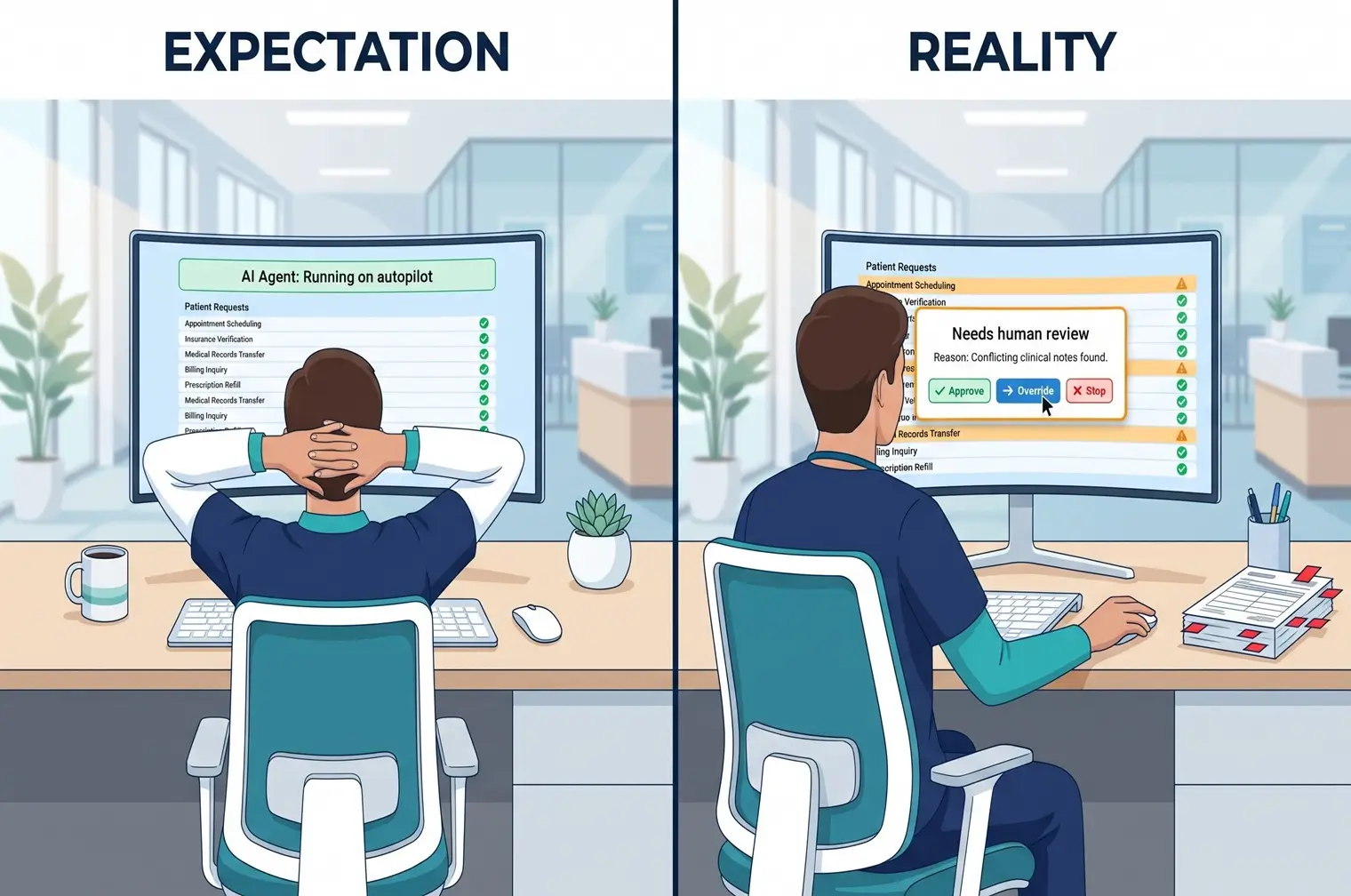
The pitch said the agent would run unattended. Three weeks after launching, a reviewer is approving its output one item at a time, and the queue grows faster than anyone can clear it. That is the common shape of a first agent rollout, and the fix is neither more autonomy nor more review. It is a better design, done before launch. Getting human-in-the-loop-AI-agents right from day one is what prevents this exact scenario, before a review queue ever has the chance to form.
Human-in-the-loop-AI-agents are agents built with defined points where a person can review, approve, override or stop what the agent does. Those points are chosen by risk, not added as a blanket safety net. Done well, humans see the few decisions that matter. Done badly, the human sees all of them, and the agent becomes an expensive way to fill a queue.
Key takeaways
- Human oversight works when it is placed by risk and reversibility, not applied to every output.
- EU AI Act Article 14 lists five capabilities an overseer must have, including the power to override and a way to stop the system.
- Reviewers who approve every item stop reading. Article 14 calls this out directly as an automation bias.
- Escalation design belongs in the first sprint, before the agent touches production data.
- A good escalation hands up the reviewer’s context and a clear decision, not a raw transcript.
The autonomy pitch versus the Monday-morning queue
Autonomy is easy to demo. The demo runs on clean inputs, every case has a known answer, and the agent finishes the task while the room watches. Nobody in that meeting asks what happens in a case the agent has never seen.
Production asks that question on day one. Inputs arrive incomplete, internal policies conflict with each other, and some cases have no precedent at all. When the agent hits one of them, the team needs an answer it rarely plans for: who decides, and how fast?
Many teams answer late. They launch, watch the first strange output, and route all output to a reviewer “for now.” That temporary fix tends to become permanent. The reviewer turns into the bottleneck, and the business case behind the agent quietly turns upside down.
The opposite failure is the one that keeps product leaders awake. An agent makes an irreversible decision, and nobody can stop it in time. Both outcomes share one cause: human-in-the-loop-AI-agents were not part of the original design. Human checkpoints were bolted on after launch instead of being built into the system from the start.
Why “send it to a human” fails as an escalation strategy
Routing every output to review feels like a safe choice. It is the mistake that undermines human-in-the-loop-AI-agents before they ever prove their value. In practice, it weakens oversight in three ways, and each one grows worse as volume rises.
The first is the volume itself. A reviewer facing hundreds of approvals a day cannot weigh each one properly, so review slowly turns into clicking. The second is automation bias: people who see a system right most of the time start trusting it by default. The EU AI Act names this risk in Article 14(4)(b), which asks that overseers “remain aware of the possible tendency of automatically relying or over-relying on the output.”
The third is missing context. An escalation that arrives as a raw log forces the reviewer to rebuild the agent’s reasoning from scratch. Short on time, the reviewer either guesses or approves, and neither counts as oversight.
Good ai agent escalation design solves all three problems at once. Fewer cases reach a person; each case arrives with the context needed to judge it, and the person holds real authority to change the outcome.
Your Reviewers Approve Every Output. Is That Oversight?
We redesign agent escalation, so humans review the decisions that carry risk, with the context to act fast and the authority to override.
Four numbers behind the pressure on product teams
Agents are moving from pilot to production faster than oversight practices are maturing. McKinsey’s State of AI survey (August 2026) found that 40% of respondents at large organizations report scaling AI agents, up from 27% a year earlier.
Governance has not kept pace with that growth. Deloitte’s 2026 State of AI in the Enterprise research, covering 3,235 leaders across 24 countries, found only 21% have a mature governance model for agentic AI (Deloitte, April 2026). Four in five organizations are scaling a technology they cannot yet fully supervise.
The cost of that gap is already visible. Gartner predicts over 40% of agentic AI projects will be canceled by the end of 2027, citing escalating costs, unclear business value or inadequate risk controls (Gartner, June 2025). Gartner’s Anushree Verma noted that most agentic AI projects “are early-stage experiments or proof of concepts.”
The same release forecasts that at least 15% of day-to-day work decisions will be made autonomously through agentic AI by 2028, up from 0% in 2024. These numbers are the real-world backdrop against which human-in-the-loop-AI-agents get built, funded and sometimes cancelled. Read together, the numbers point one way: more decisions are moving to agents, and most organizations still lack the human oversight AI agents require at scale.
Keep Your Agent Off the 40% Cancellation List
Build human oversight into your AI agent before launch, with risk controls your compliance team can sign off on and your users can trust.
What Article 14 asks a product team to build
Article 14 of the EU AI Act requires high-risk AI systems to be designed so they “can be effectively overseen by natural persons” while in use. This is the regulatory backbone that human-in-the-loop-AI-agents in high-risk settings are built around. Article 14(3) adds that oversight must be “commensurate with the risks, level of autonomy and context of use.” Put simply, the more an agent can do on its own, the stronger the controls around it need to be.
Article 14(4) then lists what the overseer must be able to do. Read as a product team; each item translates directly into a feature the agent needs to ship with.
| Article 14(4) | What the overseer must be able to do | What to build into the agent |
| (a) | Understand capacities and limits, and detect anomalies | A plain-language scope statement and live anomaly alerts |
| (b) | Stay aware of over-reliance on the output | Sampled audits of auto-approved cases and reviewer accuracy tracking |
| (c) | Correctly interpret the output | Escalations that show inputs, sources, confidence and the proposed action |
| (d) | Decide not to use the system, or disregard, override or reverse the output | An override control and an undo path for each action type |
| (e) | Intervene or interrupt via a “stop” button or similar procedure | A kill switch that halts the agent in a safe state |
For Annex III high-risk systems, these obligations apply from 2 December 2027. Systems covered under Annex I, which includes regulated medical devices, follow from 2 August 2028.
Plenty of agents will fall outside the high-risk categories altogether. Article 14 is still the clearest public blueprint for the human oversight AI agents need, and US and UK buyers increasingly ask for the same controls during procurement and security reviews.
Sorting decisions for human-in-the-loop-AI-agents by risk and reversibility
Most guidance on hitl ai design stops at “add an approval step.” The harder question is which steps need one, and two questions settle it. Can the action be undone cheaply? And how confident is the agent, measured against cases your team has already checked?
| Action | High confidence | Low confidence |
| Reversible action | Agent acts alone; sample a share for audit | Agent acts; a human review later (asynchronous) |
| Irreversible action | Agent proposes; a human approves before execution | Agent stops and escalates with full context |
This grid keeps people away from most decisions. It puts them in front of the irreversible minority, where their judgment changes the outcome. This is the core logic that makes human-in-the-loop-AI-agents practical at scale, rather than a bottleneck
Two cautions apply. Confidence scores must be calibrated against real outcomes rather than taken from the model at face value. Reversibility must also be checked in the real system, because an email that has been sent, or a claim that has been filed, cannot be pulled back.
Escalation design do’s and don’ts
These rules turn the grid into a working human-in-the-loop of automation and together they are what makes human-in-the-loop-AI-agents enforceable rather than aspirational. Each one ties to a regulatory clause or an established engineering practice, so the team can defend the design to compliance as well as to users.
Do:
- Do classify every tool the agent can call as reversible or irreversible before launching. Article 14(3) ties the strength of oversight to the level of autonomy.
- Do give the overseer a real stop of control. Article 14(4)(e) asks for a “stop” button or similar procedure that brings the system to a safe state.
- Do build an override and an undo path for each action type, matching Article 14(4)(d).
- Do send escalations with context: inputs, sources, the proposed action and the reason for escalation. This supports correct interpretation under Article 14(4)(c).
- Do pause execution, not just log it. Agent frameworks such as LangGraph support interrupts that halt a run until a person responds, then resume from the same state.
- Do audit a sample of auto-approved cases to catch drift that no escalation would surface.
Don’t:
- Don’t route every output to review. It invites the automation bias Article 14(4)(b) warns about.
- Don’t let the agent approve its own escalations or let one person both build and approve a policy change.
- Don’t trust raw model confidence without calibrating it against reviewed cases.
- Don’t add the kill switch after launch. Article 14(1) treats oversight as a design and development requirement.
- Don’t measure success by escalating alone. Track override rate and review time too. A falling override rate can mean a better agent or a tired reviewer.
Turn This Checklist into Your Agent’s Escalation Map
We map every tool your agent calls by risk and reversibility, then build the approval, override and stop controls into the first release. <
A prior authorization agent and its reviewers
Healthcare shows the design clearly, because the stakes are uneven within a single workflow. Picture an agent that assembles prior authorization requests. It reads the order, pulls clinical notes, checks payer rules, and drafts the submission. It is a representative use case for human-in-the-loop-AI-agents in a regulated workflow.
Pulling records and checking rules are reversible steps. A wrong lookup can be corrected before it matters, so the agent runs these alone. Submitting to the payer is different: once filed, the request carries the provider’s name and starts a clock that cannot be reset.
This is where human-in-the-loop-AI-agents make a practical difference. The agent proposes, and a staff member approves the submission. The reviewer sees the draft, the matched payer rule, and any missing documentation in one view, which turns a ten-minute investigation into a short, informed decision. Clinical judgment stays with clinicians throughout. If the agent finds notes that conflict, it stops and escalates rather than choosing a version.
This is what autonomous agents with human reviews look like in practice. Staff spend their time on the few cases that need them, while the agent handles the assembly work where most of the hours used to go. Teams exploring similar patterns can see more AI agent use cases in healthcare services, along with the healthcare solutions ViitorCloud builds.
How ViitorCloud designs oversight into agent builds
On our projects, ViitorCloud approaches human-in-the-loop (HITL) AI design from the first sprint, before an agent reads production data. This is the standard we apply to every human-in-the-loop-AI-agents engagement. We list every tool the agent can call, classify each one by reversibility, and assign it an oversight level based on the grid above. This approach is part of how we deliver custom AI solutions.
The stop control and override path ship with the first release, not the fifth. Reviewers test them in staging alongside the agent itself, so the people who will use them in production have already seen them work.
After launch, we track override rates, review time, and audit findings. These three signals help determine when an agent is ready for more autonomy and when it needs closer supervision. This work sits alongside our wider AI-driven automation practice and the governance approach covered in responsible AI implementation.
Where to start with your first agent
Take the agent you plan to ship next and list every action it can take. Mark each one as reversible or irreversible, then ask one question per irreversible action: who can stop it, and how fast? Any action without an answer is your first AI agent for escalation design tasks.
From there, human-in-the-loop-AI-agents earn more autonomy in one action at a time, as override rates and audits show the agent is ready. Autonomous agents with human review do not have to be slow. They need the review placed where it changes outcomes. That placement is what separates working human-in-the-loop-AI-agents from agents stuck in an approval queue.
If you want a second pair of eyes on your escalation map, talk to our team.

Vishal Shukla
Vishal Shukla is Vice President of Technology at ViitorCloud Technologies.
Frequently Asked Questions
What are humans in the loop of AI agents?
Human-in-the-loop-AI-agents are AI agents designed with defined checkpoints where a person reviews, approves, overrides or stops the agent's actions. Checkpoints are placed by risk, so routine reversible actions run automatically while irreversible or low-confidence decisions wait for a human. The goal is accountable for humans in the loop of automation, not manual review of every output.
Does the EU AI Act require human oversight from AI agents?
What is the difference between humans in the loop and humans in the loop?
How do you decide which agent actions need human approval?
How do you stop reviewers from rubber-stamping agent decisions?