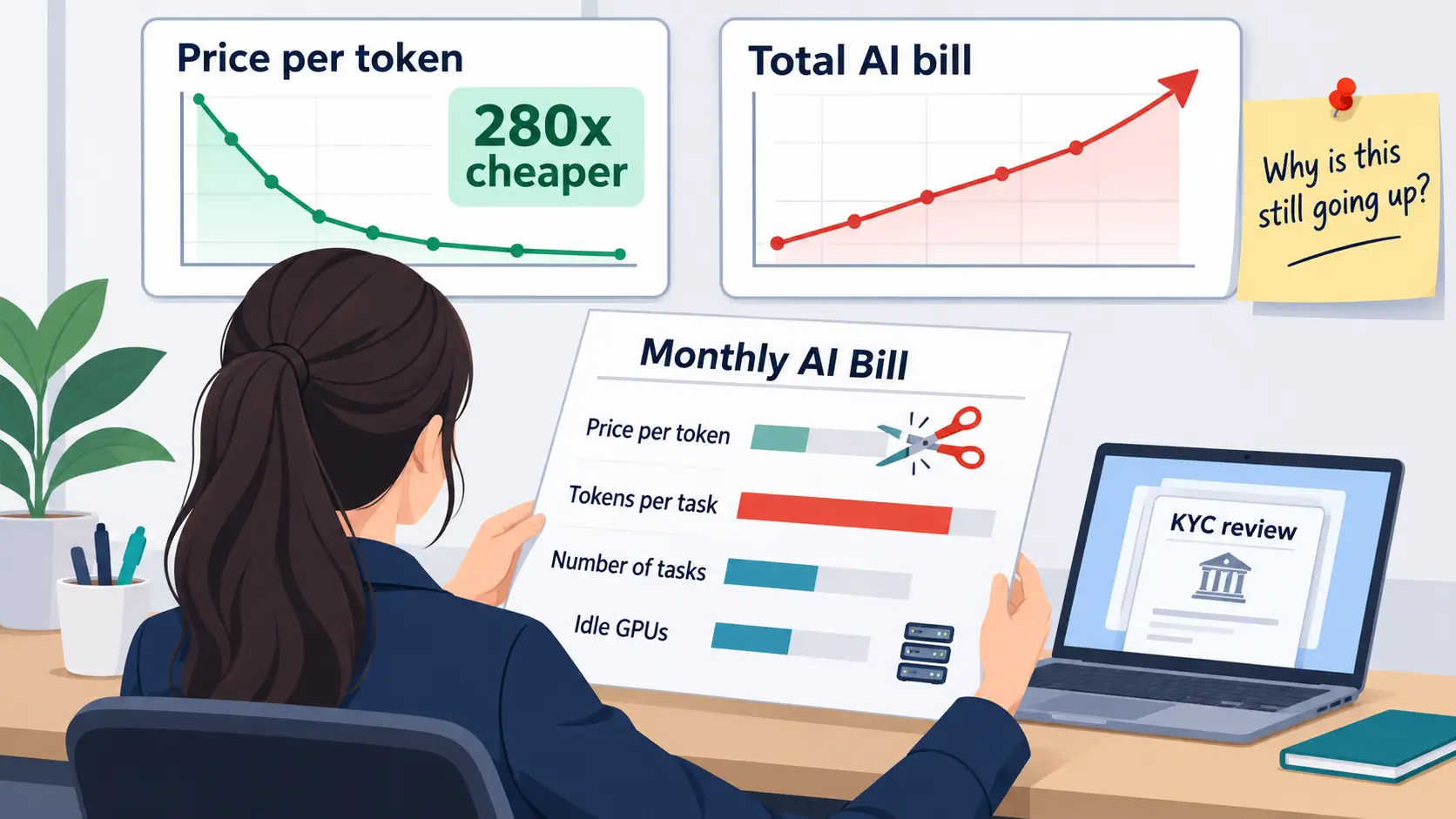
The price of running a capable language model has fallen sharply, yet many AI bills keep rising. The reason is simple: your bill is price per token multiplied by the number of tokens you use, and token use is growing faster than prices are falling. Effective llm inference cost optimization works on both parts of that sum, with most of the savings coming from using fewer tokens per task.
This post sets out the numbers behind the gap, compares inference cost optimization strategies, explains where the money goes, and matches each cost lever to the part of the bill it reduces.
Key takeaways
- Stanford HAI reports that the inference cost of a GPT-3.5-level system fell more than 280-fold between November 2022 and October 2024.
- Gartner still predicts that by 2030, generative AI cost per customer service resolution will exceed $3.
- The gap comes from tokens per task for longer prompts, multi-step agents, and more complex use cases.
- Negotiating a lower price per token is often the smallest lever. Routing, caching, batching and serving efficiency usually save more.
- Track cost per completed task each month, so finance sees one number that reflects real use the core discipline behind any llm inference cost optimization plan.
Four numbers that seem to disagree
Public data on AI costs points in two directions at once. The table below puts the headline figures side by side.
| Finding | Source | What it measures |
| Inference cost for GPT-3.5-level performance fell over 280-fold, November 2022 to October 2024 | Stanford HAI AI Index, April 2025 | Price per query at a fixed level of capability |
| Price declines range from 9x to 900x per year, depending on the task | Epoch AI, March 2025 | Price to reach a set benchmark score |
| GenAI cost per customer service resolution will exceed $3 by 2030 | Gartner, January 2026 | Total cost to complete one real task |
| Drivers include more complex use cases that consume more tokens | Gartner, January 2026 | Why total task cost rises |
The Stanford HAI 2025 AI Index credits the 280-fold drop to smaller models that now match older, larger ones. Epoch AI adds caution: the fastest drops happened recently, so it is less clear they will continue.
Gartner looks at the same market from the cost of finished work. Its January 2026 forecast says that by 2030, cost per resolution for generative AI will exceed $3, higher than many offshore human agents. Gartner analyst Patrick Quinlan said full automation “will be prohibitively expensive for most organizations.”
Both sets of figures are correct. Stanford HAI and Epoch AI measure the price of a token, and Gartner measures the full cost of a finished task.
Prices Fell. Why Is Your AI Bill Still Climbing?
We break down your inference spend by task, model and token type, so you can see which line item is driving the growth.
Why the bill rises while the price per token falls
A monthly inference bill comes from four inputs multiplied together. Looking at them one at a time shows where the growth sits.
Price per token is the rate a provider charges, often quoted as the llm cost per token, or your hardware cost per token if you host the model. This is the number that headlines track, and it has fallen fastest.
Tokens per task is how much text goes in and comes out for one piece of work. It rises when prompts carry long instructions and documents, when agents call the model several times per request, and when reasoning models write long internal steps before answering.
Number of tasks grows as more teams and customers use the feature. In a successful rollout, this grows every quarter.
Idle capacity applies to self-hosted models. GPUs (the specialized chips that run models) cost money whether they are busy or not, so low use raises the real cost per token.
If tokens per task triple while the price per token halves, the bill still grows by half. This is why llm cost per token on its own says little about what you will pay, and why llm inference cost optimization has to work on all four inputs together rather than the headline rate alone.
The line item most teams cut first
When finance asks about the bill, the usual first step is to negotiate a lower rate or switch to a cheaper provider. That lowers the llm cost per token, but it leaves the other three inputs unchanged.
In many production systems, the larger cost sits in tokens per task. A support or compliance assistant may send the full policy library with every request, repeat the same system instructions thousands of times a day, or retry a failed agent step several times. Each of these multiplies spend without any change to the price.
For self-hosted models, GPU cost optimization for LLM serving often matters more than any rate of change. A GPU cluster running at low use can cost more per token than a paid API, even when the hardware itself is cheaper.
The practical rule is to measure tokens per task before negotiating prices. This measurement is the starting point for any llm inference cost optimization effort, since it usually shows where most of the money actually goes.
Find the Token Waste Before You Renegotiate
We measure tokens per task across your AI features and show where prompts, retries and idle GPUs add cost, before you spend time on a new contract.
LLM inference cost optimization levers, matched to the bill
Each lever below reduces one input from the formula above. The sourced figures are best-case results from vendors or research papers, so test them on your own workload.
| Lever | Input it reduces | What the source reports |
| Model routing | Price per token | RouteLLM researchers report cost cuts of over 2 times in some cases without lower response quality |
| Prompt caching | Tokens billed at full price | OpenAI launched a 50% discount on cached input tokens for prompts over 1,024 tokens |
| Batch processing | Price per token for non-urgent work | OpenAI’s Batch API offers a 50% discount, with results within 24 hours |
| Serving efficiency | Idle capacity on self-hosted GPUs | The vLLM paper reports 2 to 4 times higher throughput at the same latency |
| Prompt trimming | Tokens per task | Shorter instructions, fewer attached documents and output length limits |
Model routing sends simple requests to a small, cheap model and only hard ones to a large model. The RouteLLM paper from researchers at UC Berkeley and Anyscale found this can cut costs by more than half in some cases.
Prompt caching stores repeated parts of a prompt, such as long system instructions. OpenAI’s prompt caching launch in October 2024 set a 50% discount on cached input; check current pricing, as rates vary by model and provider.
Batching groups requests that do not need an instant answer, such as overnight document reviews. The OpenAI Batch API documentation lists a 50% discount for work completed within 24 hours.
Serving efficiency matters most when you host models yourself, and it is the core of gpu cost optimization llm teams can control directly. The vLLM research paper reports 2 to 4 times higher throughput than earlier serving systems, which means more work from the same GPUs.
Together, these are the inference cost optimization strategies that address real spend, and the core of any llm inference cost optimization plan. A sensible order is prompt for trimming and caching first, then routing, then batching, and serving changes for self-hosted setups.
Cut Inference Costs Without Cutting Quality
We set up model routing, caching and batching for your AI features, then track quality and cost per task so savings hold up in production.
A bank’s document assistant, reviewed lever by lever
Here is an illustrative example. The engineering team at a mid-size bank runs an assistant that helps compliance staff review customer documents for know-your-customer (KYC) checks. Usage doubled after rolling out to new branches, and the monthly bill grew faster than usage.
The team first looked at tokens per task. Each request carried out the full KYC policy manual and long fixed instructions, so most input tokens were the same on every call. Moving these into a cached prefix to cut the share of input billed at the full rate.
Next, the team checked which requests needed for the largest model. Simple field checks, such as matching a name to an ID, went to a smaller model, while unusual cases stayed with the large one. Overnight batch reviews of archived files moved to batch processing.
The result was a bill that grew more slowly than usage — a direct result of llm inference cost optimization applied lever by lever, with quality checked against a fixed set of reviewed cases. Banks with similar workloads can see how we approach technology for BFSI, and our post on finance cost optimization with AI solutions covers the wider picture. ViitorCloud has run similar cost audits for compliance and document-heavy AI systems across BFSI clients, and publishes the token-level findings as they come in.
What to put in front of finance each month
A short monthly report helps finance understand the AI bill. These five measures show both cost and the reason behind it:
- Cost per completed task, such as cost per resolved query or per reviewed document.
- Tokens per task, split into input and output.
- Cache hit rate, the share of input tokens served from cache.
- Routing split, the share of requests handled by the smaller model.
- GPU use, for self-hosted models, as a percentage of paid capacity.
These measures support llm pricing efficiency decisions and keep llm inference cost optimization visible to finance month to month, because they show whether a new model, provider or contract would change the cost per task. Teams hosting private models can read our guide to private LLM development for the infrastructure side.
Bring your inference bill under control
LLM inference cost optimization starts with one measurement: tokens per completed task. ViitorCloud’s custom AI solutions team helps engineering leaders measure that number, apply the right levers, and report the results to finance. To review your current setup and reduce llm inference costs, talk to our team.

Vishal Shukla
Vishal Shukla is Vice President of Technology at ViitorCloud Technologies.
Frequently Asked Questions
What is llm inference cost optimization?
LLM inference cost optimization is the work of lowering the cost of running a language model in production without lowering answer quality. It covers the price per token, the number of tokens each task uses, the number of tasks, and for self-hosted models, how fully the GPUs are used. Common levers include prompt trimming, caching, model routing, batching, and serving efficiency.
Why is my AI bill rising if inference prices are falling?
How can I reduce LLM inference costs quickly?
Is self-hosting an LLM cheaper than using an API?
What metric should finance track for AI spend?