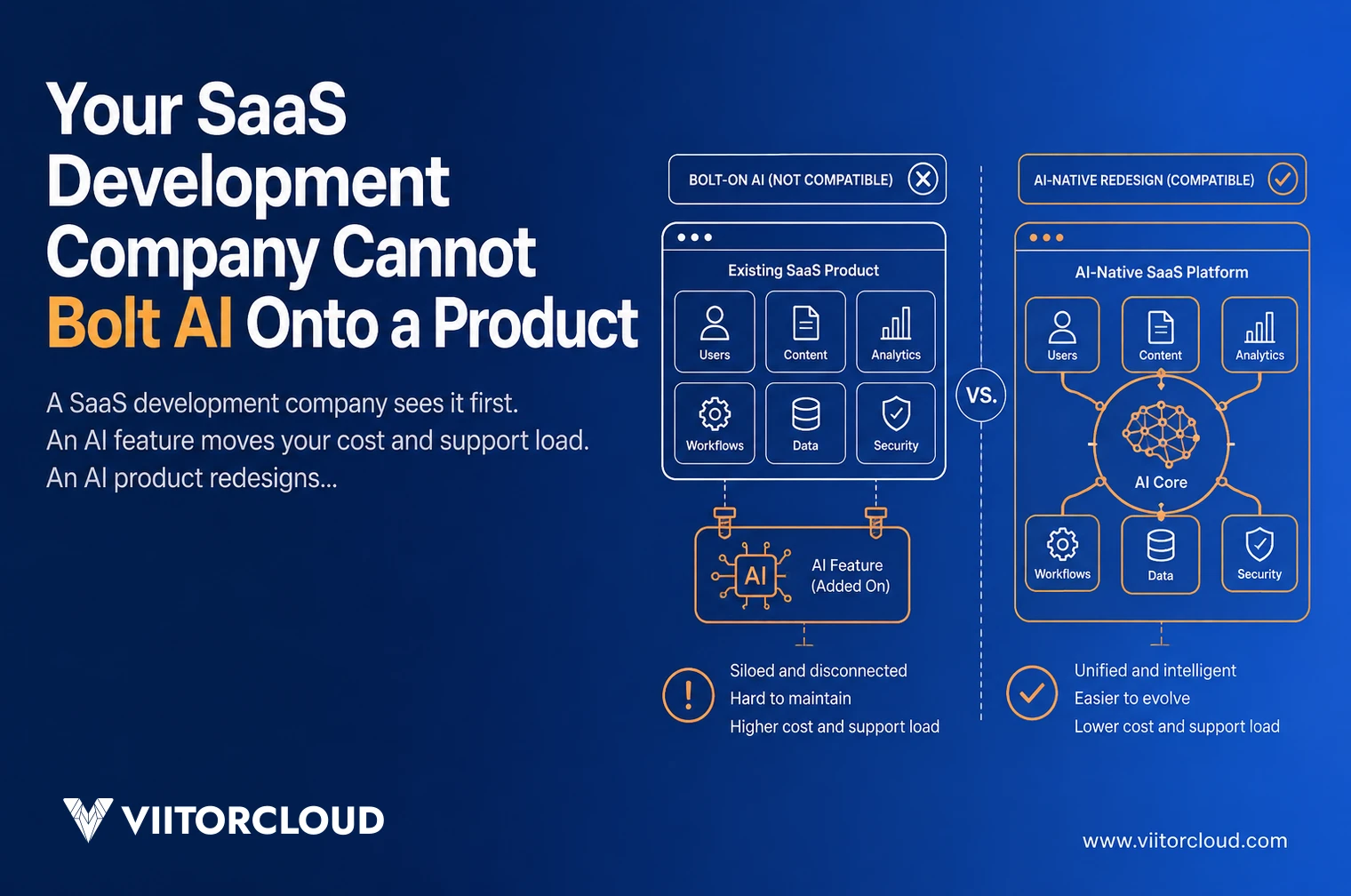
An AI feature is something your product does. An AI product is something your product is built around. The gap between the two shows up in pricing, in the data model, and in the support queue, which is why most teams call a SaaS development company only after the first invoice cycle proves the point.
Product leaders tell me they already know this distinction. Then they ship an assistant into a per-seat plan and watch cost to serve start moving by account instead of by tier.
I have built AI features into live products and rebuilt products around models. This article covers what changes on the cost line, what breaks in support, and how I sequence the work so pricing, data, and the feedback loop are designed together rather than patched afterwards.
Key Takeaways
- An AI feature is priced per seat and supported like a bug queue. An AI product is priced against usage and supported like a quality queue.
- Per-seat pricing breaks when cost to serve varies by account, and the heaviest accounts are usually the reference customers nobody wants to reprice.
- Support teams trained on deterministic defects cannot triage a wrong answer, so the ticket escalates to engineering and stays there.
- A model cannot improve without a schema that records the input, the output, the correction, and the outcome.
- AI-first SaaS development is a product decision before it is an engineering decision, so it belongs in the roadmap rather than the backlog.
What Is the Difference Between an AI Feature and an AI Product
An AI feature adds model output to an existing workflow without changing how the product is priced, instrumented, or supported. An AI product treats model output as the unit of value, so pricing follows usage, the data model captures every correction, and support handles answer quality instead of software defects.
Both are legitimate choices. A feature is right when the model improves a workflow customers already pay for. A product decision is required when the model becomes the reason they pay at all.
The failure mode is shipping the second while still running the business model of the first.
Why Per Seat Pricing Breaks the Moment You Ship a Model
Per seat pricing assumes cost to serve is roughly flat per user. Model inference breaks that assumption, because cost tracks calls, tokens, context length, and retries rather than logins.
The shape of usage in our own project work makes the point. An image editing platform we built processes about 1.2 million images a year. A QR platform we engineered handles 12 million scans a year across 30,000 customers in 12 countries. Neither product could survive on a flat per-user price, because the work happens per image and per scan. A model inside your product behaves the same way.
Compute pricing is the other moving part, and a16z on the cost of AI compute is worth reading before you commit to a margin target. For where the spend actually lands, our guide to AI and ML costs for SaaS teams maps the line items I see most often. Any SaaS application development company that prices a model before modelling that curve is guessing.
Price the Model Before You Ship It
We map cost to serve per account, name the value metric, and stress test your plan at three times current usage before a single line of pricing logic changes.
Your Support Team Cannot Triage a Wrong Answer
Support processes are built for deterministic software. A customer reports a bug, an agent reproduces it, and the ticket carries steps, an expected result, and an actual result.
A wrong answer has none of that. The agent cannot reproduce it reliably, cannot say whether the model was wrong or the source data was stale, and cannot promise a fix date. So the ticket escalates to the team that owns the model and quietly consumes the roadmap. When a SaaS development company gets called in after launch, this queue is usually the first symptom anyone can measure.
Four changes reduce that load, and all four are product decisions rather than support decisions:
- Show provenance next to the answer so a customer can check the source without opening a ticket.
- Capture the correction inside the product, in one click, at the moment the customer sees the error.
- Define severity by business impact rather than by reproducibility, because probabilistic errors never reproduce cleanly.
- Give agents a model quality view, not only an application error log.
A support lead I worked with kept a template that asked every customer for steps to reproduce. After the assistant shipped, most inbound AI tickets could not answer the first field. That template was the real defect.
The Data Model Decides Whether the Model Improves
A model that cannot learn from its own mistakes is a static feature with a variable bill. The correction loop lives in the schema, and retrofitting it later is the most expensive rework I see in AI-powered SaaS development.
Four records need to exist from day one:
- The input, with the context that was retrieved and the version of the prompt or policy behind it.
- The output, stored as a first-class object rather than a log line.
- The correction, linked to the user who made it and the account they belong to.
- The outcome, meaning what the customer did next and whether the answer held up.
Instrumentation at that level is ordinary engineering once it is planned. A livestock monitoring system we built captures more than 1 million data points a day from 15,000 sensors, and that pipeline is what made a 30% reduction in cow mortality measurable rather than anecdotal. A museum search tool we developed queries more than 1 million paintings and returns matches in a fraction of a second, because retrieval was designed as the product rather than added to it. The same discipline governs building a scalable SaaS with embedded AI, and it is the work a custom SaaS development company should be arguing for in week one.
Rebuild the Product Around the Model
Our SaaS product engineering and custom AI teams work as one group, so the schema, the correction loop, and the price card get decided together instead of in sequence.
Feature Bolted On Versus Product Built Around the Model
Here is the side-by-side I use in roadmap reviews. It is also the cleanest way to show a board why AI-first SaaS development is a different scope of work from a feature release, and why a SaaS software development company will quote it differently.
Pricing
- Bolted on. Per seat, unchanged, with model cost absorbed into gross margin until someone notices.
- Built around the model. A value metric tied to usage, with credits, tiers, or overage that move with cost to serve.
Data
- Bolted on. Prompts and responses in application logs, with no link between a correction and the account that made it.
- Built around the model. Inputs, outputs, corrections, and outcomes stored as product data and available for evaluation.
Support
- Bolted on. Bug workflow, reproduction steps, and escalation to engineering for every wrong answer.
- Built around the model. Quality workflow, provenance in the interface, in-product feedback, and severity based on impact.
Roadmap
- Bolted on. Model work sits in the backlog and competes with feature tickets.
- Built around the model. Evaluation sets, model updates, and policy changes are release items with named owners.
How I Sequence an AI-First SaaS Rebuild
These five steps run in order. A SaaS product development company that starts at step three will deliver a working feature and an unprofitable plan.
- Pick the value metric before the model. Decide what the customer is buying, then price it. Everything downstream depends on that answer.
- Map cost to serve per account at current usage, then at three times usage. If the second number breaks the plan, the plan changes before the release does.
- Design the correction loop into the schema, with account-level identity on inputs, outputs, corrections, and outcomes.
- Build an evaluation set from real customer data. Twenty representative cases beat a generic benchmark on every product I have shipped.
- Rewrite the support playbook before launch instead of after the first escalation.
None of this is exotic. McKinsey State of AI research keeps finding inaccuracy to be the most commonly reported risk of generative AI in production, which is a fair description of a model shipped without an evaluation set or a correction loop. We applied this sequence on the Creaitor AI platform, where model output is what customers came for, so output had to be the thing the product priced, measured, and supported.
Start With One Workflow
A scoped assessment of a single AI workflow shows you where margin, support load, and data gaps sit, with no commitment to a full rebuild.
Where a SaaS Development Company Earns Its Fee
A SaaS software development company earns its fee here by having done the rebuild before, not by having an opinion about models. Our team at ViitorCloud runs appointment scheduling software serving 100,000 daily users and more than 10,000 business customers, and a travel platform that has generated $46.4M in revenue, including $7.1M inside a single 72-hour Black Friday window. Both taught us the same lesson about designing pricing and data in the same pass.
If your team shipped an AI feature and the cost line, the support queue, or the pricing page is now the constraint, that is the conversation worth having. Our SaaS product engineering practice and our custom AI solutions team work as one group, so the model, the schema, and the price card get decided in one room. As a custom SaaS development company, we normally start with a scoped assessment of one workflow rather than a full rebuild proposal.
What to Fix Before Your Next AI Release
An AI feature and an AI product carry different economics. The feature changes what your software does. The product changes what your customer buys, what your data model records, and what your support team is trained to handle.
Before the next release, do three things. Name the value metric, model cost to serve at three times current usage, and write the correction loop into the schema. If any of the three has no owner, you are shipping a feature dressed as a product.
A good SaaS development company will say that in the first meeting rather than in the first post-mortem. Teams that get this right treat the model as the product and price, instrument, and support it accordingly.

Vishal Shukla
Vishal Shukla is Vice President of Technology at ViitorCloud Technologies.
Frequently Asked Questions
What is the difference between an AI feature and an AI product?
An AI feature adds model output to a workflow customers already pay for. An AI product makes model output the unit of value, which changes pricing, the data model, and support. The test is simple. If usage drives your cost, the model is the product.
Does adding AI to my SaaS break per seat pricing?
How do I support an AI feature that returns wrong answers?
Should I hire a SaaS product development company or build AI in house?
How long does an AI first SaaS rebuild take?