Many companies invest in artificial intelligence without a clear implementation plan or opt for AI consulting services. They purchase software licenses but fail to integrate the technology into their existing workflows. They skip the planning phase and move directly to coding.
Organizations must choose between evaluating their data infrastructure and building software from scratch. This decision requires a clear understanding of the differences between advisory planning and software engineering. Identifying the correct approach directly impacts the return on investment and system stability.
Business leaders in the USA and Europe face specific operational challenges. Companies in the healthcare, logistics, and finance industries hold vast amounts of unstructured data. They require precise strategies to process this information securely. Deploying artificial intelligence involves two distinct phases.
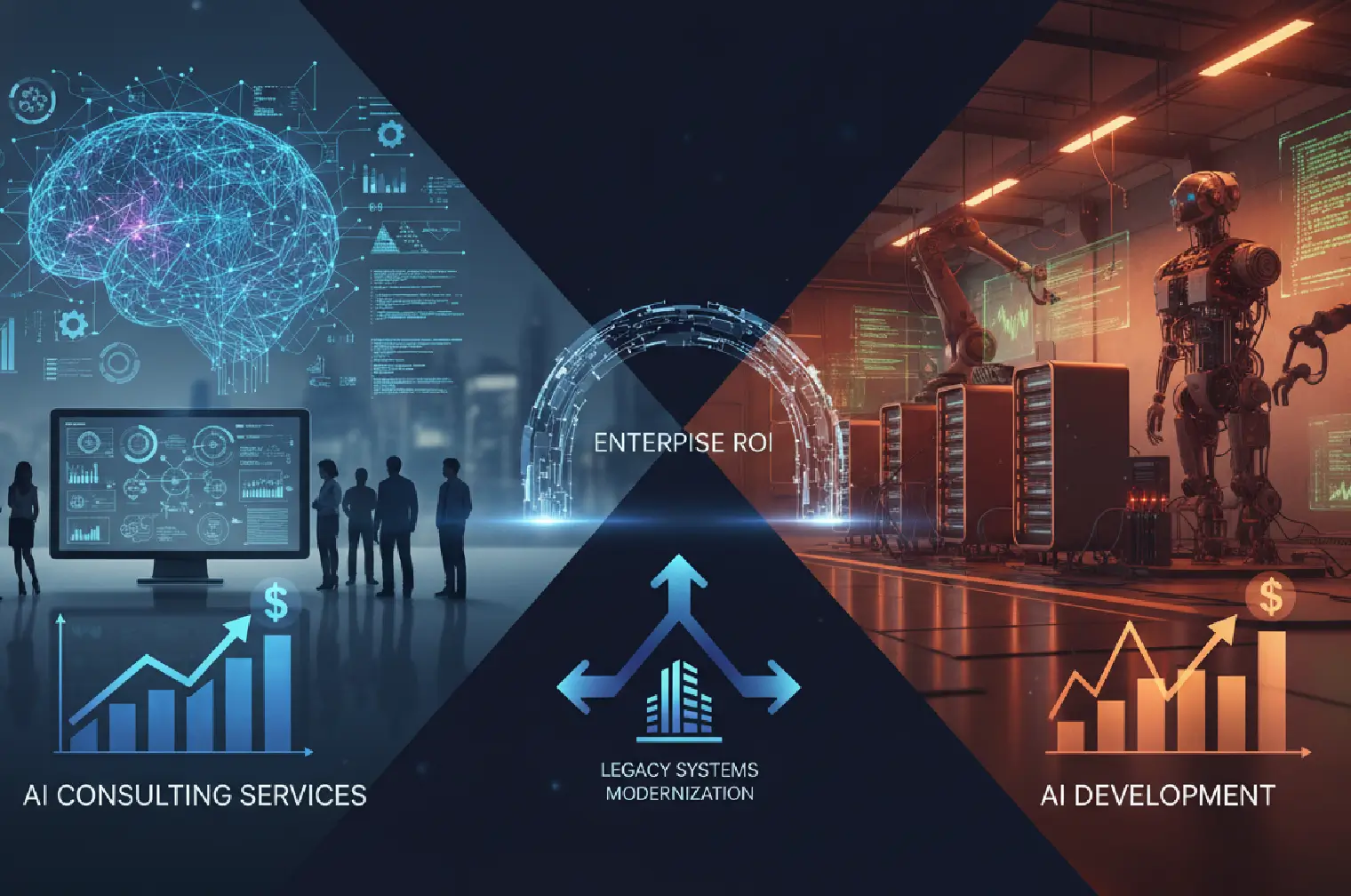
First, organizations use AI consulting services to assess data readiness and compliance. Second, they hire AI development services to engineer and deploy the actual software models.
The Structural Differences Between Strategy and Engineering
Evaluating operations and writing code serve different purposes. You engage AI consulting services to build a roadmap. Consultants review your databases, check for regulatory compliance, and identify high-impact use cases. They determine if your current infrastructure can support advanced machine learning models. They document the necessary hardware requirements and outline the project timeline.
Engineers execute the roadmap through AI development. This process involves training language models, configuring neural networks, and writing the underlying code. The engineering phase requires custom AI development to ensure the final product works with your specific enterprise resource planning (ERP) systems.
You utilize custom AI solutions to solve unique business problems that off-the-shelf software cannot address. The outcome is a functional, tested software application installed on your corporate servers.
Task Allocation by Service Type
| Service Category | Primary Function | Output Delivered |
| AI consulting services | Data auditing and compliance checks | Strategic implementation roadmaps |
| AI development services | Writing code and training models | Functional software applications |
| Custom AI development | System integration and API building | Proprietary algorithms |
| Custom AI solutions | Solving specific operational bottlenecks | Deployed, automated workflows |
Choose the Right AI Path for Enterprise ROI
Align business goals with measurable outcomes using AI Consulting Services and ROI-driven AI Development for Custom AI Solutions.
Healthcare IT Frameworks Demand Strict Data Audits
Healthcare organizations handle highly sensitive patient records. Hospitals in the USA must comply with HIPAA, while European clinics follow the strict mandates of GDPR. Implementing new technology requires rigorous oversight.
Administrators use AI consulting services to identify potential privacy risks before touching the data. Consultants map out secure data pipelines to separate patient identifiers from medical histories. They ensure data interoperability between legacy systems and modern applications.
Once the data is secure, hospitals require custom AI development. Engineers build models that analyze medical imaging and predict patient readmission rates. Off-the-shelf software rarely meets the precise diagnostic criteria of specialized clinics.
Therefore, providers rely on AI development services to create tailored diagnostic tools. You can learn more about how we implement AI-first platforms for healthcare to improve patient outcomes. These targeted custom AI solutions process electronic health records (EHR) in real-time to alert doctors of critical changes in patient vitals.
Logistics Operators Require Immediate Route Optimizations
The logistics industry operates on thin margins. Supply chain managers in the APAC region and the USA manage complex shipping routes and warehousing operations. Companies cannot afford downtime during software upgrades. They deploy AI consulting services to identify supply chain bottlenecks.
Consultants review historical shipping data to find inefficiencies in fuel consumption, load distribution, and driver scheduling. They calculate the exact financial losses caused by these inefficiencies.
After the review, logistics companies transition to AI development. Developers train machine learning algorithms on traffic patterns, weather forecasts, and fleet availability. The World Economic Forum and McKinsey report that companies implementing proactive supply chain planning see a 15% decrease in logistics costs and a 35% reduction in inventory levels.
To achieve these metrics, companies invest in AI development services. These services build predictive maintenance systems for delivery fleets. We design custom AI solutions for logistics that track inventory movements automatically. Through custom AI development, warehouse robots communicate directly with inventory management software to prevent stockouts and reduce manual picking errors.
Finance Platforms Depend on Secure Data Integration
Banks and financial institutions process millions of transactions daily. They require secure infrastructure to prevent fraud and manage risk. Before writing code, financial executives utilize AI consulting services to review their risk assessment frameworks. Consultants verify that any new algorithm meets the strict auditing requirements of federal financial regulators. They establish rules for data storage and access control.
Financial institutions require custom AI solutions to detect anomalous transaction patterns. Engineers use AI development to construct real-time scoring engines. These engines approve legitimate transactions and block fraudulent ones in milliseconds. The software flags suspicious activity and alerts human investigators immediately.
Here are the standard steps for financial software upgrades:
- Perform a readiness assessment using AI consulting services to locate data silos.
- Clean and organize historical transaction data for accurate model training.
- Initiate custom AI development to build proprietary fraud detection algorithms.
- Use AI development services to integrate the new models with legacy banking mainframes.
- Deploy custom AI solutions to automate loan approvals and customer risk scoring.
The engineering teams must ensure continuous monitoring and system updates. For a deeper understanding of enterprise execution, review our guide on AI consulting services for SMBs.
Turn AI Vision into Scalable Business Value
Accelerate innovation with expert AI Consulting Services, enterprise-grade AI Development, and tailored Custom AI Solutions.
How to Recognize the Triggers for Software Upgrades
Evaluate Operational Bottlenecks
Business leaders must identify exact operational failures before purchasing software. You observe rising customer acquisition costs, frequent shipping delays, or high error rates in manual data entry. These metrics signal the need for intervention. You utilize AI consulting services to quantify these losses. Consultants calculate the exact financial impact of your current inefficiencies. This data determines the necessary budget for future engineering work. They present a clear cost-benefit analysis to the executive board.
Select the Engineering Approach
Organizations decide when to build proprietary systems. Off-the-shelf tools fail to integrate with proprietary databases. When integration fails, companies require AI development services. Engineers build APIs that connect disparate data systems securely. They execute custom AI development to build models trained exclusively on your corporate data. This approach keeps your data secure behind your corporate firewall.
Gartner research emphasizes that organizations must establish clear data governance frameworks before deploying enterprise-wide machine learning models. You implement custom AI solutions to retain full ownership of your intellectual property and your proprietary algorithms.
Proven Execution Yields Measurable Output
Theoretical planning must translate into functional software. Organizations require measurable results to justify their technology budgets. ViitorCloud builds secure, hybrid automation systems for enterprise clients.
We provide comprehensive AI consulting services to map your security requirements and operational workflows before writing any code. We analyze your existing architecture and recommend specific system improvements.
Following the planning phase, we deliver targeted custom AI development services. Our engineering teams design systems that adhere to strict compliance frameworks. Our systems learn from your specific data and operational patterns, growing more accurate over time. If your organization requires scalable, secure software, contact ViitorCloud to schedule a technical assessment today.
Secure ROI with the Right AI Implementation Model
Drive measurable performance using strategic AI Consulting Services and production-ready AI Development for Custom AI Solutions.
Finalize Your Implementation Strategy
Companies must execute a structured sequence to achieve their technology goals. You begin with advisory planning to secure your data and outline your objectives. You proceed to AI development to write the code and train the machine learning models. Combining thorough planning with precise engineering guarantees that your software solves specific operational problems. The final deployment increases efficiency, reduces manual labor costs, and keeps your corporate data secure.

Vishal Shukla
Vishal Shukla is Vice President of Technology at ViitorCloud Technologies.
Frequently Asked Questions
What are AI consulting services?
They assess data readiness, identify operational bottlenecks, and create strategic implementation roadmaps for enterprise businesses.
When do I need custom AI development?
Do AI development services include strategy?
How do custom AI solutions benefit logistics?
Why is AI development critical for healthcare?