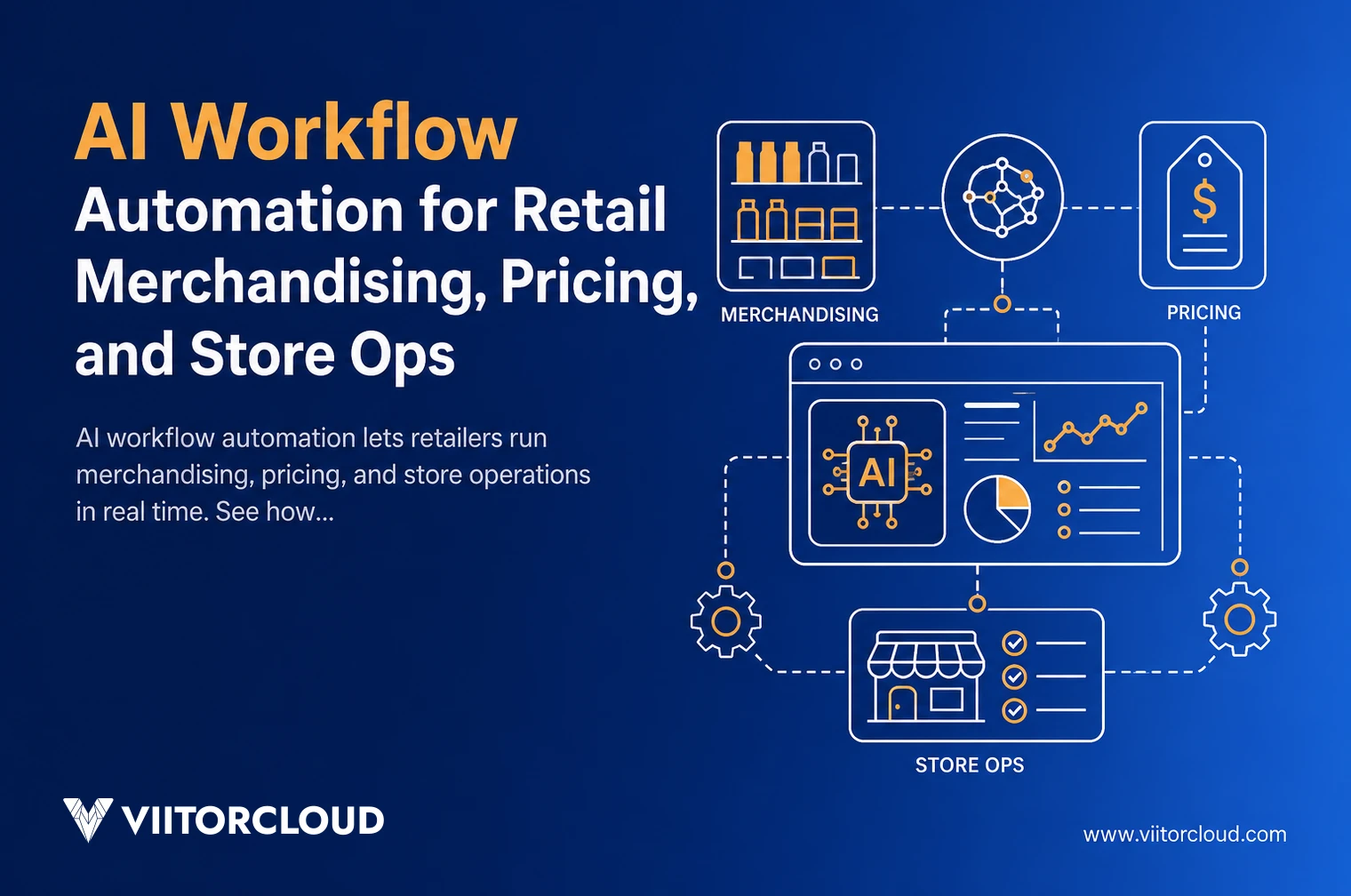
AI workflow automation lets retail teams run merchandising, pricing, and store operations as one connected, real-time system instead of a chain of manual handoffs. It uses generative AI and rules-based automation to read demand signals, adjust prices, reorder stock, and route store tasks without anyone rekeying data at each step.
Here is the gap I keep running into. Industry surveys point to roughly 68% of large retailers expecting full agentic AI within the next 12 to 24 months. Yet most still run merchandising, pricing, and store ops on spreadsheets and disconnected tools that cannot keep pace with demand that shifts by the hour.
If you lead retail operations or merchandising, you already feel this tension. In this guide I will show where AI-driven automation fits across your core retail functions, what each use case looks like in practice, and how to roll it out without breaking the systems your business runs on today.
Key Takeaways
- AI workflow automation connects merchandising, pricing, and store operations into one real-time process instead of isolated manual tasks.
- Generative AI automation handles the judgment-heavy work, drafting product content, reading demand, and flagging exceptions for people to approve.
- Dynamic pricing driven by live demand and inventory data protects margin far better than weekly manual repricing.
- The data pipeline underneath the automation decides whether it works, so clean, connected data comes before any model.
- A phased rollout starting with one high-volume workflow lowers risk and shows measurable return before you scale.
What GenAI Workflow Automation Means for Retail
GenAI workflow automation in retail is the use of generative AI to run multi-step retail processes end to end, from reading data to drafting output to triggering the next action, with people supervising rather than doing every task by hand.
Traditional workflow automation followed fixed rules. It moved data between systems and fired alerts, but it could not read messy inputs or make a judgment call. Generative AI automation changes that. It reads a supplier catalog, writes the product description, classifies the item, and prepares it for approval. That shift, from moving data to interpreting it, is what makes generative AI automation useful across retail.
Merchandising, pricing, and store operations are all business process automation problems at their core.
These three properties make GenAI practical for retail automation at scale:
- It handles unstructured input. Product specs, supplier emails, and images become structured data the system can act on.
- It works in real time. Decisions follow demand and inventory as they change, not on a weekly batch cycle.
- It keeps humans in control. The model proposes, a merchandiser or manager approves, and the system executes.
Why Manual Retail Workflows Cannot Keep Pace
The core problem is speed. Retail demand now moves faster than any team can process by hand, and the gaps in manual business process automation show up as lost margin and empty shelves.
Most retailers I work with run each function in its own silo. Merchandising lives in one spreadsheet, pricing in another, and store tasks in a third. Nobody holds a single view, so the same product data gets rekeyed three or four times, and every rekey adds delay and error. Where retail automation exists at all, it is stitched together by hand across those silos.
The cost is measurable. McKinsey research on the scale of the AI opportunity in retail points to large gains that stay out of reach while operations run on disconnected tools. When a competitor reprices in minutes and you reprice weekly, that gap compounds every single day.
See AI Workflow Automation in Action for Retail
Explore how ViitorCloud builds AI-driven automation across merchandising, pricing, and store operations.
Automating Merchandising from Catalog to Shelf
Merchandising is where generative AI automation delivers the fastest visible win. The work is repetitive, content-heavy, and slow, which is exactly what these systems handle well.
A merchandising director I advised was onboarding new suppliers entirely by hand. Her team rekeyed vendor catalogs, wrote descriptions, tagged categories, and matched images, which took days for every supplier. We mapped that workflow, then let the model draft the descriptions, assign the categories, and flag only the uncertain items for a person to review. Onboarding dropped from days to hours.
An AI workflow automation layer across merchandising handles the heavy lifting:
- Generating and standardizing product descriptions from raw supplier data.
- Auto-categorizing and tagging items for search and navigation.
- Flagging duplicate or incomplete listings before they reach the storefront.
The payoff is a catalog that grows in hours instead of weeks. Strong data pipeline development for retail is what makes this dependable, because the automation is only as accurate as the data feeding it.
Dynamic Pricing That Reacts to Real Demand
Dynamic pricing is the use case with the clearest return, because a single margin point across a large catalog adds up fast. Manual repricing cannot react to demand, competitor moves, and stock levels quickly enough to matter.
An AI-driven dynamic pricing workflow reads live inputs and proposes price changes within the guardrails you set. It watches sell-through, inventory depth, seasonality, and demand signals, then recommends a price that protects margin without starting a race to the bottom.
Control is the point. Good dynamic pricing automation never hands the model a blank check. You define the floors, the ceilings, and the margin rules, and the system works inside them. Merchandisers review the exceptions instead of setting thousands of prices by hand.
This is business process automation applied straight to the profit and loss line. Each repricing decision that used to wait for a weekly review now happens continuously, and the team spends its hours on strategy rather than data entry.
Ready to Automate Your Retail Workflows?
Map one high-volume merchandising or pricing workflow and prove the return before you scale.
Store Operations That Run Themselves
Store operations is where retail automation reaches the floor. Replenishment, labor scheduling, and task management are repetitive workflows that drain manager time and rarely need human creativity.
Take replenishment. A generative AI automation workflow watches sales velocity at each location, predicts when an item will run low, and drafts the purchase order for approval. A store manager confirms rather than calculates, and shelves stay full without constant manual checks.
Across store operations, an automation layer can:
- Forecast demand by location and trigger replenishment before shelves empty.
- Generate staff schedules that match predicted foot traffic.
- Route exceptions, such as a delivery delay or a price mismatch, to the right person automatically.
The pattern connecting merchandising, pricing, and store ops is the same. These are all retail operations challenges that share one data foundation, which is why solving them together beats buying three separate point tools.
How to Roll Out AI Workflow Automation Without Disruption
Start small. The retailers who succeed with AI workflow automation do not automate everything at once. They pick one high-volume, high-pain workflow, prove it, and then expand. This is the think big, start small approach, and it lowers both risk and cost.
The sequence I recommend stays consistent:
- Fix the data first. Audit your product, pricing, and inventory sources, and connect them before adding any model.
- Automate one workflow. Choose merchandising onboarding or repricing, something with clear and measurable pain.
- Keep humans in the loop. Let the system propose and let staff approve until the trust is earned.
- Measure, then scale. Track time saved and margin gained, then extend to the next workflow.
This mirrors proven AI business process automation practice across other industries. For grounding on where the sector is heading, the retail industry benchmarks from the National Retail Federation are a useful reference before you commit to an architecture.
Start Your Retail Automation Project
Partner with an AI-first engineering team that has delivered automation for 300+ global clients since 2011.
Where a Retail Automation Partner Fits In
The hardest part of AI workflow automation is rarely the model. It is the data pipeline and the system integration underneath it, which is where most retail projects stall. That groundwork is the work I have spent years on.
At ViitorCloud we have engineered eCommerce and retail platforms that process tens of thousands of orders and handle over a million visits, built on the same data-first foundation these automation workflows need. Founded in 2011, we have delivered custom AI and business process automation for more than 300 clients, with GDPR-compliant practices in place from the start.
If your merchandising, pricing, or store operations still run on disconnected manual work, that is the signal to map one workflow and prove the return before you scale.
Getting Ahead of the Agentic Shift
Retail is moving toward autonomous operations faster than most teams are ready for. The retailers who win will not be the ones with the most tools. They will be the ones whose merchandising, pricing, and store operations already run as connected, automated workflows.
Start with your data, automate one painful process, and keep people in control of the decisions that matter. Done in that order, AI workflow automation stops being a distant project and becomes a measurable advantage this quarter.

Vishal Shukla
Vishal Shukla is Vice President of Technology at ViitorCloud Technologies.
Frequently Asked Questions
What is GenAI workflow automation in retail?
It uses generative AI to run retail processes end to end, drafting content and triggering actions while people approve.
How does AI workflow automation improve retail pricing?
Is retail process automation only for large retailers?
How long does it take to deploy retail automation?