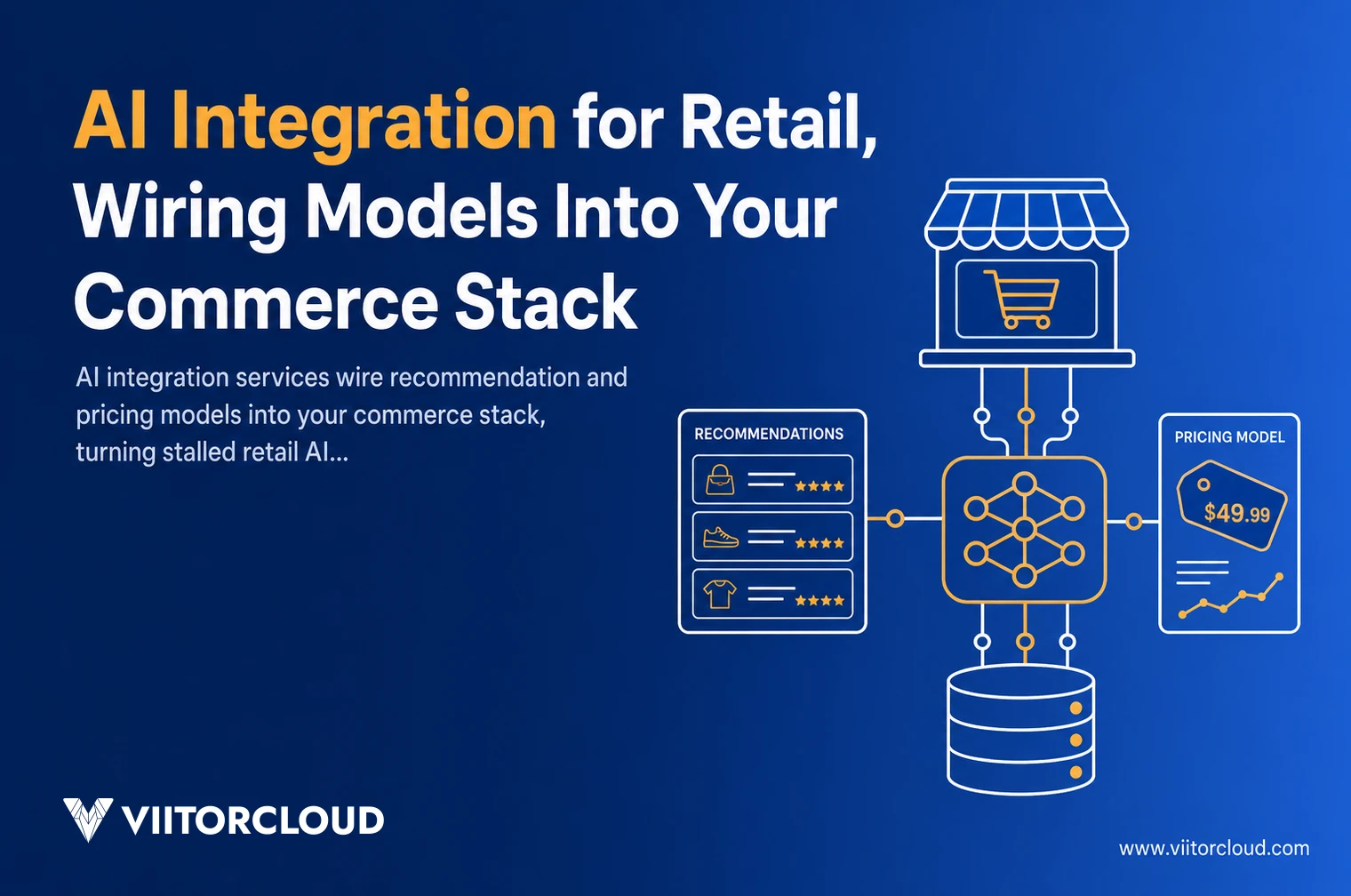
AI integration services connect your recommendation and pricing models to the live commerce stack, so a trained model actually shapes what shoppers see, add to cart, and pay. That connection – the API layer, the data pipeline, and the real-time serving path – is the difference between a retail AI pilot and retail revenue.
Most retail AI does not fail in the lab. It fails in the last mile. I have reviewed models that predicted demand accurately and recommendation engines that scored well offline, then sat idle because nothing wired them into the storefront, the cart, or the checkout.
You already know AI can lift conversion and protect margin. This guide shows how to wire recommendation and pricing models into your commerce stack, what infrastructure you need first, and how I sequence the work so models reach production instead of stalling.
Key Takeaways
- AI integration services wire trained models into carts, catalogs, and checkout so predictions change what shoppers actually experience.
- Most retail models stall because of missing APIs, universal carts, and unstandardized product data, not weak algorithms.
- A recommendation engine needs a low-latency serving path and a clean data pipeline to influence live sessions.
- Real-time pricing must connect to inventory, margin rules, and checkout, with guardrails that protect trust and compliance.
- ViitorCloud engineered commerce platforms like MariDeal that generated $46.4M in revenue, including $7.1M in 72 hours.
What AI Integration in Retail Actually Means
AI integration in retail is the engineering work that connects machine learning models to the systems shoppers touch: your ecommerce platform, product catalog, cart, pricing service, and checkout. The model produces a prediction. Integration makes that prediction appear in the customer journey in real time.
Off-the-shelf plugins give you generic output. Production AI integration services connect a model to your specific catalog structure, inventory feeds, and customer data, so results reflect how your business genuinely sells. That is what real retail personalization requires. According to McKinsey research on personalization, retailers that get it right generate significantly more revenue from those efforts.
Three layers do the work:
- A data pipeline that cleans and moves catalog, behavioral, and transaction data to the model.
- API and serving layer that returns predictions fast enough for a live page load.
- Application hooks that place those predictions into product pages, search, cart, and pricing.
When these three layers are built as one system rather than stitched from point tools, models stay reliable. That is the core of production custom AI solutions for retail.
Why Retail AI Models Stall Before They Reach the Storefront
Retail AI stalls at infrastructure, not intelligence. Research puts AI adoption among B2C marketers near 95%, yet most models never move from a notebook into the live funnel. The blocker is almost always the integration layer.
Agentic commerce and automated merchandising depend on foundations many retailers have not built: universal carts, documented APIs, and standardized product data. When a product feed carries inconsistent identifiers and missing attributes, even a strong recommendation engine cannot map its output back to real SKUs.
One retail engineering lead I worked with had three models ready and none in production. The data science was done. What was missing was the integration work, event streaming from the storefront, a feature store, and an API that could answer during a page render. We built that layer first, and the models went live within the quarter.
This pattern repeats across retailers, brands, and marketplaces. The value of AI integration services is not the model. It is the wiring that lets the model act on live traffic.
See Retail AI Integration That Ships to Production
ViitorCloud engineered the MariDeal commerce platform behind $46.4M in revenue and $7.1M in 72 hours. We wire recommendation and pricing models into live storefronts.
Wiring a Recommendation Engine Into Your Commerce Stack
A recommendation engine only earns revenue when it serves the right products during a live session, in under a few hundred milliseconds. About 35% of Amazon purchases have been attributed to product recommendations, according to McKinsey analysis, which shows the upside when integration is done right.
To wire a recommendation engine into your stack, you connect four things:
- Behavioral events from the storefront, including clicks, views, and cart actions, streamed to the model in real time.
- A serving API that returns ranked products fast enough for the page to render without delay.
- Catalog and inventory data so recommendations never surface out-of-stock items.
- Placement hooks in product pages, search, email, and cart to display the results.
This is where retail personalization becomes real. Real retail personalization means the model reorders a category page for each shopper using live signals. Generative AI integration extends this further, producing product descriptions and personalized bundles in real time from the same catalog data. You can see how we approach this in our work to build recommendation systems with generative AI.
Done well, retail personalization and a well-integrated recommendation engine lift average order value without adding headcount.
Connecting Real-Time Pricing Models to Live Inventory and Checkout
Real-time pricing adjusts prices based on demand, inventory, competitor signals, and margin targets, then pushes the new price to the storefront and checkout instantly. The model is the easy part. Connecting real-time pricing to live systems safely is the hard part.
A production real-time pricing integration needs:
- Live inventory and demand feeds so prices reflect current stock and velocity.
- Margin and business rules that cap how far any price can move.
- A pricing API the storefront and cart call as the single source of truth.
- Guardrails and audit logs that keep pricing fair, consistent, and compliant.
Guardrails matter more in pricing than anywhere else. A recommendation shown in error costs a click. A price shown in error costs trust, and sometimes a compliance problem. I build pricing integrations with hard limits and full logging, so every automated price can be explained.
I saw these stakes during a Black Friday build. On the MariDeal platform we engineered, the system processed $7.1M in revenue across 72 hours during a single sale. Pricing, inventory, and checkout stayed correct under peak load, which only happens when the integration is engineered for it.
Get Your Recommendation and Pricing Models Live
If your retail AI is stuck in pilots, the gap is integration, not data science. Let us map the pipelines, APIs, and serving layer your commerce stack needs.
The Data Pipeline and APIs Behind Generative AI Integration
Every model in this guide depends on one thing: clean data moving reliably through a pipeline. Fragmented product data is the most common reason retail AI underperforms. Fix the pipeline, and model accuracy improves without touching the model.
Standardized product data is the foundation. That means consistent identifiers, complete attributes, and one definition of a product across web, app, and store. With that in place, a shared API layer serves recommendations, pricing, and search from the same trustworthy source. Our approach to data pipeline development for retail starts exactly here.
Generative AI integration sits on top of this layer. When product data is standardized, generative AI integration can write accurate descriptions, answer shopper questions, and power conversational search. Without clean data, generative AI integration invents details it cannot verify.
This is why AI integration services and data engineering belong in the same project. You cannot separate the model from the data path that feeds it.
How I Sequence a Retail AI Integration Project
Retail teams often start with the model. I start with the path to production.
Here is the order that gets models live and keeps them there:
- Audit the data and APIs: Map catalog, inventory, and behavioral sources, and find the gaps in standardized product data.
- Build the pipeline and serving layer: Stand up event streaming, a feature store, and low-latency APIs before deployment.
- Integrate one use case: Wire a single recommendation engine, real-time pricing, or retail personalization model into a live surface and measure it.
- Add guardrails and monitoring: Track drift, latency, and business outcomes with automatic alerts.
- Scale across surfaces: Extend to search, email, cart, and generative AI integration once the foundation holds.
This think big, start small sequence reduces risk. You validate the integration on one surface, prove the lift, then expand. It mirrors how I approach AI integration across industries, and it is why models reach revenue instead of the archive.
Start Your Retail AI Integration
Wire one recommendation engine or real-time pricing model into a live surface, prove the lift, then scale across your commerce stack with a single partner.
Where ViitorCloud Fits in Your Retail AI Roadmap
At ViitorCloud, I have spent years wiring models into commerce systems that carry real traffic and real revenue. On the MariDeal platform we engineered, that work supported $46.4M in total revenue and 56,943 orders in one year across thousands of live deals. The models mattered. The integration turned them into transactions.
If your recommendation or pricing models are stuck in pilots, the gap is usually the commerce integration, not the data science. ViitorCloud builds the pipelines, APIs, and serving layers that connect AI to the storefront, and we stay through production and optimization. Our retail technology work is built for this last mile.
Turning Retail AI Pilots Into Revenue
Retail AI succeeds or fails at the integration layer. The model predicts. AI integration services make that prediction act on live traffic, in the cart, on the product page, and at checkout.
Start with the data pipeline and APIs, wire one recommendation engine or real-time pricing model into a live surface, add guardrails, then scale. That sequence moves retail AI from stalled pilots to measurable revenue.
The retailers pulling ahead are the ones who did the integration work, not the ones with the fanciest models. If your models are ready, the next step is wiring them into the stack your shoppers actually use.

Vishal Shukla
Vishal Shukla is Vice President of Technology at ViitorCloud Technologies.
Frequently Asked Questions
What is AI integration in retail?
AI integration in retail connects models to your commerce platform, catalog, cart, and checkout so predictions shape live shopping.
How does recommendation engine integration work?
What data do real-time pricing models need?
Why do retail AI models stall in pilots?