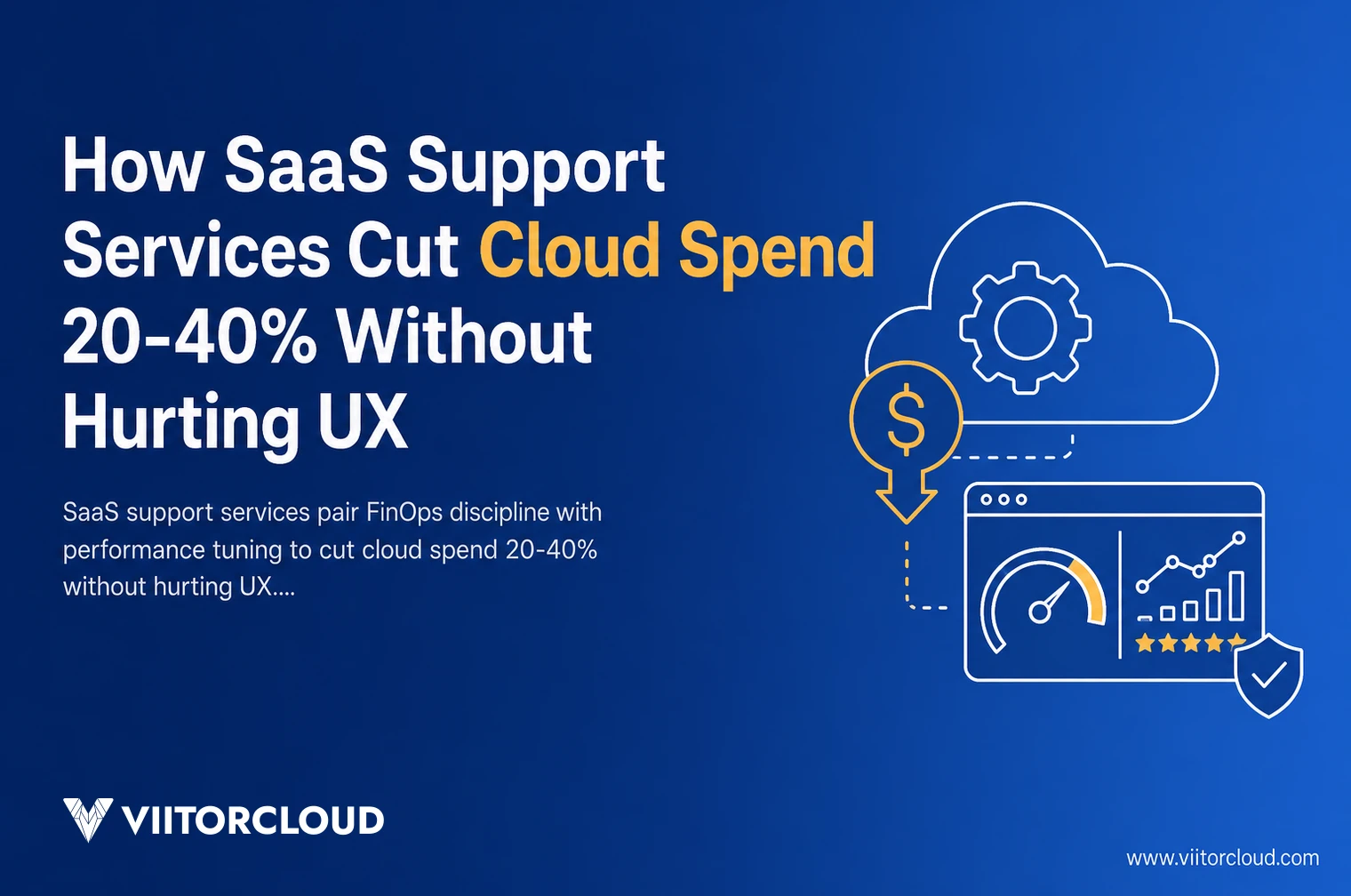
SaaS support services cut cloud spend by 20-40% when they pair FinOps discipline with continuous performance work. Most waste and most latency share the same root causes, so the two goals reinforce each other. The savings no longer come from one big fix. They come from a long tail of smaller items that only a structured program works through.
Most engineering leaders I work with have already taken the obvious steps. They bought savings plans, deleted forgotten environments, and rightsized the worst offenders. Spend still creeps up quarter after quarter, and p95 latency creeps with it. The reason is that nobody owns the unglamorous middle: application maintenance services, query tuning, storage hygiene, and a fixed review cadence.
This playbook covers where the next 20-40% hides, and how SaaS support services keep cloud cost optimization from degrading user experience.
Key Takeaways
- SaaS support services recover 20-40% of cloud spend by working a long tail of smaller savings on a fixed cadence, not through one large migration.
- Flexera research finds organizations waste close to 30% of cloud spend, which makes cloud cost optimization a standing discipline rather than a one-time project.
- FinOps protects users only when cost reviews carry performance guardrails such as p95 latency, error rates, and cost per active user.
- Neglected application maintenance services and software maintenance services cause margin and performance to decay together, a little every month.
Why the Easy Cloud Savings Are Already Gone
The first wave of cloud cost optimization ran between 2022 and 2024, when budgets tightened across the software industry. Teams bought commitment discounts, shut down idle instances, and downsized over-provisioned databases. Those were the right moves, and they are done.
What remains is different. The next tier of savings sits in hundreds of small items, each worth 0.5-2% of the monthly bill.
- Unattached storage volumes and stale snapshots
- Logs and metrics retained for years by default
- Chatty services paying cross-zone data transfer fees
- Queries scanning full tables because an index was never added
Flexera’s State of the Cloud research still finds that organizations estimate close to 30% of their cloud spend is wasted. The impact lands hardest on smaller platforms. One image editing SaaS we support processes 1.2M images a year on roughly EUR 282,000 in revenue. At that scale, idle compute comes straight out of profit.
No sprint team clears a list like this once and keeps it clear. Closing that gap is the job SaaS support services exist to do.
Cut Cloud Spend Without Touching UX
A FinOps-led review of your compute, storage, and query costs, with a latency guardrail attached to every recommendation before anything ships.
What SaaS Support Services Actually Cover
SaaS support services cover far more ground than a help desk. In our SaaS product engineering practice, support, maintenance, and optimization run as one workstream with five recurring jobs.
- Application maintenance services: Dependency upgrades, security patches, bug triage, and steady technical debt paydown.
- Software maintenance services at the platform layer: Runtime and database version management, plus infrastructure as code hygiene.
- Cost operations: Resource tagging, anomaly alerts, monthly spend reviews, and commitment planning.
- Performance engineering: Profiling, query tuning, caching strategy, and load testing before peak seasons.
- Reliability: Monitoring, incident response, and SLO tracking that feed the same backlog.
The distinction matters. A ticket desk reacts to failures. SaaS support services with this scope find cost and latency problems before users feel them. That is why the savings hold instead of rebounding two quarters later.
The FinOps Loop That Ties Spend to User Experience
FinOps is the operating model that makes the work stick. The FinOps Foundation framework describes a repeating loop of inform, optimize, and operate. That loop only protects users if performance data sits inside it. In practice, I put cost and performance in the same monthly review with three guardrail sets.
- p95 and p99 latency on the five most-used endpoints
- Error rate and availability measured against published SLOs
- Unit economics such as cost per active user, per tenant, or per 1,000 API calls
The rule is strict. No cost change ships without a latency check, and no performance change ships without a unit cost check. Teams that review the two separately end up trading one for the other, and a cheap quarter quietly becomes a slow product. I covered the wider program design in these SaaS optimization strategies, and this FinOps review is the one piece I would never remove.
Keep Your SaaS Fast After Launch
Application maintenance services on a weekly, monthly, and quarterly cadence stop the slow decay of performance and margin.
Where the 20-40% Comes From
The mix varies by platform, but six buckets show up in every SaaS optimization engagement I have run.
- Compute: Rightsizing, scale-to-zero for non-production environments, and autoscaling tuned to real traffic curves.
- Storage: Tiering cold data, deleting orphaned snapshots, and capping log retention.
- Data transfer: CDN caching, response compression, and keeping chatty services in the same zone.
- Databases: Index fixes, query rewrites, and read replicas sized to actual demand.
- Commitments: Savings plans purchased after the technical cleanup, so you never lock in waste.
- Architecture: Consolidating underused services and replacing polling with event-driven patterns.
Three of the six buckets improve latency while they cut cost. Caching, query tuning, and data locality are UX work and cloud cost optimization work in the same commit. The fear that cost cutting degrades experience usually has it backwards.
Peak load proves the point. MariDeal, a travel deals platform we engineer, processed $7.1M in revenue in 72 hours during a single Black Friday window, on top of 56,943 orders across 2024. Autoscaling tuned only for cost would have failed that weekend. Autoscaling tuned to traffic curves with latency guardrails carried it, without paying for idle capacity the rest of the year.
For the always-on portion of what SaaS support services do, autonomous cloud optimization can take over the repetitive rightsizing and scheduling decisions.
How Application Maintenance Services Protect Performance and Margin
Neglect is the quiet failure mode of SaaS. Dependencies drift out of support, ORM upgrades get deferred, dead feature flags pile up, and each release adds a few slow queries. Nothing breaks on any single day. The product simply gets slower and more expensive every month, together.
Structured software maintenance services stop that decay by putting the work on a calendar instead of waiting for an incident.
- Weekly: Dependency and security patch review, plus cost anomaly triage.
- Monthly: Slow query review, storage and log audits, and a cost per tenant report.
- Quarterly: Load tests against projected peaks, commitment coverage checks, and an architecture debt pass.
Calenso shows what this buys over time. The appointment scheduling SaaS serves 100,000 daily users across 10,000+ business customers on a platform that has run for nine years. Codebases that old stay fast only when application maintenance services run on schedule. The same discipline drives long-term maintainability and support across every enterprise platform we operate.
Know Your Cost Per Active User
We help SaaS teams baseline unit economics and stand up a FinOps review that engineering and finance both trust.
Where ViitorCloud Fits in Your SaaS Optimization Program
ViitorCloud has engineered and supported production SaaS since 2011, across 300+ client engagements, and SaaS optimization is now the most requested part of that work. The examples in this article come from our own delivery. Calenso serves 100,000 daily users, and MariDeal has generated $46.4M in platform revenue.
Most engagements start with a two-week assessment. We baseline unit costs, profile your busiest endpoints, and return a ranked backlog with projected savings and a latency guardrail for each item. Our work with technology companies covers the delivery model in more detail.
From there, SaaS support services run as a monthly program with the FinOps review built in. If a 20-40% target is on your roadmap for the next two quarters, talk to our experts, and we will scope the assessment against your stack.
Run SaaS Optimization as an Operating Habit
The easy savings are gone, and that is fine. The durable ones come from SaaS support services that treat cost and performance as one backlog, reviewed on a FinOps cadence with guardrails on every change.
Start this month. Baseline cost per active user, set latency guardrails on your five busiest endpoints, and put software maintenance services on a weekly, monthly, and quarterly calendar. Work the long tail consistently, and the 20-40% arrives while your users notice nothing except a faster product.

Vishal Shukla
Vishal Shukla is Vice President of Technology at ViitorCloud Technologies.
Frequently Asked Questions
What is SaaS cost optimization?
SaaS cost optimization is the ongoing practice of reducing cloud spend per user while protecting performance, reliability, and user experience.
What do SaaS support services include?
How does FinOps work for a SaaS company?
Can you cut cloud costs without hurting user experience?