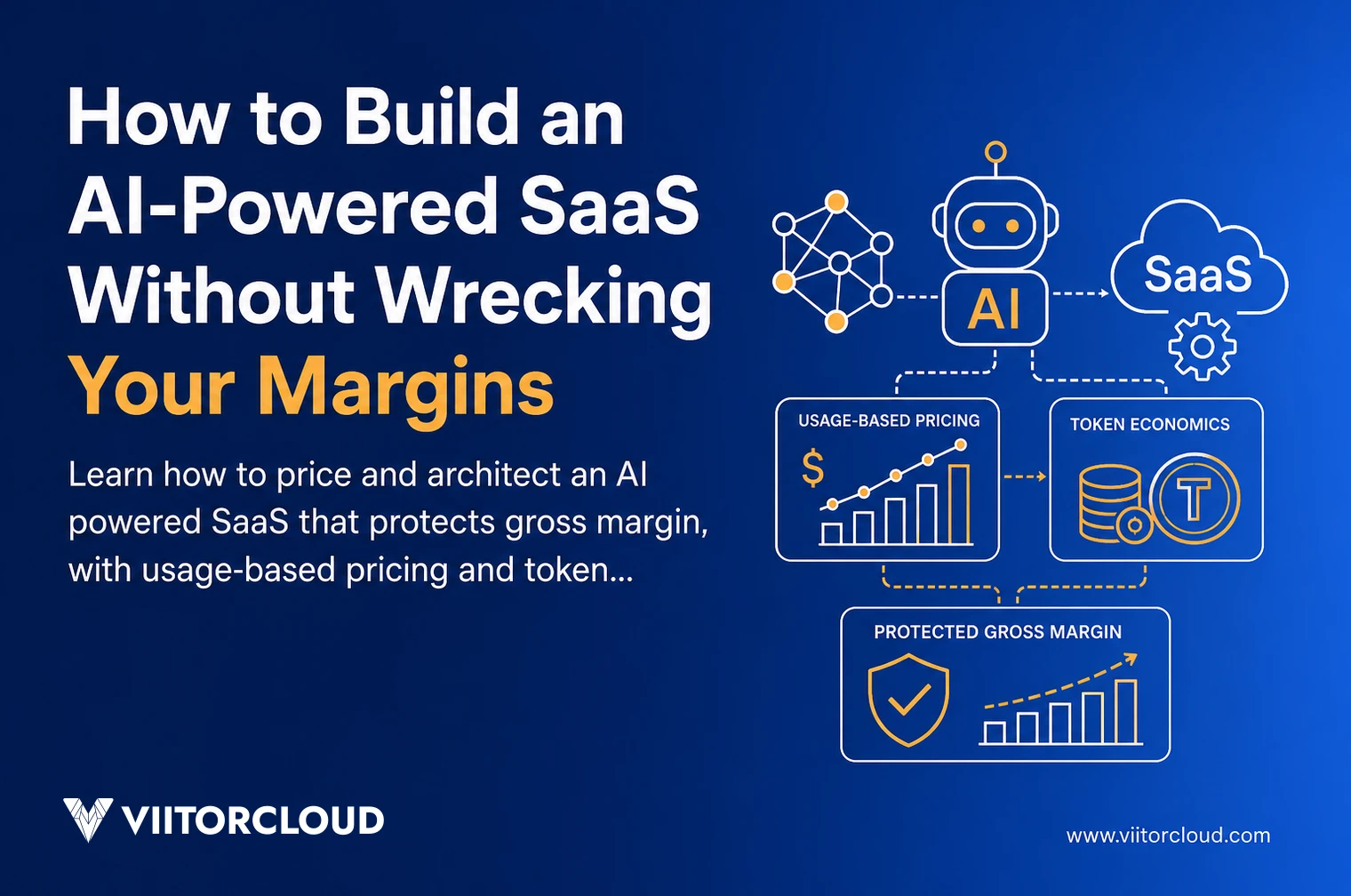
An AI-powered SaaS protects its gross margin when three decisions happen before the first feature ships. Meter every request. Price AI on consumption or value instead of flat seats. And architect the inference layer for cost control from day one. Skip any of the three, and token costs surface as invoice shock a quarter later.
I have reviewed the unit economics of dozens of SaaS products since AI features became a standard buyer expectation. The pattern repeats: teams treat inference as a rounding error, ship fast, and discover their heaviest users cost more to serve than they pay. This playbook covers the pricing models and architecture decisions that prevent that outcome. It applies whether you are building an AI-first SaaS from scratch or retrofitting AI into an established product.
Key Takeaways
- Flat seat pricing plus variable inference cost is the single biggest margin risk in an AI-powered SaaS.
- Hybrid pricing, a base subscription plus usage-based pricing for AI actions, protects margin while keeping bills predictable for buyers.
- Model routing, caching, and output caps are the core of token cost optimization and regularly cut inference spend by half or more before any pricing change.
- Per-tenant cost telemetry from the first release separates a durable AI-first SaaS from a slow-building margin problem.
Why AI-Powered SaaS Margins Erode Faster Than Teams Expect
Classic SaaS runs at 75 to 85% gross margin because serving one more customer costs close to nothing. AI features break that assumption. Every prompt, completion, embedding, and retrieval call carries a marginal cost that scales with usage, and it lands in cost of goods sold rather than a discretionary budget line.
The failure mode is consistent across the AI SaaS development projects I have audited. A team ships an assistant on an unchanged flat seat price. Power users adopt it hardest, run long-context requests all day, and quietly become the most expensive accounts on the platform. Finance sees the provider invoice weeks later, after the pricing page has already set customer expectations.
Three cost drivers do most of the damage in an AI-powered SaaS:
- Unmetered consumption: no per-tenant tracking, so nobody knows which accounts or features burn the spend.
- Model mismatch: a frontier model handling requests a smaller model could serve at a fraction of the price.
- Uncapped outputs: long completions and oversized context windows that inflate every single request.
This is why SaaS product development for AI features starts with unit economics rather than the demo. In our SaaS product engineering engagements, cost-per-action modeling now sits in the same workshop as feature scoping. A product team that knows its cost per action prices with confidence. One that does not is guessing.
Model the Margin Before You Build the Feature
Every ViitorCloud engagement starts with cost-per-action modeling and ROI estimation, so you know what each AI feature costs to serve before it ships.
Price the Meter Before You Ship the Feature
Pricing is the half of SaaS product development most engineering teams skip. In AI SaaS development, unit cost modeling is arithmetic rather than guesswork, because model providers publish per-token rates for every tier. Multiply expected tokens per action by the rate, add retrieval and storage overhead, and you have a defensible cost per action before a line of code exists.
Four Pricing Models That Survive Variable Inference Costs
- Hybrid seat plus usage: a base subscription covers the core product while AI actions draw from a metered allowance. This is my default recommendation for B2B products.
- Credit packs: customers buy credits that map to AI actions. Many AI-first SaaS products default to credits because they make usage-based pricing legible to buyers and finance teams.
- Tiered allowances with overage: each plan includes a set volume of AI usage, with transparent overage rates beyond it.
- Outcome pricing: charge per completed result, such as a processed document or a resolved ticket, when the value of each action is clear.
Usage-based pricing works for an AI-powered SaaS because it moves revenue in the same direction as cost. When a customer consumes more inference, revenue rises with the expense instead of a flat fee absorbing it.
We applied this alignment on DropYourImage, an image editing product ViitorCloud engineered around pay-per-use economics. The platform processes about 1.2 million images a year and has generated EUR 281,754 across 13,652 orders, with every order priced against the compute it consumes. The margin holds at scale because the meter and the price were designed together.
Budget modeling deserves the same rigor. My breakdown of AI and ML solution costs for SMB SaaS covers how to estimate build and run costs before committing to a SaaS product development roadmap.
An Architecture Built for Token Cost Optimization
Pricing sets the ceiling on margin. Architecture sets the floor. Token cost optimization in an AI-powered SaaS is an engineering discipline with a short list of high-yield controls, and the first three below routinely cut inference spend by half or more.
Route, Cache, and Cap Before You Scale
- Model routing: classify each request and send it to the cheapest model that meets the quality bar, reserving frontier models for the minority of requests that need them.
- Caching: cache repeated prompts, shared context, and frequent answers. Prompt caching alone removes a large share of input token spend on stable system prompts.
- Output and context caps: bound completion length and trim retrieval context to what the task requires.
- Batching: move non-interactive work to batch endpoints, which providers price at a discount.
Meter Every Tenant From the First Release
Metering is the control plane for everything else in AI SaaS development. Log tokens, model, feature, and tenant on every request, then aggregate the data into cost per action and cost per account. Rate limits and per-tenant budgets turn runaway consumption into a product conversation instead of a margin write-off.
The custom AI solutions we build treat the data pipeline, evaluation loop, and cost telemetry as one system, because a model you cannot measure is a model you cannot afford. Calenso, a scheduling platform ViitorCloud engineered, serves 100,000 daily users. At that volume, per-request discipline decides whether infrastructure spend scales linearly or runs away.
Ship an AI-First SaaS on Proven Foundations
From Creaitor AI to platforms serving 100,000 daily users, our SaaS product engineering pairs AI features with the metering and pricing controls that protect margin.
Treat FinOps as a Product Discipline From Day One
Cost management has moved from a finance afterthought to a top engineering priority. The FinOps Foundation’s State of FinOps research shows AI spend management climbing the priority rankings year over year as inference becomes a first-class cloud cost. AI-powered SaaS teams that wait for the quarterly invoice review find the problem months after it started.
The operating rhythm I install in SaaS product development engagements is simple:
- A gross margin dashboard showing cost per action, per feature, and per tenant, refreshed daily.
- Alert thresholds on unit cost drift, so a model change or a prompt regression surfaces in hours.
- A monthly pricing review comparing consumption against plan allowances, flagging accounts that need a tier conversation.
For the technology companies we support through IT industry solutions, this telemetry pays for itself the first time it catches an unpriced feature before renewal season. Usage-based pricing without usage visibility is guesswork, and token cost optimization without alerts is a one-time project that decays.
Find the Token Spend Hiding in Your Stack
A focused AI readiness assessment maps your inference costs, routing and caching opportunities, and the pricing changes that pay back fastest.
Where ViitorCloud Fits in Your AI-Powered SaaS Roadmap
ViitorCloud has delivered 300+ client projects since 2011, and our recent AI SaaS development engagements apply this exact playbook. Our work on Creaitor AI, an AI-powered content platform, paired generation features with the metering and token cost optimization this article describes. Every engagement starts with cost-per-action modeling and ROI estimation, so the margin conversation happens before the build rather than after the first invoice.
If you are planning AI features and want the pricing model and architecture validated before committing budget, start with a focused proof of concept. It is the fastest and cheapest way to learn your real unit economics.
Conclusion
An AI-powered SaaS keeps its margins when pricing and architecture are designed as one system. Model the cost per action first. Choose a structure, usually hybrid or consumption-based, that moves revenue with usage. Then engineer routing, caching, caps, and per-tenant metering so token cost optimization runs continuously instead of arriving as a rescue project.
Teams that follow this order ship AI features as confidently as any other roadmap item because the unit economics are known before launch. Teams that skip it subsidize their heaviest users and find out at invoice time. Run the margin math this quarter, and SaaS product development stays profitable rather than becoming a cost problem.

Vishal Shukla
Vishal Shukla is Vice President of Technology at ViitorCloud Technologies.
Frequently Asked Questions
How should I price AI features in a SaaS product?
Model cost per action first, then use hybrid pricing that combines a base subscription with metered AI usage or credits.
What is usage-based pricing in an AI-powered SaaS?
How do I reduce token costs in AI SaaS development?
When should an AI-first SaaS move beyond flat seat pricing?