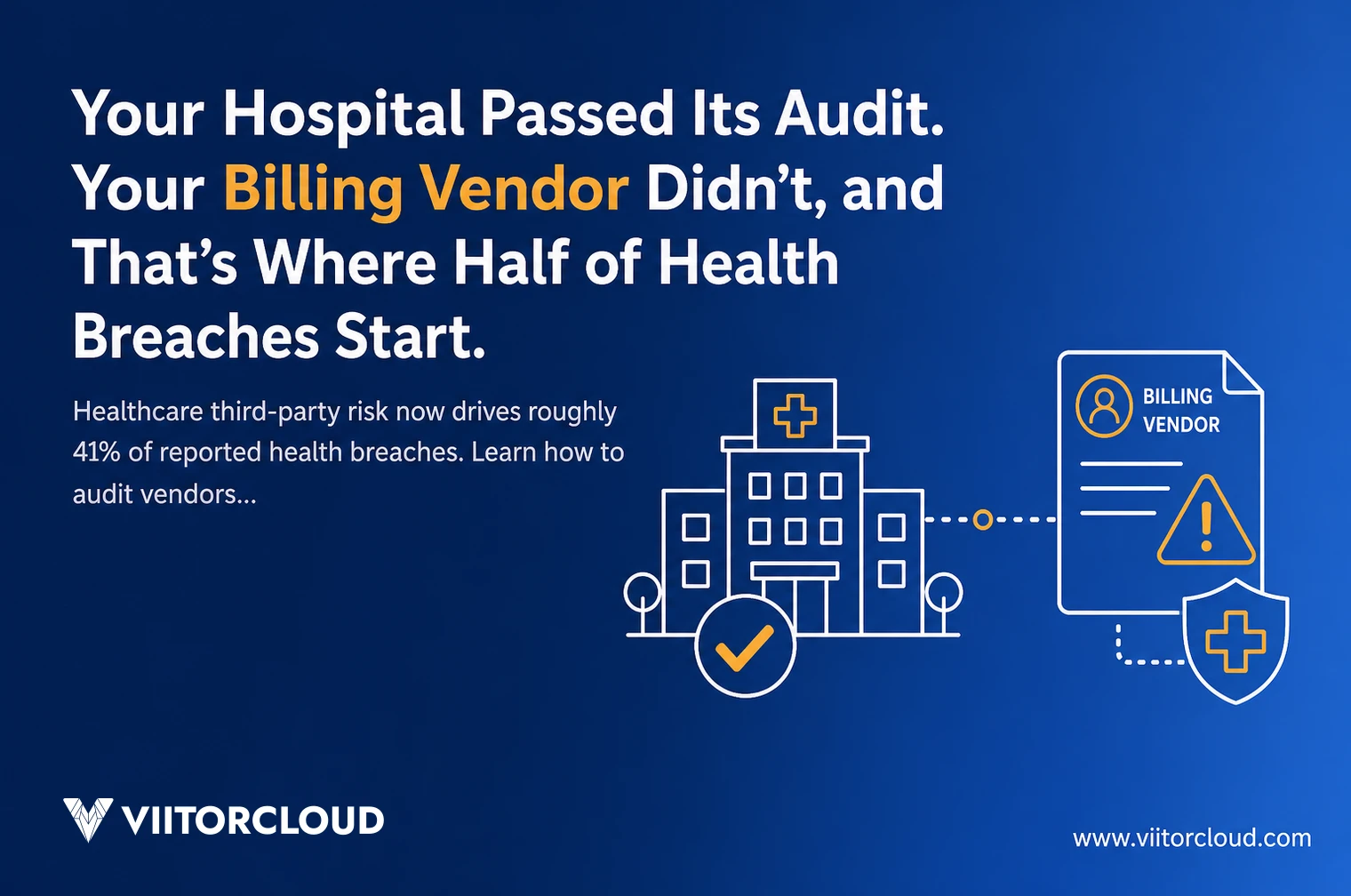
Healthcare third-party risk is now the single largest source of patient data exposure, tied to roughly 41% of reported health breaches and about half of all affected patients. Your own controls can be flawless, and your patients can still end up in a breach notification letter, because the compromise happened inside a billing clearinghouse, a transcription service, or an imaging archive you approved two years ago and never re-checked.
I have sat in enough post-incident reviews to know how this conversation goes. The security team pulls up a clean audit report. The compliance officer pulls up a signed Business Associate Agreement. And somewhere in a third-party data center, an attacker has already been inside a shared platform for six weeks, quietly reaching dozens of unrelated providers at once.
This article covers what actually breaks in vendor oversight, how one compromise fans out across a whole provider network, and the specific controls I put in place to close the gap.
Key Takeaways
- Business associates are linked to roughly 41% of reported healthcare breaches and around half of all affected patients, which makes vendors the highest-yield attack path in health IT.
- Annual questionnaires measure paperwork, not posture. A vendor can answer 200 questions accurately in January and be compromised in March.
- One clearinghouse or imaging vendor compromise reaches dozens of unrelated providers simultaneously, so your risk is a function of your vendors’ other clients too.
- Enforced access controls at the integration layer cut breach impact more than any contract clause. Scope the token, not the trust.
- Contractual security evidence, meaning log access, breach notification windows in hours, and audit rights, is what turns a BAA from a liability shield into an actual control.
Why Your Clean Audit Says Almost Nothing About Your Real Exposure
A HIPAA audit measures what you control. It does not measure what you have handed to someone else.
Most health systems I work with run between 300 and 1,500 third parties touching protected health information. Billing and revenue cycle vendors. Transcription. Imaging archives. Patient engagement platforms. Analytics providers. Print and mail houses. Each one is a live connection to clinical data, and each one has its own patch cadence, its own offshore subcontractors, and its own security budget you do not control.
The audit scope stops at your firewall. The data does not.
The Three Places Vendor Oversight Actually Breaks
- Onboarding is thorough, ongoing monitoring is not: Vendors get scrutinized hard at procurement and never again. A five-year contract gets one real security review.
- Nobody owns the fourth party: Your transcription vendor uses an offshore subprocessor. That subprocessor uses a cloud storage provider. Your BAA covers layer one.
- Access is granted broadly and never narrowed: Integration accounts are created with wide permissions during implementation because it is faster, then left that way for years.
Regulators have already noticed. The U.S. Department of Health and Human Services has proposed significant updates to the HIPAA Security Rule, with substantially tighter expectations around vendor verification and asset inventory. The direction of travel is clear: proving you asked a vendor a question will no longer count as proving the vendor is secure.
Map Your Real Vendor Exposure
Most health systems find 30% more PHI-touching integrations than their vendor register shows. We build the inventory from payment and network data, then tier it by access depth.
How One Vendor Compromise Reaches Dozens of Hospitals at Once
This is the part most risk registers get wrong. They score each vendor in isolation. Attackers do the opposite.
A billing clearinghouse serving 400 provider organizations is not 400 separate risks. It is one target with 400 payoffs. The economics strongly favor attacking the shared platform rather than any individual hospital, and the platform is usually the softer target because it is a mid-market technology company, not a regulated health system with a security operations center.
A Scenario I Have Seen Play Out More Than Once
Consider a regional health system, roughly 900 beds, with a compliance director I will call Priya. In March, her team completed a full HIPAA risk analysis with no significant findings. In June, a revenue cycle vendor serving her system and 60 others disclosed that an attacker had held credentials to its production environment since April.
Priya’s system contributed no misconfiguration, no unpatched server, and no phished employee to that incident. She still owned 214,000 patient notification letters, a state attorney general inquiry, and an eight-month remediation program. Her internal audit result was irrelevant to every part of that outcome.
That asymmetry is the core problem in healthcare supply chain security. You absorb the consequences of decisions made inside companies you cannot inspect on demand.
Why Health Data Attracts This Specifically
- Records are dense and durable: A clinical record contains identity, financial, insurance, and diagnostic data. It cannot be reissued like a card number.
- Operational pressure creates leverage: Encrypting a system that clinicians need for care decisions creates urgency no other sector matches.
- Integration surface is enormous: HL7 interfaces, FHIR APIs, SFTP drops, and flat-file exchanges accumulate for decades and rarely get decommissioned.
The European Union Agency for Cybersecurity has documented supply chain attacks as a top threat category across critical sectors, with healthcare consistently among the most affected. The pattern is not regional. It is structural.
Annual Questionnaires Are Measuring the Wrong Thing
A 200-question security questionnaire produces a document. It does not produce assurance.
Here is the practical problem: the vendor answers the questionnaire honestly on a Tuesday in January. Then they onboard a new subprocessor, spin up a new cloud region, lose their only security engineer, and skip two patch cycles. Nothing in your process detects any of that until the next annual cycle, or until the breach notification arrives first.
What Continuous Third-Party Risk Assessment Replaces It With
Effective vendor risk management healthcare programs shift from point-in-time attestation to ongoing signal collection.
The specific mechanisms:
- External attack surface monitoring: Track vendor-owned domains, certificates, exposed services, and known CVEs on their public infrastructure. Change in external posture is an early indicator.
- Access telemetry from your own side: You cannot see inside the vendor, but you can see every action their integration account takes in your environment. Baseline it and alert on deviation.
- Subprocessor change notification as a contract term: Require notice before a new fourth party touches your data, not after.
- Tiered reassessment cadence: A vendor with bulk PHI access and write permissions gets quarterly review. A vendor with a read-only feed of de-identified data does not need the same intensity.
- Evidence over assertion: Ask for the penetration test executive summary, the SOC 2 Type II with the exceptions section intact, and the actual incident response runbook.
The tiering point matters more than teams expect. Most programs fail because they try to apply enterprise-grade scrutiny to all 800 vendors, achieve it for none, and end up with uniform shallow coverage. Concentrate depth where the data concentration is.
Instrument Vendor Access Before the Next Questionnaire
Telemetry on your own integration paths beats any self-attestation. Our team builds the API gateway mediation, scoped credentials, and egress alerting that limit breach impact.
Fixing HIPAA Vendor Compliance at the Access Layer Instead of the Contract Layer
A BAA allocates liability. It does not prevent a breach. I have never seen a signed agreement stop an attacker from moving through an over-permissioned integration account.
The controls that measurably reduce impact live in the integration architecture, and this is where healthcare third-party risk programs generate real return.
The Access Controls That Actually Limit Blast Radius
- Scoped service accounts per vendor per function: One credential, one purpose, one data domain. A billing integration should be structurally incapable of reading imaging studies.
- Field-level restriction, not table-level: A claims vendor needs procedure codes and payer identifiers. It does not need clinical notes, and most integrations hand over the whole record because the interface was built that way in 2014.
- Mandatory API gateway mediation: Route every vendor connection through a gateway that enforces rate limits, logs every call, and can be severed in one action. Direct database access for a third party is an unacceptable design in 2026.
- Short-lived credentials with automated rotation: Static API keys that have not rotated since implementation are the most common finding in the vendor access reviews I run.
- Egress volume alerting: Bulk extraction looks completely different from normal operational query patterns. Most organizations have the logs and no alert threshold configured.
Contract Terms That Give You Something Enforceable
Standard BAA language is a floor, not a control. The clauses worth negotiating hard:
- Breach notification measured in hours, not the regulatory maximum: Push for 24 to 72 hours from vendor discovery, with a defined technical contact.
- Audit rights with a real trigger: The right to conduct or commission a technical assessment after any security event, not just on annual request.
- Log access on demand: Their authentication and data access logs for your data, available to your team during an investigation.
- Subprocessor approval, not just disclosure: Prior written consent before a new fourth party processes your PHI.
- Security requirements flow-down: Contractual obligation that every subprocessor meets the same standard they committed to.
Building a TPRM Program That Survives Its Own First Year
Most TPRM programs collapse under their own inventory. Here is the sequence I use to get one operational without a two-year runway.
Phase One, Build the Real Inventory
Start with money and traffic, not with the vendor list procurement gave you. Pull accounts payable records and network egress logs. Cross-reference them. The gap between those two datasets and the official vendor register is where unmanaged risk lives, and it is always larger than anyone expects. Shadow integrations set up by a service line five years ago show up here.
Phase Two, Tier by Data Concentration and Access Depth
Score each vendor on volume of PHI accessible, write versus read permissions, network position, and how many other healthcare organizations they serve. That last factor is the one most models omit, and it is the strongest predictor of whether a vendor is worth attacking.
Phase Three, Instrument Before You Assess
Get logging and alerting in place on vendor access paths before you send a single new questionnaire. Telemetry from your own environment is more reliable than any self-attestation, and it is available immediately. This inverts the usual order, and it is the change that makes the biggest difference to time-to-value.
Phase Four, Automate the Recurring Work
Reassessment scheduling, evidence collection, expiry tracking, and exception escalation are all mechanical. Teams that keep this in spreadsheets stop doing it by month nine. Teams that automate it are still running the program in year three.
Modernize the Interfaces Creating This Risk
Legacy HL7 and flat-file integrations are where over-permissioned vendor access accumulates. We have engineered healthcare platforms processing $192.2M in revenue with defensible integration boundaries.
Where ViitorCloud Fits in Third-Party Risk Work
The reason vendor risk programs stall is rarely policy. It is engineering capacity. Someone has to build the access mediation layer, wire up the telemetry, and automate the assessment workflow, and that work competes with every other item on the IT roadmap.
That is the work my team does. We have built and integrated healthcare platforms where this exact discipline decided the outcome. On LogixHealth, a healthcare revenue cycle platform we engineered, $192.2M in healthcare revenue moves through the system, which means every integration boundary and access path had to be designed defensively rather than retrofitted. On Care Monitor, patient monitoring data required HIPAA-aligned handling from the first architecture decision. Across the Cow Monitor IoT deployment, we process 1M+ data points daily from 15,000+ sensors, which is the same technical problem as vendor telemetry monitoring in a different domain.
ViitorCloud has delivered for 300+ clients since 2011, including KPMG, DP World, and the Royal Navy, with GDPR and HIPAA-compliant development practices built into how we work rather than bolted on at review. If you are building continuous vendor monitoring, redesigning integration access controls, or modernizing the interfaces that create this exposure, our system integration and modernization and healthcare technology teams work on exactly this layer. The Care Monitor patient monitoring build is a useful reference point for how we handle clinical data boundaries.
Conclusion
Healthcare third-party risk is not a compliance gap. It is an architecture gap that compliance activity has been covering. Your audit measures your controls; roughly 41% of health breaches originate with someone else’s.
Three things change the outcome. Build your vendor inventory from payment and network data rather than the procurement list. Instrument vendor access paths with your own telemetry before you send another questionnaire. Scope every integration credential to a single function and a single data domain, and rotate it automatically.
Do those three and your exposure drops before a single new contract clause is negotiated. The organizations getting this right have stopped treating vendors as entities to be documented and started treating them as connections to be governed.

Vishal Shukla
Vishal Shukla is Vice President of Technology at ViitorCloud Technologies.
Frequently Asked Questions
What is third-party risk in healthcare
It is the exposure created when vendors, business associates, and their subcontractors access patient data or connect to clinical systems on your behalf.
What counts as a business associate breach
Does a BAA protect us from vendor breaches
How often should healthcare vendors be reassessed
What is the fastest way to reduce vendor risk