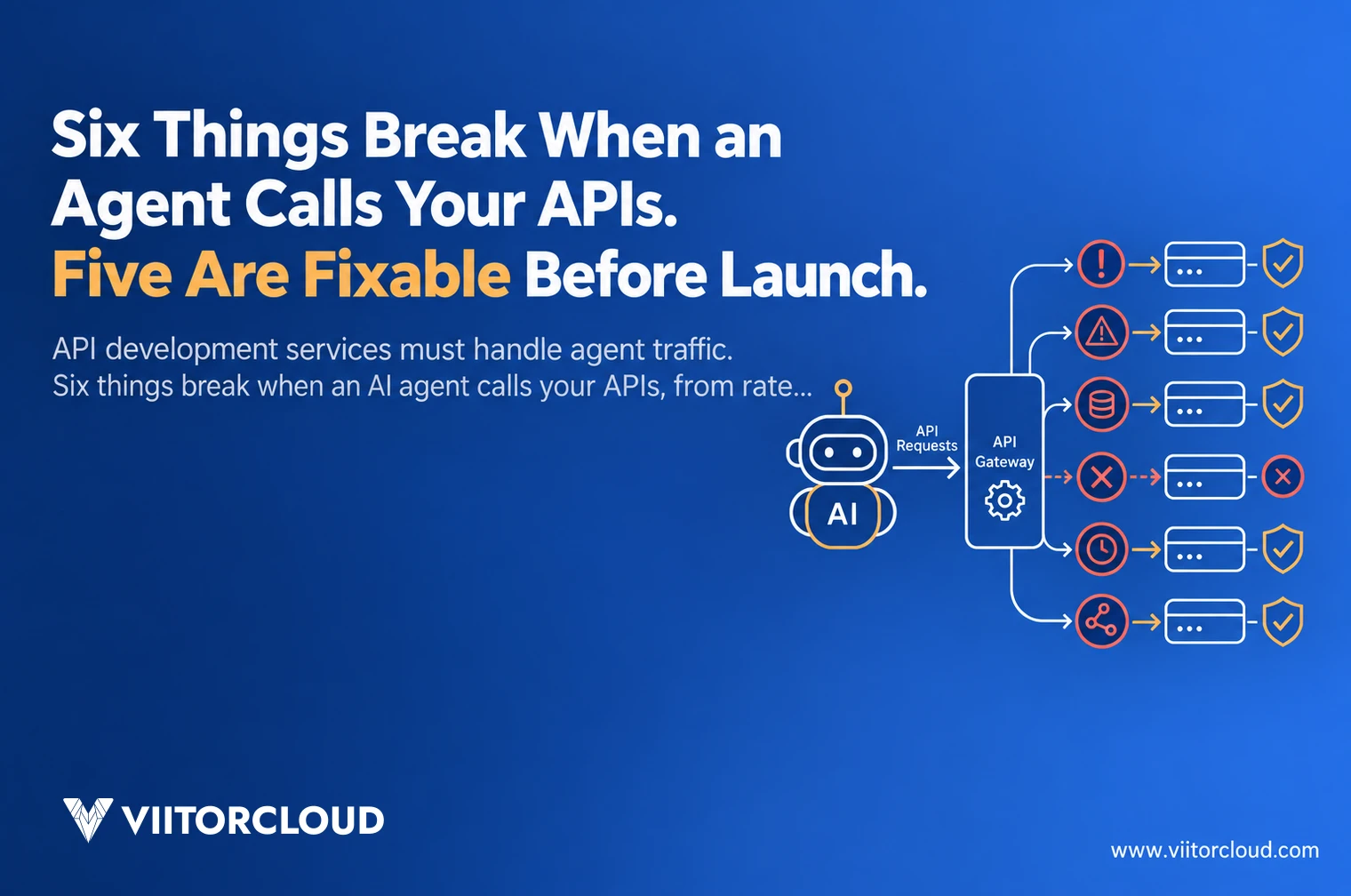
When an AI agent calls your API, six things break. Rate limits tuned for human pacing, retries with no idempotency key, error messages a model cannot act on, missing tool contracts, overly broad credentials, and endpoints that cannot report partial success. Five of those are fixable before launch with focused API development services work. The sixth needs a contract change rather than a patch.
Most internal APIs were built for a human-paced client. A person submits a form, waits, and clicks once more when it fails. An agent reads the same error, decides the call never landed, and retries within the same second. Across enterprise system integration projects, I find the reasoning layer is rarely the weak link. The API layer underneath it is.
Key Takeaways
- Six failure modes show up when an agent calls an internal API. Five are code and configuration fixes. The sixth is an API contract change.
- API rate limiting for AI callers has to communicate, not only enforce. Return 429 with Retry-After and publish limit, remaining, and reset values.
- Every write endpoint an agent can reach needs an idempotency key. Without one, a single retry becomes two orders.
- Errors need a stable, machine-readable shape with a retryable flag, not a prose sentence written for a human developer.
- The sixth failure is an API that cannot express partial success. Add a per-item result array before an agent touches a bulk endpoint.
Why Agent Traffic Breaks APIs Built for Human Pacing
An agent is only as capable as the systems it is allowed to call. The reasoning usually holds up fine. The traffic shape is what changes.
An integration lead I worked with, Priya, connected a support agent to her order API on a Thursday. It cleared 40 tickets an hour, and nobody noticed it running. On Friday, a supplier endpoint started timing out, the agent retried three times per ticket, and it exhausted the tenant rate limit in nine minutes. The agent behaved sensibly. The API had no way to tell it to slow down.
Five ways agent traffic differs from a human client:
- It bursts instead of pacing: A queue of 200 tickets arrives as 200 near-simultaneous calls, not as 200 page loads spread across an afternoon.
- It retries on ambiguity, not only on failure: A timeout, a 502, and a vague 400 all look identical to a model deciding whether to try again.
- It reads your error text as an instruction: Whatever the string says, the model acts on it, including acting on it incorrectly.
- It chains calls: One wrong response corrupts the next three steps of the workflow instead of stopping at a screen.
- It runs unattended: Nobody watches a dashboard at 2 am, so a degraded write path can run wrong for hours.
Each behavior is reasonable. None of them match what your rate limiter, retry policy, or error format was designed for. This is the part of API development services that almost nobody scopes before a pilot goes live.
Get Your APIs Ready Before the Agent Goes Live
Our engineers review the rate limits, retry safety, idempotency keys, error semantics, and tool contracts across the exact endpoints your agent will call.
Five Fixes Your API Development Services Team Can Ship Before Launch
These five are ordinary code and configuration work. They do not require an API redesign, and a competent team can close all five inside a normal sprint.
Rate Limits Tuned for Humans Collapse Under a Retry Loop
API rate limiting for AI callers has to communicate, not only enforce. A bare 429 with no guidance gives the model nothing to reason with, so it tries again immediately and the loop tightens.
- Return 429 with a Retry-After header, the standard response for rate-limited requests since RFC 6585 defined the status code.
- Expose limit, remaining, and reset values on every response so the caller paces itself before it gets blocked.
- Give each agent credential its own bucket, separate from the human-facing app, so a runaway loop cannot starve real users.
- Cap concurrency, not only request count. Ten parallel calls hurt a database far more than ten sequential ones.
- Document the expected backoff, with jitter, inside the tool description the agent actually reads.
One Retry Without an Idempotency Key Becomes Two Orders
This is the failure that costs money. An agent posts an order, the response times out, the agent retries, and the customer gets charged twice.
Rules I apply to every write endpoint an agent can reach:
- Accept an Idempotency-Key header on every POST and PATCH that moves money, stock, or state.
- Store the key with a hash of the request body and the original response for at least 24 hours.
- Return the stored response on a replay, with the same status code, so the retry is invisible to the caller.
- Reject a reused key carrying a different body as a conflict instead of treating it as a new request.
Retry safety is a design decision, not a middleware setting. It belongs in the same conversation as API first system integration planning, before the first endpoint ships.
Error Messages Written for Developers Give a Model Nothing to Act On
Invalid request tells a human to open the docs. It tells a model to guess. The model then guesses, retries, and burns your rate limit on a call that will never succeed.
A usable error answers four questions. What class of problem is this, will retrying help, which field is wrong, and what does a valid value look like? The problem details format defined in RFC 9457 gives you a stable envelope for exactly that. In most REST API development services, adding it is additive and leaves business logic untouched.
- A machine-readable body with type, title, status, detail, and a field-level list.
- An explicit retryable flag so the caller stops guessing.
- Stable error codes whose meaning never shifts under the same identifier.
- Correct status codes. A 200 carrying an error payload inside it is the most expensive habit an API can have with agent callers.
Without Agent Tool Contracts, Every Call Is a Guess
Agent tool contracts sit between your endpoints and the model. Handing a model raw OpenAPI output is the most common mistake I see, because an endpoint list is not a set of actions.
- One tool per business action: Cancel an order is a tool. Six endpoints that together cancel an order are not.
- Typed schemas with enums and required fields: Free-text parameters are where invented values enter your database.
- Side effects in the description: Say plainly that a tool charges a card, emails a customer, or cannot be undone.
- Reads and writes separated: Reads can be retried freely. Writes need approval rules and the idempotency key above.
- Versioned contracts: A silent parameter rename breaks every agent run until somebody reads the logs.
Well-written agent tool contracts do more for reliability than a larger model does. That is the practical lesson from AI integration services for agentic workflows across ordering, billing, and ticketing systems.
Broad Credentials Give an Agent More Reach Than the Task Needs
Most pilots ship with one service account that can do everything. That is survivable in a sandbox and unacceptable in billing or any regulated workflow.
- Give every agent its own identity, with tokens scoped to the tools it genuinely needs.
- Put ceilings on write endpoints. A refund tool with no maximum amount is a finance incident waiting for a bad plan step.
- Log the agent ID, run ID, and tool call on every mutation so an auditor can reconstruct a decision.
- Build a kill switch that revokes one agent without taking the API down for everyone.
In the port and freight systems our team maintains, cargo operations run across 14 active sites in more than 10 countries, and every write path carries an audit trail. That is standard practice in enterprise system integration, and an agent caller earns the same treatment on day one rather than after the first incident.
The Sixth Problem Needs a Contract Change, Not a Fix
The sixth failure is an API that cannot express partial success, and no amount of configuration solves it. Either the response can describe what happened per item, or it cannot.
Daniel, a billing lead at a mid-market platform, pointed an agent at a bulk adjustment endpoint. The agent submitted 50 line items and got a 200 back. Six of them had been rejected inside the batch, and the response body said nothing about which six. The agent reported success to the customer, and the finance team found the gap nine days later during reconciliation.
A bulk endpoint that answers all or nothing forces the agent to guess. Changing that means a version, a migration window, and consumers to notify, which is where api development and integration services planning earns its fee. Plan for:
- A per-item result array with a stable item ID, a status, and an error object for each entry.
- Multi-status semantics so a mixed outcome is never reported as a clean success.
- An operation ID for anything long-running, plus a status endpoint the agent can poll.
- A documented compensation path so the agent knows how to undo the six that failed.
This is the work that usually gets deferred, and it is the one that produces silent financial errors. I would rather ship a bulk endpoint late than ship one an agent cannot audit. The same principle shows up in API development and integration for logistics, where a partially completed shipment update is a physical problem, not a data problem.
See What Enterprise Integration Looks Like at Scale
Platforms we built process $192.2M in healthcare revenue, handled 56,943 orders in a single year, and track cargo across 14 active port sites in 10 countries.
A Pre-Launch Checklist for Agent-Ready API Development Services
Run this before an agent touches production. Every item is a yes or no answer, and a no is a launch blocker on any write path.
- Limits: Agent credentials have their own rate bucket, a concurrency cap, and 429 responses carrying Retry-After.
- Headers: Limit, remaining, and reset values appear on every response, not only on rejections.
- Idempotency: Every state-changing endpoint accepts an idempotency key and replays the stored response.
- Retries: The documented backoff includes jitter, and a maximum attempt count is enforced server-side.
- Error: Every failure returns a machine-readable body with a stable code and a retryable flag.
- Status codes: No endpoint returns 200 with an error payload inside it.
- Tool contracts: One tool per business action, typed parameters, and side effects stated in the description.
- Scopes: Tokens are scoped per agent, and write tools carry value or quantity ceilings.
- Audit: Agent ID, run ID, and tool call are logged on every mutation.
- Partial success: Bulk and multi-step endpoints report per-item outcomes, or they stay off-limits to the agent until they do.
- Kill switch: One agent can be revoked in under a minute without a deploy.
Talk Through Your Agent Tool Contracts
Bring one workflow. We map the endpoints, the write paths, and the failure modes an agent will hit in its first week against your live systems.
Where ViitorCloud Fits in Your API Development and Integration Services Plan
At ViitorCloud, I have spent most of the last decade on the systems behind the interface. That is where custom API development services either hold up under load or quietly fail.
Some of the numbers our platforms carry. A healthcare revenue platform that has processed $192.2M. A travel and deals platform that handled 56,943 orders in 2024 and $7.1M in 72 hours during a single Black Friday window. An IoT monitoring system pulling more than 1 million data points a day from 15,000 sensors. Those systems absorb load because the contracts, retry paths, and audit trails were designed in rather than added later.
If you are connecting an agent to order, billing, or ticketing systems, the useful next step is a scoped review of the endpoints it will actually call. That is the same starting point we use for custom AI solutions engagements, and it takes days rather than weeks.
What to Do Before You Point an Agent at Production
Five of the six failures are ordinary engineering work. Fix the rate limits, add idempotency keys, give errors a machine-readable shape, write real agent tool contracts, and scope the credentials. Any capable custom API development services team can close those before launch.
The sixth one, partial success, needs a contract change and a version. Start it now, because it is the failure that stays hidden until somebody reconciles the numbers.
Pick one workflow, run the checklist above against every endpoint it touches, and fix the write paths first. An agent that reasons well and acts safely is mostly a question of what your API development services allow it to call.

Vishal Shukla
Vishal Shukla is Vice President of Technology at ViitorCloud Technologies.
Frequently Asked Questions
What breaks when an AI agent calls an API?
Six things break. Rate limits tuned for human pacing, retries without idempotency keys, error messages a model cannot parse, missing tool contracts, over broad credentials, and endpoints that cannot report partial success. The first five are code and configuration fixes. The sixth needs an API contract change and a version.
Do I need an idempotency key on every endpoint an agent can call?
How should API rate limiting for AI callers differ from human traffic?
What is an agent tool contract and how is it different from API docs?
Can we make an existing REST API agent ready without rewriting it?