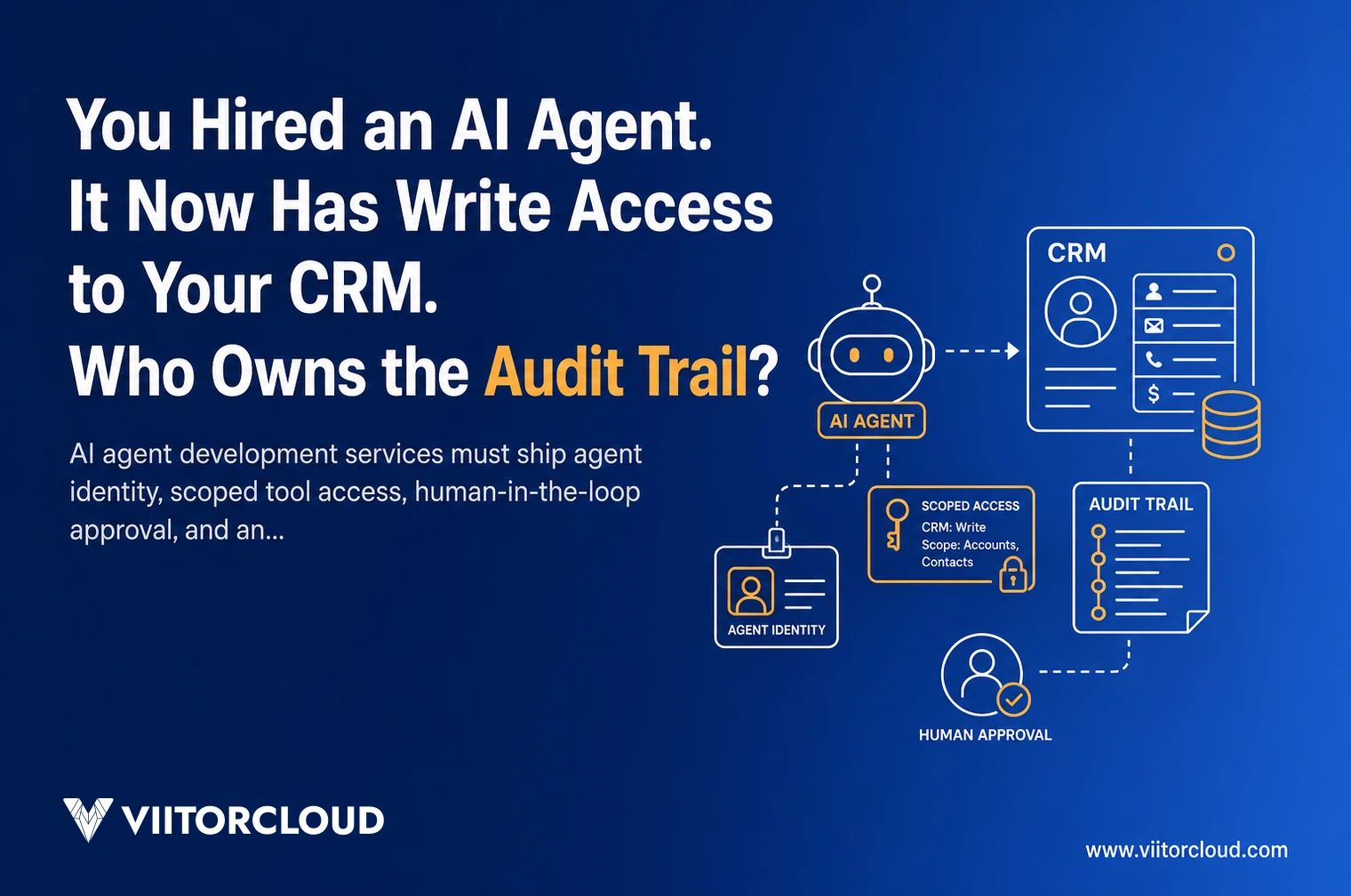
You own it. When an AI agent writes to your CRM, the audit trail belongs to whoever owns the system of record, which means your engineering organization, not the model vendor and not the framework the agent runs on. That answer catches teams off guard when they start shopping for AI agent development services, because almost no agent demo produces an audit trail at all. Gartner expects more than 40% of agentic AI projects to be canceled by the end of 2027, pointing to escalating costs, unclear business value, and inadequate risk controls. Having reviewed a fair number of production agents, I can tell you which of those three does the most damage. It is the last one.
Here is the shape of the failure. A team ships an agent that reads a support ticket, decides the customer qualifies for a credit, updates the opportunity in the CRM, and posts a summary to Slack. It works in the demo. Six weeks later, compliance asks who approved the 400 records the agent changed last Tuesday. Nobody can answer. The agent authenticated through a shared service account and wrote no per-action record.
Below are the four controls I require before any agent gets write access to a production system, and how to scope AI agent development services so those controls exist on day one instead of arriving after the security review.
Key Takeaways
- The agent audit trail belongs to the team that owns the system of record. Model vendors log inference. They do not log business consequences.
- An agent without its own AI agent identity cannot be scoped, revoked, rate limited, or attributed. Shared service accounts destroy attribution.
- Agentic workflow security is an engineering requirement, built from scoped agent tool access, distinct identity, human-in-the-loop approval, and an agent audit trail.
- AI agent observability has to be instrumented at the tool call layer, because that is where the agent touches the business.
- Every irreversible write needs a tested reversal path before the agent ships, not after an incident.
Who Owns the Audit Trail When an AI Agent Writes to Production
You do. The agent audit trail belongs to the team that owns the system of record the agent writes to. Model vendors log inference calls. Frameworks log execution traces. Neither one records which business record changed, who authorized the change, or how to reverse it.
That distinction matters because the two logs answer different questions. An inference log tells you what the model produced. An agent audit trail tells you which identity performed which action against which record, under whose authority. Auditors ask the second question. Most agent stacks only answer the first.
A complete agent audit trail records five things:
- The agent’s own identity, not a shared human credential or a broad service account
- The exact tool call made and the parameters passed to it
- The record touched, with before and after values
- The approval path, including any human-in-the-loop decision and who made it
- The reversal path, so the write can be undone without a database restore
None of this is exotic. It is the discipline any regulated platform already applies to a human user, applied to a non-human one. Teams commissioning custom AI agent development usually get this right on the second attempt, after the first agent has shipped without it, which is a costly way to learn the lesson. If you are still deciding what your agent should do at all, the practical starting point is understanding how to build custom AI agents for business workflows before wiring anything to a live object.
Review Your Agent Before the Security Review Does
We audit identity, scoped tool access, approval paths, and observability against what is already running in your product, then hand you the gaps in priority order.
Why Your Agent Has No Identity and Nobody Noticed
AI agent identity is the control teams skip most often because every platform makes it effortless to skip. The agent reaches the CRM through a connector that already holds credentials. Those credentials usually belong to whoever built the connector, or to a service account with write scope across the entire object model.
Microsoft’s Cyber Pulse reporting puts more than 80% of Fortune 500 companies building agents with low-code and no-code tooling. Gartner reports that 80% of enterprise applications shipped or updated in the first quarter of 2026 embedded at least one AI agent, up from 33% in 2024. Both figures describe the same condition. Agents are arriving faster than the identity model around them.
Without a distinct AI agent identity, four things become impossible:
- Attribution. You cannot separate agent writes from human writes in the same log.
- Revocation. Killing the agent’s access means killing a credential something else depends on.
- Scoping. Agent tool access inherits every permission the connector holds, not the subset the task needs.
- Rate limiting. A retry loop looks identical to normal application traffic.
This is why identity is the first deliverable in any agent build I run, ahead of prompt design and ahead of model selection. The same principle applies when agents are wired into existing systems through AI integration services for agentic workflows, where the connector layer is exactly where scope quietly expands.
The Four Controls I Require Before an Agent Gets Write Access
Custom AI agent development is mostly plumbing, and this is the plumbing that decides whether agentic workflow security holds up under review. I have not seen a production agent survive a serious security assessment without all four of these in place.
Give the Agent Its Own Credential
Issue the agent a first-class identity in your identity provider, with its own client credential, its own role, and its own expiry. Log every action against that identity. When the agent misbehaves, you revoke one credential and nothing else breaks. AI agent identity done properly also makes the audit trail readable, because agent activity is separable from human activity by design rather than by guesswork.
Scope Agent Tool Access to the Narrowest Useful Permission
Agent tool access should be defined per tool, per object, and per operation. An agent that advances opportunity stage does not need delete rights on contacts. Write the tool definitions so the permission boundary lives in code, not in a connector configuration screen anybody can widen. Cap the maximum impact as well. A per-run limit on records written stops a reasoning error from becoming a mass update.
Put a Human in the Loop Where the Action Cannot Be Undone
Human-in-the-loop should be a decision about reversibility rather than a hedge against a weak model. I classify every tool by whether its effect can be reversed programmatically. Reversible writes run autonomously. Irreversible ones, such as moving money, deleting records, or contacting a customer, queue for approval. That human-in-the-loop step then lands in the agent audit trail, which is what turns an approval into evidence.
Instrument AI Agent Observability Before the First Deployment
AI agent observability means tracing at the tool call layer, not only the token layer. You need the plan the agent produced, the tools it selected, the arguments it passed, the results it received, and the retries it attempted. Without that, debugging a production agent failure is guesswork. Pair it with an evaluation harness so behaviour drift shows up in a test run instead of a customer complaint, and treat both as part of responsible AI implementation rather than optional tooling.
Ship Agents With an Audit Trail From Day One
Our team has built platforms carrying records for 70M+ citizens and processing $192.2M in healthcare revenue. Traceability is designed in, not retrofitted after a compliance review.
What Agentic Workflow Security Looks Like in a Regulated Workflow
Take a payments platform that wants an agent to triage chargeback disputes. The agent reads the dispute, pulls transaction history, drafts a response, and updates the case in the core system. Useful work. Also a workflow that touches customer money and regulated records.
Agentic workflow security for that flow looks like this in practice:
- The agent holds a dedicated identity scoped to dispute cases only, with no path to account balances.
- Reading transaction history runs autonomously; writing a case decision requires analyst approval.
- Every draft, every retrieved document, and every approval lands in the agent audit trail with a timestamp and a named actor.
- Prompt injection defence sits at the tool boundary, so a hostile document cannot widen agent tool access.
- A kill switch disables the agent’s credentials without waiting for a deployment.
The NIST AI Risk Management Framework is a reasonable spine for this work, because it treats traceability and accountability as design properties rather than documentation exercises. The same pattern holds in lending, onboarding, and claims, which is the governance problem underneath AI security and risk management in banking.
How to Scope AI Agent Development Services So the Controls Ship First
Most agent projects fail at scoping, not at engineering. The statement of work describes the capability and stays silent on the controls, so the controls become a phase two that never gets funded. When I scope AI agent development services, the items below are phase one line items.
- An identity and permission model per tool, signed off before any agent code is written
- A reversibility classification for every tool, which determines where human-in-the-loop applies
- An agent audit trail schema, with retention aligned to the regulator you answer to
- An AI agent observability stack wired into your existing logging, not a vendor dashboard you cannot export
- An evaluation harness with a pass threshold that gates deployment
- A rollback runbook, tested once before go-live
Custom AI agent development costs more when these arrive late. I have watched a documentation agent in a HIPAA-scoped environment sit idle while an audit requirement was retrofitted, because it surfaced during compliance review instead of during design. The engineering work was small. The delay was procedural, and procedural delays are the expensive kind. Sequencing is the whole argument behind a disciplined path from agentic AI pilot to production.
Bring Your Tool List and We Will Map the Permissions
Send us the tools your agent can call and we will show you where scope is wider than the task needs, where a reversal path is missing, and what to fix first.
Where I Would Start Before Your Next Agent Ships
ViitorCloud has been building production software since 2011, across 300+ client engagements where the audit requirement was never optional. The government identity platform we delivered with KPMG in Tamil Nadu carries records for 70M+ citizens. The healthcare revenue platform we engineered for LogixHealth has processed $192.2M in revenue. The DP World port management system runs across 14 active sites in 10+ countries. Systems at that scale do not tolerate untraceable writes, and neither should your agent.
If you are shipping agentic features into a live customer product, the useful first step is an honest review of identity, agent tool access, approval paths, and observability against what is already running. Our custom AI solutions team runs that review as a scoped engagement before any build work begins, so the controls get designed rather than retrofitted.
When you are ready to walk through your current agent architecture, talk to our AI engineering team and bring the tool list. That is where the interesting problems always are.
Build the Audit Trail Before You Need It
Three things to take away. First, the agent audit trail is yours, because the system of record is yours. Second, an agent without its own identity cannot be governed, however good the model is. Third, human-in-the-loop belongs wherever an action cannot be reversed, and nowhere else, because approval fatigue is its own failure mode.
Agents are entering enterprise applications faster than the controls around them, and that gap is what gets projects canceled. Closing it is the actual job of good AI agent development services. Decide who owns the audit trail before your next agent gets write access, not during the security review that follows it.

Vishal Shukla
Vishal Shukla is Vice President of Technology at ViitorCloud Technologies.
Frequently Asked Questions
Who owns the audit trail for AI agent actions?
The team that owns the system of record owns it. If an agent writes to your CRM, ERP, or core banking platform, your application has to log which identity acted, on which record, with what approval. Model vendors log inference calls, not business consequences, and a framework trace is not an audit trail.
How do you secure AI agents in production?
What is AI agent identity?
How do AI agents get write access to systems like a CRM?
When should an AI agent have a human in the loop?