


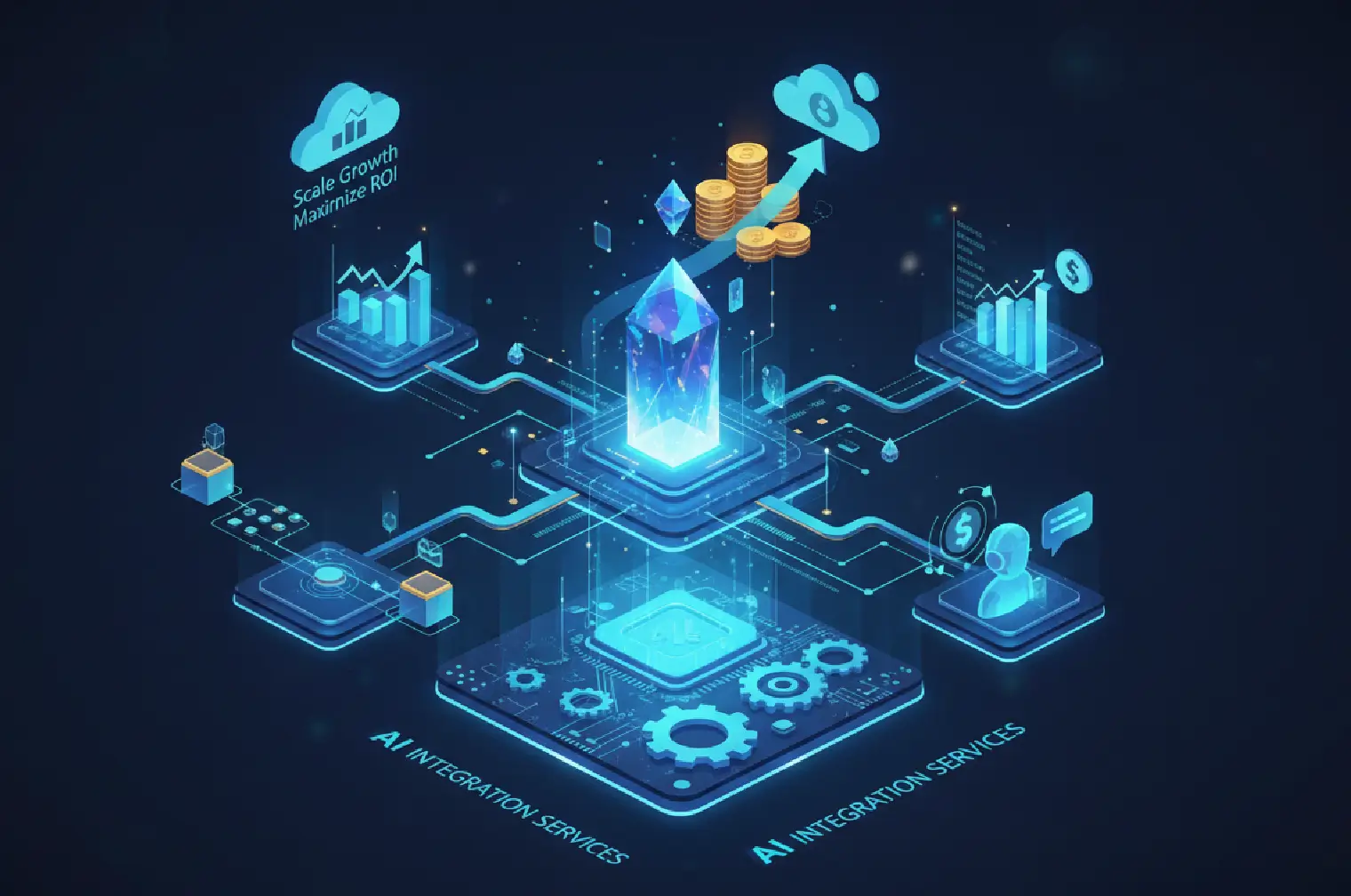
AI integration services are the deciding factor between an AI pilot that works in a demo and one that works in production.
Most enterprises that launched AI programs in 2024 and 2025 are in the same position: the proof-of-concept succeeded, but production deployment stalled. The agent answered questions in the sandbox. In the real environment, it could not reach the CRM, authentication failed on the ERP, and the data pipeline was never connected.
This is not a model quality problem. It is an integration problem.
According to Deloitte’s 2026 Tech Trends report, only 14% of organizations have production-ready agentic AI, while the majority remain stuck in experimentation. The gap between pilot and production is caused by three consistent failures: disconnected internal tools, a missing orchestration layer, and fragmented data access.
Let’s discuss what production-grade AI integration services look like in 2026, what infrastructure agentic systems require, and what enterprise leaders in technology, finance, healthcare, and logistics need to get right before they can scale.
Why AI Pilots Keep Stalling at the Same Stage
Enterprises do not fail at AI because of the model. They fail at the infrastructure layer that sits between the model and the business systems it needs to use.
The three most consistent blockers are:
- Tool connectivity gaps: The agent functions in isolation but cannot access ERP, data warehouse, or internal APIs in a live environment.
- No orchestration control: Multiple agents run independently with no shared context, no task routing, and no fallback logic when a tool fails.
- Data fragmentation: Agents make decisions on partial data pulled from siloed systems that were never designed to communicate with each other.
Solving these is not a prompt engineering task. It requires system integration and modernization work that connects AI systems to the real enterprise data layer.
The Gap Between a Copilot and a Real Agentic AI Integration
ChatGPT and Copilot deployments answer questions. An agentic AI integration takes instructions, selects tools, executes multi-step workflows, and operates with bounded autonomy.
The architecture required is fundamentally different:
- Live, authenticated connections to internal systems (CRM, ERP, HRMS, databases)
- A defined toolset the agent can call with clear permission boundaries
- Logic for handling tool failures, unexpected outputs, and edge cases
- A complete audit trail for every action the agent takes
Enterprises moving from copilots to agents cannot simply upgrade their existing configuration. They need a different custom AI solution architecture designed for tool use, decision logic, and production reliability from the start.
Stop losing enterprise revenue to manual, outdated workflows
Static automation limits your growth and drains your daily profit margins. We deliver elite AI integration services that transform your operations through seamless LLM workflow integration. Execute advanced agentic AI integration and build powerful multi-agent systems with our experts. We deploy autonomous AI agents for enterprise that scale your output and crush your overhead right now.
LLM Workflow Integration: The Layer Most Enterprises Skip
LLM workflow integration is where most enterprise agentic projects break down in 2026. Organizations deploy agents but never build the orchestration layer that manages them at scale.
What a proper LLM orchestration layer handles:
- Task routing to the right model or agent based on capability and cost
- Prompt construction, context injection, and token budget management
- Retry logic, fallbacks, and error state handling
- Cost tracking, latency monitoring, and compliance logging for every LLM call
Without this layer, every agent becomes an independent silo. Adding agents without a control plane creates a system that is impossible to monitor, audit, or scale.
IBM’s 2026 AI technology predictions identify centralized “super agent” control planes as the primary enterprise differentiator this year. Organizations that build this orchestration layer early gain a structural advantage in how quickly they can add agents as new use cases emerge.
Multi-Agent Systems: The Coordination Problem Nobody Talks About
Multi-agent systems are not inherently complicated. Uncoordinated ones are.
The actual challenge is not the number of agents deployed. It is the absence of coordination logic between them.
What coordination between agents requires:
- A shared memory or context store that agents can read from and write to
- Clear task ownership rules to prevent duplicate or conflicting actions
- A communication protocol for tool standardization across agents
- Human-in-the-loop checkpoints for decisions that carry high business risk
AI-driven automation at enterprise scale means engineering these agents as a coordinated system. Deploying them as separate tools without coordination logic is the leading cause of multi-agent system failures in production.
Five Infrastructure Requirements Every Enterprise Integration Layer Needs
AI agents for enterprise are only as effective as the systems they can reach. The integration layer determines which data the agent can access, which tools it can invoke, and which actions it is permitted to take.
- API-first connectivity: RESTful, GraphQL, or gRPC bridges between agents and internal systems. Legacy systems without modern APIs need middleware adapters or event-driven connectors.
- Role-based access control: Every agent operates within a defined permission scope and cannot access data or take actions outside its assigned role.
- Secure credential management: API keys, OAuth tokens, and service account credentials are stored and rotated securely, not hardcoded in configuration files or prompts.
- Real-time data access: Agents making time-sensitive decisions need access to current system state through streaming or low-latency query interfaces, not batch pipelines.
- Observability and tracing: Every tool call, retrieval, and model response is logged with enough context to trace decisions and actions end-to-end.
The AI integration services that deliver production results are built around this architecture from day one. Retrofitting these controls after deployment is significantly more expensive and disruptive.
Outpace your competitors with autonomous enterprise workflows
Falling behind on the 2026 AI shift costs you serious market share. We engineer dynamic multi-agent systems that solve your biggest operational bottlenecks without human intervention. Rely on our top-tier AI integration services for flawless LLM workflow integration and complex agentic AI integration. We build robust AI agents for enterprise that take immediate action and secure your market dominance.
How Industry Demands Shape Agentic AI Integration Requirements
The infrastructure requirements for agentic AI integration are not uniform. Regulated industries face additional constraints that most general-purpose AI frameworks are not equipped to handle.
Finance
AI agents in finance handle fraud detection, document review, compliance checks, and customer communication. Every action must be explainable, auditable, and regulation-compliant. Integration with core banking systems, AML platforms, and transaction databases requires real-time connectivity and strict access controls. AI-driven automation in finance workflows require data governance controls built into the integration layer, not added after the fact.
Healthcare
Agents in healthcare access patient records, clinical data, and scheduling systems. HIPAA compliance is mandatory, and integration with EHR platforms requires certified connectors and PII stripping at the data layer before any information enters the LLM. AI and automation in healthcare demand anonymization controls that cannot be optional configuration settings.
Logistics
In logistics, agents manage route optimization, inventory queries, warehouse task allocation, and supplier communication. Integrations span fleet management systems, WMS platforms, and real-time IoT or GPS feeds. Latency tolerance is low, and system uptime requirements are high.
Technology
Technology enterprises use AI agents for code review, incident management, infrastructure monitoring, and developer productivity. Integrations connect to GitHub, Jira, Slack, PagerDuty, and internal data platforms. The orchestration layer must handle concurrent agents and parallel tool calls without race conditions or duplicated actions.
Five Questions to Ask Before Choosing an AI Integration Services Provider
Not every provider builds for agentic production environments. Before committing to an approach or partner, the evaluation criteria should be direct:
- Do they build a dedicated orchestration layer, or do they rely on the model to manage tool selection?
- Do they have a documented security and compliance approach for your specific industry?
- Can they connect to your existing systems without requiring you to replace them first?
- Do they provide observability tooling so you can monitor agent behavior after deployment?
- Do they have documented production deployments in your industry vertical?
These questions separate production-grade delivery from configured API wrappers.
ViitorCloud Has Already Solved These Integration Problems for Enterprises
ViitorCloud has built AI-first software and platforms for enterprises across finance, healthcare, logistics, and technology sectors. The work includes custom LLM orchestration layers, multi-agent pipeline architecture, and secure API integration with legacy enterprise systems that were not designed for AI access.
The AI integration services at ViitorCloud delivers are structured around production requirements from the project start: API-first architecture, role-based access, real-time data connectivity, and full end-to-end observability.
Enterprises that have moved from pilot to production with ViitorCloud have not needed to rebuild their architecture mid-deployment. The integration layer was designed for scale from day one.
If your AI program is ready to move beyond the pilot stage, connect with ViitorCloud’s team to assess your current architecture and identify the integration gaps holding production back.
Turn your static data into dynamic action with intelligent agents
Fragmented software tools frustrate your teams and stall your critical decision-making. Master this technology shift with expert AI integration services that guarantee hard ROI. We bridge your tech stack through secure LLM workflow integration and custom agentic AI integration. Deploy unstoppable AI agents for enterprise powered by advanced multi-agent systems and watch your business scale effortlessly.
The Integration Layer Is the Deciding Factor in 2026
The enterprises that scale AI this year are the ones that treat integration as a first-class engineering problem and not as an afterthought.
The model is increasingly a commodity. The orchestration, tool connectivity, security controls, and observability stack are what separate a working agent from a stalled pilot.
AI integration services that address all five infrastructure requirements give enterprises a deployment that is production-ready on launch and scalable as agentic use cases expand. The pilot phase is over. The infrastructure question is what matters now.

Vishal Shukla
Vishal Shukla is Vice President of Technology at ViitorCloud Technologies.
Frequently Asked Questions
What is agentic AI integration?
Agentic AI integration connects AI agents to enterprise tools, databases, and systems so agents can take real, autonomous, auditable actions.
What do AI agents for enterprise need to function in production?
What is LLM workflow integration?
Why do most enterprise AI pilots fail to scale?