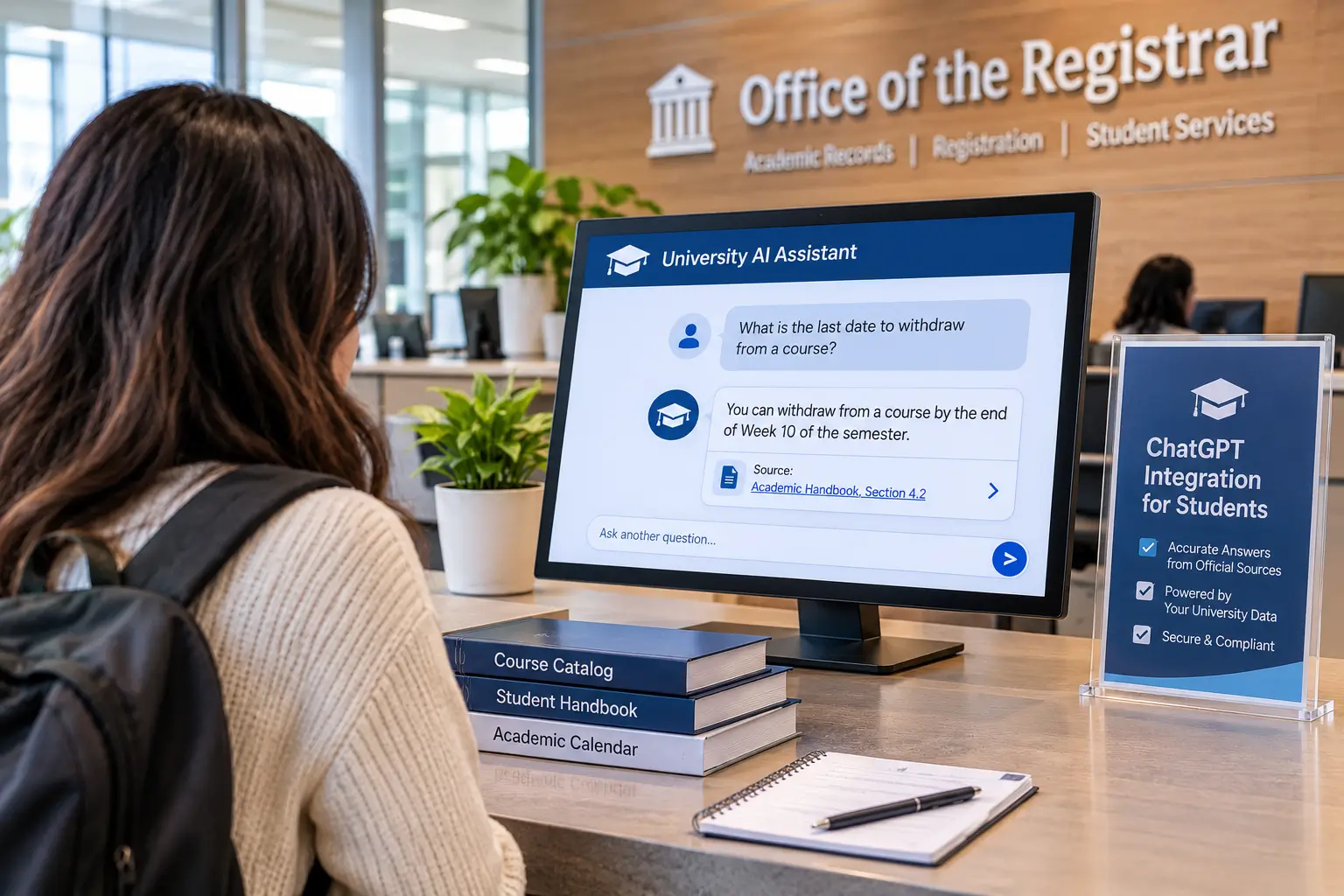
ChatGPT integration services connect OpenAI’s models to a university’s own content and systems, so a student who asks about a drop deadline or a prerequisite receives an answer drawn from that university’s current policy, with a link to the page it came from. That’s the short version. What takes longer to explain is who checks the answer, and who keeps a record of it.
Students aren’t waiting for a campus decision. In the HEPI Student Generative AI Survey 2026, 95% of UK undergraduates said they use AI in at least one way, yet only 38% said their institution provides AI tools (1,054 students, surveyed in December 2025). HEPI’s own summary is blunt: “institutional adoption is lagging behind student behavior.”
Picture a second-year student at 11 p.m. on week nine. She wants to know whether dropping a lab course now leaves a W on her transcript. She asks for a public chatbot. It answers in two seconds and sounds sure. It also quotes a withdrawal window from a different university’s handbook. Nobody on campus ever sees the question, the answer, or the mistake.
In our view, this is an integration problem first. Students will keep asking an assistant late at night, so the real choice is whether a campus-approved education AI assistant is one of the options. If it is, the university decides which documents that the assistant reads, who is allowed to see what, and where each conversation is recorded.
Key takeaways
- ChatGPT integration services put a model behind your own catalog, handbook and course pages, so answers cite your policy instead of a stranger’s.
- Accuracy is mostly a content problem. Outdated pages, conflicting sources, and the wrong catalog year cause more wrong answers than the model does.
- Access controls and logs need an owner on campus. IBM’s Cost of a Data Breach Report 2026 found that 92% of organizations hit by an AI-related breach lacked proper AI access controls.
- Test before launching with real student questions, taken from last term’s help-desk tickets and scored by the office that owns each answer.
- Some questions belong to a person, such as financial aid appeals, visa status, and accommodation requests. A good assistant hands them off fast.
Where do students’ wrong answers come from today?
Most wrong answers come from three gaps. A public chatbot has never read your catalog. Your own web pages often disagree with each other. And nobody on campus can see what students asked or what they were told. ChatGPT integration services close the first gap directly and make the other two visible enough to fix.
Start with the first gap. A general model knows how universities usually work. It doesn’t know that your engineering school moved it add/drop deadline last spring, or that your nursing program has a separate attendance rule. A general answer can sound right and still be wrong in the details that matter to one student on one date.
Gap two is quieter. A department page written in 2022 gives one deadline, the registrar page gives another, and both are still live. A person on staff knows which one wins. A chatbot doesn’t, unless someone tells it.
Gap three is visibility, and it isn’t limited to students. EDUCAUSE’s 2026 report on AI and work in higher education found that 56% of staff and faculty respondents had used AI tools their institution didn’t provide for work tasks (1,960 respondents, surveyed September to October 2025).
Unapproved use has a security cost too. IBMs Cost of a Data Breach Report 2026 found that shadow AI, meaning AI tools used without approval or oversight, was involved in 43% of the incidents studied, more than double the previous year’s share.
Give Students Answers from Your Own Policies
ViitorCloud connects ChatGPT to your catalog, student handbook and course pages, so every answer your education AI assistant gives cites a page your registrar has signed off.
What do ChatGPT integration services include for a university?
For a university, ChatGPT integration services cover the work around the model: connecting approved content sources, retrieving the right passage for each question, checking who the student is, attaching a citation to every answer, routing sensitive questions to staff, and logging each exchange. Calling the model is the smallest part of the building.
A typical campus build includes these parts:
- Content connectors for the course catalog, student handbook, registrar and financial aid FAQs, and LMS course pages, each tagged with an owner and an effective date.
- A retrieval layer that finds the passage that answers the question before the model writes a reply.
- Identity and role checks through the campus single sign-on, so an applicant, an enrolled student and a staff member each see what they’re allowed to see.
- Student context, such as program, campus and catalog year, used to filter which rules apply.
- Citations on every answer, linking to the source page.
- Handoff rules that send defined question types to a named office.
- Logs and scoring let the institution review what was asked and how well the assistant answered.
Each of these parts is standard AI integration services work, and most LLM integration projects in other sectors use the same pieces. What changes in education is the content itself: policies that change by term, by program and by the year a student enrolled.
Grounding answers in the catalog, handbook and course pages
Grounding means the assistant answers only from documents you’ve approved and shows which one it used. Engineers usually build this with retrieval-augmented generation (RAG), a setup that searches your documents first and then passes the matching passage to the model. If no approved passage matches, the assistant says it doesn’t know and points to the right office.
That refusal matters more than it sounds. A confident wrong answer about a refund deadline costs a student money. A short “I can’t confirm that, here’s the bursar page” costs them a click.
Access controls and logs the institution owns
AI access controls decide which content, and which records the assistant can reach for each user. In the US, student education records fall under FERPA, the federal law that protects the privacy of those records, so an assistant’s reading enrollment or grade data has to respect the same permissions as the student portal. UK institutions have equivalent duties under UK GDPR. This isn’t a theoretical risk: IBM’s 2026 report found that 92% of organizations with an AI-related breach lacked proper AI access controls, such as role-based access and multifactor authentication.
This is where the connection to your student information system and identity provider matters. Done properly, it’s system integration work: the assistant inherits existing roles and adds none of its own. Logs should sit in storage of the university controls; with a retention period your records office has agreed.
ChatGPT Edu or custom integration: Which one answers student questions?
ChatGPT Edu gives students, faculty and staff a managed ChatGPT workspace under a university contract. A custom ChatGPT integration puts a grounded assistant inside your own website, student portal or LMS, reading your content under your rules. Some campuses will run both, because they solve different problems.
OpenAI said in March 2026 that hundreds of universities work with it through ChatGPT Edu. On data, OpenAI’s business data privacy page states that, by default, inputs and outputs from ChatGPT Edu and from its API platform aren’t used to train its models. That covers both routes. Where they differ is reach and control.
| Question | ChatGPT Edu workspace | Custom ChatGPT integration |
| Who can use it | Licensed students, faculty and staff | Anyone you allow, including applicants without a campus account |
| Where it lives | OpenAI’s ChatGPT interface | Your website, student portal, LMS or app |
| What it reads | Sources that workspace admins connect | Only the documents and systems you wire in |
| How rules are applied | Workspace roles and admin settings | Your SSO roles plus student context such as catalog year |
| Best fit | Study help, drafting and research for licensed users | Answering policy and service questions with a citation |
If the main job is a public “ask us” box on the admissions site, a workspace license doesn’t reach those visitors. That’s custom chatbot development territory, built on the same models through the API. Custom chatbot development also lets you place the assistant inside the student portal, next to the records it’s allowed to read.
Why does the catalog year matter more than the model?
A student is usually held to the degree requirements in the catalog from the year they entered, often called their catalog year. An assistant that reads only the current catalog will give a third-year student the wrong graduation requirements, even with a strong model. Fixing that content work: dating each document and filtering the student’s year.
Here’s what that looks like in practice. A student who started in fall 2023 asks how much lab credit she must complete. Her 2023 catalog said six credits. This year’s catalog says eight. A generic answer says eight, and says it clearly, which makes the mistake harder to spot.
Our advice is to budget more time for the content inventory than for the model setup. List every source the assistant will read. Give each owner an effective date and an end date. Decide in writing which source wins when two disagree, usually the registrar over a department page, and send each conflict the assistant finds back to the owner to fix.
This part is slow, detailed work. It’s also where most of the accuracy comes from, and it keeps paying off after launch, because each corrected page helps human staff as well.
How do you test answer accuracy before students see it?
Build a test set from real student questions, usually a few hundred taken from last term’s help-desk tickets and emails. For each one, the office that owns the answer writes the correct reply and the source page. Run the assistant against the set, score every answer, and agree a pass mark before launch. Then re-run it every term.
A simple scoring scale works well:
- Correct and cited to the right source.
- Correct but uncited, which still needs fixing.
- Wrong, which blocks release if it touches money, deadlines or eligibility.
- Correctly refused, where the assistant handed off a question it shouldn’t answer.
Grounding makes a measurable difference, but it doesn’t make errors disappear. In a July 2026 arXiv paper, a team building a RAG-based university chat assistant reported that hallucinations fell from 31.7% to 6.6% in their own evaluation. Your numbers will differ, which is the point of testing on your own questions.
Connecting student data has a track record that predates generative AI. In a Georgia State University field experiment published in AERA Open, Lindsay Page and Hunter Gehlbach found that admitted students who received text guidance tied to their own enrollment tasks were 3.3 percentage points more likely to enroll on time. That system used university records to decide which reminder went to which student, which is the same principle as a grounded assistant, relies on.
Test Your Campus Assistant on Real Student Questions
Share last term’s help-desk questions. ViitorCloud turns them into a scored test set and shows where a grounded ChatGPT assistant answers correctly, answers wrongly or hands off.
Which student questions should an AI assistant hand to a person?
An assistant should hand off any question where a wrong answer changes a student’s money, legal status, academic record or safety. That includes financial aid appeals, visa and immigration questions, disability accommodations, grade appeals and misconduct cases. Any message that signals distress should route to your counseling or crisis process at once, following your institution’s protocol.
Build the handoff list with each office before launch. Pass the conversation along with the handoff so the student doesn’t have to repeat themselves. A fast “this one needs a person, here’s who” builds more trust than a long, careful sounding answer the assistant isn’t qualified to give.
A one-term rollout plan for a student support assistant
A single academic term is enough to pilot a grounded assistant with one office and one channel. Start narrow, measure against your test set, and expand only when the scores hold. Pick the office with the highest volume of repeat questions, often the registrar or financial aid, and leave advising for a later phase.
- Weeks 1 to 3, content inventory. List sources, assign owners and dates, and settle conflict rules.
- Weeks 3 to 6, build and connect. Set up retrieval, SSO roles, citations, handoff topics, and logging.
- Weeks 6 to 8, tests. Run the question set, fix content gaps, and re-run until the pass mark holds.
- Weeks 8 to 12, limited launch. Open the assistant to one student group, review logs weekly, and add new questions to the test set.
- End of term, review. Compare ticket volume and answer scores, then decide whether to add a second office.
What to ask before you choose ChatGPT integration services
Whether you compare AI integration services from one provider or a shortlist, ask these questions and expect specific answers:
- Who owns the logs, where are they stored, and can we export them at any time?
- How do you handle catalog year and other student-specific rules?
- What does the test set look like, and who signs off the pass mark?
- What happens when OpenAI changes or retires from a model, and how is the assistant re-tested?
- Can we switch models or providers later without rebuilding the content layer?
That last question matters for any LLM integration. Model versions change often, and a provider that hard-wires your content to one model leaves you rebuild at the worst time. Your content, roles, and test set should outlast any single model.
Plan a One-Term Pilot for Your Student Assistant
Start with one office and one channel. ViitorCloud scopes the ChatGPT integration, AI access controls and logging plan with your IT and registrar teams.
Where ViitorCloud’s education work fits in
ViitorCloud is a software engineering company, founded in 2011 and headquartered in Ahmedabad, that builds AI integrations, custom software and data systems. Its education work so far sits on the systems side that a grounded assistant depends on.
For a school management platform, ViitorCloud built Smart School features covering attendance, results and parent notifications, with role-based access for parents, teachers and administrators.
For a state youth employment program in Odisha, the team built an MIS portal for enrollment, training and assessment, which the case study reports have enrolled more than 5,000 students.
Neither project is a ChatGPT assistant. Both deal with the student records, roles and reporting that an assistant has to respect. For the AI layer itself, ViitorCloud’s custom AI solutions team handles retrieval, model integration, and testing.
Which student question would you trust an assistant to answer first?
If you can name it, you already have the scope for a pilot: that question type, the office that owns it, and the page that answers it. ChatGPT integration services work best when they start that small. Send us that first question and the pages that answer it, and we’ll show you what a grounded, cited answer looks like on your own content. You can reach the ViitorCloud team here.

Vishal Shukla
Vishal Shukla is Vice President of Technology at ViitorCloud Technologies.
Frequently asked questions
What are ChatGPT integration services for universities?
ChatGPT integration services connect OpenAI's models to a university's approved content and systems, such as the course catalog, student handbook, LMS and single sign-on. What students see is an assistant on the university's own website or portal that answers from current policy, cites its source, applies the student's role and catalog year, and hands sensitive questions to staff.
Can a ChatGPT integration access student records safely?
How is custom integration different from ChatGPT Edu?
Does grounding stop an AI assistant from making mistakes?
How long does a campus pilot take?