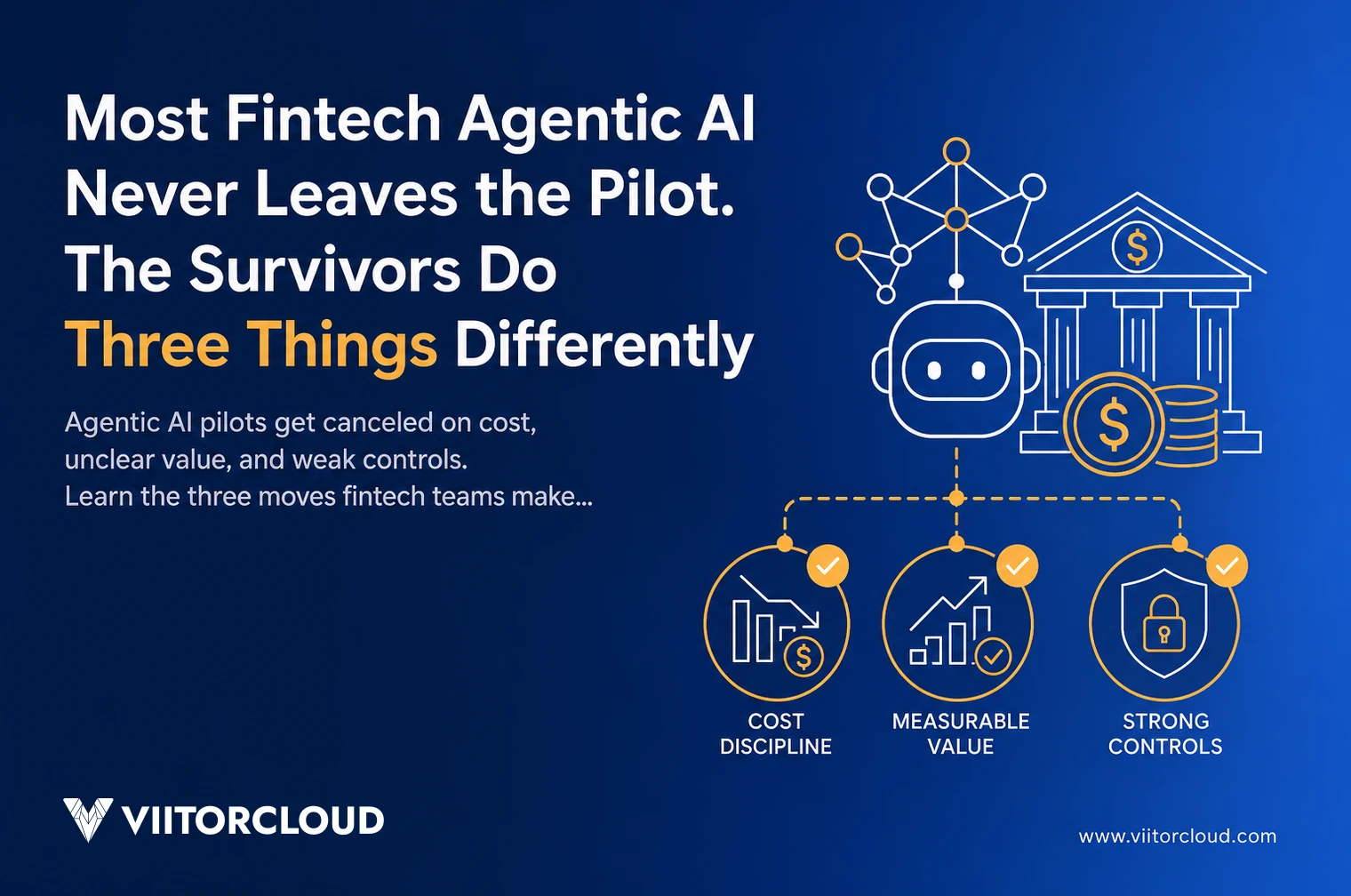
Most agentic AI pilots in fintech stall for three predictable reasons. Costs escalate, business value stays unclear, and risk controls cannot survive an audit. Gartner expects more than 40% of agentic AI projects to be canceled by the end of 2027 for exactly those reasons.
I lead AI engineering work for fintech and BFSI clients at ViitorCloud, and I see the same split every quarter. A few teams run AI agents inside live, regulated workflows. Most run polished demos that never touch production data. The gap is rarely the model.
The teams that reach production follow three habits the stalled teams skip. This article breaks them down, from scoped autonomy to agent guardrails to the multi-agent orchestration work that holds up under real volume.
Key Takeaways
- Gartner expects over 40% of agentic AI projects to be canceled by the end of 2027, citing escalating cost, unclear business value, and inadequate risk controls.
- Gartner’s 2026 Hype Cycle for Agentic AI finds that about 17% of organizations have deployed AI agents, while more than 60% plan to within two years, so the pilot-to-production gap is where budgets stall.
- Production teams give agents scoped autonomy, meaning one decision inside one agentic workflow with hard boundaries and escalation paths.
- They place human-in-the-loop checkpoints at irreversible actions and build agent guardrails that map to existing model risk frameworks.
- They treat multi-agent orchestration as an engineering discipline and fund PoC to production in phases, each with its own ROI gate.
Why Do Agentic AI Projects Get Canceled Before Production?
Agentic AI projects get canceled when spend scales ahead of proven value and when controls fail compliance review. The deployment numbers make the gap visible. Gartner’s 2026 Hype Cycle for Agentic AI puts organizations running AI agents in production at about 17%, while more than 60% plan to deploy within two years. Most agentic AI budgets stall between those two numbers.
Agentic AI means software that plans and executes multi-step work toward a goal, calling systems and making decisions along the way. That capability is exactly what makes fintech reviewers cautious. An agentic workflow that moves money or touches customer credit inherits every obligation the underlying process already carries.
Pilots feel none of that pressure. Demos run on curated data in a sandbox with an engineer watching, while production runs on messy data at volume with a regulator able to request the decision trail. Most pilots were never designed to answer that request, and that is the real PoC to production gap. I mapped the adoption side of this problem in our agentic AI playbook for business.
Scope Your First Production Agent
ViitorCloud has delivered AI and platform systems for 300+ clients since 2011, including a platform that has processed $192.2M in regulated revenue. We start with one scoped workflow, defined guardrails, and a per-phase ROI gate.
They Give AI Agents Scoped Autonomy Instead of Open-Ended Goals
Scoped autonomy is the first habit. The agent owns one decision inside one workflow, with explicit limits on the data it reads, the actions it takes, and the moment it must hand work to a person.
Stalled pilots usually start the opposite way. Last year I reviewed a lending pilot where the brief was to let an agent manage document intake end to end. It could rename files, update the loan system, and email customers. Compliance shut it down in week three, and the objection was justified.
We rescoped that agentic workflow to a single job. The agent classified three document types and extracted their fields, and everything else escalated to a human queue. That narrow version shipped. On a comparable document workflow automation build, ViitorCloud cut processing time from 15-20 minutes per document to 2-3 seconds, and the narrow scope is what made that number provable.
A scoped autonomy spec fits on one page:
- The single decision the agent owns, stated in business terms
- The data sources it can read, and nothing else
- The actions it can execute, with exposure limits on each one
- The thresholds that trigger human-in-the-loop escalation
- The rollback path when an action must be reversed
This is how autonomous software agents produce business impact without producing open-ended liability. Autonomy gets extended by evidence, one boundary at a time.
They Put Agent Guardrails and Human-in-the-Loop Reviews Where Risk Lives
The second habit is control placement. Weak pilots attach a human approval to everything, which erases the value, or to nothing, which makes the system unshippable. Production teams place human-in-the-loop checkpoints only at irreversible actions such as payments, credit decisions, and outbound customer communication.
Agent guardrails cover the rest of the surface, and the ones that pass review in banking environments are concrete:
- Action allowlists, so the agent can only call approved systems
- Exposure caps per transaction, per customer, and per day
- Full decision logging that a reviewer can replay
- A kill switch that halts the agentic workflow in one step
- Drift monitoring that compares live behavior against the tested baseline
None of this is new territory for financial institutions. Banks already govern models under frameworks such as the Federal Reserve’s SR 11-7 guidance on model risk management. The survivors extend that framework to AI agents instead of inventing a parallel one, which is also why their approvals move faster.
Human-in-the-loop is not a permanent tax either. Review rates start high and fall as the agent builds an evidence trail. We design AI systems for BFSI environments with that trust curve planned from the first sprint.
Pressure-Test Your Stalled Pilot
Bring us the agentic AI pilot that stalled. Our engineers map the gaps across scoped autonomy, human-in-the-loop controls, and multi-agent orchestration, then hand you a phased path to production.
They Engineer Multi-Agent Orchestration to Survive PoC to Production
The third habit appears the moment a second agent joins. A single-agent demo hides the hard part. Real fintech processes need multi-agent orchestration, where one agent classifies, another retrieves records, another drafts, and another checks the draft against policy.
Every handoff is a failure point. One BFSI team I met had four agents that each tested well in isolation, yet the chained agentic workflow broke on timeouts, conflicting outputs, and lost state. Nobody owned the orchestration layer. The pattern I see repeatedly is that the model is fine and the orchestration is not.
Production-grade multi-agent orchestration is standard engineering:
- Versioned prompts, models, and tools, so behavior changes stay traceable
- State management with retries and timeouts at every handoff
- An evaluation harness that replays real cases before each release
- Cost telemetry per step, because unit economics decide the rollout
PoC to production then becomes a funded sequence instead of a leap. The PoC proves decision quality on real data, a limited release proves unit economics on live volume, and full rollout proves scale. Each phase carries its own ROI gate, which is how the budget survives every review. The same discipline runs through AI and automation in BFSI operations more broadly.
Build Agents for BFSI Workflows
From document intake to exception handling, we design agentic workflows that fit existing model risk frameworks and compliance reviews in banking and fintech environments.
Where ViitorCloud Fits When Your Pilot Stalls
I work at ViitorCloud, where we have delivered software and AI systems for 300+ clients since 2011, including engagements for KPMG, DP World, and the Royal Navy. One platform we engineered has processed $192.2M in regulated healthcare revenue, the kind of money-moving workflow where agent guardrails stop being theoretical. Our custom AI solutions team applies the same phased model to agentic AI. We scope one workflow, define the guardrails with your compliance team, and gate every phase on measured ROI.
If your agentic AI program is stuck between demo and deployment, bring the pilot as it stands. A short scoping conversation is usually enough to identify which of the three habits is missing, so talk to our AI engineering team when you are ready to move.
The Pilot Was Never the Product
Agentic AI in fintech does not fail because the models are weak. It fails when autonomy is unscoped, controls are retrofitted, and orchestration is improvised. The production teams made three quiet decisions early. They gave AI agents scoped autonomy, they aligned human-in-the-loop reviews and agent guardrails with existing risk frameworks, and they funded multi-agent orchestration phase by phase from PoC to production.
Pick one workflow this quarter. Scope it to a single decision, write the guardrails with compliance in the room, and set the ROI gate for the first phase. That is the difference between the 40% of agentic AI projects that get canceled and the ones that survive.

Vishal Shukla
Vishal Shukla is Vice President of Technology at ViitorCloud Technologies.
Frequently Asked Questions
What is agentic AI?
Agentic AI is software that plans and executes multi-step tasks toward a goal with limited supervision. Unlike a chatbot that answers one prompt at a time, AI agents read data, call systems, take actions, and decide next steps inside an agentic workflow, working under guardrails and human-in-the-loop checkpoints.
Why do agentic AI projects get canceled?
Why do AI agents fail in production?
What does human-in-the-loop mean in agentic AI?
How long does it take to move an AI agent from PoC to production?