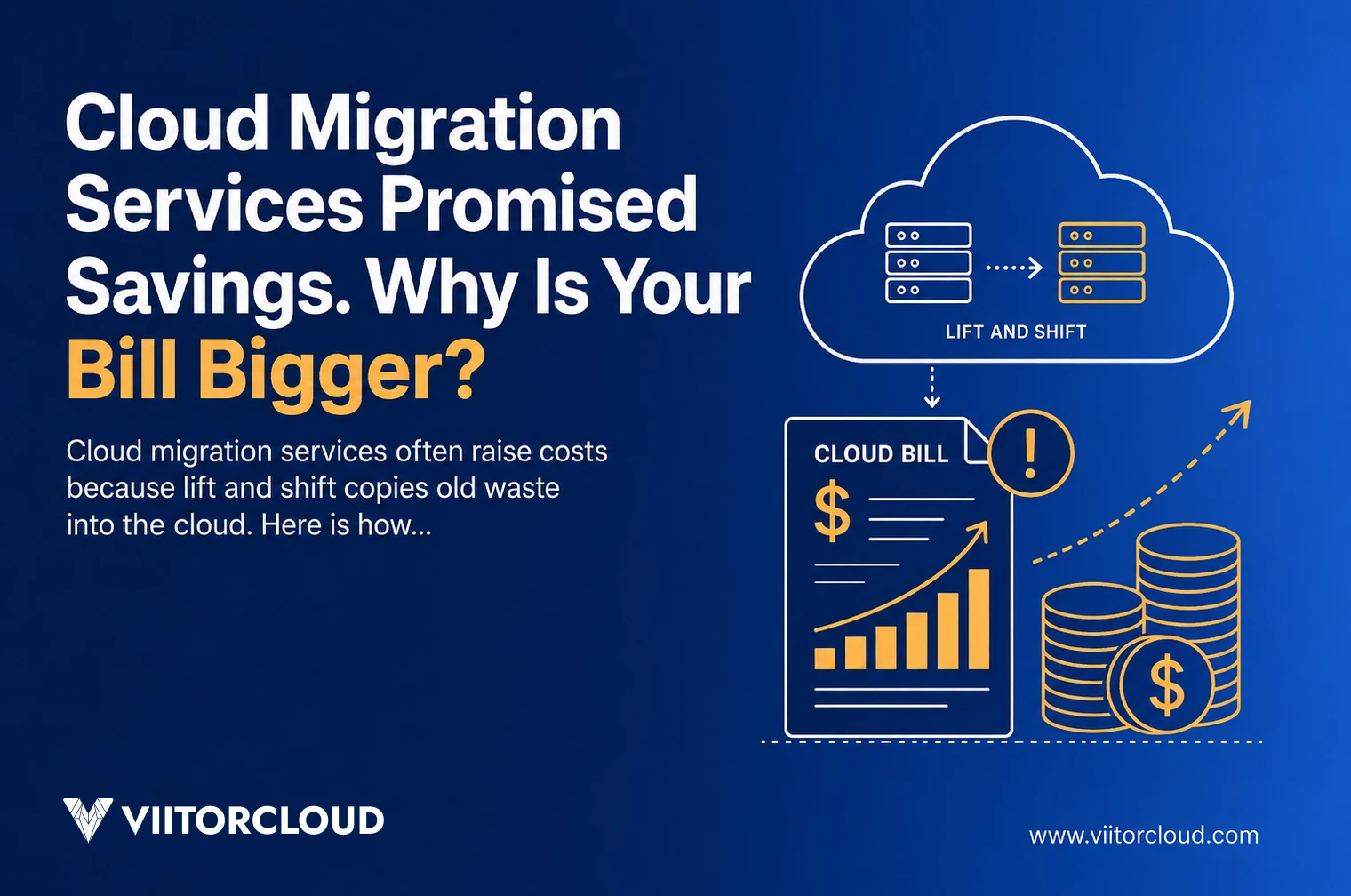
Your cloud bill went up because the move copied your old systems across unchanged. Most cloud migration services lift every server exactly as it runs today, idle capacity included, then charge you by the hour for waste that used to sit quietly inside hardware you had already bought.
I have sat through enough post-migration reviews to know how the meeting opens. Someone shares the invoice. The number is higher than the hardware line it replaced, and nothing runs any faster.
That outcome is common, and it is fixable. The savings were real. They were never automatic, because they come from changing how software consumes resources, not from changing where the software sits.
Below I break down where the extra spend comes from, what separates a fast copy from a careful move, and the questions worth asking before you sign with a cloud migration services provider.
Key Takeaways
- A single-shot lift and shift preserves every inefficiency in your old estate, so the monthly invoice reflects peak sizing that now runs 24 hours a day on metered infrastructure.
- Storage tiers, duplicate datasets, and outbound traffic make cloud data migration the most underestimated line item in most migration budgets.
- A phased cloud migration moves systems in small waves, right-sizes each one before it lands, and checks the bill after every wave instead of after the whole program.
- Cloud cost control is an engineering practice, not a procurement exercise. Tagging, autoscaling, and shutdown schedules have to be built during the move.
- Ask any cloud migration services provider for the cost model per workload before migration starts. If they cannot produce one, the invoice will surprise you.
Why Moving Old Software to the Cloud Rarely Saves Money on Its Own
Moving old software to the cloud changes the billing model before it changes anything else. On-premises, you bought capacity once and used whatever fraction of it you needed. In the cloud, you rent that same capacity by the minute.
Most legacy servers were sized for a peak that happens twice a year. That decision was free when you owned the hardware. It is not free now.
- Peak sizing becomes permanent rent: A 32-core database server averaging 8% utilization cost nothing extra on owned hardware. In the cloud, you pay for all 32 cores every hour.
- Non-production never sleeps: Development, test, and staging environments get copied across and then left running overnight and through weekends.
- Old code cannot scale down: Monolithic applications that keep session state on the local disk cannot shrink when traffic drops, so autoscaling stays switched off.
- Licensing follows the core count: Database and middleware licenses tied to cores get more expensive when the migration team oversizes instances to be safe.
None of this is a cloud problem. It is an architecture problem, and moving old software to the cloud is simply the moment it becomes visible on a monthly invoice.
Find Out What Your Cloud Estate Actually Costs
ViitorCloud baselines utilization per workload, models the target run cost before anything moves, and sequences the rest of your migration into waves you can measure against the invoice.
What Most Cloud Migration Services Quietly Carry Over
The scope of the contract usually explains the bill. Many cloud migration services are sold on speed, and speed means rehosting each workload without touching it. The estate arrives intact, along with everything in it that was already wasteful.
Three things travel across almost every migration:
- Chatty integrations: Systems that exchanged data freely across a local network now cross a metered boundary, and every call has a price.
- Backup sprawl: Seven years of snapshots move too, landing on premium block storage because nobody classified them first.
- Orphaned workloads: Every estate carries services nobody owns. In a copy-and-paste move, they become billable line items instead of decommissioning candidates.
Good cloud migration consulting services catch all three during discovery, before a single workload moves. That audit is unglamorous, and it is where most of the savings are found.
Where Cloud Data Migration Adds Cost You Did Not Budget For
Cloud data migration moves the most and gets estimated the least. Data has weight. Once it lands in the wrong place, moving it again costs money and time.
- Tier mismatch: Archive data placed on hot storage can cost several times what cold storage would.
- Parallel copies: Teams keep the on-premises copy running for months as a safety net, so you pay for both.
- Egress traffic: Reporting tools, partner feeds, and analytics jobs that pull data out are charged by the gigabyte.
- Rework: A cloud data migration that skips profiling gets redone once data quality problems surface in production.
I plan cloud data migration as its own workstream with its own budget. Classifying data before the move is far cheaper than reclassifying it afterwards, because cloud data migration decisions set your storage bill for years.
A Fast Copy and a Careful Move Do Not Cost the Same
Both approaches are sold as cloud migration services. Both get you to the cloud. They produce very different invoices, and the honest comparison looks like this.
The Quick Copy and Paste Move
- The whole estate moves in one window, often over a single weekend
- No application changes, so no code risk during the cutover
- Instance sizes mirror the old hardware, peak sizing included
- The real cost baseline is unknown until the first full invoice lands
- Optimization becomes a separate project that usually gets deferred
- Fastest exit from a data center lease, slowest return on the investment
The Careful Step-by-Step Move
- Workloads move in small waves, grouped by dependency
- Each workload is right-sized, tagged, and scheduled before it lands
- Cost per wave is measured, and the next wave is planned using that data
- Old code is refactored where refactoring pays back and rehosted where it does not
- Cloud cost control tooling goes live with the first wave, not after the last one
- Slower to finish, and materially cheaper to run
Neither is always right. If a lease expires in eight weeks, the fast copy is the sensible call, provided everyone agrees the optimization work is scheduled and funded. Understanding the difference between migration and modernization matters here, because it decides which of the two you are actually buying.
Plan the Next Wave Before You Pay for It
Our cloud migration consulting services start with a cost model for every workload, so the bill after each wave matches what was agreed in the plan rather than surprising finance 30 days later.
How Phased Cloud Migration Puts Cost Control Back in Your Hands
A phased cloud migration works because it creates feedback. You move a small group of systems, see the real bill, then adjust the plan for everything still waiting behind it.
The sequence I use on most engagements runs like this:
- Baseline first: Measure current utilization per workload across a full business cycle, not a quiet week in August.
- Right-size on paper: Model the target instance, storage tier, and runtime schedule for every workload before it moves.
- Move a low-risk wave: Start with something real but recoverable, such as internal reporting or archive storage.
- Compare the model to the invoice: Where the estimate missed, find out why and correct the model for the next wave.
- Automate the controls: Tagging, budget alerts, autoscaling, and non-production shutdown schedules go live with wave one.
- Scale the waves up: Accuracy and confidence both improve once the model has been tested against a real bill.
Cloud cost control is an operating discipline rather than a one-time cleanup. The FinOps Foundation frames it as a shared responsibility between engineering and finance, which matches what I see working in practice. Engineers make the sizing decisions and finance sees the consequence 30 days later. A phased cloud migration shortens that gap to a single wave, which is why cloud migration consulting services should begin with measurement rather than with a migration window.
A written plan matters more than it sounds. Working through a structured migration checklist keeps the cloud cost control steps in scope when the deadline tightens. Steps that live in one person’s head get skipped.
What to Ask a Cloud Migration Services Provider Before You Sign
The proposal stage is where the eventual bill gets decided. These six questions separate a cloud migration services provider who will own the outcome from one who will hand over a running estate and an invoice.
Strong cloud migration consulting services answer all six without hedging.
- Can you show the target run cost per workload?
Not a total. A number for each system, with the assumptions behind it. - What is your right-sizing method?
Ask which utilization data they use and over what period. - Who owns the bill after go-live?
Optimization with no named owner does not happen. - How is cloud data migration priced?
Storage tiering, transfer, and parallel running should all be itemized separately. - Which workloads would you refactor and which would you leave alone?
A provider with no opinion here has not read your estate. - What happens if wave one costs more than modeled?
The answer should describe a correction process, not a change request.
The refactor question matters most. Some legacy systems repay modernization quickly and others never will, so knowing the difference between refactoring and replacing stops you paying cloud rates for code that should have been retired. Vendor guidance says the same thing in different words. The AWS cost optimization pillar is built around measuring demand before provisioning capacity, which is precisely the step a rushed migration skips.
Modernize the Systems Driving the Bill
Some legacy workloads repay refactoring within months and others never will. We identify which is which before you pay cloud rates for code that should have been retired.
How I Would Sequence Your Next Cloud Move
The systems my team runs in production are why I argue for phasing. The port management platform we built for DP World is live across 14 active sites in more than 10 countries, added site by site since 2016 rather than in one cutover. The travel platform we engineered at ViitorCloud for MariDeal processed $7.1M of revenue in 72 hours during a single Black Friday, which only works when capacity scales up for the peak and back down afterwards.
Both cases follow the rule that governs your bill. Capacity should follow demand, and demand should be measured before it is provisioned. If your cloud spend is climbing while performance stays flat, the ViitorCloud system integration and modernization team can baseline the estate, model the target cost per workload, and sequence the remaining moves into waves you can verify. Cloud migration consulting services are worth the most before the next wave, not after it.
The Bottom Line on Cloud Migration Costs
A bigger bill after a cloud move is not evidence that the cloud is expensive. It is evidence that the move preserved what the old environment was hiding. Peak sizing, idle non-production, unclassified data, and chatty integrations all become visible the moment somebody meters them.
Three things to take from this. Cloud migration services priced purely on speed will move the waste along with the workload. Cloud cost control has to be engineered during the migration through tagging, scheduling, and right-sizing. A phased cloud migration gives you real invoice data early enough to change the plan while it still costs nothing to change it.
If the first move did not deliver the savings, the second one still can. Start by baselining what you are paying for, one workload at a time.

Vishal Shukla
Vishal Shukla is Vice President of Technology at ViitorCloud Technologies.
Frequently Asked Questions
Why did my cloud bill go up after moving to the cloud?
Because a lift and shift move copies your existing sizing into a metered environment. Servers built for an annual peak now bill for that peak every hour, non production environments run overnight, and old data lands on premium storage tiers. The waste existed before. The cloud simply put a price on it.
How are cloud migration services usually priced?
Is lift and shift ever the right choice?
What is a phased cloud migration?
How do I get cloud costs under control after a migration?