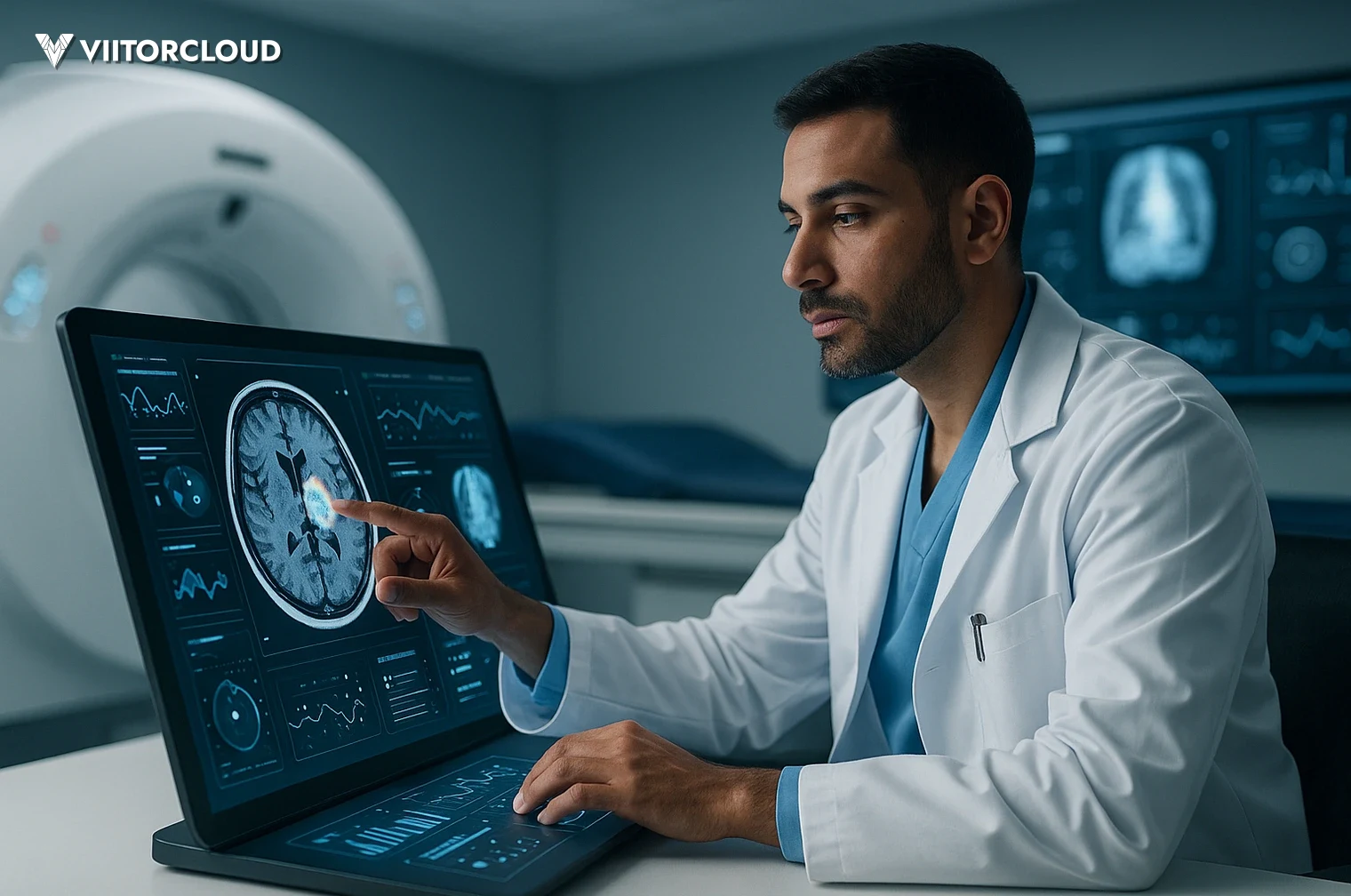
Machine learning for medical imaging works by training models, usually deep convolutional or transformer networks, to detect, segment, and classify findings in X-rays, CT, MRI, mammography, and digital pathology. The hard part was never hitting a high diagnostic AI accuracy score in a research notebook. It’s turning that score into a model that holds up on unfamiliar scanners, earns clinician trust, slots into the radiology workflow, and survives regulatory review.
Here’s the counterintuitive part: the most dangerous imaging model isn’t the one that fails its test set. It’s the one that quietly passes, ships, and then degrades the first time it meets a scanner, protocol, or patient population it never saw in training. If you lead AI, data science, or clinical innovation, you already feel this tension. The demo dazzles. The deployment stalls. The gap between those two moments is where most healthcare AI budgets go to die, and it’s exactly where disciplined machine learning development services prove their value.
This guide walks the full path from diagnostic AI accuracy to real clinical deployment. We’ll cover how production performance is actually measured, how to make medical imaging AI explainable enough to trust, how to wire models into PACS and reporting workflows, how to clear the FDA and EU regulatory bar, and what a deployment-first engineering partner does differently. It’s written for the people who own that outcome, not just the proof of concept.
Key Takeaways
- Most medical imaging AI models fail in deployment, not development, because of dataset shift across scanners, sites, and patient populations, not weak algorithms.
- Real diagnostic AI accuracy depends on calibration, subgroup performance, and prospective validation, not a single AUROC from a curated test set.
- Clinicians ignore black-box outputs; explainable imaging AI with region overlays and uncertainty scores is what gets ML adopted at the point of care.
- Workflow integration through DICOM, PACS, and FHIR, plus regulatory readiness for SaMD, the FDA, and the EU AI Act, decides whether a model ever reaches patients.
- Deployment-first machine learning development services pair model building with MLOps, drift monitoring, and governance from the first sprint.
Why Medical Imaging Machine Learning Models Stall Between the Lab and the Clinic
The single biggest reason imaging models stall is dataset shift: the model learns the statistical quirks of its training data instead of the disease. A network trained on one vendor’s CT scanners can lean on subtle acquisition artifacts that vanish, or even invert, on another vendor’s hardware. Performance that looked locked in at 0.95 AUROC quietly slides into the low 0.80s at a new hospital.
This isn’t hypothetical. Published external-validation research has repeatedly shown that imaging classifiers which excel on their home dataset generalize far worse to outside institutions, sometimes because they learned to recognize a hospital’s equipment or markup tokens rather than the pathology itself. The model wasn’t wrong on its own data. It was solving the wrong problem.
Three confounders cause most of this drift:
- Acquisition variation: scanner vendor, field strength, slice thickness, and reconstruction kernels all change the pixel distribution.
- Population shift: disease prevalence, demographics, and comorbidities differ across sites, which moves the decision boundary.
- Label noise: retrospective labels pulled from reports carry the original radiologists’ inconsistencies straight into the model.
Consider a scenario imaging teams know well. Dr. Anika Rao, an informatics lead at a mid-sized health system, inherits a stroke-detection model with glowing internal numbers. In a silent trial on live scans, its sensitivity drops sharply on the overnight CT unit, an older machine underrepresented in training. Nothing was faulty. The model simply never learned that scanner. Catching that before go-live is the whole game.
If your imaging models look brilliant in validation but you can’t yet predict how they’ll behave on day one in production, that’s the gap to close first. Our machine learning engineering team builds that production-readiness check into the model itself, not into a postmortem.
Move Your Imaging Model From Lab to Bedside
Our machine learning development services turn high-accuracy models into explainable, workflow-integrated, compliant clinical AI. Let’s map your deployment path together.
What Diagnostic AI Accuracy Really Means Once a Model Is Live
In production, ‘accuracy’ is a misleading headline number. A model can post 95% accuracy and still be clinically useless if the 5% it misses are the urgent cases. What matters is the full picture of how a model behaves against real prevalence and real consequences.
These are the measures that actually predict clinical safety:
- Sensitivity and specificity: the trade-off between catching disease and crying wolf, tuned to the clinical cost of each error.
- PPV and NPV: predictive values shift with disease prevalence, so a model strong in a screening population can stumble in a referral center.
- Calibration: when a model says it’s 80% confident, is it right 80% of the time? Poorly calibrated diagnostic AI erodes trust fast.
- Subgroup performance: accuracy broken out by age, sex, scanner, and site, so a strong average doesn’t hide a failing subgroup.
Equally important is how that performance was earned. A number from a curated, retrospective test set is a hypothesis. A number from a prospective, multi-site evaluation on consecutive real patients is evidence. The distance between those two is where overconfident machine learning models get into trouble, and why mature teams insist on external validation before anyone signs off on a deployment.
Earning Clinician Trust With Explainable Imaging AI
A radiologist will not stake a diagnosis on a number with no reasoning behind it, and they shouldn’t. The fastest way to kill an otherwise strong model is to ship it as a black box that prints a probability and nothing else. Explainability isn’t a compliance checkbox here; it’s the adoption strategy.
Practical explainability for medical imaging AI usually combines several layers:
- Localization overlays: heatmaps or region highlights, such as saliency maps, Grad-CAM, and bounding boxes, that show where the model is looking.
- Uncertainty estimates: a calibrated confidence score and a ‘defer to human’ flag when the input is out of distribution.
- Case-level rationale: similar prior cases or structured findings the clinician can verify in seconds.
Trust also comes from honest validation. Reporting how ML in healthcare performs across subgroups, disclosing where it underperforms, and running it in shadow mode alongside clinicians before it influences decisions all build the credibility that turns a pilot into standard practice. A model that says ‘I’m not sure, look closer’ is often more valuable than one that’s confidently wrong.
Stuck Between Validation and Deployment?
Get a deployment-readiness review of your medical imaging AI covering dataset shift, validation gaps, and PACS integration risks before you scale.
Fitting Machine Learning Into the Clinical Workflow, Not Around It
The best model in the world fails if using it means extra clicks. Clinical adoption lives or dies on workflow integration: the output has to appear where radiologists already work, in the rhythm they already have. That means deep integration with the imaging stack, not a separate dashboard nobody opens.
Real model deployment in imaging touches several systems:
- DICOM and PACS: results returned as structured objects or secondary captures that surface inside the existing viewer.
- RIS and reporting: findings pre-populated into the structured report, with the radiologist as final authority.
- HL7 and FHIR: interoperable messaging so results and worklist priorities flow across the EHR.
- Worklist prioritization: flagging likely-critical studies so they rise to the top of the queue automatically.
Latency and fail-safes matter just as much. If inference adds two minutes to every read, it won’t be used; if the service goes down, the workflow has to continue untouched. Picture a chest-CT triage tool that was accurate but required a separate login and a 90-second wait. Radiologists quietly stopped opening it within a week. The fix wasn’t a better model; it was clinical ML delivered invisibly inside the worklist they already used.
If you’re scoping a rollout, the integration design deserves as much attention as the model. Talk to our ML engineering team about a workflow-integrated pilot before you commit to a full build.
Clearing the Regulatory Bar Without Stalling the Roadmap
For most diagnostic imaging models, the software is a regulated medical device, and treating regulation as an afterthought is the surest way to lose a year. Building the evidence trail while you build the model is far cheaper than reconstructing it later.
The essentials to plan for early:
- Software as a Medical Device (SaMD): the FDA’s framework for AI-enabled devices expects documented intended use, validation, and risk controls.
- Predetermined Change Control Plans: a defined way to update a learning model post-clearance without a fresh submission for every retrain.
- The EU AI Act and MDR: medical AI is classed as high-risk, with strict requirements for data quality, transparency, and human oversight.
- Privacy and governance: auditable data lineage, de-identification, and access controls that satisfy health-data rules across jurisdictions.
None of this has to slow the science. When documentation, validation, and post-market monitoring are designed into the pipeline from the start, regulatory readiness becomes a byproduct of good engineering rather than a separate scramble at the end.
Build Clinical ML That Holds Up in Production
From MLOps and drift monitoring to FDA and EU AI Act readiness, we engineer healthcare ML for the long run.
What Deployment-Ready Machine Learning Development Services Look Like
Most teams can train a model. Far fewer can keep one safe, accurate, and compliant in production for years. That’s the real test of machine learning development services for healthcare, and it’s why model building is only the first third of the work.
A deployment-first engagement is built around the full lifecycle:
- Robust data pipelines: curation, de-identification, and harmonization across scanners and sites to fight dataset shift before training begins.
- MLOps and monitoring: a model registry, versioning, and live drift detection that flags when real-world performance starts to slip.
- Explainability and validation baked in: overlays, uncertainty, and external testing as standard deliverables, not extras.
- Governance and security: audit trails, role-based access, and the documentation regulators and hospital IT both demand.
This is where pairing imaging expertise with broader custom AI development pays off: the same engineering discipline that ships a reliable model also builds the data infrastructure, integration layer, and monitoring around it. The goal isn’t a model that wins a benchmark. It’s clinically deployable, explainable AI that a health system can trust on a Tuesday morning two years from now.
The organizations that succeed treat deployment as the product. They scope monitoring, retraining governance, and workflow integration in the first planning sprint, not after the model is ‘done’.
From Diagnostic AI Accuracy to Clinical Impact
The leap from a high validation score to a model clinicians rely on is the defining challenge of healthcare AI, and it’s an engineering problem as much as a data-science one. Get it right and machine learning becomes a quiet, trusted second reader. Get it wrong and you’ve built an expensive demo.
The teams that cross the gap do a few things consistently:
- They measure real-world performance, not just curated benchmarks, and validate prospectively across sites.
- They make imaging AI explainable and run it in shadow mode to earn clinician trust.
- They design workflow integration and regulatory evidence in from the start, not after.
- They invest in MLOps and monitoring so accuracy holds up long after launch.
If you’re ready to move a medical imaging AI model from the lab toward real clinical deployment, that’s the conversation worth having now. Book a consultation with our machine learning development services team and we at ViitorCloud, will map your model’s path to the bedside, from validation to compliant, workflow-ready deployment.

Vishal Shukla
Vishal Shukla is Vice President of Technology at ViitorCloud Technologies.
Frequently Asked Questions
What is machine learning for medical imaging?
It uses trained models to detect, segment, and classify findings in medical scans like X-ray, CT, MRI, and pathology images.
Why do medical imaging AI models fail after deployment?
How is diagnostic AI validated for clinical use?
Do medical imaging AI models need regulatory approval?