The retail platforms that stay online through Black Friday run on an event-driven microservices architecture, not a single monolithic codebase. When traffic climbs 10 times in an hour, independent services scale on their own, and a failure in one does not take down the whole store. That is the core reason to re-platform before your next peak.
I have watched this play out with real numbers. One travel and deals platform we engineered at ViitorCloud processed $7.1 million in revenue in just 72 hours during a single Black Friday sale, part of $46.4 million generated overall. Peak did not break it, because the architecture underneath was built to absorb the surge.
Most retail engineering teams already sense their monolith is the risk. This guide covers what event-driven microservices actually are, how headless and composable commerce fit in, and how a phased approach to microservices development lets you re-platform without stopping the business.
Key Takeaways
- A monolithic commerce platform scales as one block, so a spike in checkout can take the entire store offline at the worst possible moment.
- Event-driven architecture lets services communicate through events, so the catalog, cart, and payment run and fail independently.
- Headless commerce and composable commerce separate the storefront from back-end services, giving teams best-of-breed components and faster releases.
- Cloud-native development with containers and autoscaling turns “handle more traffic” into an automatic response instead of a 2 a.m. emergency.
- You do not need a full rebuild. A phased, strangler-style migration re-platforms the riskiest services first while the business keeps running.
Why Monolithic Commerce Platforms Buckle Under Peak Traffic
A monolithic commerce platform packages the catalog, search, cart, checkout, promotions, and account management into one deployable unit. That design is simple to start with. Under peak load, it becomes the problem.
When everything shares the same process and database, one hot path drags down the rest. I have seen a flash-sale promotions query exhaust a connection pool and take checkout, search, and product pages down together. Shoppers stared at spinning carts while the marketing team watched conversions fall in real time.
The stakes at peak are not small. In 2024, U. S. shoppers spent a record $10.8 billion online on Black Friday alone, with Cyber Monday reaching $13.3 billion, according to Adobe Analytics. An hour of downtime inside that window is revenue you never recover.
The pressure is heavier for omnichannel retailers syncing stores, apps, and marketplaces. By some retail technology estimates, only about 12% of retailers have the infrastructure to run true omnichannel. A rigid stack that cannot scale independently is why many retail technology teams dread their busiest day instead of banking on it. A microservices architecture removes that single point of failure by giving each capability its own runtime and its own scaling rules.
Re-Platform Before Your Next Peak Season
Scope a proof-of-concept that moves your riskiest commerce service to event-driven microservices, then validate it under real peak load.
What Event-Driven Microservices Architecture Actually Means
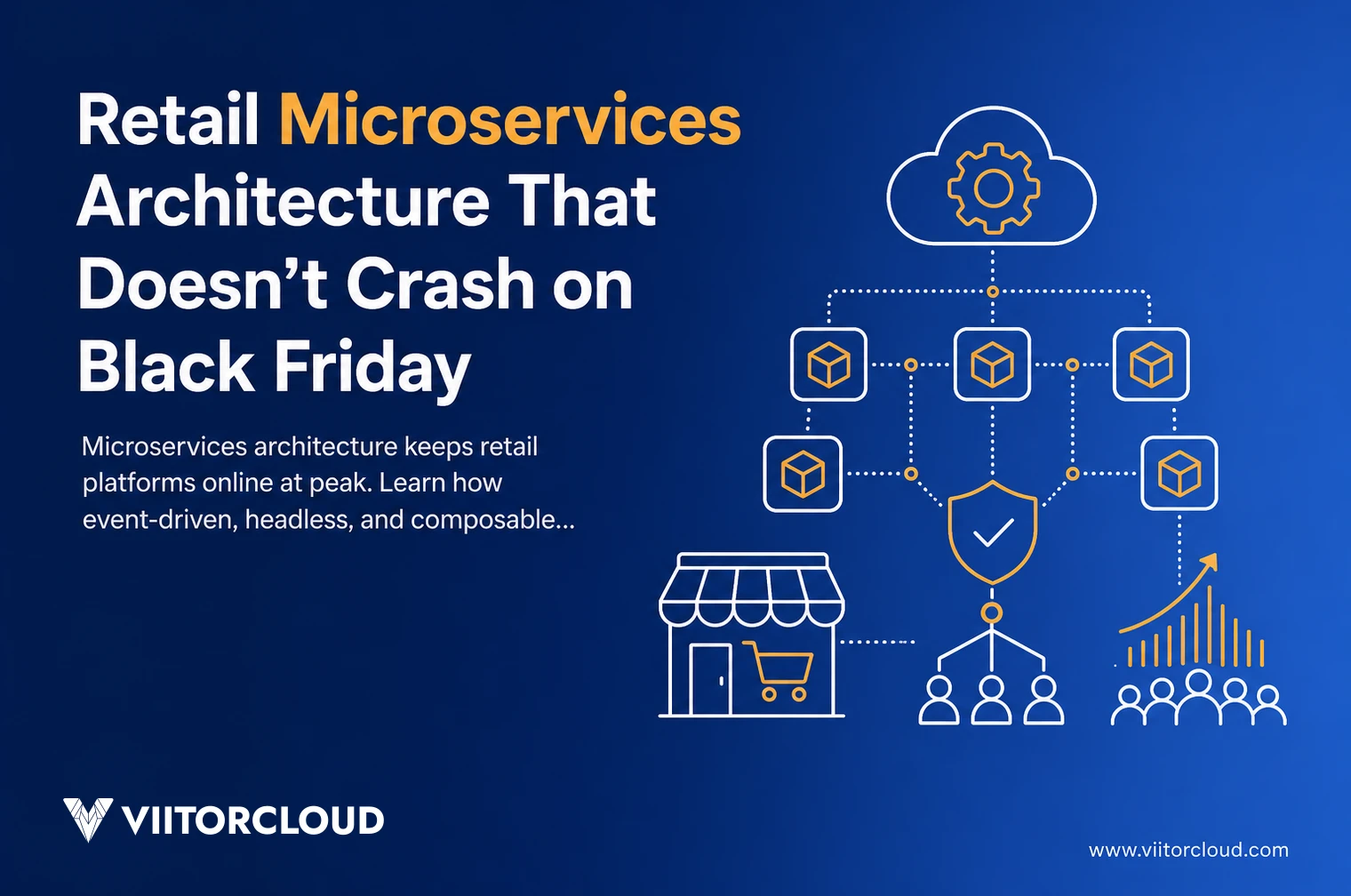
A microservices architecture breaks a commerce platform into small, independent services that each own one job, such as pricing, inventory, cart, or payment. Each service deploys, scales, and fails on its own. Event-driven architecture is how those services talk to each other.
Instead of calling each other directly and waiting, services publish events to a message broker. “Order placed” is an event. The inventory service, the email service, and the analytics service each react to it on their own schedule. Nothing blocks waiting for a slow downstream call. If you want a retail-specific primer, our breakdown of how microservices work in a retail setting goes deeper on the patterns.
How Events Keep Checkout Alive When a Service Slows Down
This is the part that saves Black Friday. If the recommendation service falls behind during a spike, the event queue absorbs the backlog and checkout keeps processing. An event-driven architecture keeps the failure contained. In a monolith, that same slowdown would compete for the same threads and stall the purchase.
Here is what an event-driven architecture buys a retail platform at peak.
- Independent scaling, so you add capacity only to the services under load.
- Fault isolation, so one failing service does not cascade into a full outage.
- Asynchronous processing, so spikes are queued and handled instead of dropped.
How Headless and Composable Commerce Fit Together
Two terms come up constantly in retail re-platforming, and teams often blur them. Headless commerce separates the customer-facing storefront from the back-end commerce services and connects them through APIs. Your web, mobile, and in-store screens all pull from the same services without being locked to one front end.
Composable commerce goes a step further. Instead of one vendor’s suite, you assemble best-of-breed components, a search service here, a payment service there, a content system somewhere else, each swappable through APIs. Composable commerce is a strategy, not a product you buy off a shelf, and headless commerce is usually its first building block.
The business case is speed. Gartner has projected that organizations adopting a composable approach would outpace competitors by 80% in the speed of new feature implementation, according to its research. When you can update the checkout service without redeploying the catalog, you ship faster and break less.
Front-end performance matters here too. Pairing headless commerce with a modern framework is how teams build fast, scalable storefronts that hold up when traffic multiplies. That combination is what makes a composable commerce strategy feel fast to the shopper, not only the engineer.
Talk to a Retail Platform Engineer
Get a direct assessment of whether your commerce stack will hold at peak and where a phased microservices migration should begin.
Building for Elastic Scale With Cloud-Native Development
A microservices architecture only delivers elastic scale when it runs on infrastructure built for it. Cloud-native development means packaging each service in a container, orchestrating those containers with a platform like Kubernetes, and letting the system add or remove instances automatically based on real demand.
During a Black Friday spike, checkout and payment might need 20 times their normal capacity while the account service barely moves. Because the services already use an event-driven architecture, scaling them individually is straightforward. Cloud-native development lets you scale only what is under pressure, then scale back down when the surge passes. You pay for the peak, not for a year of idle servers sized for one day.
A platform lead I worked with had been over-provisioning for peak all year, spending budget on capacity that sat idle 360 days out of 365. After moving to autoscaling services, the same store handled its biggest sale on a fraction of the standing infrastructure and scaled to the surge in minutes.
Getting there usually means moving from a legacy stack to cloud-native architecture in deliberate steps. Cloud-native development is the difference between hoping your servers hold and knowing they will.
A Phased Path to Microservices Without Stopping the Business
The biggest fear I hear from retail CTOs is a risky big-bang rewrite that stalls the roadmap for a year. Sound microservices development does not work that way. The proven path to a microservices architecture is incremental.
You wrap the monolith and peel off one capability at a time. Start with the service that hurts most at peak, often checkout or inventory, build it as an independent service, and route traffic to it while the monolith handles the rest. Each release lowers risk instead of adding it. This is the “think big, start small” approach we apply across engagements.
Signs Your Commerce Platform Is Due for Re-Platforming
- The site slows or crashes during every major sale or campaign.
- A small change forces a full redeployment and regression test of everything.
- Adding a new sales channel or region takes months instead of weeks.
- Personalization is hard because customer data is trapped inside the monolith.
If two or more of those sound familiar, sequencing the migration matters more than the tools you pick. Structured system integration and modernization keeps each phase of microservices development shippable, tested, and reversible.
See How We Build Peak-Ready Commerce
Explore how ViitorCloud engineers event-driven, cloud-native retail platforms that scale elastically through Black Friday demand.
Re-Platforming Retail Before the Next Peak Season
Peak traffic rewards the retailers who prepare their architecture early. The travel and deals platform I mentioned did not survive Black Friday by luck. It ran on services designed to scale under exactly that kind of load, which is how it moved $7.1 million in 72 hours.
At ViitorCloud, we have delivered this pattern across 300+ projects, re-platforming monoliths into event-driven, cloud-native systems through disciplined microservices development. If you are scoping a re-platform, the engineering approach behind that peak-ready commerce build is a useful reference before you commit to a microservices architecture. Start with a proof-of-concept on your riskiest service, validate it under load, and scale what works.
The Retailers Who Win Peak Season Re-Platform First
A monolithic platform is the single biggest reason retail sites crash on Black Friday. A microservices architecture fixes that by making services scale and fail independently, event-driven communication keeps checkout alive under load, headless and composable commerce speed up releases, and cloud-native development turns scaling into an automatic response.
You do not have to rebuild everything at once. Start with the service that fails first at peak, prove it, and expand from there. The retailers who treat re-platforming as a phased program of microservices development, rather than a one-time gamble, are the ones who bank their biggest days instead of dreading them. Your next peak is a deadline worth designing for.

Vishal Shukla
Vishal Shukla is Vice President of Technology at ViitorCloud Technologies.
Frequently Asked Questions
What is event-driven microservices architecture?
It is a design where independent services communicate through events, so each one scales and fails on its own.
What is the difference between headless commerce and composable commerce?
How do microservices stop retail sites from crashing on Black Friday?
Do I need to replace my whole platform to adopt microservices?