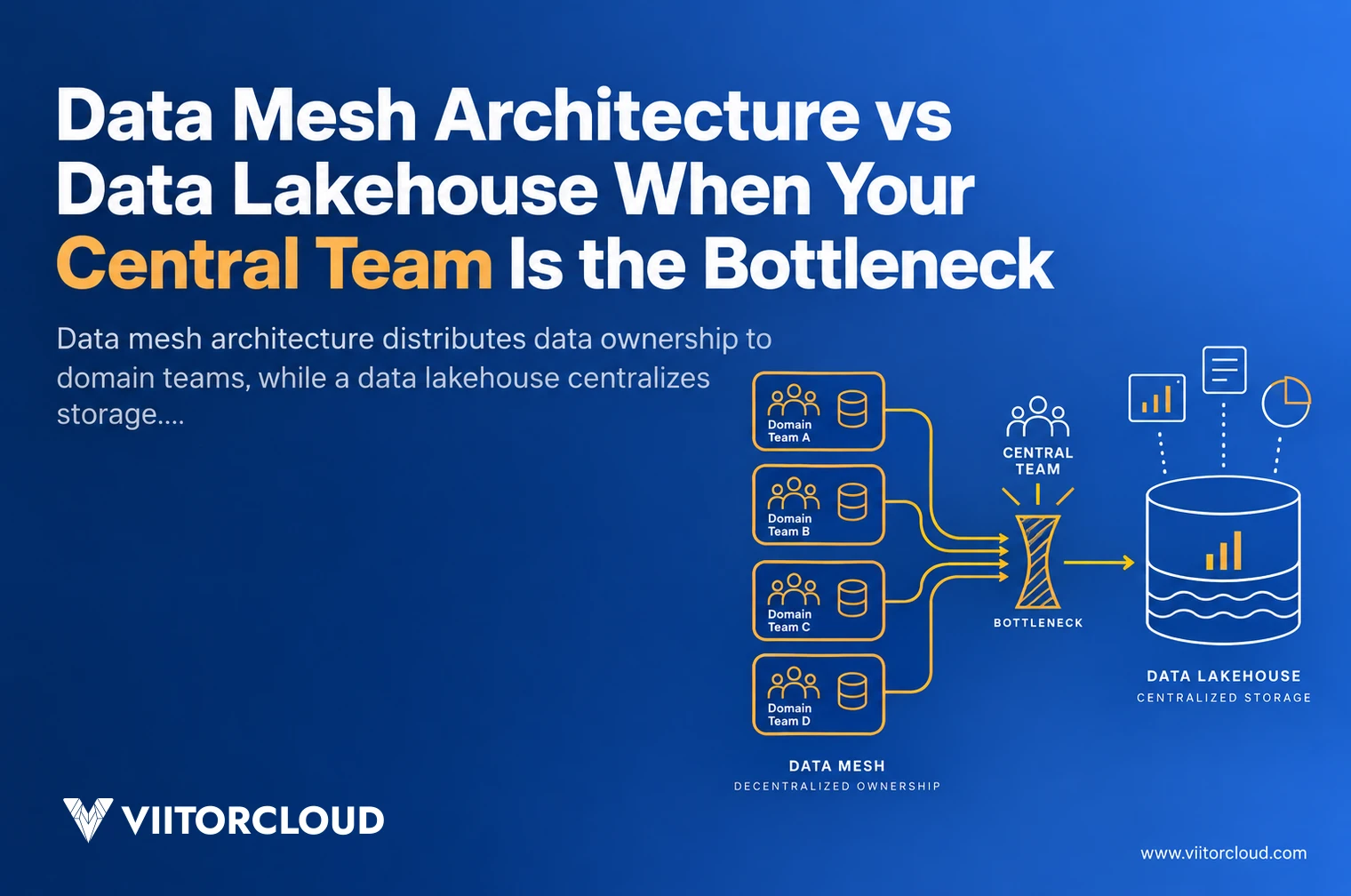
A data mesh architecture distributes data ownership to the domain teams that produce the data, while a data lakehouse centralizes storage and compute in a single platform. The mesh answers who owns, publishes, and supports a dataset. The lakehouse answers where data is stored and queried. One is an operating model with federated data governance; the other is infrastructure.
Here is the part most architecture debates skip. If five product squads wait three weeks for a pipeline change, your storage layer is not the problem. Your central data team is the queue, and separating storage from compute does not clear a queue.
I have spent years building data platforms for logistics, healthcare, and commerce clients, and the pattern repeats in almost every mid-market engagement. Below I compare both models on ownership, governance, and platform role, then set out the implementation sequence I use when a mesh is genuinely the right call.
Key Takeaways
- A data lakehouse solves storage and compute economics. It does not change who owns a pipeline, so the central team remains the queue.
- Data mesh architecture moves ownership to domains, publishes data as versioned products, and reduces the central team to a platform and standards role.
- The four data mesh principles are domain-driven data ownership, data as a product, a self-serve platform, and federated data governance.
- Below, roughly three real data domains and one product line, a lakehouse with clear service levels beats the coordination cost of a mesh.
- Most data mesh implementation work stalls because governance was written after the first domain shipped. Contracts and shared identifiers come first.
Why Your Central Data Team Became the Bottleneck
Count the queue before you redesign the stack. Five product squads, each shipping a model or a dashboard, all filing requests to one data team of six or eight engineers. Every request competes with four others, and priority goes to whoever escalates hardest.
The team is not slow. The structure is serial.
The context problem is worse than the capacity problem. On the port management platform my team built for a global operator, cargo data flows from 14 active sites across 10 or more countries, and those sites do not agree on much. Some measure in TEU containers, others in metric tons of general cargo. Local operations know what a valid record looks like at their own berth. A central engineer three time zones away does not.
So the central team writes a transformation, the domain reviews it two weeks later, and the correction round begins. Multiply that by five squads and the quarter disappears.
Scale sharpens it. A livestock monitoring system we built pulls more than 1 million data points a day from over 15,000 sensors, and every schema change in that stream touches downstream models. When one team owns every change, the change rate is capped by that team’s headcount rather than by demand. Disciplined data pipeline development raises the ceiling. A data mesh architecture removes it.
What Data Mesh Architecture Actually Changes About Ownership
Data mesh architecture is an operating model, not a product you buy. It rests on four data mesh principles that AWS describes in its own architecture guidance, and each one moves a specific responsibility off the central team.
- Domain-driven data ownership: The team that generates the data owns the pipeline, the schema, and the fixes. Payments owns payment data. Fulfillment owns shipment data.
- Data as a product: Each domain publishes discoverable, documented, versioned datasets with a named owner and a stated service level.
- Self-serve data platform: The central team builds paved paths for ingestion, storage, transformation, and access so a domain engineer can ship without filing a ticket.
- Federated data governance: Global rules for identity, privacy, quality, and interoperability are agreed once and enforced automatically inside the platform.
Read those four together, and the real change is obvious. The central team stops being a build shop and becomes an enablement team whose output is standards, tooling, and guardrails.
That reassignment is the hard part. The data mesh implementation efforts I see rarely stall on technology. They stall because nobody rewrote the central team’s job description, so the same engineers keep absorbing tickets while also being asked to build the platform.
Find Out Where Your Data Delivery Actually Stalls
We assess domain readiness, platform maturity, and governance gaps before any build starts, so the ownership model you pick survives contact with production.
Data Mesh vs. Data Lakehouse Across Ownership, Governance, and Platform Role
These two are not competing purchases in most cases. A lakehouse is often the substrate a mesh runs on. The comparison matters because leaders keep buying the lakehouse and expecting the delivery speed of a mesh. Here is where data mesh vs. data lakehouse actually diverges.
- Ownership:
Lakehouse: one central data team owns ingestion, modeling, and quality for every domain.
Mesh: each domain owns its data products end to end. - Governance:
Lakehouse: central policy applied by the platform team and reviewed manually.
Mesh: federated data governance where a shared council sets global rules and domains implement them locally. - Platform role:
Lakehouse: the platform is the destination.
Mesh: the platform is the paved road and the destination is a catalog of published data products. - Delivery speed:
Lakehouse: bounded by one backlog.
Mesh: bounded by each domain’s own capacity, running in parallel. - Main failure mode:
Lakehouse: a queue that grows faster than the team.
Mesh: inconsistent definitions and duplicated pipelines when governance lags adoption.
Choosing between them is simpler than the debate suggests. Stay with a lakehouse when one team can realistically hold the operational context of every domain. Move to a data mesh architecture when it cannot, and when your domains already employ engineers capable of data product engineering.
When a Data Lakehouse Alone Is Still the Right Call
I talk clients out of a mesh regularly. It carries real coordination cost, and below a certain size that cost is pure overhead.
Stay centralized when most of these are true:
- You have three or fewer genuine data domains and a single product line.
- No domain team has an engineer who can own a pipeline alongside their existing roadmap.
- Your platform is still being migrated, and the paved paths do not exist yet.
- Your backlog is a staffing problem rather than a context problem, and two more engineers would clear it.
That last point is the honest test. If the central team is slow because it is understaffed, hire. If it is slow because it has to learn a different part of the business for every ticket, hiring does not fix the cause.
There is also a sequencing rule. A mesh needs a working platform underneath it. If you are mid-migration and still moving legacy systems to cloud-native architecture, finish that first. Distributing ownership onto unstable infrastructure distributes the instability with it.
Build the Platform Layer Your Domains Can Ship On
Our team built the data layer under a port system spanning 14 active sites in 10 or more countries and a healthcare platform processing $192.2M in revenue.
How Federated Data Governance Stops Domains From Drifting
The predictable failure of a mesh is definitional drift. Sales counts an active customer one way, finance counts it another, and by the third quarter no two dashboards agree.
Federated data governance prevents that with a small set of global rules every domain must implement and a large amount of local freedom about everything else. In practice, I hold five things global.
- Shared identifiers: One canonical customer, order, and asset identifier across every domain.
- Data contracts: A published schema with a version, an owner, and a breaking-change policy. Consumers build against the contract rather than the table.
- Quality service levels: Freshness, completeness, and availability targets stated per data product and monitored automatically.
- Access and privacy policy as code: Classification and masking enforced by the platform, which matters the moment a domain handles clinical or payment records.
- Interoperability standards: Agreed formats and access patterns so products compose cleanly.
This is where API-first system integration earns its keep.
Everything else belongs to the domain. Modeling choices, refresh cadence, and internal tooling do not need a committee.
Microsoft draws a similar boundary in its cloud-scale analytics guidance on data mesh, and it is the boundary I would defend. Standardize the interfaces. Leave the internals alone.
A Data Mesh Implementation Sequence That Survives the First Year
Every failed data mesh implementation I have reviewed started the same way. A big-bang reorganization, a dozen domains at once, and governance to be defined later. This is the order that works.
- Write the governance contract before the first domain ships. Identifiers, contract format, quality service levels, and classification rules. Two weeks of writing saves two quarters of reconciliation.
- Pick one domain with a waiting consumer. Choose data another squad already queues for. The value shows up immediately, and the pain is already documented.
- Build the paved path for that one domain. Ingestion, transformation, catalog registration, and access control as a repeatable template. Resist building the general platform first.
- Move the central team to platform work formally. Change the intake process on the same day. If tickets still land, the mesh is decoration.
- Add domains in pairs and measure the queue. Track days from request to published data product. If that number is not falling, stop adding domains and fix the platform.
Data product engineering is the skill that makes step three repeatable. A domain engineer who has only built dashboards needs support the first time they own a versioned, monitored, documented product, so budget for that pairing. The same phased logic applies to any roadmap from proof of concept to production on the AI side. Validate on one slice, then scale the pattern.
Restructure Data Ownership Without Stopping Delivery
Phased data mesh implementation that starts with one domain and a written governance contract, then scales the pattern once the queue measurably shortens.
What to Get Right Before You Restructure Data Ownership
Ownership models are cheap to draw and expensive to reverse. Before committing, I want an honest read on three things. Whether your domains have the engineering capacity to own products, whether your platform can carry self-serve traffic, and whether the central team’s mandate can genuinely be changed.
That assessment is where most of our data engagements begin. My team at ViitorCloud has built the data layer under a port management system running across 14 active sites in 10 or more countries, a healthcare platform that has processed $192.2M in revenue, and a government records platform serving more than 70 million registered citizens. Those are three very different governance realities, and none of them tolerated a guess about ownership.
If you want that read on your own estate, our data analytics and platform team runs it as a scoped assessment before any build begins.
The Bottom Line on Data Mesh Architecture
A lakehouse fixes storage economics. Data mesh architecture fixes delivery speed, because it hands ownership to the teams that already understand the data and reduces the central team to standards and tooling.
Three things worth keeping. The bottleneck is an ownership problem wearing an infrastructure costume. Federated data governance has to exist before the second domain publishes. And a mesh across fewer than three domains usually costs more than it returns.
Measure one number this week. Median days from a squad’s data request to a usable dataset. If that number embarrasses you, the architecture debate is already settled, and the work ahead is organizational before it is technical.

Vishal Shukla
Vishal Shukla is Vice President of Technology at ViitorCloud Technologies.
Frequently Asked Questions
What is data mesh architecture in simple terms?
Data mesh architecture is an operating model where each business domain owns and publishes its own data as a product, supported by a shared self-serve platform and federated data governance. The central data team sets standards and builds tooling instead of building every pipeline itself.
Is data mesh replacing the data lakehouse?
How many teams do you need before data mesh makes sense?
What is federated data governance in a data mesh?
How long does a data mesh implementation take?