What IT Leaders Must Change for AI in Flexible Work

Technology is reshaping how teams operate, compressing decision cycles and redefining productivity across distributed environments, yet the experience on the ground remains fragmented for many knowledge workers today.

IT leaders are racing to embed AI across workflows, with 99% of executives signaling near‑term investment, but employees still struggle to understand where, when, and how AI improves their daily work.

New research underscores a disconnect: 91% of IT leaders say their company uses AI effectively to support remote and hybrid work, but only 53% of those employees agree, and 62% of workers say AI has been overhyped so far.

To meet the real needs of flexible work, AI must be deployed as a people‑centered system, not a stack of tools, aligning skills, guardrails, support, and ROI measurement around measurable outcomes—and that is exactly where ViitorCloud partners with leaders to deliver value from day one.

AI’s Promise vs. Workplace Reality

AI arrived with a promise to compress repetitive work, enhance focus, and free time for higher-value tasks, and employees who use AI report exactly those benefits—time savings at 90%, improved focus at 85%, and notable boosts in creativity and engagement. Yet the day-to-day reality is more contradictory: 78% of AI users are bringing their own tools (BYOAI), often to cope with relentless pace and volume, which 68% say they struggle to manage alongside persistent meeting and email overload.

Leadership signals optimism, but the execution gap remains material—60% of leaders worry their organization lacks a plan and vision for AI, which keeps adoption tactical and fragmented rather than transformational. Training is a critical bottleneck, with only 39% of AI-using employees reporting company-provided training and just 25% of companies planning to offer generative AI training this year, weakening proficiency and consistency.

Security and privacy anxieties grow in the vacuum, with cybersecurity and data protection ranked as the top leadership concern as shadow AI expands. The pitfall is clear: capability without choreography produces sporadic gains, creeping risk, and eroded trust rather than a durable productivity lift.

A Practical Rethink: The Deployment Roadmap for IT Leaders

Sustainable value in flexible work emerges when AI is embedded with intent—anchored to business problems, supported by training and guardrails, and measured against outcomes that matter to the enterprise and the employee experience. The goal is not more tools, but smarter operationalization that turns frontline experimentation into governed, scalable patterns tied to transparent ROI signals.

Make learning continuous and outcome-led

Employees are racing ahead of formal enablement, but proficiency cannot be left to chance if organizations want quality, safety, and scale in flexible environments. Establish role-based curricula that blend prompt engineering, data literacy, and applied usage patterns by function, then validate learning through measurable outcomes such as cycle-time reduction, quality improvements, or customer-response acceleration.

Close the enablement deficit with a cadence of micro-learnings, live clinics, and practice labs, moving beyond one-off webinars toward durable capability building that adapts as tools evolve.

With only 39% receiving training and just 25% of organizations planning to provide it, making learning habitual and contextual is the fastest way to convert interest into consistent value creation in distributed teams. ViitorCloud complements in-house L&D with advisory and enablement programs tailored to your stack and workflows.​

Lead the Change with AI in Flexible Work

Empower your IT strategy with ViitorCloud’s custom AI solutions designed to modernize hybrid workplaces.

Guide high‑value use cases by role

Power users experiment more, save over 30 minutes daily, and are 66% more likely to redesign workflows—signal that disciplined experimentation drives step-change gains when channelled to the right tasks.

Publish domain blueprints that pair priority use cases with prompts, inputs, quality checks, and risk notes for roles like support, finance, sales, and engineering, converting scattered pilot energy into repeatable patterns. Start with measurable, high-friction processes—summarization, knowledge retrieval, case deflection, or first-draft generation—where employees already feel the pinch of digital debt.

Then operationalize evaluation criteria and dashboards that reveal how AI changes the shape of work across flexible teams, enabling leaders to manage toward outcomes rather than anecdotes. ViitorCloud’s AI integration approach emphasizes use-case definition tied to measurable business impact to reduce time-to-value.​

Engineer support, guardrails, and resilience

Shadow AI proliferates when guidance is scarce, exposing organizations to data leakage, uneven quality, and compliance risks—precisely the concerns leaders rank highest as they scale AI.

Build a troubleshooting backbone that combines tiered support, prompt libraries, model selection guidance, and human-in-the-loop checkpoints, so flexible teams can escalate issues quickly and recover from failure modes gracefully. Codify governance with clear do/don’t guidance, sensitivity classifications, and red-team routines that tune prompts, retrieval pipelines, and output validation over time.

Instrument usage to identify drift, misuse, and performance regressions early, connecting remediation to platform and policy updates rather than chasing incidents ad hoc. ViitorCloud helps implement guardrails and AI automation patterns that embed quality, observability, and governance into day-to-day work at scale.​

Redefine IT Operations with Custom AI Solutions

Streamline collaboration, automation, and decision-making with intelligent systems built for AI in Flexible Work.

Partner to deploy right, not more

The constraint is rarely imagination but orchestration: stitching together data foundations, model choices, integration paths, security controls, and change management into a cohesive run-state for flexible work. Strategic partners accelerate momentum by translating business goals into a pragmatic AI roadmap, hardening pilots for production, and integrating with collaboration and work platforms that employees already use.

ViitorCloud brings consulting, custom AI development, and integration services to operationalize the right use cases with the right tooling—from discovery and prototyping to enterprise-grade deployment and lifecycle management.

Explore our AI capabilities, services, and case studies to align initiatives with outcomes, not just features, and to scale what works across teams and geographies without reinventing the wheel each time.

Trust is the adoption multiplier

Trust determines whether flexible teams lean into AI or work around it, and today the signals are mixed. 52% of AI users are reluctant to admit using it for critical tasks, and 53% worry it makes them look replaceable. Leaders must normalize safe, transparent use by clarifying acceptable scenarios, recording data-handling practices, and documenting human oversight for quality-critical decisions.

Address the top concern, cybersecurity and data privacy, by pairing least-privilege access, robust redaction policies, and tenant-isolated architectures with clear audit trails and review checkpoints. Publish evaluation standards for accuracy, bias, and completeness, and make them visible so employees understand how outputs are judged and improved over time.

Finally, align incentives by rewarding teams for responsible adoption and measurable outcomes, turning trust from a compliance topic into a performance multiplier across flexible work.

Drive Innovation with AI in Flexible Work

Adopt ViitorCloud’s custom AI solutions to create scalable, secure, and adaptive digital work environments.

Conclusion

Flexible work will thrive on AI when deployments are human‑centered, outcome‑driven, and rigorously supported—not when more tools are added to already noisy workflows without guidance, skills, or governance.

The mandate for IT leaders is clear that they need to architect AI systems that people trust and can master, measure what matters, and scale what works, so productivity gains show up where customers, employees, and P&L can feel them.

ViitorCloud helps leadership teams make that shift—prioritizing the right use cases, building the enablement muscle, and operationalizing AI with measurable returns across your distributed enterprise. Contact us now and book your complimentary consulting call with our experts.

Revolutionizing Healthcare with AI: From Diagnosis to Operations

AI in healthcare is moving from pilot projects to production systems that enhance diagnostics, streamline operations, and elevate patient experiences, backed by a market projected to grow from about $26.6 billion in 2024 to $187.7 billion by 2030. This shows the rapid enterprise adoption and ROI realization within months.

Organizations are deploying machine learning for imaging, triage, and predictive analytics, while automating administrative workflows and modernizing data infrastructure to reduce friction from intake to discharge.

ViitorCloud partners with healthcare leaders to integrate AI, automation, data engineering, and cloud-native delivery, aligning solutions to clinical and operational outcomes with practical integration and deployment expertise.

Hospitals and Healthcare Providers

Providers face workforce shortages, documentation burden, variability in patient flow, and fragmented data across EHRs and ancillary systems, which impede capacity, quality, and cost performance.

High-impact AI healthcare applications include:

  • AI-assisted diagnostics in imaging and triage
  • AI workflow automation for scheduling and revenue-cycle tasks
  • predictive analytics for admissions and LOS
  • EHR optimization for unstructured data extraction and care coordination.

ViitorCloud enables these outcomes with AI & Machine Learning Development for clinical models, GenAI Workflow Automation to streamline documentation and communication, Data Pipeline & Cloud Integration to connect EHRs and devices, and System Modernization & API Development to make AI safely interoperable across hospital systems.

The takeaway is a measurable lift in throughput, accuracy, and patient satisfaction by embedding clinical AI and operational automation into everyday care delivery at scale.

HealthTech Startups

HealthTech founders need to build AI-first SaaS products quickly, validate in real-world workflows, and scale reliably on the cloud while meeting healthcare-grade security and compliance.

Generative AI co-pilots, multimodal models, and automated data pipelines can accelerate MVP-to-market cycles and enable differentiated experiences for clinicians and patients in areas such as clinical documentation, insight retrieval, and personalized engagement.

ViitorCloud supports this journey with AI Co-Pilot Development, SaaS Product Engineering, and Cloud Deployment that combine rapid prototyping, robust MLOps, and secure data integrations to reach product-market fit and scale sustainably.

The result is faster go-to-market with AI solutions for healthcare that are cloud-native, interoperable, and ready for enterprise pilots and procurement.

Diagnostics Labs

Diagnostics organizations wrestle with imaging backlogs, manual document processing, and siloed device data that slow reporting and limit insight generation.

Priority AI solutions include:

These solutions are applied to unify connected analyzers and imaging modalities for quality and throughput gains. Adherence to best practices such as AI transparency and validation checklists in medical imaging further supports safe deployment and scale-up.

ViitorCloud delivers end-to-end value with Data Pipeline & Cloud Integration for device and PACS/LIS connectivity, AI & Machine Learning Development for imaging and NLP models, and GenAI Workflow Automation for report drafting and exception handling.

Labs can expect faster TAT, fewer operational bottlenecks, and stronger clinician satisfaction through AI healthcare applications that make every step from intake to interpretation more reliable and responsive.

Reimagine Patient Care with AI in Healthcare

Enhance diagnostics, automate workflows, and improve outcomes through ViitorCloud’s custom AI solutions built for modern healthcare systems.

Insurance and TPAs

Payers and TPAs face rising claims volumes, fraud, waste, and abuse risks, and member experience gaps due to manual workflows and fragmented data. Combining AI + RPA for claims intake and adjudication, machine learning for fraud detection, and conversational automation for member and provider support delivers significant speed and accuracy improvements in claims processing and risk management.

Market analyses highlight fraud detection as a high-growth application area, reinforcing the imperative to operationalize advanced analytics and real-time decisioning in payer environments.

ViitorCloud supports these outcomes with AI Integration and automation services that orchestrate data ingestion, model scoring, and workflow actions across claims platforms and CRMs with auditability and performance monitoring.

The net impact is lower leakage, faster cycle times, and better experiences across the customer journey, powered by AI solutions for healthcare payers.

Pharma and Life Sciences

Pharma confronts long discovery timelines, expensive clinical development, and operational complexity from R&D to manufacturing and commercialization. Generative AI is unlocking step-change value, from in silico molecule design and target prioritization to clinical trial automation and regulatory document drafting, while cloud-based data engineering makes multimodal research and real-world evidence analysis more accessible and repeatable.

The opportunity spans AI in pharma use cases across discovery, development, and operations, with potential acceleration of trial timelines, cost reductions, and improved success probabilities through smarter data and model pipelines.

ViitorCloud provides AI & Machine Learning Development, Data Pipeline & Cloud Integration, and AI Co-Pilot Development to support discovery informatics, trial operations co-pilots, and regulatory content automation—engineered for security, observability, and scalability. Life sciences teams gain a durable platform for health tech innovation that compounds productivity and insight across the drug lifecycle.

Accelerate Innovation with Custom AI Solutions

Transform healthcare operations—from diagnosis to treatment—using ViitorCloud’s intelligent, data-driven AI in healthcare applications.

Government and Public Health

Public health agencies must strengthen disease surveillance, improve citizen access to services, and achieve large-scale data interoperability across care settings and registries. AI-driven monitoring and analytics can augment early detection and response, while AI-enabled portals and automation streamline citizen services and reduce administrative burden region-wide.

Modern data exchanges, privacy-by-design architectures, and compliant automation are essential for scale and trust in digital transformation in healthcare at the population level.

ViitorCloud supports System Modernization & API Development, Data Pipeline & Cloud Integration, and Cloud Deployment to implement secure data flows, analytics, and AI services aligned to policy, governance, and operational SLAs.

Agencies can move from siloed systems to intelligent platforms that advance outcomes and equity through evidence-based action.

How ViitorCloud Delivers End-to-End Value

ViitorCloud brings an engineering-led approach that unifies AI, data, and cloud with domain-aware UX to convert pilots into production-grade systems that clinicians, staff, and citizens trust.

From AI & Machine Learning Development and GenAI Workflow Automation to Data Pipeline & Cloud Integration, System Modernization & API Development, and UI/UX Design & Cloud Deployment, the team aligns technology to measurable KPIs across diagnostics, operations, and experience.

With a strong focus on interoperability, security, and continuous improvement, solutions are built for ongoing monitoring, governance, and scale—whether modernizing EHR workflows, launching AI co-pilots, or integrating connected devices and imaging.

Empower Medical Decisions with AI in Healthcare

Leverage ViitorCloud’s custom AI solutions to streamline clinical insights, boost precision, and enable smarter healthcare delivery.

Final Words

AI in healthcare is reshaping the ecosystem from diagnosis to operations, with market momentum and maturing use cases spanning imaging, clinical decision support, workflow automation, claims analytics, and next-generation pharma R&D.

ViitorCloud’s integration-first methodology and cloud-ready engineering make AI healthcare applications robust, interoperable, and outcomes-focused across providers, payers, labs, pharma, and public health.

The future of healthcare is intelligent, connected, and patient-centric—partner with ViitorCloud to build scalable, custom AI solutions that deliver measurable impact, from diagnosis to operations.

Contact our team at [email protected].

AI-First SaaS Development: The Competitive Edge Every Startup Needs in 2025

AI-first SaaS development is now the defining competitive edge for startups, as buyers expect intelligence embedded across workflows, decisions, and customer experiences rather than bolt-on features that merely automate tasks.

In 2024–2025, AI adoption surged across functions, with executives leading usage and organizations scaling impact beyond pilots, turning AI from experimentation into core product capability.

The shift correlates with measurable value creation in product and go-to-market, which is why leaders are rewiring operating models and investment roadmaps to make AI a first-class product surface and engineering discipline.

There is effectively “no cloud without AI” anymore, making AI-first roadmaps table stakes for SaaS growth and fundraising in 2025. For CTOs and founders, the mandate is to move from opportunistic features to a durable AI-first edge that compounds via data, feedback, and continuous learning.

From AI-enabled to AI-first

AI-enabled software adds models to existing flows; AI-first SaaS treats intelligence as the product’s primary engine for value, differentiation, and defensibility. In 2025, this looks like agentic experiences, embedded copilots, and adaptive UX that personalize journeys in real time while optimizing cloud cost, security posture, and revenue yield.

High-performing startups now design architecture, data contracts, and observability around AI behaviors, not merely endpoints, because benchmarks for “great” have shifted beyond classic SaaS metrics.

As models converge in raw performance, differentiation moves to problem framing, data advantage, and grounded evaluation loops tied to user outcomes. The result is an experience that feels less like software and more like a collaborative teammate driving outcomes with governance and auditability.

DimensionAI-enabled SaaSAI-first SaaS
Product postureFeature-level automation layered on workflowsIntelligence defines core experience and outcomes
Data strategySiloed analytics and periodic trainingContinuous feedback loops and real-time personalization
Ops disciplineBasic monitoring for models/endpointsFull LLMOps with evals, guardrails, and rollback paths
AI-enabled to AI-first

Empower Your Healthcare Startup with AI-First SaaS Development

Redefine patient experiences and accelerate innovation with ViitorCloud’s advanced SaaS Product Engineering solutions.

Product engineering that compounds

AI-first SaaS product engineering fuses discovery, data, model design, and platform into a single lifecycle where telemetry, feedback, and experimentation collapse time-to-learning. Teams accelerate roadmaps by automating repetitive engineering tasks while using adaptive experiments to validate UX and pricing faster, enabling faster iteration without compromising reliability.

The engineering stack spans event-driven data capture, feature stores, prompt/version management, and secure multi-tenant isolation so that intelligence scales predictably across customer cohorts.

What changes most is governance of behavior: product, data, and platform teams co-own KPIs and evaluation baselines so quality, cost, and trust move together every sprint. This creates a data and learning flywheel that sharpens differentiation while containing complexity and spend.

Data, privacy, and governance by design

Trust underwrites adoption, so AI-first SaaS must embed the NIST AI Risk Management Framework’s functions—Map, Measure, Manage, and Govern—throughout the AI lifecycle.

Mapping the system context, stakeholders, and harms enables targeted controls; measurement informs risk trade-offs; management implements mitigations; governance aligns risk posture with business goals.

For US buyers, SOC 2 attestation remains a cornerstone signal across security, availability, processing integrity, confidentiality, and privacy, aligning controls to enterprise expectations.

Healthcare and adjacent verticals add HIPAA obligations, including Security and Privacy Rules plus Business Associate Agreements, requiring technical and administrative safeguards and breach notification processes.

Building compliance into pipelines, logging, and tenant isolation ensures a trustworthy-by-default posture that accelerates procurement and expansion.

MLOps, LLMOps, and evaluation discipline

AI-first SaaS lives or dies by its ability to evaluate, observe, and control model behavior in production against business-relevant metrics. As performance converges across frontier and open-weight models, private and grounded evals tied to real data, tasks, and risk contexts become the differentiator.

Continuous monitoring for drift, cost, latency, and safety, plus human-in-the-loop review where risk warrants, keeps systems reliable at scale. Investing in a unified pipeline for prompts, versions, datasets, and rollbacks reduces incident impact and speeds learning without sacrificing governance.

The result is a measurable quality loop that maintains velocity while protecting brand and users.

  • Establish task-level evals linked to user KPIs before launch to anchor decisions in value, not vibes.
  • Ground prompts and agents with domain data and constraints; log every variable for reproducibility.
  • Automate canarying, rollback, and red-teaming to catch regressions and safety failures early.
  • Track unit economics per request to balance latency, accuracy, and margin across providers.

Build Scalable HealthTech Platforms with AI-First SaaS Development

Leverage intelligent automation and robust SaaS Product Engineering to stay ahead in digital healthcare innovation.

Go-to-market and monetization that fit AI

Winning pricing models balance willingness-to-pay with cost curves that change by request, model, and guardrail policy, making usage-aware packaging and outcome-aligned tiers more common.

Copilots bundled into core plans can increase ARPU and stickiness, but require clear value communication and anchored evals so customers trust decisions and recommendations.

Sales motions benefit from live demos that showcase personalization and agentic workflows, while post-sale success teams instrument adoption, safety feedback, and ROI telemetry to defend expansion.

Investors now judge AI-native SaaS with updated benchmarks and archetypes, rewarding durable growth, retention, and disciplined cost-to-serve over vanity model choices. The strongest brands ship explainable intelligence that earns renewals through measurable outcomes and transparent governance.

Build vs. buy: a pragmatic playbook

Founders should treat models as components, not strategy, choosing between frontier APIs and open-weight models based on data sensitivity, latency, cost, and required control.

High performers increasingly customize and fine-tune for proprietary contexts, reflecting a shift toward “maker/shaper” strategies rather than pure off-the-shelf usage. Agentic patterns belong where workflows are well-bounded and auditable, while assistive copilots fit exploration or high-variance tasks with human approvals.

Platform choices should preserve optionality across model providers and inference patterns while centering unified evals, observability, and tenancy controls. The guiding principle is to invest where the business gains a defensible data advantage, and rent where commoditization accelerates speed and learning.

Transform Healthcare Solutions with AI-First SaaS Product Engineering

Adopt AI-driven development to enhance care delivery, boost system performance, and future-proof your SaaS ecosystem.

Partner with ViitorCloud for AI-first SaaS

ViitorCloud delivers AI-first SaaS product engineering that blends strategy, custom AI development, and cloud-native execution for startups that need velocity without trading off governance or reliability.

Capabilities span discovery, data engineering, model integration, LLMOps, and secure multitenant architectures, with custom AI solutions tailored to industry, user journeys, and unit economics. With presence in the US and engineering hubs in India, teams collaborate across time zones for rapid, high-quality delivery aligned to enterprise expectations.

For founders and CTOs ready to operationalize AI-first SaaS development in 2025, contact ViitorCloud to co-design your roadmap, build evaluation-first pipelines, and launch trustworthy, scalable intelligence into your product.

Put an AI-first edge into production, safely, measurably, and fast, with a partner accountable for outcomes from concept to run state.

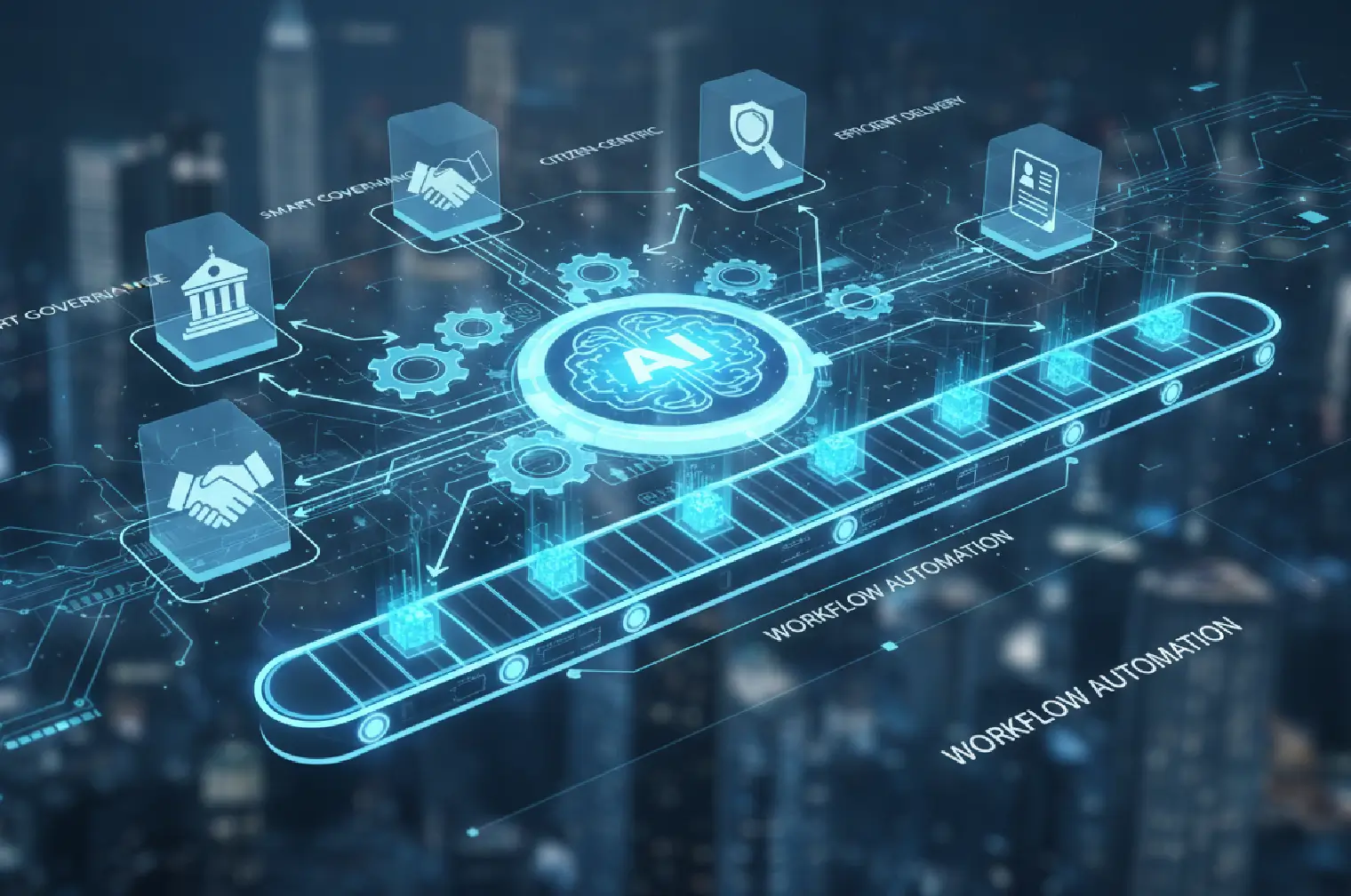
AI Workflow Automation: Reimagining Public Sector Service Delivery

Government agencies worldwide face mounting pressure to deliver faster, more transparent, and cost-effective services, meeting the high expectations set by the private sector.  

However, the ambitious goal of digital transformation in government is often hindered by deeply ingrained operational inefficiencies. Traditional government workflows frequently rely on outdated, paper-based, or manual systems that lead to lengthy processing times, inevitable human errors, and a fragmented flow of information across departments. 

AI workflow automation offers a powerful solution by eliminating repetitive tasks, integrating disjointed systems, and using intelligent decision-making to streamline processes. This technology helps agencies transition from slow, rule-based systems to innovative, self-tuning platforms capable of managing complex, dynamic workflows. 

Let’s discuss: 

  • The practical function and value of AI workflow automation in the public sector. 
  • Specific public sector functions that gain the most efficiency from AI. 
  • The role of custom AI solutions in enabling smarter governance. 

What Is AI Workflow Automation and Why Does It Matter for the Public Sector? 

AI workflow automation refers to the digitization and orchestration of tasks, documents, and decisions within public sector operations, replacing manual intervention with sophisticated technology.  

Unlike rudimentary rule-based automation focused solely on simple tasks like data entry, modern automation utilizes a comprehensive AI automation platform that embeds artificial intelligence technologies such as machine learning (ML), natural language processing (NLP), and predictive analytics. This approach is often referred to as intelligent automation (IA) or intelligent business automation.  

For the public sector, this shift matters immensely because it enables government institutions to offer superior services, significantly reduce operating costs, and optimize internal processes.  

By leveraging an AI automation platform, government agencies can automate entire complex processes, such as processing applications for grants or citizenship, which historically involved extensive manual effort. This capability is critical to achieving a sustainable future where public administration is both agile and proactive in responding to a digitally demanding citizenry. 

Reimagine Public Service Delivery with AI Workflow Automation

Empower departments to deliver faster, data-driven outcomes using ViitorCloud’s AI workflow automation for the public sector.

How Can AI Transform Government Service Delivery and Operations? 

AI in public sector operations transforms service delivery by moving government agencies beyond merely automating simple tasks toward integrating sophisticated decision-making capabilities. This enhancement empowers staff to concentrate on strategic priorities rather than mundane, repetitive work.  

By applying automation with AI, governments can analyze large volumes of data quickly to make decisions wisely and accelerate bureaucratic approvals without compromising transparency or security. AI-powered systems excel at handling unstructured data, such as emails or documents, converting them into actionable insights—a critical function for extracting necessary information from multiple sources during complex decision-making processes.  

This capability allows agencies to re-engineer core processes, such as permit processing and business registration, which formerly took weeks but can now be completed in minutes. Furthermore, AI facilitates a vital strategic pivot, enabling governments to transition from reactive responses to proactive governance by anticipating problems and future service needs, such as forecasting epidemic outbreaks or predicting infrastructure requirements. 

What Are the Core Benefits of AI-Driven Automation for Citizen Services? 

The benefits of AI in the public sector deployment are many. 

Improved Operational Efficiency is paramount, as automating repetitive, rule-based processes drastically reduces processing times; for instance, loan processing times can shrink from days to hours.  

Cost Reduction is achieved by minimizing manual labor, decreasing administrative errors, reducing the need for rework, and optimizing resource allocation—all crucial for governments operating with limited budgets. Beyond efficiency, AI-driven workflows enhance Accuracy and Compliance by consistently validating data inputs and embedding compliance checks directly into every step of a process.  

This provides clear audit logs, helping governments meet strict regulatory requirements and simplifying audit processes. Ultimately, these benefits culminate in Improved Citizen Experience, providing quicker processing for documents like passports, faster resolution of requests, real-time status tracking, and 24/7 self-service options, which contribute to greater public trust and accountability. 

Which Public Sector Functions Gain Most from AI Workflow Automation? 

AI in government is not limited to a single department; rather, its widespread application streamlines diverse functions across federal, state, and local levels.

Key areas that realize substantial benefits from AI workflow automation include: 

  • Citizen Engagement and Support: Chatbot services for governments provide immediate, consistent, 24/7 support, answering frequently asked questions, guiding users through complex forms, and reducing wait times. This self-service capability frees up public employees from routine inquiries, allowing them to focus on high-impact initiatives. 
  • Case Management and Eligibility: Intelligent automation (IA) can process complex applications for grants or social services by verifying eligibility, flagging anomalies for fraud detection, and coordinating actions across multiple agencies in real time. 
  • Regulatory and Administrative Processes: Utilizing robotic process automation (RPA), governments can automate the management of business registration, tax processing, and operating licenses, eliminating bureaucracy. 
  • Public Safety and Health: Machine learning (ML) systems enable the anticipation of problems, such as identifying areas with higher crime rates or predicting epidemic outbreaks, leading to more efficient resource allocation and preventive planning. 
  • Logistics and Resource Management: AI-powered fleet management software optimizes routes for public transportation or waste collection, saving time and fuel while planning predictive maintenance for critical vehicles. 

Check: Transform government operations with ViitorCloud’s AI Services 

Transform Governance with Custom AI Solutions

Modernize public infrastructure and streamline operations with ViitorCloud’s custom AI solutions for government services.

How Do Custom AI Solutions Enable Smarter Governance? 

While off-the-shelf automation platforms offer standardized efficiency gains, custom AI solutions are essential for achieving truly smarter governance and personalized public service delivery. Government workflows are often unique, requiring systems to integrate with legacy technology, adhere to specific jurisdictional compliance frameworks, or handle proprietary data sets.  

Custom AI solutions for government services allow agencies to implement sophisticated technologies tailored precisely to their needs. For instance, machine learning models can be custom-trained on historical agency data to improve predictive analytics for highly specific public health or fiscal oversight domains. Furthermore, generative AI can be customized to draft official documents or generate code for legacy modernization, enabling greater efficiency with human-level criteria.  

By focusing on creating bespoke applications, providers like ViitorCloud can develop custom AI solutions that manage complex inter-agency case management, address highly nuanced regulatory requirements, and ensure seamless integration across fragmented data silos, thereby driving deeper and more reliable digital transformation. This personalized approach ensures AI systems are not only efficient but also contextually relevant and trustworthy. 

Use Cases of AI in Public Sector Workflows 

The implementation of AI in public sector workflows demonstrates a growing commitment to operational excellence: 

  • Generative AI in Document Creation: Generative AI is used to create content, draft official documents, and summarize long texts, significantly accelerating repetitive administrative tasks while empowering public servants to focus on critical judgment. 
  • Intelligent Automation in Licensing and Permits: Local governments have automated the processing of operating licenses and business registrations, turning processes that once required days or weeks into tasks completed in minutes. 
  • Machine Learning for Risk Detection: Tax agencies utilize machine learning to analyze financial behavior and predict the risk of tax evasion, while health departments use similar methods to anticipate epidemic outbreaks, optimizing resource allocation. 
  • Chatbots for Citizen Interaction: Public-facing chatbots and virtual assistants, which are core components of AI workflow automation, provide immediate responses to queries regarding document renewals, utility payments, or enrollment in social programs 24/7. For example, the city of Helsinki deployed virtual assistants to help busy employees answer constituent questions quickly and accurately. 
  • Document Digitization (OCR): Optical character recognition (OCR) technology helps government agencies digitize historic and legal documents, such as those at the Library of Congress, creating searchable databases and redundant backups. 
  • Fleet Management Optimization: AI-powered software optimizes routes for services like garbage collection based on traffic and population density, reducing costs and consumption while scheduling predictive maintenance for municipal vehicles. 

What Challenges Exist in Deploying AI for Government Services and How to Overcome Them? 

While the promise of AI for government services is vast, adoption is fraught with unique challenges that policy leaders and digital transformation advisors must proactively address. 

  • Legacy System Integration: Many public agencies run on complex, outdated IT systems that struggle to interoperate with modern AI solutions. This must be overcome by selecting robust AI automation platforms that offer strong integration capabilities (APIs, connectors) to create cohesive workflows, even with legacy infrastructure. 
  • Ethical Risks and Algorithmic Bias: AI models can inherit human biases present in historical data, potentially perpetuating discrimination or generating misinformation. Overcoming this requires the establishment of trustworthy AI governance, clear safety guardrails, and policies to ensure transparency, privacy, and equity in deployment. 
  • Data Security and Privacy: Handling sensitive citizen data (e.g., health records, SSNs) necessitates high levels of security and compliance with stringent regulations (e.g., FISMA, HIPAA). Government agencies must invest in secure, scalable infrastructure and clear governance to mitigate data breach risks. 
  • Workforce Adaptation and Skills Gaps: Resistance to change and a lack of necessary AI competencies among staff can hinder successful deployment. This challenge is best mitigated through inclusive change management strategies, upskilling employees to work alongside AI tools, and prioritizing hybrid models where AI augments human decision-making. 

Deploy AI-Driven Automation for Smarter Citizen Services

Streamline public workflows, enhance transparency, and boost efficiency with ViitorCloud’s AI-driven automation for citizen services.

How ViitorCloud Helps Governments Reimagine Service Delivery with AI Workflow Automation

The path to fully realizing the benefits of digital transformation in government requires strategic partnerships and an intelligent approach to technology implementation. ViitorCloud, as a trusted provider of AI workflow automation and custom AI solutions, specializes in helping government institutions modernize their complex operations. We understand that moving toward an agile, citizen-centric government is an operational necessity.  

ViitorCloud helps agencies deploy a comprehensive AI automation platform that is adaptable, secure, and focused on delivering sustainable success. By leveraging our expertise in developing custom AI solutions for government services, we empower leaders to integrate AI securely across silos, eliminating bottlenecks in areas ranging from regulatory compliance and case management to procurement and citizen support.  

Whether you need to streamline manual processes, implement predictive analytics, or deploy advanced chatbots, ViitorCloud offers the tailored technology and ethical guidance necessary to increase public trust, realize substantial cost savings, and define the future of public service delivery. 

Contact ViitorCloud for a personalized consultation and explore how our custom AI solutions can help you reimagine service delivery and achieve relentless efficiency. 

How OpenAI’s October 2025 Releases Move AI from Pilot to Platform

Enterprise leaders evaluating custom AI solutions now have a decisive moment. OpenAI’s October DevDay 2025 platform shift turns experimental pilots into production‑grade capabilities that are easier to build, govern, and scale across mission‑critical workflows.

The new stack spans:

  • Apps in ChatGPT with a preview of the Apps SDK
  • AgentKit for robust agentic orchestration
  • Sora 2 in the API
  • GPT‑5 Pro via API
  • Gpt-realtime-mini for low‑latency voice
  • gptimage1mini for cost-efficient visuals
  • Codex is now generally available

This collectively enables reliable, secure, and extensible foundations for enterprise AI and AI-driven automation at scale.

For organizations prioritizing uptime, governance, and total cost of ownership, these releases reduce integration friction, compress time to value, and narrow vendor risk by anchoring innovation on widely adopted, managed services rather than bespoke scaffolding.

This is the practical inflection point where custom AI solutions move from proofs to platforms—with the component maturity and ecosystem support C-suite and product stakeholders have been waiting for.

Turn OpenAI Innovation into Action

Leverage OpenAI’s latest advancements to build your next Custom AI Solution with ViitorCloud’s expert team.

What OpenAI Announced

Apps in ChatGPT

OpenAI introduced Apps in ChatGPT, a native app layer that runs inside ChatGPT, and a preview Apps SDK so developers can design chat‑native experiences with conversational UI, reusable components, and MCP‑based connectivity to data and tools while reaching an audience of hundreds of millions directly in chat.

AgentKit

AgentKit extends this by giving teams a production‑ready toolkit—Agent Builder for visual, versioned workflows, a Connector Registry for governed data access, ChatKit for embeddable agent UIs, and expanded Evals for trace grading and prompt optimization—so agents can be built, measured, and iterated with enterprise rigor.

Codex

Codex is now generally available with developer‑friendly integrations and enterprise controls, aligning agentic coding and code‑generation use cases with standardized governance and deployment patterns for engineering teams.

GPT‑5 Pro via API

On the model side, GPT‑5 Pro arrives in the API for tasks where accuracy and deeper reasoning matter—think regulated domains, complex decision support, and long‑horizon planning—enabling services that must explain, justify, and withstand audit, not just autocomplete.

gpt‑realtime‑mini

For voice, gpt‑realtime‑mini offers low‑latency, full-duplex speech interactions and is about 70% less expensive than the larger voice model, making natural voice UX viable for high‑volume support, concierge, and contact‑center automations. A practical scenario is a voice concierge that authenticates callers, looks up orders, and resolves intents in seconds via SIP/WebRTC, with observability and redaction applied upstream for compliance and quality assurance at scale.

gpt‑image‑1‑mini

For creative and product pipelines, gpt‑image‑1‑mini cuts image generation costs by roughly 80% versus the larger image model, which changes the unit economics for iterative concepting and catalog enrichment workflows across retail, marketplaces, and marketing operations.

Sora 2 in API

Sora 2 in API preview adds advanced video generation to application stacks, enabling controlled, high‑fidelity assets for training, product explainers, and promotional content, with teams able to prototype short videos and route them through brand safety checks and legal sign‑off before distribution.

Together, these updates let enterprises design composite systems. Apps in ChatGPT for front‑ends, AgentKit for orchestration, GPT‑5 Pro for reasoning, and Sora 2/gpt‑image‑1‑mini for rich media can be mapped to use cases like KYC automation, claims triage, controlled catalog enrichment, and multilingual support bots.

Check: AI Co-Pilots in SaaS: How CTOs Can Accelerate Product Roadmaps Without Expanding Teams

Scale Smart with Custom AI and Automation

Integrate OpenAI-powered intelligence into your workflows with our Custom AI Solution and AI Automation services.

Why This Matters Now

OpenAI reports platform scale of more than 4 million developers, 800 million+ weekly ChatGPT users, and approximately 6 billion tokens per minute on the API, a footprint that signals mature tooling, hardened operations, and a vibrant ecosystem of patterns, components, and skills that reduce integration risk and speed up delivery.

For CIOs planning phased adoption in FY26, this ecosystem density shortens learning curves, supports standardized controls, and improves hiring and partner availability, which directly improves time‑to‑value and mitigates vendor concentration risk.

The AMD–OpenAI strategic partnership commits up to 6 gigawatts of AMD Instinct GPUs over multiple years, beginning with a 1‑gigawatt rollout in 2026, adding meaningful supply to accelerate availability and stabilize latency for bursty and near‑real‑time inference demands as enterprise adoption grows.

Reporting from Reuters and the Wall Street Journal underscores the deal’s multi‑billion‑dollar trajectory and execution milestones, which should influence cost curves and capacity planning for AI‑first architectures beyond a single vendor stack.

For technology leaders, this translates into improved confidence in capacity headroom and planning for multi‑tenant loads, seasonal spikes, and global rollouts of voice and agentic experiences without relying on brittle, bespoke infrastructure.

From Pilot to Production

Production‑grade AI requires more than a model choice, which is why AgentKit’s evaluation and governance primitives—datasets for evals, trace grading for end‑to‑end workflows, automated prompt optimization, and third‑party model support—are consequential to building measurable, composable agent systems from day one.

A robust blueprint couples this with retrieval‑augmented generation for fresh, governed context, model‑agnostic evaluation harnesses for ground‑truth scoring, and role‑based guardrails that separate customer data entitlements from tool‑execution permissions for safer agent behaviors under stress.

Safety, compliance, and governance must be layered, with OpenAI’s October 2025 “Disrupting malicious uses of AI” update offering directional reassurance that abuse is being detected and disrupted across threat categories with transparent case studies and enforcement.

On the platform side, Azure OpenAI’s content filtering system and Azure AI Language PII detection provide model‑adjacent controls to flag harmful content and identify/redact sensitive fields as part of standardized pipelines that combine upstream filtering, domain‑specific red teaming, and human‑in‑the‑loop review.

For voice and real‑time experiences, OpenAI’s gpt‑realtime stack and Azure Realtime API patterns illustrate how to achieve low‑latency UX while instrumenting observability, retention policies, and transcript governance in regulated environments.

Read: AI Consulting and Strategy: Avoiding Common Pitfalls in Enterprise AI Rollouts

Build the Future with OpenAI and ViitorCloud

Transform your business operations through our Custom AI Solution and AI Automation expertise tailored to your goals.

Partnering with ViitorCloud

ViitorCloud offers focused consulting sprints that turn these releases by OpenAI into execution: GPT‑5 Pro reasoning service blueprints for regulated decision support, AgentKit‑powered agent design and evals, Sora 2 pilot pipelines for safe marketing and training assets, and voice UX prototyping with gpt‑realtime‑mini—all mapped to measurable operational KPIs and governance checkpoints.

The approach emphasizes rapid proof cycles tied to a prioritized workflow, such as claims triage or multilingual support, followed by hardening with eval datasets, retrieval, PII guardrails, and targeted human review gates before scaling across regions or business units.

Delivery teams operate from India, aligning IST workdays for strong overlap with EMEA and APAC while remaining deeply connected to India’s technology ecosystem and serving global clients with a follow‑the‑sun model for responsiveness and velocity.

Request a discovery workshop with ViitorCloud’s AI team to translate these October 2025 capabilities into enterprise results with confidence and speed, then scale what works across customer service, back‑office automation, and analytics augmentation.

AI Co-Pilots in SaaS: How CTOs Can Accelerate Product Roadmaps Without Expanding Teams

AI co-pilots in SaaS are emerging now because enterprise generative AI usage leapt to 65–71% in 2024, creating the cultural and technical readiness to embed assistants that plan, execute, and optimize product workflows end-to-end.  

At the same time, agentic AI is on track to permeate one-third of enterprise software by 2028 and autonomize 15% of work decisions, signaling a near-term shift from passive helpers to outcome-driven AI teammates inside SaaS products and platforms. 

For CTOs, this convergence means strategic leverage: commercial and custom AI models can be wrapped into governed, measurable copilots that reduce toil, derisk launches, and amplify senior talent across product management, engineering, and operations without adding headcount.  

Generative AI investment is also compounding, with Gartner forecasting $644B in 2025 spend, which ensures rapid capability maturation across the stack that SaaS leaders can harness rather than rebuild from scratch. 

ViitorCloud pairs AI co-pilot development with mature SaaS product engineering to help startups and enterprises accelerate roadmaps with measurable business impact and production-grade governance. This blend of AI integration in SaaS and disciplined delivery allows teams to ship AI-powered SaaS solutions faster, safer, and with clear ROI milestones. 

How do AI co-pilots accelerate product roadmaps without hiring? 

AI co-pilots in SaaS compress discovery, build, and launch by automating document analysis, spec drafting, test generation, code review, release notes, and post-release analytics, moving critical work from hours to minutes and reducing context-switching overhead for senior contributors.  

McKinsey’s research shows generative AI can double speed on select software tasks, indicating copilots that target high-frequency activities can materially shorten critical path timelines across sprints. 

Because copilots learn from product artifacts and live telemetry, they continuously refine backlog quality, improve estimation, and reduce rework, which raises throughput without adding capacity.  

With enterprise gen AI adoption rising sharply, these gains are now repeatable at scale, provided leaders build the right guardrails for data, model choice, and feedback loops. 

Accelerate Product Roadmaps with AI Co-Pilots in SaaS

Leverage Custom AI Solutions to reduce development cycles and deliver value faster with ViitorCloud’s SaaS Product Engineering expertise.

What is the role of SaaS product engineering in AI adoption? 

SaaS product engineering provides the integration tissue—APIs, data pipelines, model ops, observability, and release automation—that turns clever prompts into durable platform capabilities that can be secured, scaled, and audited.  

In practice, that means designing AI co-pilots for SaaS startups and enterprises as services with SLAs, fallbacks, human-in-the-loop checkpoints, and versioned behaviors, not as ad hoc scripts. 

This discipline ensures AI integration in SaaS aligns with multitenant architectures, regional compliance constraints, and cost envelopes, so copilot value grows with usage rather than spiking then stalling under load or policy friction.  

It also enables continuous value capture by instrumenting AI-powered SaaS product development with KPI baselines, winrates, and error budgets that connect engineering work to commercial outcomes. 

Check: AI-First SaaS Engineering: How CTOs Can Launch Products 40% Faster 

Which AI agents for SaaS products deliver quick wins? 

Early wins come from AI agents for SaaS products that handle backlog hygiene, design doc first drafts, unit/integration test generation, dependency upgrades, and support triage summaries, all high-leverage activities proven to save developer time and raise quality.  

On the business side, B2B SaaS AI co-pilots that assist with customer research synthesis, release note generation, and in-app guidance accelerate the SaaS roadmap with AI by streamlining cross-functional handoffs. 

As agentic patterns mature, multistep copilots orchestrate tasks like “spectoteststoPRtodeploy” with human approval gates, reducing cycle time while preserving control and auditability in regulated contexts.  

For SaaS AI automation at scale, start with constrained scopes that map to measurable KPIs, then expand to adjacent workflows once reliability thresholds are consistently met. 

Copilot impact quickmap

Use case Measurable outcome Timetovalue 
Test generation and coverage suggestions Faster regression cycles and fewer escaped defects Days to weeks with seeded repositories 
Spec and doc drafting from tickets Reduced PM/eng context switching and higher doc completeness Immediate in existing tools 
Code review assistants Consistent standards and lower rework on recurring issues Weeks with policy scaffolds 

How do AI-powered SaaS solutions boost speed, agility, and innovation? 

AI-powered SaaS solutions improve speed by automating routine steps in the software delivery life cycle, freeing senior contributors to focus on architecture and product-market signal detection that meaningfully drives differentiation.  

They improve agility by turning telemetry into backlog insights and by enabling rapid, low-risk experiments via sandboxed copilot behaviors that can be A/B tested before broad rollout. 

Innovation accelerates when generative AI in SaaS is framed as a capability layer—search, summarization, generation, decision support—available to every squad, not a single team’s project, ensuring compounding reuse and lower marginal cost of new features.  

With global GenAI spending surging, the ecosystem will keep delivering models and runtimes that expand this capability surface for CTOs to exploit safely. 

Empower Your Teams with AI Co-Pilots in SaaS

Adopt Custom AI Solutions and SaaS Product Engineering to scale innovation without expanding headcount.

How can CTOs design an AI-powered SaaS product roadmap? 

Anchor the AI-powered SaaS product roadmap in objective value: pick 3–5 workflows with high volume, high cost, or high error rates, then set baseline KPIs and acceptance thresholds before enabling copilot actions beyond suggestions.  

Standardize evaluation with golden datasets, offline tests, and red team scenarios so changes to prompts, models, or tools never bypass product quality gates. 

Plan for platformization: expose copilot primitives as internal APIs so squads can compose new AI scenarios without reimplementing data prep, safety filters, and observability each time, turning “AI co-pilots in SaaS” into shared infrastructure.  

Finally, budget for operational excellence—latency SLOs, drift detection, abuse prevention—so success scales without unexpected cost or risk spikes. 

A simple sequencing framework 

  • Prove value with assistive modes, then graduate to semiautonomous steps with human approvals, and only then to fully autonomous actions in well-bounded domains. 
  • Tie each graduation to KPI gains and incident-free runtime hours to maintain trust with security, legal, and customer success stakeholders. 

What challenges block AI adoption, and how to mitigate them? 

Common blockers include unclear ROI, data fragmentation, governance gaps, and overreliance on PoCs that never cross the production chasm, which Gartner notes is prompting a shift toward embedded, off-the-shelf GenAI capabilities for faster time-to-value. Model reliability, evaluation drift, and cost predictability also confound teams when copilots scale across tenants and geographies. 

Mitigation starts with product engineering rigor: consistent evaluation harnesses, model registries, safety rails, and cost/performance policies that treat AI like any other critical dependency under change management.  

It continues with portfolio governance that sunsets low-value experiments and doubles down on “AI transforming SaaS industry” use cases where telemetry proves durable and compounding gains. 

Why partner with ViitorCloud to accelerate with AI co-pilots? 

ViitorCloud brings integrated SaaS product engineering and AI co-pilot development, combining strategy, build, and ongoing operations so copilots become resilient platform capabilities, not side projects that stall post-launch.  

The team delivers AI-powered SaaS product development with enterprise-grade security, observability, and governance tuned to multitenant environments. 

As demand and spend for GenAI intensify, a partner with proven AI integration in SaaS ensures the roadmap accelerates without expanding teams and without trading speed for reliability or compliance.  

ViitorCloud’s approach aligns copilot success to objective KPIs across quality, velocity, and cost, enabling “accelerate SaaS roadmap with AI” outcomes that leadership can measure and scale. 

Reimagine SaaS Growth with AI Co-Pilots

Unlock the power of SaaS Product Engineering and Custom AI Solutions to build smarter, scalable products with ViitorCloud.

How does this translate into tangible results next quarter? 

Within 90 days, most SaaS teams can deploy copilots for test generation, documentation, and support summarization that reduce cycle time and free senior talent for roadmap epics, validating value while building platform scaffolds for broader use. By Q2, expanding into code review assistance, release orchestration, and in-product guidance can raise throughput and customer adoption with clear audit trails and rollback paths. 

As agentic patterns mature, selected workflows can move to semiautonomous execution with human approvals, preserving control while realizing step-change gains in lead time for changes and mean time to recovery. The compounding effect is a resilient, AI-powered SaaS product roadmap that scales without proportional headcount growth, aligning directly to board-level outcomes. 

Partner with ViitorCloud to operationalize AI co-pilots in SaaS—from opportunity mapping to secure integration and runstate excellence—delivered by a team that unites AI engineering and SaaS product engineering under one accountable model. Explore ViitorCloud’s SaaS and AI engineering capabilities to turn strategic intent into shipped outcomes, faster and safer. 

Frequently Asked Questions 

An AI copilot is an embedded assistant that plans and executes defined tasks within the product lifecycle (from discovery to operations) under governance, observability, and KPIs tailored to SaaS contexts.

Most teams achieve measurable time savings within a few weeks by targeting high-frequency tasks, such as tests, documents, and triage, with research showing substantial productivity gains in specific developer activities.

Agentic AI is rapidly maturing, with forecasts indicating that one-third of enterprise apps will include agents by 2028; however, prudent rollout utilizes assistive and semi-autonomous stages with human approvals first.

Tie copilot releases to baseline KPIs (lead time, escaped defects, support resolution time, infra cost) and requires statistically meaningful improvements before graduating autonomy levels. 

ViitorCloud unifies AI solutions with SaaS product engineering—governed data, model ops, and platform integration—so “AI copilots for SaaS startups” and enterprises move from PoC to durable production value.

Low-Code Government Apps: Empowering Non-Tech Teams in Government & Public Sector

Low-code government apps are helping public institutions deliver modern services faster by shifting routine build work from constrained IT backlogs to domain experts, without compromising compliance or security.

AI-driven automation for government augments these apps with intelligent routing, document processing, and service orchestration to scale citizen services with fewer manual handoffs and improved auditability.

The modernization mandate

Across jurisdictions, demand for digital services continues to outpace IT capacity, making low-code and no-code viable accelerators for digital transformation in government with measurable gains in responsiveness and inclusion.

Analysts also frame an inflection point: by mid-decade, a majority of new applications are expected to use low-code/no-code approaches, underscoring a permanent shift in delivery models for the public sector.

Check: AI Automation Logistics for SMBs: Transforming Last-Mile Delivery

Build Smarter Public Services

Transform service delivery with Low-Code Government Apps and AI-Driven Automation for faster, seamless solutions.

Why low-code fits the government

By combining visual development, reusable components, and guardrails, low-code government apps compress delivery cycles from months to weeks while retaining extensibility for complex, policy-driven workflows.

This approach aligns with budget constraints by reducing specialist dependency and enabling incremental modernization for legacy portfolios, a priority for digital transformation in government. 

Factor Low-code in government Traditional development 
Delivery speed Visual tooling, templates, and composable services cut lead time to weeks for new public services. Full-stack builds and bespoke integrations extend timelines, delaying service improvements. 
Compliance & security Platforms offer baked-in controls and deployment to accredited enclaves such as FedRAMP/StateRAMP where available. Platforms offer baked-in controls and deployment to accredited enclaves such as FedRAMP/StateRAMP, where available. 
Total cost of ownership Lower build/maintenance effort and reuse reduce lifecycle costs across programs. Specialist-heavy teams and one-off patterns raise long-term maintenance costs. 
Empower non-tech teams Policy experts can compose workflows and forms safely, accelerating change cycles. Reliance on scarce developers creates bottlenecks and longer feedback loops. 
Interoperability API-first, modular services enable government workflow automation across departments. Case tracking was assembled ad hoc with limited analytics and inconsistent user experience. 
Case management Government case management apps delivered as CMaaS unify AI, workflow, and reporting. Case tracking was assembled ad hoc with limited analytics and an inconsistent user experience. 
Low-code fits the government

When platforms make it safe to empower non-tech teams, program managers can author service flows, forms, and rules, reducing reliance on IT bottlenecks and accelerating project delivery while IT governs standards and integrations. This shift has become central to no-code public sector automation initiatives where straightforward processes benefit from visual composition and rapid iteration.

AI-driven automation at scale

AI-driven automation for government blends machine learning, NLP, and intelligent automation to triage requests, extract data from documents, and route cases based on policy and risk, reducing manual effort and cycle time.

Done well, AI-driven automation in government raises service throughput and consistency while enhancing explainability through embedded audit trails and policy-linked decisioning.

  • Document intake and verification streamline permits, benefits, and grants with OCR and NLP, improving first-time accuracy and speed.
  • Virtual assistants extend 24/7 access, deflect routine queries, and escalate sensitive cases with full transcripts for compliance review.
  • Predictive analytics prioritize inspections, fraud screening, and emergency response, optimizing limited resources transparently.

Read: Importance of AI-Driven Automation for SMEs in 2025

Empower Non-Tech Government Teams

Enable your teams to create solutions quickly with Low-Code Government Apps integrated with AI-Driven Automation.

Case management transformed

Modern government case management apps deliver a unified operational picture—case data, evidence, tasks, SLA clocks, and communications—with AI assistance to accelerate resolution and improve citizen outcomes.

With case management as a service (CMaaS), agencies compose configurable solutions once and reuse patterns across benefits, licensing, grants, and enforcement programs, boosting ROI and consistency.

Public sector platforms increasingly offer deployment in accredited security enclaves and maintain continuous updates, aligning with frameworks like FedRAMP and StateRAMP to meet stringent data protection needs.

Governance practices recommended by audit bodies emphasize clear AI policies, model oversight, and risk controls to keep AI-driven automation in government both effective and accountable.

From pilots to platforms

Early wins often start with Government business process automation in a single program, then expand into cross-department Government workflow automation using an API-first, modular strategy.  

Scaling requires operating models that pair platform engineering with federated delivery so agencies can standardize guardrails while enabling No-code public sector automation where appropriate.

Low-code government apps typically reduce backlog by accelerating change requests, cutting handoffs, and surfacing metrics that guide continuous improvement across service lines.  

Combining low-code with AI-driven automation for government further improves throughput, reduces rework, and enables proactive service by detecting needs and risks earlier in the process.

Read: How AI Automation is Redefining Customer Experience 

Where to start

Target policy-stable, high-volume processes—permits, benefits, licensing—where Government business process automation offers immediate relief and clear KPIs for success. Next, expand into Government case management apps to unify channels, data, and decisions, creating a consistent experience across programs while tightening compliance controls.

Streamline Government Workflows

Reduce inefficiencies and enhance collaboration using Low-Code Government Apps powered by AI-Driven Automation.

Partner with ViitorCloud 

ViitorCloud helps public sector leaders accelerate digital transformation in government with a pragmatic platform strategy that blends low-code patterns, integration engineering, and AI-driven automation in government for measurable outcomes in months, not years.  

As a trusted delivery partner, ViitorCloud designs secure, maintainable solutions—from rapid pilots to enterprise-grade rollouts—grounded in reusable assets for Government workflow automation and repeatable success across portfolios. 

Explore how ViitorCloud’s digital experiences practice delivers resilient services, modern casework, and AI-ready architectures tailored to public sector needs, ensuring value, compliance, and citizen impact from day one. 

What is AI-Powered Data Pipeline Development for Real-Time Decision Making in Technology Firms?

AI-powered data pipeline development is the engineered process of ingesting, transforming, and serving data—via both batch and streaming paths—to power machine learning and analytics, enabling decisions to be made with low latency and high reliability in production systems.  

In technology firms, this discipline connects operational data sources to model inference and business logic, enabling actions to be triggered as events occur rather than hours or days later, and facilitating truly real-time decision-making at scale.  

With AI-powered data pipeline development, custom AI solutions for technology firms convert raw telemetry into features and signals that drive automated actions and human-in-the-loop workflows within milliseconds to minutes, depending on the service-level objective. 

Real-time pipelines are crucial because applied AI and industrialized machine learning are scaling across enterprises, and the underlying data infrastructure significantly impacts latency, accuracy, trust, and total cost of operation. By the time a dashboard updates, an opportunity or risk may have vanished—streaming-first designs and event-driven architectures close this gap to unlock compounding business value. 

What is AI-Powered Data Pipeline Development? 

AI-powered pipeline development designs the end-to-end flow from data producers (apps, sensors, services) through ingestion, transformation, storage, and feature/model serving so that AI systems always operate on timely, high-quality data.  

Unlike traditional ETL that primarily schedules batch jobs, these pipelines incorporate event streams, feature stores, and observability to keep models fresh and responsive to live context. The result is a cohesive fabric that unifies data engineering with MLOps so models, features, and decisions evolve as reality changes. 

Build Smarter Decisions with AI-Powered Data Pipeline Development

Integrate data seamlessly and make real-time decisions with ViitorCloud’s Custom AI Solutions.

Why Real-Time Pipelines Now? 

Enterprise adoption of applied AI and gen AI has accelerated, with organizations moving from pilots to scale and investing in capabilities that reduce latency and operationalize models across the business.  

Streaming pipelines and edge-aware designs are foundational enablers for this shift, reducing time-to-insight while improving decision consistency and auditability for technology firms. 

How to Build an AI-Powered Data Pipeline 

  1. Define decision latency and SLA 
    Clarify the “speed of decision” required (sub-second, seconds, minutes) and map it to batch, streaming, or hybrid architectures to balance latency, cost, and reliability. 
  1. Design the target architecture 
    Choose streaming for event-driven decisions, batch for heavy historical recomputation, or Lambda/Kappa for mixed or streaming-only needs based on complexity and reprocessing requirements. 
  1. Implement ingestion (CDC, events, IoT) 
    Use change data capture for databases and message brokers for events so operational data lands consistently and with lineage for downstream processing. 
  1. Transform, validate, and enrich 
    Standardize schemas, cleanse anomalies, and derive features so data is model-ready, with governance and AI automation embedded in repeatable jobs. 
  1. Engineer features and embeddings 
    Generate and manage features or vector embeddings for retrieval and prediction, and sync them to feature stores or vector databases for low-latency reads. 
  1. Orchestrate, observe, and remediate 
    Track data flows, schema changes, retries, and quality metrics to sustain trust, availability, and compliance in production pipelines. 
  1. Serve models with feedback loops 
    Deploy model endpoints or stream processors, capture outcomes, and feed them back to improve data, features, and models continuously (industrializing ML). 
  1. Secure and govern end-to-end 
    Integrate controls for privacy, lineage, and access while aligning with digital trust and cybersecurity best practices at each pipeline stage. 

What Benefits Do Real-Time, AI-Powered Pipelines Deliver? 

  • Faster, consistent decisions in products and operations through event-driven processing and low-latency data delivery. 
  • Higher model accuracy and reliability because data freshness and feature quality are monitored and continuously improved. 
  • Better cost-to-serve and scalability via clear architecture choices that align latency with compute and storage economics. 
  • Stronger governance and trust with lineage, observability, and controls aligned to modern AI and cybersecurity expectations. 

Transform Your Tech Stack with AI-Powered Data Pipeline Development

Drive efficiency and scalability through real-time data processing with our Custom AI Solutions.

Which Pipeline Architecture Fits Which Need? 

Pipeline type Processing model Latency Complexity Best fit 
Batch Periodic ingestion and transformation with scheduled jobs Minutes to hours; not event-driven Lower operational complexity; simpler operational state Historical analytics, reconciliations, and monthly or daily reporting 
Streaming Continuous, event-driven processing with message brokers and stream processors Seconds to sub-second; near-real-time Operationally richer (brokers, back-pressure, replay) Live telemetry, inventory, fraud/alerting, personalization 
Lambda Dual path: batch layer for accuracy, speed layer for fresh but approximate results Mixed; speed layer is low-latency, batch is higher-latency Higher (two code paths and reconciliation) Use cases needing both historical accuracy and real-time views 
Kappa Single streaming pipeline; reprocess by replaying the log Low-latency for all data via stream processing Historical analytics, reconciliations, and monthly or daily reporting Real-time analytics, IoT, social/event pipelines, fraud detection 
Pipeline Architecture

What Do the Numbers Say? 

McKinsey’s 2024 Technology Trends analysis shows generative AI use is spreading, with broader scaling of applied AI and industrialized ML and a sevenfold increase in gen AI investment alongside strong enterprise adoption momentum. The report also highlights cloud and edge computing as mature enablers—key dependencies for real-time AI pipelines in production contexts. 

“Real-time pipelines are where data engineering meets business outcomes—turning raw events into timely, explainable decisions that compound competitive advantage,” —industry expert. 

How ViitorCloud Can Help Your Tech Firm 

ViitorCloud specializes in developing custom AI solutions for technology firms, designing and implementing robust AI-powered data pipelines that enable real-time decision making, enhance operational efficiency, and drive competitive advantage. With a global presence, the team aligns architecture, features, and model serving with the firm’s latency and reliability targets to deliver measurable business outcomes.  

For discovery sessions, solution roadmaps, or implementation support, explore the Artificial Intelligence capabilities and engage the team to discuss the specific pipeline needs and success metrics for the next initiative. 

Accelerate Decision-Making with AI-Powered Data Pipeline Development

Leverage real-time insights and automation tailored to your needs with ViitorCloud’s Custom AI Solutions.

How to Choose Between Architectures 

  • For event-driven products that demand seconds or sub-second responses, prioritize streaming or Kappa, then add replay and observability for resilience. 
  • For heavy historical recomputation with strict accuracy, keep a batch path or Lambda to merge “speed” with “truth” views. 
  • Where cost and operational simplicity dominate, use batch-first with targeted streaming for the few decisions that truly require immediacy. 

Frequently Asked Questions 

Traditional ETL moves data in scheduled batches for downstream analysis, while AI-powered pipelines unify batch and streaming paths to feed features and models for low-latency, in-production decisions. 

Lambda helps when both accurate historical batch views and fresh stream views are required, whereas Kappa simplifies to one streaming path and replays the log for reprocessing, where low latency is paramount. 

In most systems, real-time implies seconds to sub-second end-to-end latency enabled by event-driven ingestion and stream processing, distinct from minutes-to-hours batch cycles. 

Embed validation, schema management, and monitoring into transformation stages, then track lineage and retries to ensure consistent, trustworthy feature delivery. 

Data engineering, MLOps, and platform engineering are core, with demand rising as enterprises scale applied AI and industrialize ML across products.

RPA + AI Hybrid Automation for Cross-Border Payments

RPA + AI hybrid automation streamlines cross-border payments by pairing fast, deterministic bots with adaptive models that interpret data, learn from patterns, and make risk-aware decisions across complex, multi-party payment flows.  

This fusion reduces manual touchpoints, accelerates settlement, and tightens controls in areas like sanctions screening, AML/KYC, and reconciliation, where traditional rules-based systems are costly and prone to errors.  

As global payment volumes expand and regulators push for cheaper, faster, more transparent cross-border rails, hybrid automation offers an operational blueprint that improves speed, compliance fidelity, and unit economics at scale. 

Hybrid automation is really important now because cross-border payment flows and market revenues continue to rise, even as frictions around data standards, compliance complexity, and interoperability persist.  

Average consumer remittance costs remain elevated globally at around 6–7 percent, underscoring the need for automation-led cost compression and smarter routing across corridors.  

At the same time, legacy AML stacks can generate up to 90–95 percent false positives, creating alert fatigue, avoidable investigations, and customer friction that AI-driven detection can materially reduce. 

What is Hybrid Automation? 

RPA automates structured, rules-based tasks such as data collection, enrichment, and posting, while AI handles judgment-heavy steps like anomaly detection, name screening disambiguation, and document understanding in KYC and trade flows.  

Together, they deliver “intelligent automation,” where bots orchestrate end-to-end processes and invoke models for exceptions, risk scoring, and decision support to reduce latency and errors across payment lifecycles.  

Case studies in reconciliation show that pairing RPA ingestion/matching with AI exception handling achieves high accuracy and same-day closes in high-volume environments, demonstrating the model’s scalability for cross-border operations. 

Check: AI Automation Logistics for SMBs: Transforming Last-Mile Delivery 

How Does It Fix Cross-Border Inefficiencies? 

Hybrid automation compresses delays by automating data handoffs and accelerating in-flight processing that still relies on multi-party checks and legacy queues, reinforced by global modernization efforts like the G20 Roadmap and service-level benchmarking across networks.  

ISO 20022’s richer, structured data unlocks better routing, smarter compliance checks, and faster reconciliation when combined with AI classification and RPA-driven normalization, reducing breaks and manual repair work.  

By automating sanctions/AML workflows and triaging alerts with machine learning, institutions lower false positives, contain compliance costs, and keep legitimate transactions moving. 

Revolutionize Cross-Border Payments

Streamline financial operations with RPA + AI hybrid automation in finance and achieve faster, error-free transactions.

Why This Is Important 

Payment providers face scale-led pressure as global cross-border revenue pools grow and customer expectations shift to near-real-time experiences across regions and methods.  

Despite progress, cross-border remittance costs remain persistently high in many corridors, which incentivizes orchestration, smart routing, and automated exception management to protect margins and experience.  

Regulators and market infrastructures are simultaneously pushing for standardized data and measurably faster, cheaper payments, making automation table stakes rather than optional. 

Industry Use Cases and Practices 

Payment reconciliation benefits from RPA bots that ingest statements and ledger entries at scale while AI proposes probable matches and normalizes formats, enabling same-day reconciliation and audit-ready trails in complex, multi-currency environments.  

AML and sanctions screening leverage AI to cut false positives and improve true positive capture, as shown in large-bank deployments where name screening and transaction monitoring accuracy measurably increase.  

Customer onboarding speeds up with AI-driven identity and document verification while RPA orchestrates data collection, PEP/sanctions checks, and case routing to cut days into minutes without sacrificing compliance. 

Read: How AI and Automation are Transforming BFSI Operations 

What Are the Challenges and How Can We Solve Them 

Legacy systems and fragmented data create brittle integrations and reconciliation breaks; an orchestration-first approach with APIs allows RPA to bridge systems while AI enriches and validates ISO 20022 fields for downstream reliability.  

Regulatory complexity and data privacy concerns require transparent models, defensible governance, and complete audit trails, which hybrid approaches can deliver via explainable AI, policy-driven workflows, and automated reporting.  

Operating risk shifts from manual processing to model and bot lifecycle management, making MLOps, bot governance, and change control for standards like ISO 20022 essential capabilities. 

Read: Why is AI-powered process automation necessary for your business? 

Scale Smart with AI-Driven Automation

Enhance compliance and speed with AI-driven automation in finance tailored to your global payment processes.

Final Words 

At ViitorCloud, hybrid automation blends the speed of RPA with the intelligence of AI to streamline global payments, from screening and onboarding to reconciliation and reporting.  

It is increasingly critical as volumes climb, costs remain elevated in many corridors, and regulators press for cheaper, faster, and more transparent cross-border transactions.  

Adoption hurdles exist, but the trajectory is accelerating with ISO 20022, orchestration, and AI-ready operating models setting the foundation for sustained impact in cross-border finance. 

Frequently Asked Questions

It is the integrated design of deterministic bots and adaptive models to automate end-to-end financial workflows, invoking AI for unstructured data, risk, and exceptions while RPA executes structured tasks and system handoffs. The approach improves throughput, auditability, and consistency in processes like KYC, payments, and reconciliation.

It automates handoffs between institutions, enriches and validates ISO 20022 messages, accelerates screening, and reduces manual exception handling, thereby cutting delays, costs, and errors. AI-guided alert reduction and smarter routing help sustain faster settlement without compromising compliance.

Banks must address legacy integration, model risk management, explainability, and data governance while meeting evolving regulatory expectations and standard migrations like ISO 20022. Successful programs use API-first architectures, orchestration layers, and robust change controls to de-risk delivery. 

Security relies on robust access controls, encryption, model governance, and auditable workflows, which are enhanced by the richness of ISO 20022 data and standardized exchange. AI-enhanced AML and fraud monitoring improve detection fidelity while reducing noise that drives operational risk.

Expect tighter coupling of AI with standardized data, wider orchestration across multi-rail ecosystems, and selective use of blockchain/stablecoin rails for 24/7 liquidity and settlement. Institutions that operationalize MLOps and orchestration will shape the next generation of global payments efficiency and resilience.

AI Consulting and Strategy: Avoiding Common Pitfalls in Enterprise AI Rollouts

Enterprises struggle with AI rollouts because they jump from pilots to production without a cohesive plan that ties business outcomes, data foundations, governance, and integration into an end-to-end operating model, leading to stalled projects and missed ROI despite strong executive interest in AI adoption.  

AI Consulting and Strategy reduces this risk by aligning use cases to measurable KPIs, strengthening data and governance early, and sequencing delivery from pilot to scale so value is realized beyond isolated experiments. 

Only 25% of AI initiatives have delivered expected ROI, and just 16% have scaled enterprise-wide, underscoring why an advisory-led approach that prioritizes architecture, change, and measurement is essential to escape “pilot purgatory” and achieve durable impact across functions.  

With adoption moving fast but scaling constrained by organizational readiness, custom AI solutions guided by strategy help technology enterprises standardize what should be centralized (governance, data) while tailoring solutions to function-level needs (engineering, service, product) for measurable bottom-line benefits. 

Why This Matters 

AI is now a core engine of digital transformation, with more than three-quarters of organizations using AI in at least one function and rapidly increasing gen AI adoption across product, service, marketing, and software engineering.  

Yet despite this momentum, most organizations have not achieved organization-wide EBIT impact from gen AI, which reflects gaps in scaling practices, KPI tracking, and workflow redesign rather than the technology’s potential. 

Failed implementations are costly: fragmented architectures, weak data quality, and the absence of governance stall scale, erode trust, and waste budget, and CEOs themselves cite disconnected, piecemeal technology and the need for an integrated data architecture as barriers to AI value realization.  

Enterprises that move deliberately, linking AI investments to clear metrics, tightening risk controls, and investing in talent and process change, consistently progress from pilots to production at higher rates. 

Transform Your Business with AI Consulting and Strategy

Overcome common AI rollout challenges with ViitorCloud’s proven Custom AI Solutions tailored for your enterprise needs.

What is AI Consulting and Strategy? 

AI consulting and strategy is an advisory-led discipline that defines high-value use cases, quantifies business outcomes, designs the target data and governance architecture, and sequences delivery from pilot to scaled operations with measurable KPIs.  

Unlike generic AI development focused on building models or features, strategy-led programs start with business alignment, codify operating and risk controls, and integrate AI into enterprise systems and workflows to unlock enterprise-wide value rather than isolated wins.  

This approach is particularly critical now as organizations report fast adoption but uneven progress on scaling, talent readiness, measurement, and trust, all of which require structured change and executive sponsorship to resolve. 

Why Do Enterprises Fail in AI Rollouts? 

A lack of strategy and KPI discipline means many AI pilots optimize model metrics without clear links to P&L, weakening the business case for scale and leaving CFOs without durable evidence of value.  

Poor data readiness, disconnected platforms, low-quality inputs, and incomplete governance prevent reliable production performance and cross-functional collaboration in ways CEOs now explicitly recognize as impediments to AI ROI. 

Absent stakeholder alignment and ownership, organizations distribute experiments without a scaling mandate or a center of excellence for risk and compliance, which correlates with minimal enterprise-level EBIT impact from gen AI.  

Unrealistic timelines and underinvestment in organizational change, training, and infrastructure slow adoption, and survey data show that scaling progress depends as much on talent, transparency, and process redesign as on the models themselves. 

Check: Choose an AI Services Company for Your Business Success 

Common Pitfalls in Enterprise AI Implementations (with Solutions) 

Pitfall Recommended solution 
No clear KPI or ROI model for pilots, making it impossible to justify scale Define outcome metrics and finance-approved KPIs up front; track them from discovery through production to demonstrate business impact and prioritize scale investments 
Disconnected, piecemeal data and platforms that block cross-functional AI Establish an integrated enterprise data architecture with clear ownership, quality controls, and pipelines fit for production workloads 
Governance and risk treated as afterthoughts, limiting trust and adoption Centralize AI governance in a center of excellence, standardize policies, and deploy transparency and monitoring to build trust and accelerate safe scaling 
Talent and process gaps that prevent workflow redesign and operationalization Pair technical enablement with role-based training, redesign workflows where value is realized, and fund change management as part of the core plan 
Scaling without a roadmap, causing duplication, rework, and stalled deployments Build a phased adoption roadmap across business units, clarify what’s centralized vs. federated, and sequence integrations to reduce time-to-value 
Common Pitfalls in Enterprise AI Implementations

Build Smarter with AI Consulting and Strategy

Avoid pitfalls and scale confidently with ViitorCloud’s Custom AI Solutions designed for sustainable growth.

How Custom AI Solutions Help Enterprises 

Custom AI solutions align models, prompts, retrieval, and workflows to business-specific data and processes, which is essential because CEOs emphasize proprietary data and integrated architecture as the key to unlocking gen AI value at scale.  

For technology enterprises, tailored patterns—like domain-tuned copilots for software engineering, retrieval-augmented knowledge systems for support, and product analytics copilots—map directly to functions where gen AI is already gaining traction and driving unit-level gains. 

Scalable infrastructure and integration are non-negotiable: organizations that centralize data governance, define a clear adoption roadmap, and invest in cross-functional tech infrastructure report greater progress toward scaling and measurable benefits beyond cost reduction alone.  

In practice, custom systems reduce failure points by controlling context quality, enforcing policy consistently, and capturing KPIs that translate directly to revenue, margin, and productivity outcomes. 

Case Insights and Data Points 

Surveyed CEOs report only 25% of AI initiatives have met expected ROI, and just 16% have scaled enterprise-wide, highlighting the need for tighter KPI discipline and integrated data architecture to unlock value.  

Adoption is racing ahead. Nearly half of organizations say they are moving fast on gen AI, yet experts note scaling requires better measurement, workforce evolution, and investment in data capabilities and infrastructure. 

Most organizations still report limited enterprise-level EBIT impact from gen AI, and fewer than one-third follow most adoption and scaling practices known to drive value, indicating why strategy-led operating models matter at this stage of maturity.  

Meanwhile, public-sector and regional measures show overall AI adoption remains uneven, reinforcing that readiness and risk controls, not just enthusiasm, determine the pace and depth of enterprise transformation. 

Read: Custom AI Solutions for SaaS and SMBs Explained 

Key Takeaways 

  • Enterprises fail with AI mainly due to poor planning, fragmented data, weak governance, and a lack of a KPI-driven strategy that connects pilots to production. 
  • AI Consulting and Strategy ensures alignment between business goals, operating models, and architecture, improving the odds of scaling and enterprise-level impact. 
  • Custom AI solutions grounded in proprietary data and integrated platforms make adoption scalable and practical across technology functions. 
  • Avoiding pitfalls early by investing in data, governance, measurement, and change saves cost, time, and organizational credibility while accelerating ROI. 

Optimize Your Enterprise AI Rollouts

Partner with ViitorCloud for expert AI Consulting and Strategy to deploy Custom AI Solutions without costly missteps.

Final Words 

If you are ready to transform enterprise AI with confidence and speed through custom AI solutions guided by a strategy-first approach, ViitorCloud aligns KPIs, data architecture, and governance to scale AI across technology functions with measurable ROI and resilient operations.  

Book a consultation to avoid costly pitfalls and accelerate adoption with a roadmap built for outcomes, not experiments. 

Frequently Asked Questions

It is an advisory-led approach that aligns AI use cases to business KPIs, designs integrated data and governance, and sequences delivery from pilots to scaled operations with measurable outcomes.

Scaling beyond pilots while maintaining a reliable ROI is the hardest step, with only 16% of initiatives reported as scaled and CEOs citing disconnected, piecemeal technology as a barrier.

Look for strategy-first delivery with KPI tracking, integrated data architecture expertise, centralized governance patterns, and experience operationalizing AI across functions.

Timelines vary, but organizations that define a roadmap, centralize governance, and invest in talent and infrastructure progress faster from pilots to production compared to ad hoc scaling.

Technology, financial services, and services operations see strong functional adoption, particularly in software engineering, marketing and sales, and service workflows.

Weak KPI discipline, fragmented data architecture, insufficient governance, and underinvestment in change management undermine production performance and value capture.