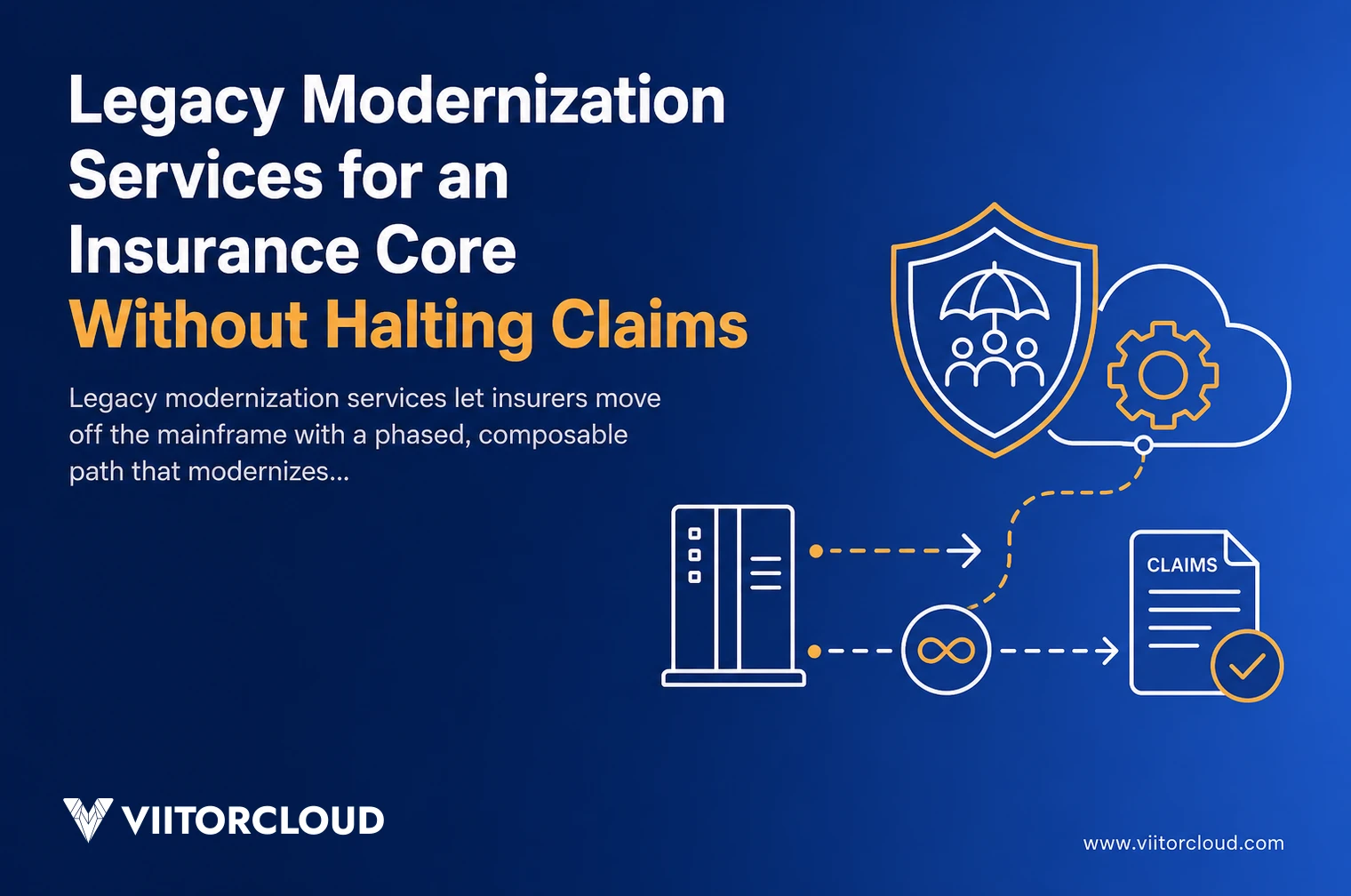
You modernize a legacy insurance core without halting claims by moving in phases, not in one high-risk cutover. You wrap the mainframe with APIs, route new work to modern composable services, and retire legacy components one at a time while claims keep processing. That phased approach is what mature legacy modernization services are built to deliver for insurers.
I have sat in steering meetings where a Head of Core Platforms knows the policy system is the bottleneck and still refuses to touch it. The reason never changes. The core runs claims, and claims cannot stop.
That fear is rational. It is also why technical debt compounds and maintenance costs climb every year the decision is deferred. The good news is that a phased path off the mainframe removes the halting-claims risk, and it is how real insurance software modernization gets done. This guide covers the framework, the sequence to follow, and how claims stay live the entire way through core modernization.
Key Takeaways
- A phased, composable approach is the safe way to modernize an insurance core, because it never requires claims processing to stop.
- Rip-and-replace fails most often on risk, not technology, since a big-bang cutover puts every policy and claim on one go-live date.
- Legacy modernization services wrap the mainframe with APIs first, then move policy, billing, and claims into independent services.
- Composable architecture lets you decommission legacy components progressively, so every phase lowers run cost and reduces risk.
- ViitorCloud has run phased, live-system migrations at scale, including a platform that has processed $192.2M in healthcare claims revenue.
Why Insurers Stall on Core Modernization
Most insurance cores were built decades ago, often in COBOL, on a mainframe that has quietly run the business ever since. It works, which is exactly the problem. Every year it costs more to run and gets harder to change.
Three pressures now force the issue for CIOs and enterprise architects, and together they explain why legacy system modernization is no longer optional.
- Run cost. A large share of the IT budget goes to keeping the legacy core alive rather than building anything new. Analysts at Gartner have long tied that maintenance burden to falling IT agility.
- Change speed. A single business-rule change in a legacy claims module can take weeks of specialist effort, so new products stall behind the queue.
- Regulation. Real-time regulatory reporting and modern data-protection rules assume clean, accessible data. A closed mainframe cannot serve it on demand.
I worked with an architect at a mid-size insurer whose claims platform needed six weeks to change one rating rule. Competitors shipped the same change in days. He understood the cost of waiting perfectly. What he lacked was a path that did not bet the whole book of business on a single weekend. For the financial framing that wins these arguments internally, the ROI case for legacy system modernization lays out the run-cost math in detail.
See Phased Modernization in Action
Explore how ViitorCloud carves a legacy insurance core into composable services without stopping claims.
Why Rip and Replace Is the Wrong Default
The instinct is to buy a new core platform and switch over. For an insurer, that is the highest-risk option on the table.
A big-bang replacement puts every policy, every open claim, and every integration on one go-live date. If anything breaks, claims stop, and stopped claims mean regulatory exposure and real customer harm. These projects also run 18 to 36 months before delivering anything, and both the market and the requirements move during that time.
Phased legacy application modernization inverts that risk. You deliver value in months, not years, and no single step can take the business down. The decision to rebuild or evolve is worth making deliberately, which I break down further in this guide on whether to refactor or replace a legacy application.
The Phased Path Off the Mainframe
The pattern that works is progressive replacement. Good legacy modernization services build modern services around the old core, redirect traffic to them piece by piece, and shrink the mainframe until it can be switched off. Claims never stop, because the old and new systems run in parallel during each phase.
Here is the four-phase sequence I use for insurance core modernization, in order.
Phase One, Map the Core and Its Dependencies
Before touching code, document what the core does and what depends on it. Note which services read policy data, which write to the claims ledger, and which feed regulatory reports. This map is what makes every later phase safe.
Phase Two, Wrap the Mainframe With APIs
Put a clean API layer in front of the legacy core. New channels and services then talk to the API, not the mainframe directly. This one step decouples the front end from the core and buys you room to move underneath.
Phase Three, Carve Out Composable Services
Move one bounded capability at a time, such as document handling, then billing, then a claims sub-process. Each new service runs alongside the core and takes over its slice of traffic. Our legacy application modernization work is structured exactly this way, one capability per phase, so the first result arrives early.
Phase Four, Decommission Legacy Components Progressively
As each capability moves, retire the matching part of the mainframe. Run cost drops with every phase, and the final switch-off becomes a formality rather than an event. Structured legacy system modernization always moves in this decommission-as-you-go order, so value compounds instead of being gambled on one date.
Map Your Mainframe Dependencies
Start with a focused assessment that finds the safest first capability to move off the core.
Why Composable Architecture Is the Right Target
Composable architecture means building the core as independent business services, with policy, billing, and claims each deployable on its own. For insurers, that is what turns a rigid core into one you can change safely.
- Independent change. You update claims logic without redeploying policy or billing.
- Selective scale. You scale the claims service during a catastrophe surge without scaling the rest of the core.
- No lock-in. Composable services on open standards avoid trading one closed core for another.
Composable architecture is also what makes the progressive decommissioning above possible. The best legacy modernization services aim at this target, not another monolith. The goal of any serious insurance software modernization is a core you can keep changing, not a system you will have to replace again in ten years.
How Claims Keep Running During Migration
This is the objection that stalls every program, so it deserves a direct answer. Claims keep running because the legacy core and the new services operate in parallel until each cutover is proven.
The techniques are well established across regulated finance:
- Parallel run. Old and new process the same transactions side by side, and you compare outputs before trusting the new path.
- Shadow testing. Route real traffic to the new service silently, measure it, and promote it only when results match.
- Incremental cutover. Move a small percentage of claims first, watch it closely, then ramp up.
- Instant rollback. If a phase misbehaves, traffic falls back to the mainframe with no data loss.
A claims operations lead I advised was certain any migration meant a frozen weekend and a call center full of angry adjusters. We ran her highest-volume claim type in parallel for a full cycle first. By the time we switched it over, the new service had already handled the same load correctly for weeks. Nothing froze.
This discipline matters most in regulated finance, where an outage is also a compliance event. Legacy system modernization here lives or dies on parallel-run rigor. The same principles run through our work on system integration in finance, and research from McKinsey consistently links this kind of core modernization to faster product launches and lower operating costs.
Talk to a Core Modernization Team
Bring your core platform challenge to engineers who have run live, phased migrations in regulated finance.
Where to Start Your Legacy Modernization
The hardest part of legacy application modernization is the first phase, not the whole roadmap. My advice is to think big and start small. Pick one high-cost, low-risk capability, prove the parallel-run model on it, and let that success fund the next phase.
This is how at ViitorCloud, our legacy modernization services have supported regulated, high-throughput clients for 14 years. We built and run a healthcare revenue platform that has processed $192.2M in claims revenue, consolidated 70M+ citizen records on a government platform, and rolled out an enterprise port management system across 14 live sites since 2016 without stopping operations at any of them. Our delivery is GDPR and HIPAA-compliant by default, which matters when the system you are changing is the one regulators watch. If your program reaches wider financial services, our BFSI modernization work shows the same phased method applied across banking and insurance.
Ready to scope your first phase?
Start your core modernization with a short assessment that maps your mainframe dependencies and identifies the safest capability to move first.
Modernize the Core Without Betting the Business
Insurers do not stall on core modernization because the technology is unclear. They stall because rip-and-replace threatens the one thing that cannot stop, which is claims. A phased, composable path removes that threat.
Wrap the core in APIs, move one capability at a time into composable services, run old and new in parallel, and decommission the mainframe progressively. Done this way, legacy modernization services turn a feared big-bang project into a steady sequence where each phase lowers cost and risk. Start with one capability, prove it live, and build from there.

Vishal Shukla
Vishal Shukla is Vice President of Technology at ViitorCloud Technologies.
Frequently Asked Questions
How do I modernize a legacy insurance core?
Wrap the mainframe in APIs, then move policy, billing, and claims into composable services one phase at a time while claims keep running.
What is a core modernization strategy?
Can insurers modernize without halting claims processing?
How long does insurance software modernization take?