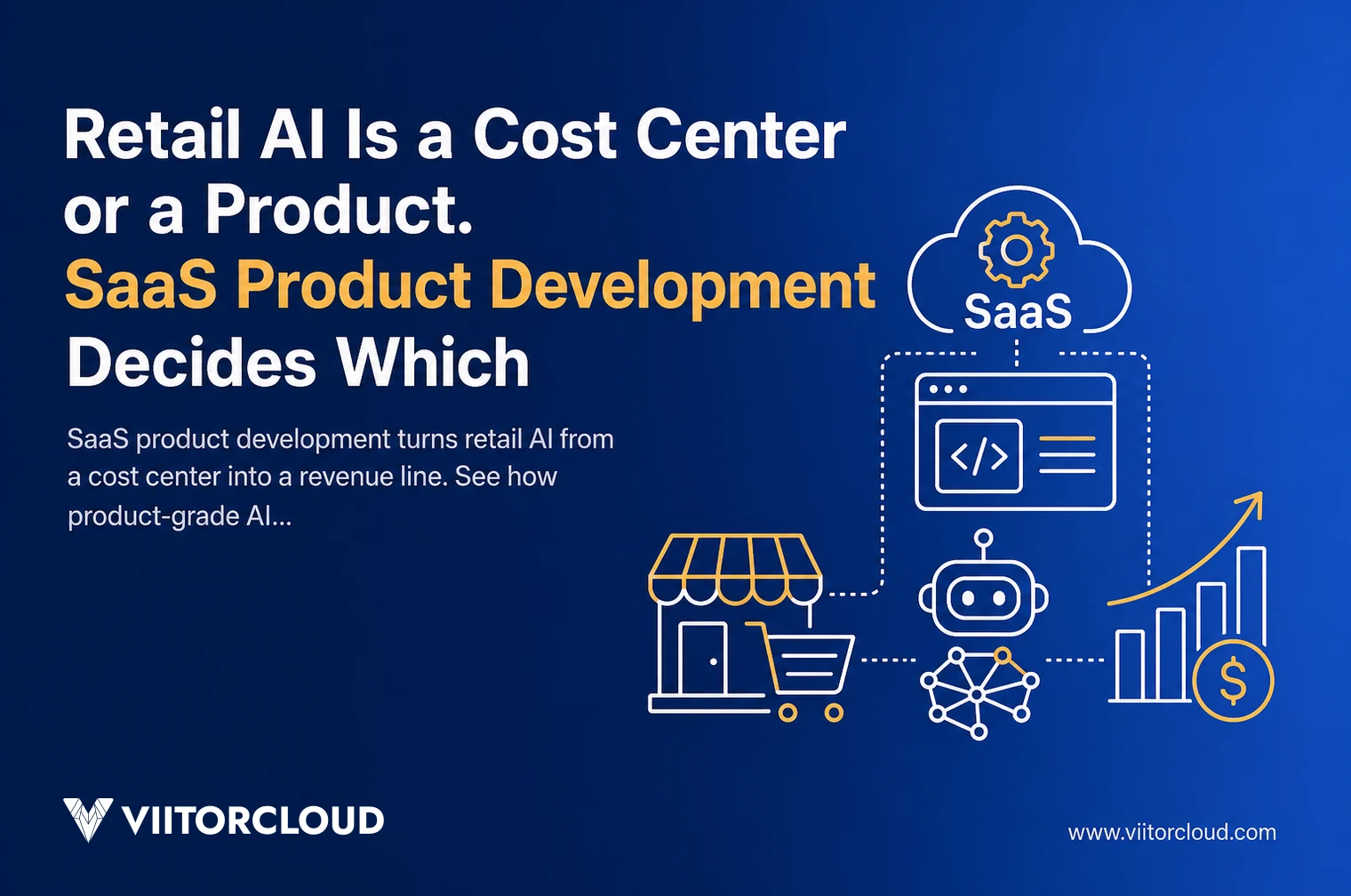
Retail AI becomes a revenue line the moment it is built through SaaS product development instead of an IT budget request. A cost center is a pile of bolt-on features that nobody prices, meters, or owns. A product has a buyer, a price, a usage meter, and a roadmap. The engineering discipline between those two outcomes is the entire gap.
I have watched retail and commerce SaaS teams spend two quarters shipping AI search, AI descriptions, and an in-app assistant, then present a slide showing inference costs with no revenue attached to any of it. The features worked. The product decisions never happened.
Below is what separates AI that funds itself from AI that drains margin, plus the SaaS product development sequence I use to move a retail platform from one to the other.
Key Takeaways
- Retail AI earns revenue only when it has a named buyer, a price, a usage meter, and a product owner. SaaS product development supplies all four.
- McKinsey estimates generative AI could create $240 billion to $390 billion in value for retail, with margin gains of 1.2 to 1.9 points. Product-grade engineering captures that value.
- The AI in retail market reached $18.4 billion in 2026 and is projected at $130.88 billion by 2033. Category growth does not land on your invoice automatically.
- Monetizable AI needs three decisions before the build starts. Cost per unit, a metering layer, and a packaging boundary.
- Vertical AI SaaS holds its ground in retail because the proprietary data and workflow context already sit inside your platform.
Why Retail AI Keeps Landing on the Cost Side of the Ledger
The pattern is easy to spot from outside the company. AI appears in the release notes and never appears on the pricing page. Nobody can say what one AI call costs to serve, or which plan it belongs to. That gap is a SaaS product development problem, not a model problem.
Three things are usually true when retail AI stays an expense.
- No owner: The work sits with an engineering or data team, not with a product manager who carries a revenue number.
- No meter: Usage is never measured per account, so finance sees one aggregate compute bill and has nothing to bill against it.
- No boundary: Embedded AI features go live on every plan at once, which deletes the upgrade path before it exists.
The money on the table is real. McKinsey estimates generative AI could create $240 billion to $390 billion in value for retail, with margin gains of 1.2 to 1.9 points. That value reaches platforms that ship AI as a product. It skips platforms that ship AI as a line item in the infrastructure budget.
Most teams I meet in retail technology are not short on AI capability. They are short on the product layer that turns capability into monetizable AI and, eventually, into an invoice.
Turn Retail AI Into a Revenue Line
We engineer retail AI as a priced, metered product with a named buyer, using the same SaaS product development sequence described above.
What Changes When SaaS Product Development Owns the AI Roadmap
SaaS product development treats an AI capability the way it treats anything else that has to earn a place on the roadmap. Who buys it. What it replaces. What it costs to serve at peak usage. Where it sits in the plan structure.
Those four answers exist before the first model call gets written. The shift is commercial, not technical.
Most retail platforms already have model access, a vector store, and a prompt library. Embedded AI features are usually shipping already. What they lack is entitlement, metering, packaging, and a pricing hypothesis small enough to test inside one quarter.
On one commerce build, the team had an AI description generator that every customer praised, and nobody paid for. We did not touch the model. We added a meter, moved the high-volume tier above the mid plan, and capped the allowance below it. Same code, new revenue line, one release cycle.
That is the difference between AI product engineering and AI feature delivery. One produces something you can price. The other produces something you can demo. The operating model that makes the first outcome repeatable is set out in this SaaS product development company framework.
Four Tests That Separate Monetizable AI From a Bolt-On Feature
Before a retail AI feature reaches the roadmap, I run it through four questions. Monetizable AI passes all four. A bolt-on passes one, sometimes two. This is the cheapest hour of SaaS product development you will ever spend.
- The buyer test: Name the role that approves the spend. If the answer is that everyone benefits, nobody buys.
- The meter test: Choose the unit you will count before you build. Generated descriptions, resolved tickets, forecast SKUs, or matched returns. A unit you can count is a unit you can charge for.
- The margin test: Model cost per unit at real usage, not demo usage. Revenue-generating AI holds gross margin when a single account triples its volume. If it does not, you have built a discount.
- The removal test: Switch the feature off in your head. If no account would notice by Friday, it is a cost center wearing a product badge.
Most retail platforms fail the meter test first. Metering is unglamorous, so it slips, and once embedded AI features ship without it, adding usage data across live accounts becomes a migration rather than a config change. Build the meter first. This is the step of end-to-end AI product engineering that gets skipped most often and costs the most later.
Get a Second Opinion on Your AI Packaging
Bring your current roadmap. Our engineers will show you where the meter, the plan boundary, and the margin instrumentation are missing.
Why Vertical AI SaaS Wins in Retail
General-purpose AI is good at general problems. Retail is not a general problem. Size curves, return fraud patterns, shelf-level demand, promotional cannibalization, and marketplace listing rules are specific, and the data explaining them already lives inside retail platforms.
That is the structural advantage behind vertical AI SaaS. The model is a commodity. The retail context is not.
The AI in retail market reached $18.4 billion in 2026 and is projected to reach $130.88 billion by 2033, according to Coherent Market Insights. Growth on that scale pulls in horizontal entrants quickly. A vertical AI SaaS product defends itself with proprietary data, workflow depth, and outcomes a general tool cannot reproduce.
Three defensibility layers belong in any AI-native SaaS build for commerce.
- Proprietary signal: Transaction, catalog, and returns data your customers already generate inside the platform.
- Workflow ownership: The AI acts inside the system of record instead of producing a suggestion someone copies elsewhere.
- Outcome accountability: The feature is measured against sell-through, margin, or return rate, not against model accuracy.
An AI-native SaaS architecture assumes all three from day one. Retrofitting them into a platform designed for simple record management is expensive, which is why SaaS product development choices about architecture matter more than model selection. The architecture behind scalable retail SaaS platforms sets the ceiling on what your AI can ever be worth.
The SaaS Product Development Sequence I Use for Revenue-Generating AI
This is the order I follow. AI product engineering works best when it stays commercial at the front and technical in the middle, because the expensive mistakes happen when those two swap places.
- Pick one workflow with a countable outcome: One workflow, one unit, one buyer. A platform-wide AI strategy is not a starting point.
- Write the pricing hypothesis first: One sentence covering which plan, which unit, what price, and what allowance.
- Build metering and entitlement before the feature: It takes days now and quarters later.
- Ship to a paid cohort rather than to everyone: Product-led AI works when a capped allowance creates a visible ceiling, and the upgrade removes it.
- Instrument margin per account: Track cost to serve next to revenue from day one, per account, never in aggregate.
- Expand along the same data: The second feature should reuse the first one’s pipeline, which is how monetizable AI compounds instead of fragmenting.
Product-led AI is the fastest route for mid-market retail platforms because the allowance becomes the sales motion. Usage rises, the ceiling arrives, and the upgrade conversation starts without a sales call. That only works when the meter exists, and someone drew the packaging boundary on purpose.
Run this sequence twice and revenue-generating AI stops being a strategy slide. It becomes a line your finance team can forecast, which is the point of treating AI as a SaaS product development rather than infrastructure.
Build AI-Native From the Architecture Up
Platforms we engineered have processed 56,943 orders in a year and handled $7.1 million in 72 hours at peak. That is where architecture decisions show.
What Product-Grade Retail AI Looks Like in Practice
I will use our delivery record rather than a hypothetical. Platforms we engineered at ViitorCloud on the commerce side carry real peak load and real money. One deals and commerce platform we built has generated $46.4 million in total revenue, including $7.1 million in 72 hours during a single Black Friday sale, and processed 56,943 orders in 2024 across 8,342 unique deals.
Peak commerce is where architecture decisions become visible, and it is where revenue-generating AI either holds its margin or quietly loses it. We engineered Creaitor, an AI content management platform, as a product with paying users rather than an internal tool. Product-led AI gives mid-market teams a sales motion they can run without adding headcount.
If your retail AI roadmap currently reads like a feature list, run it through the four tests above and rebuild the packaging before the next release. Our SaaS product engineering team applies AI product engineering to mid-market platforms that need enterprise-grade delivery from a team the size of yours. Every engagement starts with the same SaaS product development questions listed above, and embedded AI features get a price before they get a launch date.
AI-native SaaS is a set of engineering decisions, not a label. If you want a second opinion on where your revenue line should sit, start a conversation with our engineers and bring your current roadmap.
Retail AI Earns Its Line, or It Does Not
The binary is uncomfortable and useful. Retail AI is either a product with a buyer, a meter, and a margin, or it is an expense you defend at every budget review. Very little survives in between.
Three moves change the outcome. Name the buyer before the build, ship the meter before the feature, and price the unit before the launch. Monetizable AI follows from those three, and product-led AI does most of the conversion work after that, on the codebase you already have.
That is what SaaS product development delivers for a retail platform. It ships AI that pays for itself and then funds the release after it.

Vishal Shukla
Vishal Shukla is Vice President of Technology at ViitorCloud Technologies.
Frequently Asked Questions
What is SaaS product development?
SaaS product development is the discipline of building software as a commercial product rather than a set of features. It covers the buyer, the pricing model, the usage meter, the packaging boundary, and the roadmap alongside the engineering work. For retail AI, that commercial layer decides whether a feature earns revenue.
How do you monetize AI features in a SaaS product?
What makes AI-native SaaS different from adding AI later?
How long does it take to turn a retail AI feature into a revenue line?
Is vertical AI SaaS better than horizontal AI tools for retail?