Why AI-Driven Automation Will Replace Traditional Digital Transformation

Digital transformation traditionally refers to the integration of digital technology into all areas of a business.

For the past decade, small and medium businesses (SMBs) in logistics, IT, and healthcare focused on digitizing paper records and moving data to the cloud.

While these efforts improved accessibility, they often resulted in static digital environments that still required significant human intervention.

In 2026, the industry shift has moved toward AI-driven automation.

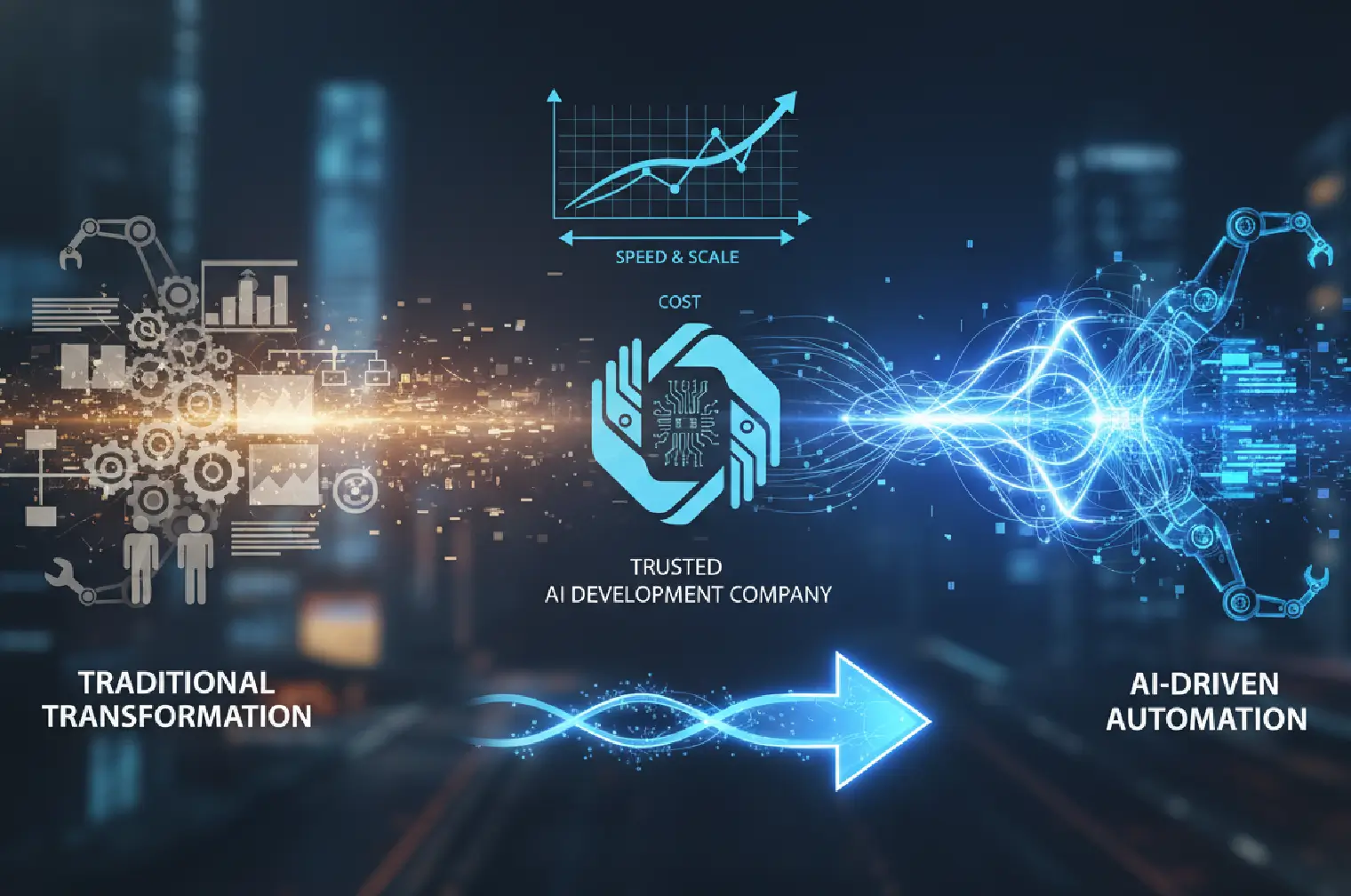
Unlike traditional digital transformation, which prioritizes the digitization of existing processes, AI-driven automation focuses on creating systems that act independently based on data insights.

This evolution allows companies to move from reactive management to an automated operation model.

The Transition from Traditional Digital Transformation to AI-Driven Automation

Traditional digital transformation created a foundation of data.

However, many organizations found that digital tools alone did not solve the problem of high operational costs or human error. 

AI automation addresses these limitations by adding a layer of intelligence to digital systems.

Instead of a human checking a dashboard to make a decision, AI-driven automation analyzes the data and executes the necessary action directly.

The following table outlines the functional differences between these two approaches:

FeatureTraditional Digital TransformationAI-Driven Automation
Primary GoalDigitization and connectivityAutonomous execution and intelligence
Data UsageHistorical reportingPredictive and real-time action
Human RoleConstant monitoring and decision-makingOversight and strategic management
Operational StateReactiveAutomated operation
ScalabilityLimited by human headcountDecoupled from labor hours
The Functional Differences Between Traditional Digital Transformation and AI-Driven Automation

Businesses that implement AI-driven automation often see a direct increase in automation service leads, as the efficiency gains allow for faster response times to market demands.

According to research from Gartner, hyper-automation, the combination of AI and RPA, is now a requirement for organizations to remain competitive in high-volume sectors.

Lead Change with AI-Driven Automation

Replace outdated systems and accelerate growth using ViitorCloud’s AI-Driven Automation and Custom AI Solutions.

Automation in Healthcare

The healthcare sector has moved beyond the simple adoption of Electronic Health Records (EHR).

 Modern automation in healthcare now focuses on clinical and administrative intelligence. 

AI automation allows hospitals and clinics to process patient data without manual entry, reducing the administrative burden on medical staff.

ViitorCloud provides specialized healthcare tech consulting services that focus on integrating these intelligent systems.

For example, AI-driven automation can now analyze medical imaging to flag abnormalities before a radiologist reviews the file.

This application of automation in healthcare improves diagnostic speed and accuracy.

Specific applications of AI automation in this field include:

  • Automated patient triage based on symptoms and history.
  • AI-powered medical billing and claims adjudication.
  • Predictive analytics for patient admission rates.

Implementing automation in healthcare reduces errors in insurance claims, which prevents financial losses.

As clinics adopt these systems, they generate more automation service leads by demonstrating superior patient outcomes and operational reliability.

You can learn more about how these technologies are applied in our detailed guide on intelligent automation in healthcare.

Supply Chain Automation for Logistics SMBs

Logistics companies face increasing pressure to deliver goods faster while maintaining low costs.

Traditional digital systems allowed for package tracking, but supply chain automation now enables autonomous decision-making in routing and inventory management.

In a typical automated operation, AI algorithms monitor weather patterns, traffic data, and fuel consumption in real-time.

The supply chain automation system then re-routes vehicles without dispatcher intervention.

This level of AI-driven automation ensures that shipments arrive on time despite external disruptions.

ViitorCloud’s expertise in AI-driven automation for SMEs helps logistics providers transition to these models. 

Supply chain automation also optimizes warehouse storage by predicting which items will have high demand. This prevents overstocking and reduces storage fees.

When logistics firms stabilize their costs through AI automation, they attract more automation service leads from larger enterprises looking for reliable shipping partners.

A study by McKinsey & Company indicates that companies using AI-driven automation in their supply chains can reduce logistics costs by 15% to 30%. This efficiency is critical for SMBs that do not have the capital to absorb the waste associated with manual processes.

Upgrade Digital Transformation with AI

Drive smarter decisions and efficiency with AI-Driven Automation powered by Custom AI Solutions.

Automated Operation in Information Technology

In the IT sector, the focus has shifted from managing infrastructure to overseeing an automated operation.

Developers and IT managers now use AI-driven automation to handle routine maintenance, such as software updates, security patching, and server scaling.

Our AI-driven automation services enable IT departments to focus on product innovation rather than system maintenance.

For instance, AI automation can detect a security anomaly and isolate the affected segment of a network instantly.

This proactive automated operation prevents data breaches that traditional systems might only report after the damage occurs.

The integration of AI-driven automation into the development lifecycle, often referred to as AI product engineering, shortens the time-to-market for new software.

By using end-to-end AI product engineering, businesses ensure that their digital tools are built with automation as a core feature rather than an afterthought.

This approach consistently generates high-quality automation service leads as clients seek out modernized, self-sustaining platforms.

The Impact on Business Growth and Lead Generation

The primary objective of moving to an AI-driven automation model is to achieve measurable business outcomes.

For many organizations, the most significant impact is the increase in automation service leads.

When a business operates with high efficiency and low error rates, its market reputation improves, leading to more inquiries for its services.

Furthermore, AI automation allows companies to scale without a linear increase in employees.

This capability is vital for SMBs in logistics and healthcare, where labor shortages are common.

An automated operation can handle a 50% increase in workload with the same number of staff members.

Key benefits of this shift include:

  • Operational Resilience: Supply chain automation identifies risks before they become disruptions.
  • Cost Reduction: Automation in healthcare minimizes the need for clerical staff for data entry.
  • Enhanced Precision: AI-driven automation eliminates the “human factor” in repetitive data tasks.

Companies looking to begin this transition can review our digital transformation consulting to identify which manual processes are the best candidates for AI automation.

Build Future-Ready Systems with AI

Scale operations faster using AI-Driven Automation and tailored Custom AI Solutions.

The Bottom Line

Traditional digital transformation is no longer sufficient to maintain a competitive edge. The complexity of modern data requires an automated operation that can process information and act in real-time.

Whether it is through supply chain automation in logistics or automation in healthcare to improve patient care, AI-driven automation is the technology that delivers tangible results.

By partnering with an experienced provider like ViitorCloud, businesses can implement AI automation that aligns with their specific industry needs.

Contact us: [email protected]

This transition creates a robust framework that generates automation service leads and ensures long-term sustainability.

For more insights on how to future-proof your organization, explore our research on AI agents in healthcare services and our broader AI capabilities.
Why AI-First Companies Will Outperform Their Competitors in 2026

By 2026, companies that prioritize an AI-first strategy operate with higher efficiency and lower costs than those using traditional software models.

An AI-first approach treats artificial intelligence as the primary architectural component of the business.

This shift allows for autonomous workflows, predictive resource allocation, and real-time operational adjustments.

For CXOs and founders in the IT and SaaS sectors, shifting to an AI-first strategy is a technical requirement for maintaining market share.

Organizations that rely on manual data processing or basic automation cannot match the speed and accuracy of AI-driven systems.

The Shift to Agentic AI and Autonomous Execution

In 2026, AI integration focuses on agentic systems. These systems perform specific tasks without constant human intervention.

They connect to APIs, manage databases, and execute multi-step workflows.

This reduces the time spent on administrative overhead and increases the output of technical teams.

MetricTraditional SoftwareAI-First Strategy (2026)
Data ProcessingBatch processingReal-time streaming & inference
Workflow ManagementHuman-triggeredAgent-triggered
Problem SolvingRule-basedAdaptive learning
Operational SpeedHigh latencyLow latency
The Shift to Agentic AI and Autonomous Execution

According to Gartner’s 2026 Strategic Technology Trends, agentic AI will handle 15% of all daily work decisions by 2026.

This allows employees to focus on high-level strategy while the system manages routine operations.

To implement these systems, businesses need a specialized AI development company to build custom agents that understand their specific business logic.

Integrate AI Seamlessly into Your Business

Streamline operations and improve decision-making with ViitorCloud’s AI Integration Services.

When to Go for Custom AI Solutions for Specific Business Needs

When generic AI tools often fail to meet the security and precision requirements of SMBs and enterprise SaaS companies, custom AI solutions solve this by training models on proprietary data.

This ensures the output remains relevant to the company’s goals and customer base.

A trusted AI solutions provider evaluates a company’s existing data silos to create a unified data lake.

This infrastructure supports custom AI solutions like predictive maintenance for manufacturing or automated underwriting for fintech.

ViitorCloud develops these custom AI solutions to ensure data remains secure and private.

Using an AI-first strategy involves moving data from static storage into active inference engines. This transition requires deep technical knowledge.

A specialized AI development company provides the engineering talent necessary to deploy these models at scale.

You can read more about how AI-first software and platforms change business outcomes on our blog.

Technical Requirements for Effective AI Integration

Successful AI integration requires a modern tech stack. Legacy systems often create bottlenecks that prevent AI from accessing data in real-time.

To fix this, companies must modernize their cloud infrastructure.

AI integration involves three main stages:

  1. Data Harmonization: Consolidating data from different sources into a readable format.
  2. Model Deployment: Implementing custom AI solutions within existing software.
  3. Monitoring and Optimization: Using AIOps to track model performance and prevent drift.

A trusted AI solutions provider helps manage these stages to prevent technical debt. ViitorCloud offers digital transformation services that prepare legacy systems for deep AI integration.

By aligning your infrastructure with an AI-first strategy, you ensure the system can scale as data volume increases.

Why SMBs Use an AI Development Company for Scaling

SMBs and SaaS founders often lack the internal resources to build complex AI models.

Partnering with an AI development company provides access to specialized engineers, data scientists, and ML specialists.

This partnership allows SMBs to deploy custom AI solutions faster than their competitors.

A trusted AI solutions provider also offers guidance on AI governance. This is important for meeting regulatory standards in 2026.

Board members require clear documentation on how AI makes decisions. This transparency builds trust with stakeholders and customers.

ViitorCloud assists in building AI-driven automation that includes clear audit trails.

Research from McKinsey & Company shows that high-performing AI companies invest heavily in training their workforce to work alongside AI.

An AI development company can assist in this transition by providing technical training and support.

Build Custom AI Solutions That Deliver Results

Create scalable AI applications tailored to your business goals with our expert team.

Building Trusted AI Solutions and Governance

In 2026, security is a primary concern for any AI-first strategy. Businesses must protect their proprietary models from data poisoning and prompt injection attacks.

A trusted AI solutions provider implements security protocols at the architectural level.

Implementing custom AI solutions requires:

  • Encrypted Data Pipelines: To protect data during transit.
  • Bias Mitigation: To ensure AI decisions are fair and accurate.
  • Version Control: To manage updates to machine learning models.

ViitorCloud acts as a trusted AI solutions provider by incorporating these security measures into every project.

For example, using blockchain for AI security helps create immutable logs of AI activities.

This level of detail is necessary for maintaining board-level trust and ensuring the company remains an AI-first strategy leader.

The Financial Impact of an AI-First Strategy in 2026

An AI-first strategy directly affects the bottom line.

By reducing the cost of manual labor and increasing the accuracy of demand forecasting, companies improve their net margins. 

AI integration allows for dynamic pricing models that respond to market changes in seconds.

A specialized AI development company helps identify which processes will yield the highest ROI when automated.

For instance, custom AI solutions in customer service can reduce ticket resolution time by 40%.

These efficiencies allow companies to reinvest capital into research and development.

Companies that ignore the shift to an AI-first strategy will face higher operating costs and slower response times.

Partnering with an AI development company ensures that your business remains competitive in a rapidly changing market.

Check oout blog to learn if machine learning is right for your business.

Accelerate Growth with AI Development Services

Transform your workflows using enterprise-grade AI development from ViitorCloud.

The Bottom Line

To outperform competitors in 2026, companies must adopt an AI-first strategy today.

This involves moving beyond basic AI integration and building a foundation for custom AI solutions.

Working with a trusted AI solutions provider allows you to navigate technical challenges and deploy AI at scale.

As an AI development company, ViitorCloud provides the expertise needed to transform your business into an AI-first organization.

Our focus on custom AI development ensures your technology stack is ready for the demands of 2026.

Frequently Asked Questions

An AI-first company builds its entire product and operations around artificial intelligence. AI is the primary way they solve problems. A company that “just uses AI” typically adds AI features to an existing, traditional system as a secondary tool.

The timeline varies depending on the size of the company and its data readiness. For most SMBs, a partnership with a specialized AI development company can produce a functional pilot in 3 to 6 months. Full organizational transformation often takes 12 to 24 months.

The initial development of custom AI solutions requires more investment than a subscription to a generic tool. However, custom solutions often have lower long-term costs because they are optimized for your specific data and do not require expensive third-party seat licenses.

A trusted AI solutions provider uses encryption, secure data pipelines, and strict access controls. They also ensure the AI models comply with global regulations like GDPR or HIPAA by implementing data anonymization and audit trails.

Yes. Industries like manufacturing, logistics, and healthcare use an AI-first strategy to optimize supply chains, manage inventory, and improve patient diagnostics. Any industry that generates large amounts of data can benefit from deep AI integration.

AI Solutions for Healthcare in 2026: Use Cases, Compliance & ROI

The healthcare sector in 2026 has officially transitioned from the era of “AI experimentation” to the era of “Agentic AI.”  

For healthcare executives and tech consultants, the conversation is no longer about the theoretical potential of machine learning.  

Instead, the focus has shifted toward the deployment of enterprise-grade AI in healthcare services that can act autonomously, ensure stringent regulatory compliance, and deliver a verifiable Return on Investment (ROI). 

As we approach the new phase of technology, the demand for AI solutions for healthcare has pivoted toward platforms that offer more than just data visualization.  

Today’s leaders require systems that can predict patient deterioration, automate the heavy lifting of Revenue Cycle Management (RCM), and bridge the gap between clinical silos.  

In this context, custom AI solutions for healthcare are becoming the differentiator for organizations looking to scale without proportionally increasing their administrative or clinical overhead. 

From Predictive to Agentic AI 

The primary shift today is the rise of Agentic AI—systems designed not just to suggest an action, but to execute it within a secure framework.  

Whether it is managing a prior authorization workflow or adjusting a patient’s remote monitoring schedule based on real-time vitals, the maturity of AI in healthcare services is now measured by its autonomy. 

According to research by Deloitte Insights on the 2026 outlook, the integration of generative and agentic models is expected to alleviate up to 30% of the current administrative burden on nursing staff.  

For digital transformation managers, this represents a massive opportunity to deploy AI solutions for healthcare that directly address the chronic staffing shortages affecting the US healthcare system. 

At ViitorCloud, we emphasize that moving toward these advanced models requires a strategic roadmap for AI-powered healthcare that prioritizes interoperability from day one. 

Build Future-Ready AI Solutions for Healthcare

Design compliant, scalable, and ROI-driven systems with ViitorCloud’s Custom AI Solutions for healthcare organizations.

High-Value Use Cases for 2026 

1. Autonomous Revenue Cycle Management (RCM) 

Administrative costs still account for a significant portion of healthcare spending. In 2026, custom AI solutions for healthcare are tackling this by automating clinical documentation improvement (CDI) and denial management. These agents can parse thousands of pages of payer policies and compare them against clinical notes to ensure that claims are submitted with 98% accuracy. By leveraging AI in healthcare services, providers are seeing a drastic reduction in “days in accounts receivable.” 

2. Ambient Clinical Intelligence 

The “quiet” revolution in 2026 is happening in the exam room. Ambient listening tools now capture patient-provider conversations and automatically generate structured notes within the EHR. This application of AI solutions for healthcare allows physicians to focus entirely on the patient rather than the screen. This is a core component of our healthcare technology consulting services, where we help organizations integrate these tools without disrupting existing workflows. 

3. Predictive “Hospital-at-Home” Models 

With the US aging population, the “hospital-at-home” model has become a standard of care. This requires custom AI solutions for healthcare that can process data from wearables and IoT devices in real-time. These systems don’t just alert a doctor when a heart rate is high; they use multi-modal data to predict a cardiac event hours before it occurs. This proactive use of AI in healthcare services is essential for reducing readmission rates and improving patient outcomes in decentralized care settings. 

The 2026 Compliance Need 

Compliance is the cornerstone of any digital transformation in the US.  

In 2026, the regulatory environment has evolved to include the FAVES framework (Fairness, Appropriateness, Validity, Effectiveness, and Safety) as mandated by the Office of the National Coordinator for Health IT (ONC). 

For tech consultants, ensuring that AI solutions for healthcare are transparent is paramount. It is no longer enough for an algorithm to be accurate; it must be explainable.  

This means that when a custom AI solution for healthcare flags a patient for a specific intervention, the system must provide the clinical rationale behind that decision to the clinician. 

Regulatory Pillar Focus Area for 2026 Impact on AI Implementation 
Transparency Algorithm Explainability Must provide clinical “reasoning” for AI-generated insights. 
Data Privacy LLM & PHI Management Strict silos for Large Language Models handling patient data. 
Bias Mitigation Equity in Diagnostics Regular auditing of datasets to ensure no demographic is underserved. 
Interoperability FHIR Standard Maturity Seamless data exchange between custom AI and legacy EHRs. 

Maintaining this level of compliance requires a rigorous development process. Organizations often find success by starting with an AI MVP development approach, which allows for testing compliance and security protocols in a controlled environment before a full-scale rollout. 

Turn Healthcare Data into Intelligent Decisions

Apply real-world AI Solutions for Healthcare that improve outcomes, ensure compliance, and deliver measurable ROI.

Measure the ROI of AI in Healthcare 

The financial justification for AI in healthcare services has moved beyond simple cost-cutting. While reducing labor costs is significant, the 2026 ROI model includes revenue enhancement and risk mitigation. 

When implementing custom AI solutions for healthcare, organizations should look at the “Triple Aim” of ROI: 

  • Operational ROI: Reducing the cost per claim and decreasing patient wait times. 
  • Clinical ROI: Improving diagnostic accuracy and reducing adverse drug events. 
  • Experience ROI: Increasing patient satisfaction scores (HCAHPS) and reducing clinician burnout. 

According to data from the HHS Office of the National Coordinator for Health IT, interoperability and AI-driven data analysis are key drivers in reducing the $1 trillion annual waste in the US healthcare system.  

By deploying targeted AI solutions for healthcare, facilities can identify leakage in their referral networks and capture revenue that would otherwise be lost to out-of-network providers. 

The Strategy: Custom vs. Off-the-Shelf 

As we move through 2026, the “Buy vs. Build” debate has settled into a hybrid reality. While off-the-shelf tools exist for generic tasks, the most significant competitive advantages come from custom AI solutions for healthcare.  

These bespoke systems are trained on an organization’s specific patient demographics and integrated deeply into their unique operational workflows. 

For digital transformation managers, the goal is to create an ecosystem where AI in healthcare services feels like a natural extension of the medical team.  

This requires a partner who understands both the technical nuances of custom AI development and the high-stakes reality of clinical environments. 

A successful implementation of AI solutions for healthcare in 2026 follows a structured path: 

  1. Data Foundation: Cleaning and structuring legacy data to be “AI-ready.” 
  1. Use Case Prioritization: Focusing on high-friction areas like prior authorization or nursing triage. 
  1. Governance: Establishing an AI oversight committee to monitor bias and accuracy. 
  1. Scaling: Moving from a localized pilot to enterprise-wide adoption. 

Scale Healthcare Innovation with Confidence

Adopt Custom AI Solutions built for modern healthcare challenges, regulatory needs, and long-term growth.

Conclusion: Future-Proofing Your Healthcare Organization 

The year 2026 marks a turning point where AI in healthcare services is no longer a luxury but a necessity for survival in the US value-based care model. The ability to deploy AI solutions for healthcare that are compliant, scalable, and ROI-positive will define the industry leaders for the next decade. 

By focusing on custom AI solutions for healthcare, organizations can move past the limitations of generic software and build tools that truly reflect their clinical excellence.  

Whether you are a tech consultant looking to modernize a client’s infrastructure or a digital transformation manager aiming to reduce burnout, the path forward is clear: integrate AI with purpose, govern it with transparency, and scale it with patient outcomes in mind. 

At ViitorCloud, we are dedicated to helping healthcare providers navigate this evolution. Our expertise in building robust, secure, and intelligent systems ensures that your organization stays ahead of the curve.  

To learn more about how we can transform your clinical and administrative operations, schedule a complimentary consultation with our team. 

The Rise of Private LLMs: Why Businesses Are Moving Away from Public Models

As we cross into the second half of this AI-transformative decade, the world of corporate artificial intelligence is undergoing a seismic shift. In 2024 and 2025, businesses rushed to integrate public models like GPT-5 and Claude into their workflows.

However, by 2026, a new consensus has emerged: for Small and Medium-sized Businesses (SMBs) in the US and EU, public models are no longer the finish line—they are the starting block.

The migration toward private LLM development is driven by more than just a desire for better performance; it is a fundamental move to protect intellectual property and establish deep security trust with global clients.

As a leading AI solution provider, ViitorCloud has seen a 40% increase in requests for privatized infrastructure as companies realize that public APIs often act as a “black box” where data goes in, but control never comes out.

The Limitations of Public Models for Modern SMBs

While public models offer ease of access, they carry high hidden costs and risks. For an IT company or a healthcare provider, the prompt data shared with a public model can inadvertently train the next iteration of that model, essentially leaking proprietary logic or patient nuances to the public domain.

FeaturePublic LLM ModelsPrivate LLM Development
Data PrivacyShared/Vendor-controlledFully Sovereign/VPC-based
CustomizationBasic (System prompts)Deep (Fine-tuning & Distillation)
ComplianceGeneral (Shared responsibility)Strict (HIPAA, GDPR, EU AI Act)
CostAPI-based (Variable/Scalable)Infrastructure-based (Fixed/Predictable)
LatencyNetwork-dependentOptimized/Local Inference
Feature: Public LLM Models vs. Private LLM Development

Many organizations find that generic models lack the “industry vocabulary” required for niche sectors. This is where custom AI solutions provide a competitive edge. Instead of a model that knows “everything about nothing,” businesses are choosing models that know “everything about their specific domain.”

Build Secure AI with Private LLM Development

Protect sensitive data and gain full model control with ViitorCloud’s Private LLM Development and Custom AI Solutions.

The Regulatory Drive: EU AI Act and US Privacy Standards

In 2026, regulatory compliance is no longer optional. The EU AI Act is now in full force, demanding that any AI system used in high-risk sectors—such as healthcare, education, or critical infrastructure—must be transparent, traceable, and secure. For SMBs targeting the European market, public LLM APIs often fail to provide the granular audit logs required by these new laws.

Similarly, in the United States, sector-specific regulations like HIPAA for healthcare and emerging state-level privacy laws in Indiana and Kentucky have made data residency a top priority.

Choosing a private LLM development path allows companies to keep their data within their own Virtual Private Cloud (VPC), satisfying the most stringent legal requirements while still leveraging cutting-edge intelligence.

By working with an experienced AI solution provider, businesses can navigate these legal hurdles using “Compliance-by-Design.” This approach ensures that your AI integration services aren’t just functional but are fully defensible in a court of law or during a security audit.

Sector-Specific Impact: Where Private LLMs Excel

The rise of private LLM development is particularly visible in four key sectors where data sensitivity and accuracy are paramount.

1. Healthcare: Protecting Patient Trust

In medical settings, a “hallucination” isn’t just a technical glitch; it’s a patient safety risk. Public models often lack the context of specific EHR/EMR structures. By developing custom AI solutions that run privately, hospitals can analyze clinical notes and laboratory data without ever sending that data over the public internet. This builds immense security trust with patients who are increasingly wary of how their medical data is used.

Learn how we implement AI Integration in Healthcare to drive clinical efficiency.

2. Logistics: The Competitive Edge of Proprietary Data

In the logistics world, your route data and carrier pricing are your “digital gold.” Using a public LLM to optimize supply chains risks exposing your trade secrets. Through AI integration services, logistics firms can now deploy Small Language Models (SLMs) that are specifically trained on their historical shipping data, providing highly accurate demand forecasting that public models simply cannot replicate.

3. IT & Software Development

For IT companies, code privacy is the ultimate priority. Developers are moving away from public AI coding assistants toward private, self-hosted instances. This ensures that the proprietary logic of a SaaS product is never used to help a competitor solve a similar coding challenge. As a specialized AI solution provider, ViitorCloud helps IT firms integrate these private coding “agents” directly into their dev pipelines.

Explore our custom AI solutions for logistics and supply chain management.

4. Education: Personalized and Secure Learning

Educational institutions are under pressure to provide personalized learning while protecting student identities. Private LLM development allows for the creation of virtual tutors that understand a specific school’s curriculum and a student’s progress without violating privacy standards like COPPA or the EU’s educational data protections.

Move Beyond Public Models with Custom AI Solutions

Design scalable, compliant, and high-performance systems using Private LLM Development tailored to your business.

The Technical Pillar: AI Integration Services

Building a private model doesn’t mean starting from a blank slate. Most modern private LLM development involves taking powerful open-source foundation models—such as Llama 3.2 or Mistral—and applying a technique known as Retrieval-Augmented Generation (RAG).

According to a 2026 AI Business Prediction report by PwC, the “disciplined march to value” in AI is driven by moving away from ground-up crowdsourcing toward centralized, secure AI studios. This is where AI integration services become critical. These services bridge the gap between your raw internal data (PDFs, SQL databases, emails) and the LLM, ensuring the model only provides answers based on your verified, private documents.

Key benefits of this integration approach include:

  • Reduced Hallucinations: The model is “anchored” to your private facts.
  • Cost Predictability: You pay for the infrastructure you use, not per token to a third-party vendor.
  • Offline Capability: For industries like maritime logistics or remote mining, private LLMs can even run without a constant internet connection.

Building Security Trust Through Custom AI Solutions

The term “Security Trust” has become a key differentiator for SMBs in the 2020s. When you can tell a potential client in the US or EU that their data will never touch a public AI’s servers, you instantly gain a competitive advantage. Custom AI solutions allow you to offer “Sovereign AI”—intelligence that is owned and operated entirely by the client.

As an AI solution provider, our role is to ensure that this transition is seamless. We don’t just “install” a model; we build a workflow. This involves:

  • Data Cleansing: Ensuring the private model is trained on high-quality, unbiased data.
  • Architecture Setup: Choosing the right cloud or on-premise hardware to balance speed and cost.
  • Continuous Monitoring: Ensuring the private LLM development project stays updated as new open-source breakthroughs occur.

For businesses looking to scale, the roadmap is clear. The first half of the decade was about “Can we use AI?” The second half is about “How do we own our AI?”

Scale AI Confidently with Private LLM Development

Reduce risk, improve performance, and maintain ownership with enterprise-ready Custom AI Solutions.

Conclusion: Owning the Future with ViitorCloud

The move away from public models is not a retreat—it is an evolution. For SMBs, private LLM development represents the maturity of their AI strategy. It is the transition from a “toy” to a “tool,” and from a “risk” to an “asset.”

Whether you are in healthcare, logistics, or IT, your competitive advantage lies in your data. Protecting that data while extracting its maximum value requires the expertise of a dedicated AI solution provider. At ViitorCloud, our AI integration services are designed to help you build custom AI solutions that are secure, compliant, and uniquely yours.

Are you ready to claim your GEO authority and build lasting security trust? Explore our custom AI solutions for SaaS and SMBs or contact us today to begin your journey into private, high-performance AI.

Closing the Perceptual Integrity Gap: Why Custom AI Solutions are the New Trust Standard for SaaS and SMBs in 2026

In the early years of the AI boom, the primary goal for businesses was only ‘adoption.’ Whether you were a startup or a mid-sized enterprise, the objective was to “get AI into the stack.”

However, as we move through 2026, the conversation has fundamentally shifted. Leadership teams are no longer asking if a system is “AI-powered”; they are asking if it is truthful.

We are currently navigating what industry leaders call the Perceptual Integrity Gap (PIG). This concept, popularized by Tech Mahindra, describes a dangerous decoupling between the quality of presentation (how polished an AI’s output looks) and the truth of its substance (the actual logic behind it).

For Software-as-a-Service (SaaS) companies and Small-to-Medium Businesses (SMBs), this gap is a significant business risk.

The Anatomy of the Gap: Why “Polished” is No Longer Enough

In traditional human-led workflows, a “sloppy” report usually signaled a “sloppy” thinker. There was a direct correlation between the quality of the presentation and the integrity of the work.

Large Language Models (LLMs) and generative AI have broken this correlation. An AI can now generate a 100% professional, well-formatted financial forecast or medical summary that is 0% accurate.

For an SMB or a SaaS provider, relying on generic AI wrappers creates a foundation of “polished sand.” You might offer a feature that looks enterprise-grade, but if the underlying logic fails under pressure, the resulting loss of customer trust can be terminal. This is where custom AI solutions become the critical differentiator.

The Problem with Generic AI

Most off-the-shelf AI tools are trained to be plausible, not necessarily truthful. They prioritize the perception of correctness. For a SaaS business managing sensitive client data or an SMB optimizing high-stakes logistics, “plausible” is a liability. Closing this gap requires a move away from generic “wrappers” toward AI integration that is deeply embedded in your specific business logic.

Build Trust with AI Integration That Delivers

Strengthen product credibility and decision accuracy with enterprise-ready AI Integration tailored for SaaS and SMB growth.

Industry Deep Dives: Where Integrity Matters Most

The Perceptual Integrity Gap manifests differently across sectors. At ViitorCloud, we focus on engineering systems that prioritize “Verification Coverage”—the ability to test how an AI behaves not just in the average case, but in the stress case.

1. Healthcare: Beyond “Polished” Patient Data

In healthcare, the gap is a matter of safety. A patient summary generated by an AI might look perfectly coherent, but if it misses a subtle drug-to-drug interaction or hallucinates a lab value, the consequences are severe.

Healthcare AI transformation today is focusing on explainability. For a healthcare SaaS provider, it is no longer enough for the AI to provide a diagnosis; it must cite its “why.” Through our custom AI solutions, we implement “Forced Explainability” layers that require the AI to ground every output in verified clinical documentation.

2. Logistics: The Reality of the Supply Chain

In logistics, the Perceptual Integrity Gap often appears in predictive analytics. An AI might present a beautiful dashboard showing an “optimized” route. However, if that AI hasn’t been integrated with real-time telemetry or historical weather patterns specific to a region, the “optimization” is a hallucination.

Logistics companies are moving from simple automation to complex AI use cases that include “Behavioral Monitoring.” This ensures that as market conditions shift, the AI’s decision-making doesn’t “drift” away from reality. By focusing on custom AI solutions for logistics, SMBs can ensure their “internal logic” matches the “external polish” of their delivery promises.

3. Finance: The High Stakes of Logic

For finance-focused SaaS and SMBs, the gap is found in fraud detection and risk assessment. An AI might flag a transaction with high confidence, but without proper AI integration into the core ledger, that “confidence” is merely a statistical probability, not a verified fact.

As we noted in our analysis of AI ROI in 2026, the most successful firms are those that treat AI as an “accountability layer.” They don’t just use AI to generate reports; they use it to verify the integrity of the data across silos.

Closing the Gap: The ViitorCloud Strategy

To close the Perceptual Integrity Gap, businesses must shift from “using AI” to “engineering for integrity.” This requires a three-pillar approach:

Pillar 1: Custom AI Solutions (The Logic Layer)

Generic models lack the context of your specific business. Custom AI development allows us to build “Confidence Thresholds.” If the AI’s logic falls below a certain threshold — for example, in a medical context—the system is programmed to “admit” it doesn’t know and trigger a human-in-the-loop review. This prevents the “polished error” from ever reaching the end-user.

Pillar 2: Digital Experience Services (The Trust Layer)

How a user interacts with AI determines their trust levels. Our digital experience services focus on designing interfaces that expose the AI’s reasoning. Instead of a “Black Box” experience, we create “Glass Box” systems.

  • Source Citations: Every AI claim is linked to a data source.
  • Confidence Scoring: Visually indicating how certain the AI is about its output.
  • Feedback Loops: Allowing users to correct the AI, which in turn retrains the custom model.

Pillar 3: AI Integration (The Connectivity Layer)

The gap often exists because the AI is “disconnected” from the truth—your data. Robust AI integration ensures that the AI is not just predicting text, but querying live, verified databases. This aligns with Gartner’s AI TRiSM framework, which emphasizes that trust and risk management must be integrated into the AI lifecycle from day one.

Close the Trust Gap with Custom AI Solutions

Design Custom AI Solutions that align data, logic, and outcomes to build confidence across users and stakeholders.

Comparison: Generic AI vs. Custom Engineered AI

FeatureGeneric AI WrapperCustom AI Solution (ViitorCloud)
Integrity FocusPlausibility (Looks right)Accuracy (Is right)
Data SourceGeneral training dataYour private, verified enterprise data
ExplainabilityMinimal (Black Box)Forced (Cites all sources)
Risk ManagementReactive (Fix after failure)Proactive (Behavioral Monitoring)
User ExperienceStatic ChatbotDigital Experience (Context-aware)
Generic AI vs. Custom Engineered AI

The Strategic Path Forward for SMBs and SaaS

For small and medium businesses, the Perceptual Integrity Gap is actually an opportunity. Large enterprises often struggle with the “legacy debt” of moving their massive, unverified datasets into AI systems. SMBs and SaaS startups are more agile; they can build for integrity from the ground up.

1. Mandate “Verification Coverage”

Stop asking your developers how fast the AI can respond. Start asking what happens when the input data is “noisy” or corrupted. At ViitorCloud, we focus on AI integration that includes automated “stress-testing” of the AI’s logic.

2. Human-in-the-Loop is a Feature, Not a Bug

In an AI-driven world, the most valuable asset is not the intelligence itself—it is the accountability. We view the “Human-in-the-loop” as a high-value accountability layer. Our custom AI solutions are designed to empower your team to be the “final arbiters of truth,” ensuring that when your business speaks, the truth is guaranteed.

3. Focus on “Agentic” Outcomes

By 2026, we are moving from “Assistive AI” (writing an email) to “Agentic AI” (executing a refund or scheduling a surgery). When an AI has the power to take action, the Perceptual Integrity Gap becomes a mission-critical failure point. Ensuring your systems are agent-ready requires a modernization of your underlying data architecture.

Scale with AI Solutions Built for Trust

Deploy AI Solutions that improve transparency, reliability, and performance across your digital products.

Conclusion: The Trust Dividend

The race for AI adoption is over. The race for AI Trust has just begun. The businesses that will win this decade are not the ones who deploy the fastest, but the ones who can guarantee the integrity of their outcomes.

By closing the Perceptual Integrity Gap through custom AI solutions and sophisticated digital experience services, you are building a reputation, and that is more valuable than just building a product. In a world of AI-generated polish, the most disruptive thing your business can be is true.

Explore how ViitorCloud’s AI integration services can help you move from “polished sand” to “production-grade” integrity. 

Contact our experts today for a strategic consultation.

AI Integration in EHR/EMR: Custom AI Solutions in 2026

In 2026, AI integration is now more than about “adding intelligence” to digital records; it is about converting abundant clinical data into decisions clinicians can trust and act on in real time.

In practice, AI in healthcare becomes valuable only when it is deeply embedded into workflows, and when custom AI solutions are designed around how care is actually delivered, not how software wants data to be entered.

From digitized to humanized care

Healthcare has largely digitized the patient record, yet day-to-day work still feels fragmented for clinicians because data availability is not the same as data utility.

Multiple studies and industry reporting continue to show that EHR work consumes a large share of a clinician’s day, with research widely cited that physicians spend far more time on EHR/desk work than direct patient interaction in ambulatory settings.

This is why AI integration has shifted from “innovation theater” to operational survival: resource constraints, clinician burnout, and growing patient expectations are forcing hospitals to translate documentation, coding, risk, and coordination into automated, assistive systems.

Meanwhile, interoperability policy momentum—such as information-blocking rules tied to the 21st Century Cures Act, keeps pushing the ecosystem toward more open exchange, which is essential for scalable AI in healthcare.

Why traditional EHRs and EMRs failed

Many EHR/EMR platforms were designed primarily for billing, compliance, and retrospective documentation rather than bedside decision-making, so they often behave like a digital filing cabinet instead of an active clinical partner.

This misalignment contributes to cognitive overload because clinicians must hunt for context across screens, tabs, and duplicated workflows, and large portions of the workday can be absorbed by documentation and EHR interaction rather than patient care.

Even when organizations “optimize templates,” the burden persists because the underlying architecture was not built for predictive reasoning or continuous assistance; for example, EHR time outside scheduled hours remains a measurable reality in multiple specialties.

A pediatric-focused study using EHR metadata found total daily EHR time around 5 hours per physician workday, with additional EHR work occurring outside scheduled clinic time.

Interoperability gaps also compounded failure: “closed” ecosystems created data silos, and the industry had to respond with policy and enforcement mechanisms against behaviors that interfere with exchanging electronic health information. The concept of “information blocking” and the push for interoperability in the Cures Act era highlight why breaking down silos is foundational before custom AI solutions can safely operate across settings.

Accelerate EHR/EMR with AI Integration

Enable smarter clinical workflows and data-driven care using secure AI Integration and Custom AI Solutions.

Is AI in digital records an illusion?

Skepticism is healthy because some “AI” adds only a conversational layer on top of disconnected databases, without changing how care is delivered. Early AI in healthcare also struggled with the “black box” problem—when clinicians cannot explain why a model made a suggestion, trust erodes, and adoption stalls, and academic discussion has repeatedly warned about the risks of unexplainable medical AI.

The difference between hype and transformation is whether AI integration is operational or superficial. Operational AI is measured by outcomes like fewer claim denials, faster documentation, earlier risk detection, and reduced coordination failures; marketing AI is measured by demos.

Area“Marketing AI”“Operational AI”
Primary roleInterface wrapper over old workflowsWorkflow execution + decision support
Typical scopeGeneric Q&A, basic chatCoding automation, risk prediction, care-gap closure
Trust modelVague outputsExplainable signals, audit trails, human review gates
Integration depthMinimal EHR contextDeep AI integration with real clinical and revenue workflows

The verdict: AI integration is an illusion only when it avoids the hard work—data normalization, interoperability, clinical governance, and human-in-the-loop design.

Why AI integration isn’t optional in 2026

Workforce pressure makes automation a patient-safety issue, not just an IT enhancement. Physician supply and demand forecasts from the Association of American Medical Colleges (AAMC) continue to project large shortages by 2030, reinforcing the reality that care teams must do more with fewer clinicians.

On the financial side, revenue cycle friction is one of the fastest places to prove ROI, and denial prevention is a practical target for custom AI solutions. Experian has publicly described outcomes from AI-driven denial prevention engines, including an average performance of about a 30% reduction in initial eligibility and coordination-of-benefits claim denials across its client base.

Patient expectations also raise the bar: people increasingly expect personalized, responsive care journeys, and that level of “next best action” coordination cannot be delivered consistently through manual chart review. Done correctly, AI in healthcare enables personalization by transforming the record into a continuously updated clinical narrative rather than a static archive.

The AI–EHR/EMR integration landscape

The modern landscape is less about single-purpose tools and more about connected capabilities that make the record “alive,” especially when AI integration is designed around care delivery.

  • Agentic AI: Beyond chat, emerging agent-style patterns aim to trigger tasks (orders, reminders, follow-ups) under strict permissions, approvals, and auditability, which is where custom AI solutions become essential for aligning with local policies.
  • Ambient clinical intelligence: Solutions such as Nuance DAX Copilot are positioned to securely capture patient-clinician conversations and generate draft clinical documentation that can be delivered into the EHR for clinician review and editing.
  • Point-of-care workflow automation: Stanford Medicine has described the use of ambient listening technology that can generate draft clinical notes, reducing the need for clinicians to document everything manually after the visit.
  • Interoperability-first data access: HL7 FHIR is widely used to make healthcare data exchange more application-friendly via modern, web-style patterns, supporting real-time exchange through APIs and standardized resources.

When these elements are combined thoughtfully, AI in healthcare becomes a coordinated system: documentation support feeds coding quality, coding quality improves denials performance, and cleaner data strengthens predictive models—creating compounding value from one AI integration program.

Build Custom AI Solutions for EHR & EMR

Transform clinical decision-making and interoperability with purpose-built AI Solutions for healthcare systems.

How to integrate AI in EHRs and EMRs

A dependable approach to AI integration balances speed with safety and avoids automating broken processes.

A practical step-by-step pathway looks like this:

  • Step 1: Workflow audit
    Map “friction points” by role (physicians, nurses, coders, care coordinators) and identify where delay, rework, and cognitive load occur most often, because custom AI solutions only succeed when they remove real work rather than add steps.
  • Step 2: API + HL7/FHIR standardization
    Treat standards as architecture, not a checkbox: HL7 FHIR is explicitly designed to enable consistent exchange of EHR/EMR data elements through modern interfaces and resources, making it a strong backbone for scalable AI integration.
  • Step 3: Choose build vs. buy intentionally
    Off-the-shelf add-ons can accelerate basic use cases, but specialty workflows (oncology, pediatrics, perioperative, emergency medicine) often demand custom AI solutions that reflect local protocols, note styles, and risk thresholds.
  • Step 4: Pilot + clinician feedback loop
    Start with one department, measure documentation time, denial rates, and safety signals, then iterate. This is also where explainability matters most, because black-box skepticism is a known barrier for AI in healthcare adoption.
  • Step 5: Scale with monitoring and drift controls
    As you expand across service lines, implement ongoing performance monitoring, governance checkpoints, and retraining strategies so models do not degrade as patient mix, payer rules, or documentation behaviors evolve.

Ethical considerations that decide success

Ethics is not a separate workstream; it is the credibility layer that makes AI integration sustainable.

  • Data privacy and “patchwork” compliance
    HIPAA’s Privacy Rule remains the core U.S. baseline for protecting individually identifiable health information, but real-world compliance increasingly intersects with evolving state-level privacy obligations. Legal analysis has noted that a large number of state consumer privacy laws are in effect, increasing complexity for organizations operating across jurisdictions.
  • Algorithmic bias and disparity risk
    Bias controls must be built into data selection, model evaluation, and post-deployment monitoring so AI in healthcare does not amplify disparities for underserved populations.
  • Human-in-the-loop decision authority
    Clinical accountability should remain with licensed providers, with AI outputs designed as recommendations, alerts, drafts, or prioritization—not autonomous final decisions—especially in high-risk domains.

Prepare Your EHR/EMR for AI-Driven Care in 2026

Adopt scalable AI Integration and future-ready AI Solutions that align with evolving healthcare standards.

ViitorCloud: from software to clinical transformation

The window for waiting has closed: organizations that treat AI integration as a strategic capability, rather than a one-off tool, will be better positioned to protect clinician time, patient safety, and margins in 2026.

Interoperability standards like HL7 FHIR make it feasible to integrate intelligence across systems, but the real differentiator is execution: governance, workflow fit, explainability, and measurable operational outcomes.

ViitorCloud approaches AI in healthcare as an end-to-end transformation, designing custom AI solutions that align data, security, clinical workflows, and revenue processes into one cohesive operating model.

Ready to turn your EMR into an intelligent powerhouse? Contact ViitorCloud today at [email protected] for a strategic AI readiness audit.

AI Agents vs Chatbots: A 2026 Decision Guide for SMEs

Business automation is entering a new phase where the goal is no longer “better conversations,” but measurable outcomes, which result in faster resolution, fewer handoffs, and cleaner operations. For SMEs evaluating AI agents vs chatbots, the right choice can determine whether teams stay ahead of demand or get buried under it.

In logistics, healthcare, and SaaS, the decision is less about novelty and more about operational resilience: chatbots improve responsiveness, while AI agents can redesign how work gets completed across systems.

AI Agents vs Chatbots

An AI chatbot is primarily built to converse and respond; traditional versions rely on rules and scripted flows, while more modern bots add NLP and retrieval to answer from a knowledge base. This design is fundamentally reactive: a user asks, the bot answers, and the loop usually ends there.

An AI agent, in contrast, is designed to achieve a goal, not merely respond to a message; it can gather information, make decisions, and execute a plan, often across multiple systems. Salesforce describes AI agents (autonomous agents) as going beyond limited chat to take actions and operate more independently than chatbots.

In practical deployments, agents are commonly connected to internal tools, APIs, CRMs, ERPs, ticketing systems, and knowledge bases, so they can move from “explaining what to do” to actually doing it with auditability and guardrails.

The technical jump from chatbot to agent is usually the shift from a decision-tree or retrieval pattern to a reasoning-and-execution loop: interpret intent, plan steps, call tools, validate results, and self-correct when something fails.

This is why many teams are moving past surface-level “AI agents vs chatbots” debates and instead asking a sharper question: “Do we need conversational support, or autonomous task completion with custom AI agents?”

Choose the Right Path: AI Agents vs Chatbots

Understand how AI Agents vs Chatbots impact your SME and build Custom AI Solutions that drive real business outcomes.

Structural differences and architectures

At a high level, chatbots are optimized for repeatable Q&A, while AI agents are optimized for multi-step workflows that span systems. The table below captures the structural differences most SMEs feel during implementation and scaling.

FeatureAI chatbotsAI agents
Primary outputAnswers and guided interactions (text-first).Completed tasks and workflows (action-first).
Core logicScripted flows or retrieval-driven responses.Reasoning, planning, and tool use with adaptive steps.
AutonomyLow; typically needs explicit user prompts and narrow intents.Higher; can decide next actions and chain tools toward a goal.
Best fitHigh-volume FAQs, status checks, basic triage.Complex processes: ticket resolution, approvals, multi-system operations.
Enterprise integrationOften limited to a few predefined actions.Designed to connect across systems and update records end-to-end.
Operating modelSingle assistant experience.Often deployed as multi-agent patterns for specialization and control.
AI Agents vs Chatbots

This is where “chat-first” versus “agent-first” architecture becomes a real engineering decision. A multi-agent system (MAS) is commonly defined as multiple AI agents working collectively to perform tasks on behalf of a user or system. In enterprise automation thinking, MAS is often positioned as a foundation for broader autonomous operations, where specialized agents coordinate across departments and systems.

For SMEs, MAS can be a governance advantage rather than extra complexity: one agent can focus on intake and validation, another on policy checks, another on execution, and a supervisor layer can orchestrate and monitor outcomes, an approach also discussed in modern enterprise orchestration patterns. Deloitte also frames multi-agent systems as a way to transform rules-based processes into more adaptive, cognitive processes.

Advantages and challenges (the realistic view)

Chatbots win on speed-to-launch and stability when the scope is narrow and the questions are predictable. This is why they remain a strong “first automation” step for many SMEs—especially when the target is deflection (reducing human-handled inquiries) rather than full resolution.

In the selection of AI agents vs chatbots, AI agents win when the business wants AI automation that resolves work, not just routes it. ServiceNow highlights that autonomous AI agents can gather data, make decisions, and execute plans, while most chatbots are limited to answering questions and performing predefined actions without deeper autonomous decision-making. In operational terms, that difference shows up as fewer escalations, fewer swivel-chair handoffs, and lower cycle time across workflows.

The tradeoff is that AI agents raise the bar for security, infrastructure, and data readiness. OWASP’s Non-Human Identities (NHI) project notes that NHIs are used to identify, authenticate, and authorize software entities such as applications, workloads, APIs, bots, and automated systems, and they are not intrinsically tied to a human.

Okta similarly defines non-human identity security as protecting, managing, and monitoring credentials used by machines, applications, and automated processes to access systems and data—often autonomously and at scale. If an AI agent can take actions, it effectively becomes an NHI that must be governed like any other privileged identity, with least privilege, monitoring, and lifecycle control aligned to modern identity security practices.

From an engineering standpoint, agent programs also require stronger foundations: reliable data pipelines, clean system boundaries (APIs), observability, and an evaluation discipline that measures not only response quality but task success rate and safe failure behavior. Multi-agent deployments amplify this need because orchestration without monitoring can turn small inconsistencies into repeated operational errors at scale.

Build Smarter Systems with Agentic AI

Move beyond traditional Chatbots and adopt Agentic AI through Custom AI Solutions tailored for scalable SME growth.

Industry use cases and decision matrix

In logistics, a chatbot might answer shipment status or capture a pickup request, but an AI agent can coordinate actions across routing, yard operations, and exception management, especially when integrated with TMS/WMS/ERP APIs and rule constraints. In real operations, this supports “sense-and-act” workflows such as dynamic rerouting, proactive delay notifications, and structured exception resolution, where the output must be an operational change rather than a message.

In healthcare, chatbots typically handle appointment questions and basic pre-visit guidance, while agents are positioned to automate intake workflows and documentation-adjacent tasks when integrated responsibly with clinical systems. The broader industry narrative around healthcare agents includes scheduling, EHR-oriented automation, and generating structured documentation outputs as part of workflow automation.

In SaaS and IT operations, chatbots handle repetitive support entry points such as FAQs and basic access guidance, but agents can triage tickets, execute safe remediation steps, update ITSM records, and escalate only when approvals or high-risk actions are required. This aligns with the general “agents can execute multi-step workflows across systems” framing seen in agent vs chatbot guidance across enterprise platforms.

In finance and retail, chatbots can support routine customer queries, while agents are increasingly mapped to end-to-end workflows like identity verification steps, proactive risk signals, and personalized service actions—where compliance and audit trails matter as much as speed.

To decide quickly, use this practical matrix for AI agents vs chatbots planning:

Your situationChoose a chatbotChoose an AI agent
Primary goalReduce repetitive support load and improve response time.Automate multi-step processes and reduce human intervention.
Workflow complexityOne-step answers and simple routing.Cross-system tasks with validation, approvals, and updates.
Risk toleranceLow-risk informational interactions.Managed risk with guardrails, identity controls, and audits.
Data readinessLimited structured data; knowledge-base heavy.Strong APIs, reliable records, and defined business rules.
Target outcomeDeflection (fewer tickets reach humans).Resolution (tickets are completed end-to-end).
AI agents vs chatbots Planning

Budgeting matters going into 2026, because customer operations are steadily shifting toward automation-first service models. A commonly cited Gartner expectation is that 70% of customer interactions will be handled by AI technologies. Even if the exact percentage varies by channel and industry, the directional signal is clear: SMEs that invest in scalable automation now are more likely to keep unit economics under control as interaction volume grows.

Finally, the future direction is “agentic AI,” where agents collaborate and optimize workflows continuously rather than waiting for prompts, especially in supply chain coordination and care operations where timing and dependencies are everything. Multi-agent thinking supports this by letting organizations separate responsibilities, apply policy gates, and improve governance through orchestration instead of building one oversized assistant.

Turn AI Decisions into Business Advantage

Leverage insights from AI Agents vs Chatbots to implement Custom AI Solutions that improve efficiency and decision-making.

ViitorCloud’s approach to this shift is straightforward: build custom AI solutions that match real operational boundaries, integrate cleanly with enterprise systems, and are secure by design. If the next step is moving from reactive chat to proactive AI automation, the fastest path is a focused pilot that targets one measurable workflow, proves value, and scales into an agent-first architecture without creating unmanaged non-human identities.

Explore our AI expertise at ViitorCloud, and let’s build your first autonomous agent today. Contact us at [email protected].

Top 8 AI Trends in 2026 to Look For: A Strategic Roadmap for SMEs and SaaS

For CEOs and CTOs, AI trends in 2026 are less about “more models” and more about building controllable, auditable systems that improve margins, speed, and risk posture.

McKinsey’s latest State of AI research shows adoption is already widespread (with more than three-quarters of organizations using AI in at least one function), yet only 1% of executives describe their gen AI rollouts as “mature,” which is why 2026 becomes a turning point for operational discipline—not experimentation.

In parallel, Forrester predicts a stricter ROI climate in 2026 (including deferring a quarter of planned AI spend into 2027), which raises the bar on governance, value tracking, and production readiness.

In this environment, custom AI solutions become the practical path to measurable ROI and safer deployment because they can be tuned to your data, controls, and compliance requirements instead of inheriting the risk profile of generic models.

Gartner’s 2026 strategic technology trends also signal where leadership attention should go next, including multiagent systems, domain-specific language models, AI-native development platforms, physical AI, preemptive cybersecurity, digital provenance, and geopatriation.

1. Multiagent Systems (MAS) & Agentic AI

Multiagent systems use multiple specialized AI agents that collaborate to complete complex, multi-step work instead of returning a single answer. For SMEs and SaaS teams, the business value is faster cycle time and lower operating cost because “digital workers” can execute workflows end-to-end with human oversight.

PwC highlights that agentic AI is moving beyond analysis to automating parts of complex, high-value workflows and that successful deployments require disciplined execution, testing, and oversight. Practically, MAS becomes the orchestration layer for cross-functional work that used to break at department boundaries.

  • SaaS: Agent teams for customer onboarding, renewals risk, and tier-1 support deflection with escalation logic.
  • Logistics: Agents that negotiate constraints (ETA, cost, capacity) and generate dispatch-ready plans.
  • Healthcare/Finance: Agentic work gated by approvals, audit trails, and role-based access to reduce operational risk.

2. Domain-Specific Language Models (DSLMs)

Domain-specific language models are models tuned to a regulated domain’s vocabulary, policies, and decision context—so outputs are more reliable and easier to govern. Their business value is higher accuracy and lower compliance risk in industries where mistakes create financial, legal, or patient-safety exposure.

Gartner explicitly calls out domain-specific language models as a 2026 strategic trend, reinforcing that specialization is becoming the default for high-stakes environments. Among the most important artificial intelligence trends for regulated sectors, DSLMs reward teams that invest in data stewardship, labeling strategy, and evaluation harnesses.

  • Finance: More consistent policy interpretation for KYC, transaction monitoring narratives, and internal controls documentation.
  • Healthcare: Safer clinical documentation assistance when bounded to approved terminologies and institutional guidelines.
  • Insurance: Better claims triage and fraud narratives when grounded in policy language and historical adjudication logic.

When paired with custom AI solutions, DSLMs also reduce data leakage risk because they can be deployed with tighter tenant isolation, logging, and domain-specific red-teaming.

3. AI-Native Development Platforms

AI-native development platforms treat AI as a core runtime capability—instrumented, governed, and observed like any other production system. The business value is that SaaS companies can ship AI features faster while keeping reliability, cost, and compliance predictable.

Gartner lists AI-native development platforms among its 2026 strategic trends, which validates the architectural shift from “bolt-on AI” to “AI-first” system design. From a product strategy angle, AI trends in 2026 reward SaaS leaders who standardize how prompts, tools, evals, telemetry, and rollout controls move through CI/CD.

  • Build: Model gateways, prompt/version control, evaluation suites, and policy checks as first-class pipeline stages.
  • Run: Cost observability (token/unit economics), drift monitoring, and incident playbooks for model behavior.
  • Govern: Centralized access control, audit logs, and human-in-the-loop workflows for high-risk actions.

4. Physical AI & Intelligent Robotics

Physical AI brings perception-and-action intelligence into real environments—robots, drones, and sensor-rich systems that can detect, decide, and act. The business value is throughput and quality gains in operations where labor, shrink, and real-time variability directly hit margins.

Gartner includes physical AI as a 2026 strategic technology trend, reflecting how AI is moving from screens into operational terrain. For logistics and retail, this is where AI stops being “analytics” and becomes execution.

  • Logistics: Smarter yard management, drone-assisted inspection, and dynamic routing informed by real-world conditions.
  • Retail: Shelf monitoring for out-of-stocks, planogram compliance, and shrink signals that trigger tasks automatically.
  • Manufacturing/IT: Vision-based QA plus autonomous exception handling that reduces rework loops and downtime.

5. Preemptive Cybersecurity (PCS)

Preemptive cybersecurity uses AI to anticipate attack paths and prioritize controls before threats fully materialize. Its business value is fewer high-impact incidents and lower response cost because defense becomes predictive instead of purely reactive.

Gartner names preemptive cybersecurity as a 2026 strategic trend, aligning security investment with the speed and automation of modern attacks. As one of the most consequential artificial intelligence trends, PCS also forces a governance upgrade: model access, credential handling, and telemetry become board-level concerns, not just IT tasks.

  • Predict: Behavioral baselines and anomaly forecasting to reduce dwell time.
  • Prevent: Automated hardening recommendations tied to asset criticality and likely exploit chains.
  • Prove: Continuous reporting that links controls to risk reduction and business continuity.

For SMEs, custom AI solutions can increase security by keeping detections, context graphs, and response playbooks inside your controlled environment rather than exposing sensitive telemetry to broad third-party systems.

6. Digital Provenance & Content Authenticity

Digital provenance verifies the origin and transformation history of content, helping teams distinguish trusted assets from manipulated media. The business value is brand safety and reduced fraud because marketing, customer support, and compliance teams can validate what is real.

Gartner lists digital provenance as a 2026 trend, underscoring how authenticity becomes infrastructure as synthetic content scales. This sits near the center of artificial intelligence trends for finance, healthcare, and retail where impersonation and document fraud can trigger direct losses.

  • Marketing: Proof that campaign assets are approved, traceable, and unaltered.
  • Customer operations: Faster dispute resolution when documents and communications have verifiable lineage.
  • Compliance: Stronger evidence trails for audits, investigations, and regulated disclosures.

7. Geopatriation & Sovereign AI

Geopatriation is the operational reality that data, models, and compute must follow regional laws, cultural expectations, and geopolitical constraints. The business value is continuity and compliance because organizations can keep AI services running while meeting local residency and governance requirements.

Gartner includes geopatriation as a 2026 strategic trend, reinforcing that “where AI runs” is now a strategy decision, not a hosting detail. Forrester’s 2026 predictions explicitly point to a rise in domestic-first choices, citing signals like the EU AI Act and other national initiatives, which means product, legal, and engineering must align early on deployment geography. Within AI trends in 2026, this is where custom AI solutions often outperform generic models: they can be architected for localized inference, controlled data flows, and region-specific policy enforcement.

  • SaaS: Offer region-bound processing, configurable retention, and jurisdiction-aware audit logs.
  • Healthcare/Finance: Support sovereign controls without fragmenting the entire product roadmap.
  • Enterprise sales: Reduce procurement friction by proving residency, model lineage, and control coverage.

8. AI-Driven Digital Twins

AI-driven digital twins are continuously updated simulations of real operations—fed by live data to test decisions before executing them. The business value is better planning and fewer costly surprises because teams can validate “what-if” scenarios against near-real-time conditions.

Gartner highlights hybrid computing architectures as a growing enterprise direction, which complements digital twins that need scalable compute across environments. In supply chains, retail networks, and complex IT estates, digital twins turn AI from “prediction” into decision rehearsal.

  • Logistics: Simulate route plans, capacity constraints, and disruption responses before committing resources.
  • Retail: Test promotions, pricing, and staffing impacts by store cluster and region.
  • IT/FinOps: Model cost and performance tradeoffs for AI workloads as usage scales.

Strategic Outlook

For 2026, the most durable advantage will come from narrowing the gap between pilots and production: value hypotheses, KPI instrumentation, governance, and rollout discipline.

This matches PwC’s position that transformation requires focused leadership choices, centralized enablement (such as an AI studio model), and measurable outcomes rather than scattered experiments. It also aligns with Forrester’s prediction that AI investments face tighter financial scrutiny in 2026, pushing teams to prove ROI and security posture with evidence, not optimism.

ViitorCloud’s strategic view is that SMEs win by standardizing delivery (AI-native platforms), reducing risk (provenance + preemptive security), and prioritizing custom AI solutions that fit regulated workflows—because in a market shaped by artificial intelligence trends, the best results come from systems you can govern, measure, and continuously improve through AI trends in 2026.

11 AI Integration Challenges and How to Fix Them

In 2026, the fastest teams aren’t “building more prompts”—they’re shipping reliable agents into real systems, and that’s where the real friction starts. If your roadmap includes agentic workflows, this deep dive breaks down the most common AI integration challenge patterns and the fixes that actually hold up in production.

Gartner has been blunt about where this is heading: up to 40% of enterprise applications are expected to include integrated task-specific agents by the end of 2026 (up from under 5% “today,” per the same coverage of Gartner’s view).

Meanwhile, a late-2025 global survey of 1,000 executives reported an average expected ROI of 171% on agentic AI investments—expectations are sky-high, and your integration decisions will decide whether that optimism turns into margins or into incident tickets.

1. From chatbots to autonomous agents breaks execution assumptions

Because chatbots talk, but agents do—and doing means touching production systems, workflows, and audit trails. McKinsey’s 2025 State of AI survey found 39% of respondents experimenting with AI agents and 23% already scaling agentic AI in at least one business function, which explains why CTO calendars suddenly look like “tool-calling” architecture reviews.

This shift turns AI integration into a systems problem: orchestration, identity, error handling, and rollback—not just answer quality. It also forces you to pick where autonomy belongs (recommend, draft, execute) before you let an agent anywhere near “Approve” or “Send.”

2. Brittle APIs and non-idempotent workflows derail agent reliability

The first thing that snaps is assumption debt: undocumented rate limits, non-idempotent endpoints, silent partial failures, and ambiguous “success” responses. Agents amplify these issues because they retry, branch, and chain calls, often faster than humans notice.

Fixing this isn’t glamorous, but it’s decisive: treat APIs like products, define contracts, and instrument every action. This is where AI integration services become less about “connecting tools” and more about building a stable execution layer across your stack.

Solve AI Integration Challenges with Confidence

Overcome complexity, data silos, and scalability issues with ViitorCloud’s proven AI Integration and Custom AI Solutions.

3. Agentic drift silently destroys expected ROI

Agentic drift is what happens when an agent keeps completing tasks, yet gradually stops completing the task you meant, because goals, tools, and context evolve out of sync. It’s the most expensive AI integration challenge because it looks like progress until you quantify it.

PagerDuty’s 2025 survey shows how confident leaders are in returns (average expected 171% ROI), and that confidence can encourage “ship first, govern later.” The fix is to design drift detection like any other production control: measurable outcomes, policy boundaries, and recurring evaluation.

Quick Fixes (Drift control)

  • Define “done” as a business metric, not a conversation.
  • Add budget limits (tokens, tool calls, time) per task.
  • Log every tool call with intent + outcome.
  • Re-validate prompts and tools on every release train.

4. Context fragmentation persists without MCP-style standardization

In 2026, context is a first-class integration surface: tools, permissions, schemas, and “what the model is allowed to know right now.” Model Context Protocol (MCP) has emerged as a practical idea: standardize how models and agents connect to tools and enterprise context so you stop building one-off connectors for every new model/tool pair.

Even if you don’t adopt MCP formally, copy the principle: unify context passing, enforce permission-aware retrieval, and make every context source observable. Done well, this reduces repeated AI integration work and makes upgrades (models, tools, vendors) less traumatic.

5. RAG at scale turns into document soup and inconsistent grounding

Traditional RAG fails quietly when your corpus grows, and your chunks become interchangeable. Agents make this worse because they perform multiple retrievals, then synthesize across them, compounding ambiguity.

Here’s the practical line: in 2026, retrieval quality depends as much on governance metadata (ownership, freshness, access scope) as it does on embeddings. This is also why AI integration services increasingly include data product thinking—because your “knowledge base” is now a production dependency.

Traditional RAG vs. 2026 Agentic Workflows

Dimension Traditional RAG 2026 Agentic workflows 
Objective Answer a question Complete a task end-to-end 
Failure mode Hallucinated answer Incorrect action + cascading side effects 
Context handling Single retrieval pass Iterative retrieval + tool-driven discovery 
Control plane Prompt + top-k Policies, budgets, approvals, rollback 
Observability Output-centric Action-centric (tool calls, state, decisions) 
Traditional RAG vs. 2026 Agentic Workflows

6. Energy debt rises unless you right-size with SLMs

Energy debt is what you accumulate when every new feature defaults to a larger model and higher inference cost. PwC’s analysis explicitly calls out that smaller models can be cheaper and less energy-intensive for specific tasks, and that “right-sizing” models prevents excess spend and emissions.

In practice, Small Language Models (SLMs) become your workhorses for classification, extraction, routing, and deterministic transformations—while larger models handle the truly open-ended reasoning. This is where custom AI development pays back quickly: you design a model portfolio, not a single-model religion.

Build Custom AI Solutions That Actually Work

Fix real-world AI Integration gaps with Custom AI Solutions designed for your data, workflows, and business goals.

7. Sovereign AI and data residency complicate multi-region deployments

Sovereign AI isn’t a slogan; it’s a design constraint: where data lives, where models run, who can access weights/logs, and how you prove it. If you operate across regions (or regulated industries), you’ll need clear residency boundaries for prompts, retrieved content, and telemetry.

This is also why custom AI solutions increasingly look hybrid: on-prem or in-region inference for sensitive workflows, and broader cloud models for low-risk productivity tasks—stitched together with consistent governance.

8. Prompt injection and agent hijacking demand Security 2.0 controls

Security 2.0 starts when you assume the prompt is an attack surface and the tool layer is a privilege escalation path. PagerDuty’s survey found security vulnerabilities (45%) and AI-targeted cyberattacks (43%) among the top expected risks from implementing agentic AI.

The fix is to stop treating tool calls like “model features” and start treating them like privileged operations. That means scoped credentials, content filtering for tool inputs, and policy checks before execution—especially when agents browse, read email, or touch financial systems.

Quick Fixes (Agent security)

  • Separate “read tools” from “write tools” with different permissions.
  • Add allowlists for domains, connectors, and actions.
  • Sanitize and tag untrusted text before it reaches the agent.
  • Require human approval for irreversible actions (payments, deletes).

9. Evaluation gaps block safe CI/CD for agent releases

Most teams can’t answer: “Did the agent get better this sprint?”—because they ship prompts and connectors without regression tests. McKinsey notes that many organizations still struggle to scale AI across the business, which often comes down to operational maturity, not ideas.

In 2026, evaluation is a pipeline: golden tasks, adversarial tests, cost caps, and safety checks. Treat it like software quality, not demo quality.

10. EU AI Act (August 2026) forces traceability-by-design in integration

Even if your primary market isn’t Europe, the EU AI Act timeline forces a practical change: integration needs traceability. When deadlines hit (notably August 2026 milestones for many organizations’ compliance plans), you’ll be asked to show how outputs were produced, what data was used, and what controls prevented harm.

This is the AI integration challenge that punishes “shadow agents” the hardest. The winning approach is boring but effective: documented purpose, risk classification, logging, access controls, and review workflows—baked into your architecture, not bolted on.

Quick Fixes (Compliance-ready builds)

  • Maintain model/tool inventories with owners and intended use.
  • Log prompts, tool calls, and approvals with retention policies.
  • Implement red-teaming for injection and data leakage scenarios.
  • Add user-visible disclosures for agent actions and limitations.

Unlock Smarter Systems with Agentic AI

Design Agentic AI and Agentic Workflows that automate decisions, adapt in real time, and integrate seamlessly.

11. Post-launch ownership gaps cause agents to decay faster than software

Agents decay faster than classic software because business rules change and data sources move. EY survey coverage in 2025 shows meaningful adoption momentum for AI agents among tech companies, alongside strong pressure to prove ROI—not just ship features.

So, the org model matters: product ownership, runbooks, incident response, and continuous tuning. This is where AI integration services, custom AI development, and custom AI solutions converge into one operating reality: if you can’t run it, you can’t scale it.

Cost to Build AI/ML Solutions in 2026: SMB & SaaS Budget Guide

In 2026, this topic stops being a “nice-to-have innovation” conversation and becomes a production budgeting decision you’ll revisit every quarter. If you are a SaaS founder or SMB leader, you’re probably weighing two competing fears: “Will this bankrupt me?” versus “Can we afford not to automate and compete?” We’ve seen that the difference between a great AI initiative and an expensive science project usually comes down to one thing: a realistic AI budget that matches your tier, your data complexity, and your time-to-value goals.

How much does it actually cost to build an AI solution in 2026?

If you’re building with modern AI integration services and proven patterns, most SMB-grade projects land in three practical tiers: API-first, RAG apps, or custom training.

A credible 2026 estimate usually starts around “tens of thousands” and can climb into “hundreds of thousands,” depending on whether you’re shipping a product feature or building a defensible AI capability.

AI development cost ranges reported across the market commonly span from about $50,000 to $500,000+, depending on scope and complexity, while other analyses note basic projects can start around $10,000 and more complex efforts can exceed $200,000.

Tier 1 (Entry): Smart Wrappers/API Integration (~$15k–$60k)

This is where you use existing LLM APIs, add guardrails, integrate with your app, and ship a focused workflow (think: “draft replies,” “summarize tickets,” “extract fields,” “classify leads”). Many SMEs budgeting for “custom generative AI development” are often quoted in the ~$30,000–$80,000 band, depending on complexity, and Tier 1 typically sits at the lower end because you’re not building heavy data pipelines or retrieval systems.

Tier 2 (Mid): RAG & Context-Aware Apps (~$60k–$180k)

This is the sweet spot for many SaaS teams in 2026: retrieval-augmented generation (RAG), internal knowledge search, policy-aware assistants, and “your data + an LLM” experiences. It costs more because you’re budgeting for data ingestion, chunking strategies, evaluation, access control, and a retrieval layer—but it’s usually still far cheaper than training your own model from scratch.

Tier 3 (Deep Tech): Custom Training / Fine-Tuning / Specialized Models (~$180k–$500k+)

This tier makes sense when accuracy, latency, privacy, or IP defensibility demands real custom AI development—not just prompts and APIs. Market guidance commonly puts complex builds well above $200,000, and broad AI development ranges reaching $500,000+ are also widely cited for advanced scope and features. If you’re talking about training large language models from scratch, the cost can reach “tech-giant territory,” with estimates in the millions to much higher depending on scale.

Plan Your Custom AI Development Budget for 2026

Get clear cost insights and a practical Budget Guide for Custom AI Development tailored for SMB and SaaS businesses.

What hidden costs should you budget for in 2026?

Most AI budget surprises don’t come from the first demo—they come after usage grows, data realities surface, and stakeholders ask for reliability. Data preparation is consistently one of the biggest time sinks, with IBM estimating that data preparation often takes around 50–70% of a project’s time and effort, and IBM also notes that finding, cleaning, and preparing data can take up to 80% of a data scientist’s day in many organizations.

Data cleaning and data access (the real “80/20”)

Even if your model choice is perfect, messy permissioning, inconsistent schemas, missing fields, and unclear ownership will slow you down. This is why AI integration services, connecting your CRM, product DB, ticketing system, docs, and telemetry—often matter more than the model itself.

Token and inference spend (your “per-chat” bill)

LLM costs scale with usage, context length, and output length because pricing is typically token-based; for example, OpenAI publishes per-1M-token pricing by model and separates input from output costs. This is why the same assistant can cost “pennies per conversation” in one workflow and “real money” in another when prompts balloon or users request long-form outputs.

Retrieval infrastructure (vector DB + search + storage)

RAG isn’t “free,” it needs indexing, embedding, storage, and querying; Cloudflare’s Vectorize pricing, for instance, bills based on stored and queried vector dimensions and provides example monthly estimates across workloads. The takeaway: infrastructure may be manageable, but it must be forecasted early—especially when your document counts and query volume grow.

Maintenance and drift (your model won’t stay correct forever)

Concept drift is the change in the relationship between inputs and the target over time, and production monitoring often tracks data drift and prediction drift because shifting inputs can degrade performance. In plain terms: you should budget for evaluation, monitoring, prompt/model updates, and periodic tuning so the AI stays aligned with your product and customers.

ViitorCloud typically helps you surface these line items upfront—so your AI budget for SaaS doesn’t get derailed by “invisible” operational costs once usage ramps.

How should you choose between off-the-shelf APIs and custom AI development?

OptionCostSpeedPrivacyScalability
Off-the-shelf APIsLower upfront, but ongoing token costs scale with usage; token pricing is commonly published per million tokens by providersFastest path to production for Tier 1 and many Tier 2 MVPsHigher upfront (often tens to hundreds of thousands, depending on scope)Can scale quickly, but costs can rise sharply if context length and traffic grow
Custom AI developmentHigher upfront (often tens to hundreds of thousands depending on scope)Slower initially due to data work, evaluation, and MLOpsStronger control over data flows, access, and IP when designed wellBetter long-run leverage when you optimize inference, retrieval, and governance

Build Scalable ML Solutions Without Cost Surprises

Understand ML Solutions pricing and development scope with a realistic Budget Guide designed for growing SMB and SaaS teams.

How can a Tier 2 RAG solution deliver real ROI for a SaaS team in 2026?

For example, if you run a 30-person SaaS company and your support load is climbing faster than headcount. You could train a custom model, but that pushes you into Tier 3 costs and timelines, plus a heavier maintenance burden.

Instead, we implement a Tier 2 RAG assistant connected to your help center, internal runbooks, release notes, and ticket history, with role-based access and tight evaluation. The result is a realistic outcome many teams target: a 40% reduction in support costs by deflecting repetitive tickets, accelerating agent responses, and improving first-contact resolution, without paying for full custom training. The ROI shows up quickly because you’re buying back team time and reducing churn risk, not “building AI for AI’s sake.”

How does ViitorCloud approach AI development in 2026?

We don’t start with “Which model is trending?”, we start with where AI will pay you back fastest. That means we prioritize ROI over hype and structure your roadmap so each release has a measurable business outcome (support deflection, conversion lift, onboarding speed, fraud reduction, or engineering productivity).

We also lean heavily into AI integration services because most real value comes from connecting the right data sources securely, not from generating text in a vacuum. And because governance matters more each year, we design for data security, least-privilege access, and clear IP ownership—so your custom AI development effort becomes an asset, not a liability.

Conclusion: What should you budget for?

Your 2026 budget shouldn’t be a guess. We believe it should be a strategy. When you align the tier (API, RAG, or custom training) to your product goal and data reality, you control costs while still moving fast enough to compete. If you want, we can help you map your use case to the right tier, forecast token/infrastructure spend, and define a rollout plan that earns trust from both finance and engineering.

Book a free discovery call with ViitorCloud today. Let’s build a roadmap that fits your budget and your goals.

Turn Your AI/ML Budget into Real Business Value

Align Custom AI Development with your 2026 Budget Guide and build high-impact ML Solutions for SMB and SaaS success.

Frequently Asked Questions

Buying (API-first) is usually cheaper to start, but building becomes attractive when your usage scale or IP requirements justify it. If token bills rise with growth, investing in optimization, RAG, or selective fine-tuning can reduce long-run costs.

A focused Tier 1 release can ship in weeks, while Tier 2 RAG commonly takes longer due to data ingestion, evaluation, and access controls. Tier 3 custom training typically takes months because it adds MLOps, experimentation, and governance overhead.

Not always for Tier 1, but you do need ongoing ownership. For Tier 2 and Tier 3, you’ll usually want someone accountable for evaluation, monitoring, and updates because drift and changing requirements are normal in production.

Data readiness. Data preparation can consume a majority of project effort, and IBM estimates it often takes about 50–70% of a project’s time