7 Competitive Benefits of Custom AI Solutions for Small Businesses

Summary

Custom AI solutions are helping small and mid-sized businesses unlock double‑digit gains in productivity, revenue, and cost efficiency, not just big enterprises. Recent surveys show over two‑thirds of organizations plan to increase AI spending, and many already see higher ROI from tailored AI than from generic tools. Here, we have broken down seven competitive benefits, how custom AI Solutions development works in practice, and how AI integration services from a partner like ViitorCloud can make adoption safer and faster for SMBs.

Why are small businesses rushing into AI right now?

Across industries, AI has moved from experimentation to core operations. McKinsey’s 2024 and 2025 surveys show roughly 70%+ of organizations now use AI in at least one business function, with generative AI usage almost doubling in a single year.

At the same time, Gartner reports that AI can lift business productivity by roughly a quarter over the next 12–18 months, a margin that can define who leads and who gets squeezed in competitive markets.

For SMBs in logistics, healthcare, IT, finance, and retail, the pressure is real: customers expect personalization, instant responses, and flawless operations, but smaller teams often lack in‑house data science talent and cannot afford multi‑year platform experiments.

This is where custom AI solutions and well‑planned AI integration services change the game, allowing focused, high‑ROI projects instead of risky, one‑size‑fits‑all deployments.

Read: Custom AI Solutions for Logistics that Drive Efficiency

How do custom AI solutions turn AI from hype into hard ROI?

Custom AI solutions start with your real data, workflows, and KPIs rather than a generic feature checklist. Instead of forcing your team to adapt to a rigid product, custom AI solutions development aligns models, interfaces, and integrations with your existing systems and compliance needs from day one.

Consider a regional logistics SMB battling rising fuel costs and missed delivery windows. By deploying a tailored route‑optimization engine trained on its own historical delivery patterns, vehicle constraints, and local traffic data, companies like this have reported logistics cost reductions of around 15%, better inventory balance, and efficiency gains of roughly 30% when AI is deeply embedded in the supply chain.

In a small healthcare network, a custom AI triage assistant tuned to local clinical protocols and regulatory rules can cut manual admin, flag high‑risk patients earlier, and maintain data privacy and auditability that generic chatbots cannot guarantee.

Unlock Growth with Custom AI Solutions

Boost productivity and stay competitive with Custom AI solutions for small businesses tailored to your needs.

What are the 7 competitive benefits of custom AI for SMBs?

Custom AI solutions give smaller organizations access to enterprise‑grade capabilities without the bloat and rigidity of off‑the‑shelf tools. Below are seven practical advantages that SMB leaders in logistics, healthcare, IT, finance, and retail can realize when they combine custom AI solutions development with robust AI integration services.

1. Sharper operational efficiency, not generic automation

Tailored models can automate the exact bottlenecks slowing your teams, such as claims triage in insurance, invoice reconciliation in finance, or pick‑pack‑ship scheduling in retail warehouses, delivering productivity lifts in line with the 20–25% gains Gartner associates with AI adoption.

2. Decisions powered by your data, not averages

Custom AI solutions can ingest internal transaction histories, sensor data, EMR records, or support tickets to create models that reflect your risk tolerance, customer mix, and local regulations, instead of relying on broad internet training data. For a mid‑market lender, this can mean more accurate credit scoring and fraud detection tuned to its specific portfolio rather than generic risk thresholds.

3. Stronger personalization and customer loyalty

Studies show effective AI‑driven personalization can significantly reduce acquisition costs and increase revenue, especially in consumer‑facing industries. In retail and healthcare, custom recommendation engines and intelligent engagement tools built on your customer behavior data can adapt offers, reminders, and content to each individual, improving satisfaction and lifetime value far beyond what standard recommendation widgets achieve.

4. Built‑in compliance and governance for regulated sectors

For healthcare and finance SMBs, off‑the‑shelf AI often falls short on domain‑specific terminology, consent handling, audit logging, and regional regulations. Custom AI Solutions development allows you to enforce industry standards—such as healthcare privacy requirements or financial reporting rules—directly in data pipelines, model behavior, and AI integration services, reducing regulatory risk.

5. Faster innovation cycles and competitive differentiation

When the underlying AI stack is purpose‑built, you can evolve features quickly—adding new risk scores, routing strategies, or triage rules without waiting for a vendor’s global roadmap. Research indicates that companies investing in tailored AI platforms are more likely to achieve sustainable competitive advantages because their capabilities are harder to copy than commodity tooling.

6. Better control over data, IP, and security

Generic platforms can blur the boundaries of who benefits from your training data and learned patterns. With custom AI solutions and dedicated AI integration services, SMBs can define strict data residency, encryption, and access policies while retaining ownership of their models and intellectual property, which is critical for sensitive medical, financial, and logistics data.

7. ROI that scales as you grow, not license bloat

McKinsey and other analysts highlight that organizations using tailored AI often see outsized returns—such as significant revenue uplift and cost reduction—compared with those relying mainly on generic tools. Because custom AI solutions development is mapped to your roadmap and unit economics, you scale by extending proven use cases rather than adding unused seats or redundant modules.

Check: Custom AI Solutions in SaaS: Key Use Cases & Trends

Strengthen Your Operations with Custom AI Solutions

Improve efficiency and reduce manual work with smart Custom AI solutions for small businesses.

How do off-the-shelf AI tools compare with custom AI solutions?

Research and real‑world projects show clear structural differences between generic AI tools and custom AI solutions built for specific industries and workflows. The table below highlights what this means for SMBs evaluating their next wave of AI investments.

AspectOff-the-shelf AICustom AI Solutions
Fit with business processesOffers broad, pre‑defined workflows that often require your teams to change how they work to match the product.Mirrors your existing logistics, clinical, financial, or IT workflows so staff can adopt AI with minimal disruption.
Data relevanceTrained on generic or cross‑industry data, which may miss local nuances or niche segments.Trained and fine‑tuned on your historical transactions, operational data, and domain language for higher accuracy and fewer false positives.
Compliance and governanceProvides configurable settings but rarely encodes sector‑specific regulations by default.Embeds healthcare, finance, and regional compliance requirements into data handling, model behavior, and reporting from the outset.
Integration effortConnectors are available but often shallow, requiring workarounds to sync with legacy ERPs, HIS, or core banking systems.AI integration services are designed around your architecture, enabling secure, high‑fidelity integrations with core systems and data lakes.
Scalability and evolutionRoadmap is controlled by the vendor and optimized for the broadest market, not your niche priorities.Custom AI solutions development lets you prioritize new use cases, scale specific models, and extend capabilities in line with your strategy.
Data and IP ownershipVendor often controls key model artifacts and may reuse aggregated insights across clients.You retain control of training data, models, and domain logic, creating proprietary assets that differentiate your business.
Total cost of ownershipLower entry cost but can become expensive as you layer multiple tools and unused licenses.Higher initial design effort, but better long‑term ROI because investment is tied to measurable business outcomes and targeted expansions.
off-the-shelf AI tools compare with custom AI solutions

How does ViitorCloud deliver custom AI solutions for SMBs?

ViitorCloud approaches custom AI solutions as business transformation projects, not just model‑building exercises. The team begins with consulting and strategy, defining use cases where AI can deliver measurable value in logistics, healthcare, finance, IT, or retail, then designs an implementation roadmap aligned with your KPIs and constraints.

From there, our experts handle end‑to‑end custom AI Solutions development: data engineering and preparation, model selection and training, evaluation, and deployment on cloud or hybrid infrastructure.

Dedicated AI integration services ensure that new AI components connect reliably to existing ERPs, warehouse systems, HIS/EMR platforms, CRMs, or banking cores, using secure APIs, message buses, or data pipelines as appropriate.

Because ViitorCloud has over a decade of experience delivering AI systems across industries, the team understands both the technical stack, machine learning, deep learning, generative AI, and the domain realities, such as fraud patterns in finance, routing constraints in logistics, or privacy controls in healthcare.

This combination enables us to design scalable solutions that can start as focused pilots and expand into multi‑function platforms as your AI maturity grows, supported by continuous monitoring and optimization.

Contact us at [email protected] and book a complimentary consultation call with our experts.

Scale Faster with AI Built for Small Businesses

Empower your team and streamline workflows using Custom AI solutions crafted for SMB growth.

How SMBs in Logistics, Healthcare, and Retail Can Rapidly Adopt AI

Summary

SMBs can rapidly adopt AI by starting with focused use cases, clean data, and custom AI solutions for SMBs that align with existing workflows instead of generic one-size-fits-all tools. A 2025 national survey shows AI usage among small businesses jumped from 39% to 55% in a year, with most owners calling AI essential for reaching new customers. At the same time, 96% of SMBs say they plan to adopt emerging technologies like AI, and AI-using firms report revenue growth, time savings, and competitive advantage.

Why Does AI Adoption Matter for SMBs Right Now?

AI is no longer optional—SMBs in logistics, healthcare, and retail are adopting it to cut costs, win customers, and stay competitive in an economy where margins are shrinking, and expectations keep rising. For example, recent research shows that more than half of small businesses already use some form of AI, and adoption grew over 40% year-on-year between 2024 and 2025.

The stakes are particularly high in AI in logistics, AI for healthcare, and AI in retail, where data volumes are exploding, and real-time decisions directly affect revenue and outcomes. Logistics firms using AI to optimize routes, inventory, and capacity report reduced costs and significantly better service levels.

Hospitals and clinics are scaling AI for healthcare to support diagnosis, triage, and personalized treatment, in a global market projected to grow from about $21.66 billion in 2025 to more than $110 billion by 2030. Retailers are investing heavily in AI in retail for hyper-personalized experiences, with more than 70% of digital retailers expecting AI-driven personalization and generative AI to materially shape their business.

The problem is that most SMBs are offered two extremes: rigid, off‑the‑shelf AI tools that don’t fit their workflows, or expensive, slow, enterprise-style builds that demand resources they simply do not have.

Skills gaps remain the top barrier to AI adoption, affecting nearly half of business leaders. This is exactly where custom AI solutions for SMBs become critical—lightweight, industry-focused, and designed to plug into the realities of smaller teams, budgets, and tech stacks.

What Makes Custom AI the Smart Choice Over Generic Tools?

Custom AI solutions for SMBs are the smart choice because they focus on your actual workflows, data reality, and compliance requirements, not a generic “average” customer that rarely looks like your business. Instead of forcing your team to bend around a tool, the AI is designed to fit how you already operate.

In logistics, generic software might offer basic tracking, while AI in logistics tailored for an SMB can combine historical shipments, driver behavior, traffic, and weather to dynamically optimize routes and loads. Industry analyses show AI-enabled route optimization can cut total driving distance by up to 20%, improving both fuel costs and on-time performance. More advanced AI in logistics deployments report inventory reductions of around 35%, cost reductions of about 15%, and service level improvements of roughly 65%, all by applying predictive forecasting, intelligent routing, and warehouse optimization.

For AI for healthcare, off-the-shelf tools often ignore local regulations, language, and data quality issues common in smaller hospitals or clinics. Meanwhile, the global AI in healthcare market is projected to grow at over 38% CAGR between 2025 and 2030, indicating aggressive adoption and innovation in clinical decision support, imaging, and patient engagement. In India alone, the AI in healthcare market is expected to reach about 1.6 billion USD in 2025, underscoring how even emerging markets are moving quickly. Custom AI solutions for SMBs in healthcare can be tuned for your specialties (radiology, pathology, primary care, home health), your risk thresholds, and your EHR or practice-management system.

For AI in retail, generic personalization engines can feel like glorified “people who bought X also bought Y” tools. In contrast, custom AI solutions for SMBs in retail can combine in-store behavior, online browsing, inventory, and promotions to drive truly hyper-personalized journeys—dynamic pricing, context-aware recommendations, and localized campaigns that reflect your actual customer base. Retail leaders expect AI-led personalization and generative AI to be the top game-changing retail technologies over the next few years, and SMBs that tailor AI in retail to their data stand to benefit the most.

Adopt AI Faster Across Logistics, Healthcare & Retail

Empower your teams with custom AI solutions for SMBs designed to streamline workflows and boost performance.

How Can SMBs Rapidly Implement Custom AI Without Chaos?

The fastest way to adopt AI is to think in terms of use cases, data, and integration—not buzzwords or platforms. Custom AI solutions for SMBs can be delivered in weeks, not years, when the path is clear and scoped for your scale.

  • Identify 1–2 high‑impact use cases per vertical
    For AI in logistics, that might be route optimization, demand forecasting, or shipment ETA prediction. For AI for healthcare, it could be automated triage, appointment no‑show prediction, or clinical documentation support. For AI in retail, many SMBs start with personalized recommendations and smarter promotions tied to inventory levels.
  • Audit and prepare your data
    Map where relevant data lives (TMS, WMS, EHR, POS, CRM, spreadsheets) and assess quality issues such as missing values, inconsistent codes, or duplicate records. AI in logistics and AI in retail depend heavily on transaction and event history, while AI for healthcare must also account for coded diagnoses, lab results, and unstructured clinical notes.
  • Design a right‑sized AI architecture
    For SMBs, this often means a cloud‑hosted model with lightweight connectors to existing systems instead of a huge data lake. Custom AI solutions for SMBs can leverage pre-trained models for language, vision, or forecasting and then fine‑tune them using your own data, keeping infrastructure simple and cost‑predictable.
  • Launch a focused pilot with clear KPIs
    In logistics, aim for measurable improvements such as 10–20% shorter routes, lower fuel consumption, or reduced stock‑outs. In AI for healthcare, start with metrics like triage accuracy, time saved in documentation, or reduction in readmission risk. In AI in retail, target uplift in conversion rates, basket size, or campaign ROI from AI‑driven personalization.
  • Embed AI into everyday workflows
    The most successful SMB projects hide complexity behind simple interfaces—an AI‑assisted dispatch screen, a smart scheduling assistant for nurses, or an AI‑powered product recommendation widget on your e‑commerce store. Teams adopt AI faster when it feels like a natural extension of tools they already use.
  • Iterate and scale with governance
    Once the pilot proves value, you can expand to adjacent use cases while introducing guardrails for data privacy, model monitoring, and regulatory compliance, critical in AI for healthcare and payment-processing in AI in retail.

As ViitorCloud experts like to say, “Start small, design for scale, and keep humans in the loop at every step,” a practical principle embedded in our SMB AI delivery playbooks.

How Do Traditional Methods Compare to AI-Enabled Methods in Key Sectors?

SectorTraditional methods (SMBs)AI-enabled methods (SMBs)
LogisticsStatic route planning based on driver experience and fixed schedules; manual spreadsheet forecasting that struggles with demand spikes; limited visibility into real‑time disruptions.AI in logistics uses real‑time traffic, weather, and order data for dynamic route optimization, cutting driving distance by up to 20% and reducing logistics costs by around 15% while increasing service levels by more than 60%.
HealthcareManual triage, heavily paper‑driven or fragmented digital records, and reactive care models with limited predictive insight into deterioration or readmission risk.AI for healthcare supports automated triage, imaging analysis, and predictive risk scoring in a market growing at over 38% CAGR, helping clinicians prioritize high‑risk patients and personalize treatment at scale.
RetailBroad, one‑size‑fits‑all campaigns; static pricing; manual inventory planning and limited personalization based only on basic segments.AI in retail powers hyper‑personalized recommendations, dynamic pricing, and real‑time inventory optimization, with over 70% of digital retailers expecting AI personalization and generative AI to transform their business in the near term.
Traditional Methods Compare to AI-Enabled Methods in Key Sectors

Transform Operations with Industry-Focused AI

Use custom AI solutions for SMBs to improve accuracy with AI for healthcare, speed with AI in logistics, and customer experience with AI in retail.

How Do Real-World SMBs Use AI in Logistics and Retail Today?

When ViitorCloud partners with a logistics firm, the engagement often starts with a narrow yet high‑impact problem such as late deliveries and unpredictable transport costs. The team co‑designs custom AI solutions for SMBs that connect existing TMS or ERP data with real‑time signals like GPS, traffic feeds, and weather, then trains forecasting and optimization models that schedule drivers, select routes, and prioritize loads automatically.

In practice, this kind of AI in logistics deployment can reduce total driving distance by up to 20%, lower fuel and labor costs by around 10–15%, and shrink inventory while improving service levels—outcomes consistent with broader industry findings about AI‑enabled supply chains achieving significant cost reductions and service improvements. ViitorCloud then extends the same foundation into predictive maintenance for vehicles and real‑time exception handling, helping SMB logistics providers operate with the resilience and visibility of much larger players.

A similar story plays out in AI in retail, where ViitorCloud might help a regional retailer unify POS, e‑commerce, and loyalty data to build a real‑time recommendation engine and dynamic promotion engine. These capabilities mirror the broader trend where retailers use AI to power personalized recommendations, targeted campaigns, and inventory optimization. Retailers that embrace custom AI solutions for SMBs in this way often see increased conversion rates, higher average order value, and reduced markdowns thanks to more accurate demand predictions and smarter pricing.

How Does ViitorCloud Deliver Custom AI Solutions for SMBs?

ViitorCloud’s approach is built specifically for SMB realities: constrained budgets, mixed tech stacks, and the need for visible ROI in months, not years. The focus is always on custom AI solutions for SMBs in verticals like logistics, healthcare, and retail, rather than generic, one‑size‑fits‑all platforms.

  • Industry‑first discovery
    Consultants with domain knowledge in AI in logistics, AI for healthcare, and AI in retail run targeted discovery workshops to surface 2–3 use cases with clear ROI potential, regulatory feasibility, and data readiness.
  • Data readiness and integration
    ViitorCloud designs lightweight data pipelines and connectors into existing systems, TMS, WMS, EHR, PMS, POS, CRM, or e‑commerce platforms, so SMBs do not have to rip and replace their current tools to gain AI capabilities.
  • Right‑sized architecture and model selection
    Solutions often blend pre‑trained models (for vision, language, and forecasting) with custom fine‑tuning on your data, helping control costs while preserving domain specificity, whether for AI for healthcare diagnosis support or AI in retail personalization.
  • Pilot‑first delivery with measurable KPIs
    Each engagement starts with a clearly scoped pilot, typically 8–12 weeks, focused on measurable metrics such as reduction in delivery miles, improvement in patient throughput, or uplift in campaign performance.
  • Human‑centric adoption and governance
    We ensure AI remains assistive, not intrusive, by embedding it in familiar workflows and establishing governance for data privacy, model monitoring, and compliance, especially crucial in regulated environments like healthcare and payment processing in retail.
  • Scale‑out roadmap
    Once value is proven, we help SMBs extend from one initial project into an AI portfolio across logistics operations, patient pathways, or omnichannel retail journeys, all backed by continuous optimization.

Scale Smarter with Custom AI for SMBs

Implement practical AI in logistics, AI in retail, and AI for healthcare with ViitorCloud’s tailored automation and intelligence solutions.

What Should You Do Next to Start Your AI Journey?

SMBs in logistics, healthcare, and retail are no longer asking whether to adopt AI but how fast they can do it without overwhelming their teams or budgets. By focusing on a few high‑value use cases and partnering on custom AI solutions for SMBs, you can unlock the kinds of gains, lower costs, better outcomes, and stickier customer relationships that are already redefining AI in logistics, AI for healthcare, and AI in retail around the world.

Book a free discovery call with our ViitorCloud AI expert to see real results for your business. Your transformation starts here.

Should Founders Build or Buy AI Co-Pilot Assistants in 2026?

For most SaaS founders in 2026, integrating a white-label AI solution is the superior choice over building from scratch. While building offers total control, the technical debt and maintenance costs often outweigh the benefits unless you are developing core proprietary algorithms. Integrating with a partner like ViitorCloud allows you to deploy agentic AI workflow automation rapidly, keeping your roadmap focused on product growth rather than infrastructure maintenance.

Why Is This Decision For a SaaS Founder Critical in 2026?

The landscape of artificial intelligence has shifted dramatically. We are no longer in the era of simple chatbots that answer basic questions; we have entered the age of agentic AI, where digital assistants act as a coordination fabric for the entire enterprise.

These agents don’t just talk—they execute complex workflows, plan tasks, and reason through problems.

For a SaaS founder, the decision to build or buy is more than just about code. We believe it is about whether you want to spend the next 18 months acting as an AI infrastructure company or a product leader.

In 2026, speed and reliability are the currencies of success, and the “build vs. buy” choice defines your time-to-market.

Can You Afford the Hidden Costs of Building from Scratch?

The appeal of owning your entire stack is strong, but the reality of building a custom AI assistant often leads to “integration hell”. While the initial development of a prototype might seem manageable, the long-term costs of fine-tuning LLMs for enterprise use are staggering.

You are signing up for a lifetime of model maintenance, API updates, and infrastructure debugging that can consume 50-60% of your total project budget.

Founders frequently underestimate the complexity of connecting these models to existing data warehouses and customer applications. A “free” open-source model quickly becomes a six-figure liability when you factor in the specialized talent required to manage data pipelines and authentication flows.

Instead of building value for your customers, your best engineers end up wrestling with vector databases and context windows.

Empower SaaS Products with Custom AI Co-Pilot Assistants

Give your SaaS users smarter experiences with AI Co-Pilot Assistants built for real-world workflow automation and scale.

Is a Hybrid Approach the Smartest Move for SaaS Leaders?

A binary choice between “build” and “buy” is often a false dichotomy; the most successful founders in 2026 are adopting a hybrid model. This strategy involves buying the robust, underlying “engine” (the LLM and orchestration layer) while building the specific context that makes your product unique. This allows you to leverage advanced agentic AI workflow automation without reinventing the wheel.

By partnering with an integrator, you focus on RAG for SaaS applications (Retrieval-Augmented Generation), ensuring your AI understands your specific business data while the partner handles the heavy lifting of retrieval architecture. This approach delivers the best of both worlds:

  • Speed: You deploy agentic capabilities in weeks, not years.
  • Relevance: Your specific data creates a competitive moat via RAG.
  • Reliability: You rely on tested infrastructure rather than experimental code.
FeatureBuild from ScratchPartner/Integrate (ViitorCloud)
Time-to-MarketSlow (6–18 Months)Rapid (4–8 Weeks)
Cost StructureHigh CapEx (Talent + Compute)Predictable OpEx
Technical DebtAccumulates RapidlyMinimal (Managed by Partner)
Control & IPFull Ownership (High Maintenance)Strategic Control (Core Logic)
AI MaturityLimited by Internal TalentEnterprise-Grade Day One

What Happens When You Ignore Compliance and Safety?

Consider the scenario of a hypothetical HealthTech SaaS founder who decided to build her own AI co-pilot to save money. Their team spent eight months fine-tuning an open-source model, only to face a critical hurdle: AI safety and compliance for SaaS. Their custom model began hallucinating medical advice because the team lacked the resources to implement robust guardrails.

Its launch was delayed by another six months as they scrambled to build a compliance layer from scratch. Eventually, they pivoted to integrating a managed solution that came pre-certified for data privacy and safety.

The lesson is clear that AI safety and compliance for SaaS is not a feature you add at the end; it is a foundational requirement that is incredibly difficult to self-police without specialized expertise.

Help SaaS Founders Accelerate Digital Transformation

Modernize your product roadmap with AI-driven automation that supports faster releases, better decisions, and improved customer value.

How Can ViitorCloud Accelerate Your AI Roadmap?

We view AI adoption not as a product purchase, but as a system integration challenge. ViitorCloud AI integration services are designed to provide the “chassis” for your AI strategy, allowing you to install your own “engine” of proprietary data and logic without worrying about the wheels falling off.

  • Custom Integration: We connect advanced AI agents directly into your existing software ecosystem, avoiding the “silo” problem.
  • Agentic Workflows: We build the orchestration layer that allows your AI to perform tasks, not just chat.
  • Future-Proofing: Our architecture adapts to new models, so you aren’t locked into 2025 technology in 2026 and later.

Conclusion

The race to deploy AI agents is not about who can write the most code, but who can deliver the most value to customers in the shortest time. By choosing to integrate rather than build, you secure a competitive advantage in speed, safety, and scalability.

ViitorCloud empowers you to harness the full potential of agentic AI workflow automation without becoming distracted by infrastructure, ensuring your business remains the pilot of its own destiny.

If you are ready to take the next step, book a free discovery call, download our resource, or chat now with our ViitorCloud AI expert to see real results for your business.

Scale Smarter with AI Co-Pilot Assistants for SaaS

Enhance product capabilities and reduce development time with AI Co-Pilot Assistants tailored to your SaaS vision.

Frequently Asked Questions

No, modern integration strategies allow you to retain full ownership of your proprietary data and the unique “RAG” context you build, while the underlying model infrastructure remains a utility you simply access.

RAG for SaaS applications drastically reduces hallucinations by grounding the AI’s answers in your actual business documents and real-time data, improving answer accuracy to over 90% compared to standard models.

Rarely, for most B2B applications, a well-architected RAG system using ViitorCloud AI integration services delivers superior results to fine-tuning LLMs for enterprise without the massive cost and maintenance burden.

How Can Healthcare AI Transformation Reshape Everyday Care?

Healthcare organizations need AI today because margins are shrinking, staff are overworked, and patients expect faster, more precise care across Europe and the USA. Global investment in AI for Healthcare is growing at a rate of over 30% annually, reflecting its impact on diagnostics, operations, and costs. With custom AI solutions for healthcare and end‑to‑end healthcare AI transformation, providers can automate workflows, reduce errors, and unlock new revenue models without disrupting clinical quality.

Why is AI suddenly mission-critical for healthcare leaders?

AI matters right now because healthcare costs are rising faster than reimbursement, while aging populations in Europe and the USA are driving unprecedented demand for chronic care and remote monitoring.

At the same time, clinicians are battling burnout, and legacy systems make it hard to scale safe, patient‑centric services across hospitals, clinics, and digital front doors.

Across Europe alone, the AI in healthcare market is projected to grow from under $26 billion in 2025 to more than $505 billion by 2033, indicating that AI is moving from pilots to core infrastructure.

In the USA and globally, AI in healthcare is expected to expand at a similar pace, with market forecasts pointing to several hundred billion dollars in value within the next decade.

For healthcare leaders, healthcare AI transformation is no longer a distant innovation project; it is quickly becoming a competitive requirement.

Why do healthcare businesses need AI more than ever today?

Healthcare businesses need AI more than ever because manual processes, paper‑heavy workflows, and fragmented data directly translate into delayed diagnoses, revenue leakage, and poor patient experience.

When call centers, claims processing, scheduling, and triage still rely on human-only decision making, organizations cap their throughput and expose themselves to avoidable risk.

AI for Healthcare allows you to automate routine work, augment clinical decision‑making, and surface real‑time insights from EHRs, imaging, labs, and wearables that humans simply cannot process at scale. By investing in custom AI solutions for healthcare, hospitals and health systems can build models tailored to their specialties and populations—rather than relying on generic tools that ignore local workflows, compliance constraints, and language or cultural nuances in Europe and the USA.

Done well, healthcare AI transformation turns scattered data into a strategic asset that supports safer care and more resilient operations.

Lead Everyday Care with Healthcare AI Transformation

Reimagine clinical workflows and patient experience with ViitorCloud’s advanced AI solutions.

How does AI for Healthcare improve efficiency, accuracy, and patient outcomes?

AI enhances healthcare by quietly optimizing what happens behind the scenes as well as at the point of care. From automating eligibility checks to flagging high‑risk patients before they decompensate, AI‑driven automation and analytics reduce friction for both staff and patients.

  • Automations: AI agents can handle appointment scheduling, reminders, eligibility verification, and simple billing queries, freeing staff to focus on complex cases and high‑touch interactions.
  • Workflows: Intelligent routing and workload balancing can assign cases to the right clinician or department based on acuity, skills, and capacity, reducing waiting times and improving bed utilization.
  • Diagnostics: Machine learning models can support radiologists and pathologists by highlighting suspicious regions in images, suggesting likely differentials, and reducing missed findings, especially in oncology and cardiovascular care.
  • Administrative tasks: Natural language processing can summarize consultations, auto‑draft clinical notes, and extract structured codes from free text, cutting documentation time while improving data quality for analytics and reimbursement.
Operational areaTraditional approachWith AI for Healthcare
Imaging reviewManual reads, batch reportingAI‑assisted triage and prioritization for faster reporting
Chronic carePeriodic in‑person follow‑upsContinuous remote monitoring with predictive alerts
Front officePhone queues and manual formsDigital intake, chatbots, and automated verification

Industry data shows that AI‑enabled providers are targeting double‑digit improvements in throughput, diagnostic speed, and patient satisfaction, which compound into significant financial and clinical gains over time.

For leaders focused on healthcare AI transformation, these efficiency gains are often the quickest path to funding long‑term digital strategies.

How can custom AI solutions for healthcare solve real clinical and operational challenges?

Imagine a multi‑specialty hospital network in Europe struggling with radiology backlogs, high readmission rates for heart failure, and rising call center costs. Clinicians know there is a valuable signal buried in past imaging, lab values, and discharge summaries, but the data sits in siloed systems and is impossible to interpret in real time.

With custom AI solutions for healthcare, that network can deploy imaging triage models to prioritize urgent cases, predictive analytics to flag high‑risk patients for proactive outreach, and AI agents to handle common patient queries and appointment flows.

Over 12–24 months, the expected outcomes of such healthcare AI transformation can include faster turnaround for critical scans, fewer avoidable readmissions, better clinician experience, and a measurable increase in revenue from optimized resource utilization and reduced leakage.

Modernize Care with a Custom AI Solution

Solve real healthcare challenges with tailored AI that fits your processes, goals, and patient needs.

How does ViitorCloud deliver custom AI solutions that transform healthcare operations?

ViitorCloud brings an AI‑first engineering mindset to healthcare, combining machine learning, cloud platforms, and domain‑aware UX to move from pilots to scalable, production‑grade systems. Our team operates closely with healthcare providers, payers, and healthtech product companies across Europe and North America.

  • Custom AI development: ViitorCloud designs and builds models for imaging, NLP, prediction, and AI co‑pilots tailored to specific clinical and operational use cases.
  • Workflow automation: We engineer GenAI and AI‑agent workflows that automate documentation, triage, scheduling, and back‑office tasks while keeping humans in control.
  • Predictive analytics: Our team delivers predictive models that help identify risk, prevent adverse events, and guide resource planning across hospitals and care networks.
  • Compliance and security: Solutions are aligned with healthcare regulations such as HIPAA and EU data protection requirements, embedding encryption, access controls, and observability from day one.
  • Integrations with existing systems: The team modernizes legacy stacks and uses APIs, cloud integration, and FHIR‑based interfaces to connect EHRs, LIS/PACS, portals, and devices without destabilizing live operations.

For healthcare organizations seeking AI for Healthcare that is both powerful and practical, ViitorCloud’s combination of strategy, engineering, and ongoing MLOps support offers a complete backbone for sustainable healthcare AI transformation.

How can ViitorCloud help you get started today?

Connect with ViitorCloud to discuss custom AI solutions for healthcare, whether you want to automate documentation, augment diagnostics, improve patient engagement, or unlock predictive insights from data you already own.

Schedule a consultation or discovery call to define your first high‑value AI use cases and lay the foundation for a safer, smarter, and more efficient future of care.

Accelerate Care Efficiency with AI Solutions

Enhance everyday operations and decision-making with scalable AI solutions built for healthcare.

Frequently Asked Questions

Costs vary based on scope and data readiness. Whether you start with targeted pilots or a broader roadmap, many organizations begin with focused use cases that deliver ROI within 6–18 months. With custom AI solutions for healthcare, ViitorCloud typically helps define a phased approach so investments align with clear, measurable outcomes rather than one large, risky bet.

Timelines depend on complexity, but many healthcare providers see the first AI use cases in production within 3–6 months, followed by iterative rollout to new departments. Full‑scale healthcare AI transformation often unfolds over 2–3 years as organizations modernize data pipelines, upgrade infrastructure, and scale successful pilots.

When implemented with proper governance, validation, and monitoring, AI can operate safely within strict regulatory frameworks such as HIPAA and EU health data regulations. ViitorCloud designs AI for Healthcare solutions with auditability, human‑in‑the‑loop review, and continuous model performance tracking to support safety and compliance across clinical and non‑clinical workflows.

Yes, modern healthcare AI uses APIs, interoperability standards, and cloud integration to work alongside your EHR, imaging systems, and data warehouses rather than replacing them outright. ViitorCloud frequently anchors custom AI solutions for healthcare around stepwise integration, ensuring minimal downtime and maximum reuse of your current technology investments.

Delaying healthcare AI transformation means operating with higher costs, slower decisions, and less visibility into patient risk than your AI‑enabled peers. In markets like Europe and the USA, where regulatory and reimbursement landscapes are shifting quickly, AI‑ready organizations will adapt faster and capture new models such as virtual care, outcomes‑based contracts, and population‑level prevention programs

Why Custom AI Solutions for Small Businesses Can’t Wait

TL;DR

SMBs in Europe and the USA that adopt custom AI solutions for small businesses and targeted AI automation for SMEs are seeing faster growth, lower operating costs, and higher resilience than peers that wait. Recent studies show that over half of US SMBs already use some form of AI, and those using it report strong revenue gains and productivity improvements.

AI has become a practical growth lever for small and mid-sized companies under pressure to do more with less. In both Europe and the USA, AI investment is surging, while regulations and infrastructure are maturing, making this the right moment for smaller firms to move from pilots to production. At the same time, most small businesses in Europe still lag far behind large enterprises in AI adoption, which means late movers risk a widening competitiveness gap.

Why should SMBs invest in AI today?

SMBs should invest in AI today because competitors are already using it to compress costs, accelerate decision-making, and deliver better customer experiences. By implementing custom AI solutions for small businesses that are aligned to specific workflows, owners and CTOs can unlock enterprise-grade capabilities without enterprise-sized teams or budgets.

The adoption gap is stark. In the EU, only about 11% of small businesses use AI, compared with more than 40% of large enterprises, even though overall adoption has almost doubled since 2021.

In the US, more than half of SMBs already use some form of AI, and a large majority of those say it is a “game changer” for their company and directly boosts revenue.

For IT SMBs and logistics SMEs, this means that waiting another year or two is effectively giving early adopters a multi-year operational and data advantage.

How does AI automation for SMEs actually work?

AI automation for SMEs combines data, models, and integration with your existing systems to continuously handle repetitive, high-volume tasks in the background. Instead of adding more people for every new customer or shipment, AI-driven workflows scale automatically, making it much easier to grow without proportional headcount.

At a practical level, the process typically follows these steps:

Map processes and pain points

  • Identify repetitive tasks like ticket triage, invoice processing, shipment tracking, or code-review assistance that slow down IT teams or logistics operations.

Collect and structure operational data

  • Pull data from CRMs, TMS/WMS, ERPs, email, chats, and IoT devices so that custom AI solutions for small businesses can learn from real context rather than generic templates.

Train and configure AI models

  • Use machine learning, NLP, and predictive analytics models tuned to your specific business rules and regional constraints in Europe or the USA, including compliance needs.

Integrate AI into daily tools

  • Embed AI automation for SMEs into existing dashboards, mobile apps, and workflows so teams see recommendations, forecasts, and next-best actions inside the tools they already use.

Monitor, refine, and scale

  • Start with one or two high-impact processes and then expand once value is proven, continuously improving performance as more data flows through the system.

Accelerate Growth with a Custom AI Solution

Unlock faster decisions, better efficiency, and smarter operations with tailored AI solutions designed for small businesses.

How do typical AI workflows look inside an SMB?

Workflow stageWhat AI actually does
Lead and ticket intakeClassifies, scores, and routes leads or support tickets automatically, so sales and support teams focus on the highest-value work.
IT operationsDetects anomalies in logs, predicts incidents, and recommends fixes to keep services stable with smaller NOC or DevOps teams.
Logistics planningOptimizes routes, predicts delays, and balances loads across vehicles and warehouses to cut fuel, overtime, and empty miles for logistics SMEs.
Finance & back officeAutomates invoice capture, approvals, and reconciliation, reducing manual errors and speeding up month-end close.
workflow stage & what AI actually does

Across these workflows, combining custom AI solutions for small businesses with targeted AI automation for SMEs turns fragmented processes into connected, data-driven systems that keep improving over time.

What results can SMBs expect from AI, and how ViitorCloud can help?

Independent research shows that businesses implementing AI-driven automation often see productivity gains in the range of 20–35%, along with average revenue improvements of more than 40%.

Other global studies indicate that AI projects can generate returns of roughly 3.7 times the investment, with top performers achieving even higher ROI. For SMBs already using AI, over 90% report that it boosts revenue, reinforcing that these gains are not hypothetical.

Within ViitorCloud engagements, those patterns are mirrored, especially for IT SMBs and logistics SMEs. For example, our AI automation for logistics has helped small and mid-sized carriers streamline last‑mile delivery, lower operational costs, and improve customer satisfaction by automating route planning, live tracking, and proactive notifications. When these automations are delivered as custom AI solutions for small businesses, they typically lead to double‑digit improvements in throughput, fewer manual errors, and faster response times.

Strengthen Your Business with Custom AI Solutions

Enhance productivity and reduce operational strain with AI solutions built to address your unique business challenges.

How does ViitorCloud deliver custom AI solutions for small businesses?

We focus on practical, outcome-driven implementation rather than one‑size‑fits‑all tooling, which is critical when deploying custom AI solutions for small businesses in Europe and the USA. The approach is built around understanding domain workflows, designing right‑sized architectures, and integrating AI automation for SMEs into live operations with minimal disruption.

Key elements of ViitorCloud’s delivery model include:

  • Strategic discovery and roadmapping
    • Workshops with owners, CTOs, and operations leaders to prioritize 2–3 use cases with clear KPIs, such as reduced handling time in support or lower cost per shipment.
  • Deep technical capabilities
    • Expertise across machine learning, NLP, computer vision, and generative AI, packaged into custom AI solutions for small businesses that match each client’s tech stack and data maturity.
  • AI-driven automation for core processes
    • Implementing AI automation for SMEs across ticketing, code review, demand forecasting, warehouse movements, and route optimization to unlock end-to-end visibility and control.
  • Best-fit use cases for IT SMBs
    • Intelligent assistants for developers, AI-enhanced monitoring, customer support bots, churn prediction, and personalized in-app recommendations—all delivered as secure, scalable solutions.
  • Best-fit use cases for logistics SMEs
    • Smart dispatching, dynamic routing, predictive ETAs, inventory prediction, and automated customer communications, where AI automation for SMEs directly impacts fuel, labor, and service levels.

By combining these capabilities, we help clients move quickly from idea to production, ensuring that custom AI solutions for small businesses remain maintainable, compliant, and ready to scale across regions and business units.

Stay Ahead with a Custom AI Solution

Future-proof your small business with scalable AI solutions that support growth, automation, and smarter operations.

Why is now the right moment for SMBs to invest in AI?

The global AI market has already crossed the hundred‑billion‑euro mark, and Europe and the USA are both accelerating investment, with Europe’s AI funding more than doubling in some areas and the US still leading overall. At the same time, SMB adoption is still far from saturated, which means there is a clear window for forward‑looking IT SMBs and logistics SMEs to use custom AI solutions for small businesses to leap ahead of slower rivals.

With proven productivity gains, strong ROI, and growing regulatory clarity, postponing AI initiatives increasingly means accepting structural disadvantages in cost, speed, and customer experience. Partnering with a specialist like ViitorCloud allows leaders to turn AI automation for SMEs from a buzzword into a disciplined program of operational improvements and data-driven growth. Contact our experts now at [email protected].

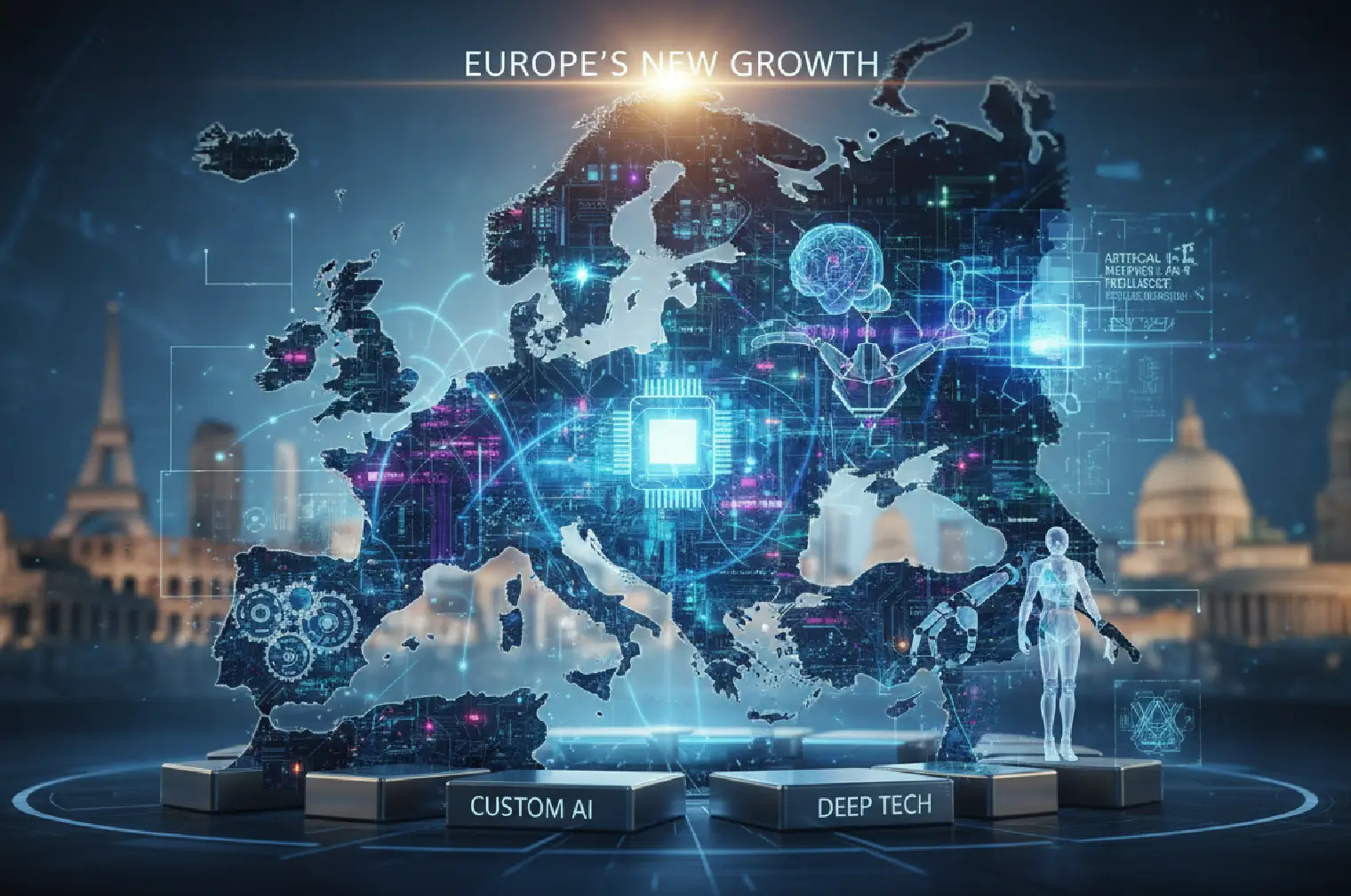
Deep Tech: Europe’s New Enterprise Growth Engine

Let’s face it: the era of simple digitization in Europe is over. We are now entering the age of Deep Tech.

For years, the narrative was that Europe lagged behind the US and China. But the data tells a new story. In 2024, Europe officially overtook Asia in deep tech investment capital, capturing nearly one-third of all venture capital on the continent. We aren’t just building apps anymore; we are building the “infrastructure of tomorrow”—from sovereign AI models like Mistral to advanced industrial robotics.

For business owners and CTOs, this macro-shift signals a critical opportunity. The convergence of world-class research, the EU AI Act’s regulatory clarity, and a hunger for technological sovereignty has created a unique environment. The challenge is to integrating these complex, novel AI systems into legacy European infrastructures to drive real economic value.

What’s Driving Deep Tech’s Rise Across Europe Today?

The surge in European Deep Tech is a structural shift driven by necessity and capability.

First, there is the push for European AI Sovereignty. Reliance on external tech giants is becoming a strategic risk for European enterprises. The rise of local champions like Mistral AI (recently backed by ASML) proves that Europe is serious about owning its own intelligence layer. This enables businesses to establish a foundation on platforms that align with European values and data privacy standards from the outset.

Second, the regulatory landscape has matured. While some view the EU AI Act as a hurdle, smart enterprise leaders see it as a roadmap. By establishing clear rules for “high-risk” AI, the EU has actually lowered the uncertainty for B2B adoption. Companies can now invest in AI automation knowing exactly what the guardrails are, effectively turning compliance into a competitive advantage against unregulated global competitors.

Accelerate Growth with Deep Tech Innovation

Strengthen your enterprise with future-ready Deep Tech strategies and Custom AI Solution capabilities.

How Does Deep Tech Unlock New Value for European Businesses?

Deep tech differs from standard IT in that it addresses tangible, scientific, or engineering problems, rather than merely enhancing user interfaces. For a European CEO, this translates to value that is defensible and hard to replicate.

Here is how custom AI solutions Europe drive that value:

  • Predictive Operational Sovereignty Standard software reports what happened; deep tech predicts what will happen. By processing vast datasets locally, businesses can optimize supply chains and energy usage with 90%+ accuracy without exposing sensitive data to non-GDPR-compliant cloud servers.
  • Regulatory-First Automation With “compliance by design,” intelligent automation tools can handle complex workflows—like financial risk assessment or healthcare triage—while automatically generating the audit trails required by EU law.
  • Hyper-Personalized Client Experiences Deep tech allows for “Novel AI” applications that adapt in real-time. Instead of static chatbots, businesses can deploy large language models (LLMs) fine-tuned on their specific proprietary data to resolve client issues instantly.
  • Industrial Efficiency (Industry 4.0) For Europe’s manufacturing core, deep tech integrates computer vision and edge computing to detect defects that human eyes miss, drastically reducing waste and increasing production velocity.
Standard IT Adoption Deep Tech Transformation 
Digitizes existing manual processes Re-engineers processes using predictive intelligence 
Uses off-the-shelf, generic software Uses custom AI solutions trained on proprietary data 
Reactive decision making Proactive, algorithmic decision making 
Focus on user interface (UI) Focus on underlying problem solving (R&D) 
Standard IT Adoption vs. Deep Tech Transformation

What Does Successful Deep Tech Implementation Look Like?

Theory is good, but execution is what matters. Consider the logistics and manufacturing sectors—the backbone of the European economy.

Imagine a mid-sized European logistics firm struggling with volatile fuel costs and unpredictable delivery windows. Standard “digital transformation” might involve buying a better dashboard. A Deep Tech approach, however, involves building a custom machine learning model that ingests historical traffic data, real-time weather patterns, and fluctuating fuel prices.

By deploying this Intelligent Automation, the firm doesn’t just see the delay; the system autonomously re-routes fleets in real-time to minimize fuel burn. The result isn’t just a 5% time saving; it’s a fundamental restructuring of the cost base and a massive leap in service reliability. This is the power of moving from “software” to “solutions”—specifically, solutions that understand the unique constraints of European infrastructure.

Unlock Efficiency with AI Automation

Automate core operations and scale seamlessly with ViitorCloud’s enterprise-grade AI Automation solutions.

How Does ViitorCloud Engineer Deep Tech Success?

At ViitorCloud, we engineer outcomes. We understand that European businesses need partners who can navigate both the technical complexity of AI and the regulatory nuance of the EU market.

Our approach to custom AI solutions is structured to minimize risk and maximize impact:

  • AI Readiness & Strategic Consulting: We begin by assessing your data infrastructure and “sovereignty readiness.” We identify exactly where AI can drive ROI versus where it’s just a distraction.
  • Custom Model Development: We don’t force your data into a generic black box. We develop and fine-tune models (ML, NLP, or Computer Vision) specifically on your proprietary datasets, ensuring the IP remains yours.
  • Compliance-Ready Integration: Our engineering teams build with the EU AI Act in mind. From explainable AI (XAI) to data lineage tracking, we ensure your deep tech adoption is audit-proof.
  • Scalable Enterprise Deployment: We move quickly from Proof of Concept (PoC) to production, integrating these new intelligence layers seamlessly into your existing ERP or CRM systems to ensure business continuity.
  • Continuous MLOps Optimization: AI models degrade if not maintained. We provide ongoing monitoring and retraining services to ensure your automation remains sharp and accurate as market conditions change.

Conclusion

The “wait and see” period for AI in Europe has ended. With €15 billion flowing into the deep tech ecosystem in 2024 alone, the infrastructure for European AI Sovereignty is being built right now.

For business leaders, the opportunity is clear: leverage this new growth engine to transform your company from a digital player into an intelligent market leader. The combination of Europe’s engineering DNA and the new wave of Enterprise AI adoption provides a rare window to build defensible, high-margin competitive advantages. But this requires more than just software; it requires a partner who understands the deep tech landscape.

Let’s build your custom AI roadmap today. Contact us at [email protected] and schedule your consultation.

Build Smarter Systems with Custom AI Solutions

Enhance decision-making and product capability with scalable Custom AI Solution engineering.

Frequently Asked Questions

Deep tech refers to technologies that address substantial scientific or engineering challenges—such as advanced AI, robotics, or quantum computing. For enterprises, it means moving beyond simple digitization to solving core operational problems using proprietary, defensive technology.

Off-the-shelf AI is often too generic for complex European industries. Custom AI solutions are trained on your specific data, allowing you to automate niche processes, predict unique market trends, and serve customers with a level of precision that competitors using generic tools cannot match.

Yes, if built correctly. The EU AI Act categorizes risk; most B2B automation falls under “low” or “limited” risk. However, high-risk use cases (like HR or critical infrastructure) require strict governance. Partnering with an expert like ViitorCloud ensures your automation is “compliant by design”.

Investment is stabilizing, talent is maturing, and competitors are moving. With Europe’s deep tech ecosystem now valued at potentially $1 trillion in future growth, waiting to adopt these technologies risks leaving your business behind in the legacy economy while the market shifts to intelligent operations.

AI in Finance Takes Center Stage: Insights from Visa’s Asia Pacific Expansion

Asia Pacific has become the laboratory for digital payments, with rapid smartphone adoption, super-app ecosystems, and surging cross-border account-to-account flows redefining how consumers and businesses pay. Visa’s latest push into AI in finance through Visa Intelligent Commerce seeks to build the infrastructure layer that lets AI agents shop, pay, and settle across borders as seamlessly as a one-click checkout today. 

Yet this digitization wave also exposes structural problems:

  • fragmented local payment rails 
  • inconsistent QR and wallet standards 
  • uneven risk controls 
  • rising fraud as scams exploit new channels 

Visa’s own AI-based platforms already analyze hundreds of data attributes per transaction in less than a millisecond to distinguish legitimate activities from fraud, showing how AI automation in finance can keep pace with sophisticated threats while preserving frictionless user journeys. 

At the same time, customers increasingly expect tailored credit, offers, and experiences across cards, wallets, and embedded finance journeys, but many institutions still operate on batch-based, siloed systems that make real-time personalization difficult. By combining network-level intelligence with custom AI solutions for finance, Visa and its partners can re-architect the region’s payment stack to be real-time, context-aware, and safer for every participant in the ecosystem. 

Unlock New Financial Insights with AI in Finance

Strengthen your financial operations and decision-making with ViitorCloud’s Custom AI Solutions.

What Is Visa’s AI Commerce Infrastructure? 

Visa’s emerging AI commerce infrastructure in Asia Pacific is centered on Visa Intelligent Commerce, a suite of integrated APIs, security protocols, and partner programs designed to let AI agents initiate and complete payments on behalf of consumers in a secure, consent-driven way. The initiative introduces a Trusted Agent Protocol that connects consumers, AI agents, merchants, and issuers through a common set of rules and signals, effectively turning Visa’s network into the trusted backbone for AI in finance across the region. 

The scope of this infrastructure spans multiple layers of the payment value chain, from tokenization, authentication, and payment instructions to real-time transaction signals and risk scoring. Existing AI-powered capabilities, such as Visa Advanced Authorization, which analyzes more than 500 risk attributes per transaction in around one millisecond, and Visa’s AI fraud monitoring that prevented 714 million AUD in fraud in Australia in a year, are now being woven into this broader AI automation in the finance fabric. 

Visa is also preparing the network for AI-driven traffic patterns: AI-driven traffic to retail websites has surged by approximately 4700% year-on-year, and 85% of shoppers who have used AI say it improved their shopping experience, underscoring the need for an AI-ready commerce infrastructure. With a history of handling 3.3 trillion transactions over 25 years and an installed base of 4.8 billion credentials, Visa is effectively converting its global payment rail into a programmable platform that developers and partners can use as the foundation for custom AI solutions for finance. 

How It Works and Why It Matters 

Visa’s new infrastructure makes AI-led commerce operational by fusing real-time data, advanced models, and network-scale APIs into a single programmable environment for AI in finance. 

First, real-time transaction intelligence is delivered through services such as Visa Advanced Authorization and AI-powered risk tools that score every payment in milliseconds, allowing issuers to approve good transactions and stop bad ones without adding friction at checkout. 

Second, predictive fraud prevention uses deep learning models that continuously learn from VisaNet’s global data, detecting clusters of suspicious behavior and new scam patterns before they spread, which has helped prevent an estimated 25 billion USD in fraud annually. 

Third, AI-driven merchant analytics tap into network data and machine learning to provide insights on customer behavior, authorization performance, and acceptance trends, enabling merchants and acquirers to optimize pricing, routing, and offers as part of AI automation in finance

Fourth, smart payment routing leverages AI to decide in real time which route, credential, or channel is likely to yield the highest approval rate at the lowest risk, especially important in a region with multiple wallets, QR standards, and local networks. 

Fifth, cross-border automation uses Visa Direct and other account-to-account capabilities to streamline international payouts and collections, applying AI to manage FX, sanctions screening, and risk controls so that global flows become as simple as domestic transfers. 

As T.R. Ramachandran, Visa’s Head of Products and Solutions for Asia Pacific, notes, agentic commerce is transforming the fabric of online transactions and requires a unified ecosystem where every interaction between AI agents and merchants is verified and transparent. In this sense, Visa’s AI commerce stack is not just another feature set; it is an infrastructure play that allows custom AI solutions for finance to plug into a trusted global network rather than rebuilding rails from scratch. 

Drive Growth with Intelligent AI in Finance

Automate financial workflows and gain real-time clarity with tailored AI systems built for your business.

Traditional vs AI-Driven Financial Infrastructure 

Dimension Traditional infrastructure AI-driven infrastructure 
Speed & latency Batch processing and rule-based checks create delays in authorization and settlement, especially cross-border. Real-time scoring and routing allow decisions in under a millisecond, even at global scale. 
Fraud detection Static rules struggle to identify novel scams and can increase false declines. Deep learning models analyze 500+ attributes per transaction, boosting detection accuracy while reducing friction. 
Personalization Limited segmentation and offline analytics constrain tailored offers and credit decisions. Network-wide data and AI in finance enable dynamic pricing, offers, and limits based on real-time behavior. 
Operations & automation Manual reviews and siloed systems lead to higher cost-to-serve. AI automation in finance orchestrates end-to-end workflows, from risk to reconciliation, reducing operational costs. 
Traditional vs AI-Driven Financial Infrastructure

How ViitorCloud Delivers Custom AI Solutions for Finance 

ViitorCloud approaches AI in finance as an infrastructure and operating-model transformation, not just a set of point tools. Our teams design AI architectures that span data ingestion, feature stores, model training, real-time scoring, and integration with core banking or payment systems, ensuring that custom AI solutions for finance are resilient, auditable, and production-grade. 

On the workflow side, we build AI automation in finance for operations such as loan origination, KYC, claims handling, and compliance checks by combining machine learning, robotic process automation, and intelligent document processing. This reduces manual effort, shortens turnaround times, and frees skilled staff to focus on judgment-heavy activities where human expertise adds the most value. 

Predictive analytics and intelligent decisioning are central to ViitorCloud’s BFSI work, with solutions that forecast default risk, detect anomalous transactions, and surface next-best actions for relationship managers across banking, wealth, and insurance. These systems are designed to operate alongside human decision-makers, offering explainable insights and guardrails aligned with internal risk frameworks. 

Compliance and security are embedded in the architecture, drawing on practices developed through system integration and automation projects across regulated BFSI environments. From data lineage and access control to audit-ready logging of model decisions, ViitorCloud ensures that AI automation in finance can satisfy both regulators and internal risk committees. 

With a growing portfolio of BFSI engagements and AI-first platform implementations, ViitorCloud has demonstrated its ability to help clients move from pilots to scaled deployments that materially improve efficiency and customer experience. For institutions seeking to plug into Visa’s AI commerce capabilities while modernizing their own stacks, ViitorCloud provides the custom AI solutions for finance and the delivery discipline needed to execute with confidence. 

Transform Financial Operations with Custom AI Solutions

Enhance compliance, risk analysis, and forecasting with future-ready AI built for finance teams.

Conclusion 

Visa’s build-out of AI commerce infrastructure across Asia Pacific signals a structural shift toward payments networks that are natively intelligent, automated, and secure. As AI agents become trusted intermediaries for shopping, travel, and business payments, the competitive advantage will lie with institutions that can combine network-level capabilities like Visa Intelligent Commerce with robust AI automation in finance inside their own operations. 

ViitorCloud is positioned as a strategic partner in this transition, helping financial enterprises design, deploy, and scale custom AI solutions for finance that plug into these emerging ecosystems while modernizing legacy processes. By aligning data, models, and workflows with business and regulatory goals, organizations can convert AI in finance from a buzzword into tangible growth, resilience, and customer trust.

Contact us at [email protected] and book a complimentary consultation call with our experts. 

Agentic AI for Business: ViitorCloud’s AI-First Playbook

Across industries, the shift from basic copilots to autonomous, outcome-driven systems has put Agentic AI at the center of business digital transformation, and ViitorCloud’s AI-first services are engineered to convert that momentum into measurable business value from day one.  

In 2025, credible benchmarks and market signals show rapid advances in real-world capability and adoption, even as governance expectations rise, making disciplined, AI-first execution the competitive line between learning and leading.  

ViitorCloud builds, integrates, and governs agentic systems that plan, act, and improve across end-to-end workflows, safely, observably, and at production scale. 

The new digital coworker 

Agentic AI elevates software from a responsive assistant to a proactive colleague that decomposes goals, orchestrates tools and APIs, and delivers outcomes with human oversight.  

Recent independent syntheses of 2025 findings highlight that agents are showing strong short-horizon performance in practical tasks while longer horizons still benefit from human-in-the-loop controls, evidence that responsible autonomy is a design choice, not an inevitability.  

ViitorCloud operationalizes this paradigm with robust agent orchestration, audit-ready guardrails, and domain-tuned policies so SMBs and SaaS can scale autonomy where it creates value and constrain it where risk dictates. 

Why is it important now? 

Teams that embed agents inside core workflows shift from fragmented copilots to measurable throughput gains, faster cycle times, and improved decision latency, a pattern reinforced by broad 2025 enterprise adoption signals. The takeaway is simple: treating agents as digital coworkers, not standalone tools, turns experimentation into a durable operating advantage. 

Compete when barriers fall 

As costs decline and capabilities spread, traditional moats like process know-how and static IP erode, making data quality, platform reuse, culture, and velocity the new defensible edges.  

With models and techniques diffusing globally, advantage concentrates in organizations that compound learning through reusable building blocks, instrumented workflows, and cross-functional squads.  

ViitorCloud helps clients protect and extend advantage by engineering AI-first platforms that unify data pipelines, agent orchestration, and governance into a single, evolvable architecture. 

  • Prioritize unique, high-fidelity datasets and feedback loops that improve faster than competitors. 
  • Standardize agent patterns for search, planning, tool use, and handoffs to accelerate reuse across verticals. 
  • Institutionalize ethics and reliability as product features, not afterthoughts, to build trust at scale. 

Accelerate Growth with Agentic AI for Business

Unlock automation and intelligent decision-making with ViitorCloud’s AI-First Business solutions.

From pilots to production 

Most organizations see limited impact when they scatter lightweight copilots across teams; the real step-change comes from “AI inside” vertical reinvention, where agents own discrete outcomes inside end-to-end workflows.  

ViitorCloud focuses on digital transformation in high-value domains — claims, onboarding, procurement, and support — and scales proven patterns across functions through shared components and observability. 

In logistics, for example, vertical agents coordinating planning, execution, and exception handling drive measurable improvements in fill rate, OTIF, and cost-to-serve. 

What to rewire first 

  • Customer operations: autonomous case triage, knowledge-grounded responses, and proactive retention workflows. 
  • Finance operations: reconciliations, anomaly surfacing, and audit-ready narratives with human approvals. 
  • Supply chain: demand sensing, dynamic replans, and last-mile exception resolution with system-of-record updates. 

Govern autonomy with confidence 

2025 is a governance watershed: prohibitions and transparency obligations are live, and phased high-risk requirements are underway, making proactive compliance and AI literacy core to enterprise design.  

Transparent data lineage, calibrated uncertainty, human oversight, and robust logging aren’t just regulatory expectations; they are the operating foundations of trustworthy agents.  

ViitorCloud implements policy-aware agents, red-team routines, and audit trails that align autonomy with risk posture, simplifying readiness for evolving global obligations. 

What regulators expect now 

  • Discontinue prohibited uses and implement transparency for general-purpose and high-risk contexts on published timelines. 
  • Maintain technical documentation, risk management systems, and meaningful human oversight where required. 
  • Demonstrate data governance, logging, and conformity assessment readiness for applicable deployments. 

Adopt Agentic AI to Transform Your Business

Empower your teams with smart, autonomous workflows through our custom Agentic AI solutions.

Architect the AI-first stack 

Engineering for agents requires different primitives: tool-using backends, vector-native retrieval, event-driven observability, and policy layers that shape behavior and boundaries.  

The modern reference stack blends agents with RAG pipelines, function calling, workflow engines, and domain ontologies, all instrumented for cost, latency, drift, and safety.  

ViitorCloud brings these pieces together as modular capabilities, enabling fast starts with room to harden, optimize, and scale. 

  • Agents as backends: flows call tools, systems, and other agents to accomplish tasks, not just respond to prompts. 
  • Retrieval-first design: vector databases, structured retrieval, and grounding policies reduce hallucination risk. 
  • Guardrails and policy: rate limits, escalation paths, and affordances turn autonomy into predictable behavior. 

Design agentic organizations 

As humans and agents collaborate, organizations shift from function-first to outcome-first structures, flatter, thinner, and more fluid, with small cross-functional squads owning ideas through impact.  

Productivity becomes a function of how many agents can be orchestrated effectively, not just hours logged, which elevates orchestration, governance, and experimentation as core capabilities.  

ViitorCloud helps establish operating models where human accountability and agent speed reinforce each other via clear roles, escalation norms, and performance telemetry. 

New leadership habits 

  • Define decision rights for agents vs. humans, including thresholds, controls, and escalation logic. 
  • Measure outcomes per agent and per squad, not tool adoption, to anchor investments in value creation. 
  • Institutionalize rapid “build-measure-learn” loops with safe sandboxes and production-grade pathways. 

Build adaptive learning loops 

In a world of near-zero marginal knowledge costs, winners learn faster because their systems and cultures make learning the default, not an event.  

The technical side is an “AI mesh” of scalable, flexible infrastructure, multicloud, reusable pipelines, portable agents, while the cultural side is a test-learn-adapt habit applied relentlessly to real outcomes.  

ViitorCloud codifies both robust platform choices with explicit pathways from experiments to governed production, ensuring improvements persist and compound. 

  • Reuse everywhere: prompts, tools, retrieval patterns, and evaluation harnesses become shared assets. 
  • Instrument everything: cost, latency, safety, and quality metrics drive automated tuning and human review. 
  • Close the loop: user feedback and ground-truth outcomes feed training and policy updates on cadence. 

Build an AI-First Business with Confidence

Strengthen strategy, scalability, and operations using ViitorCloud’s Agentic AI and AI for Business expertise.

Your AI-first mandate 

Agentic AI is a leadership mandate to launch at least one bold, end-to-end transformation while modeling fluency, governance, and personal accountability.  

The businesses that thrive in 2025 will embed agents into the work itself, rewire workflows vertically, and measure value in outcomes, not pilots. 

ViitorCloud partners as an AI-first engineering ally, designing strategy, building custom agents, integrating with your systems, and governing for scale, so your teams can move from proof-of-concept to production impact with confidence. 

  • AI strategy and roadmaps aligned to risk, value, and compliance realities. 
  • Custom agent development, orchestration, and workflow rewiring in priority verticals. 
  • Integration, observability, and governance to make autonomy safe, auditable, and scalable. 
  • Continuous optimization loops that turn local wins into enterprise capabilities. 

Select a high-impact domain, define outcome metrics, and stand up an “AI inside” workflow with clear guardrails and a 90-day learning plan. With proven agent patterns, a modular stack, and production-grade governance, ViitorCloud makes the shift to agentic operations practical, fast, and value-anchored. Contact us at [email protected] and book a complimentary consultation call with our experts. 

Why CTOs Are Incorporating AI in SaaS Products as the New Competitive Edge

In 2025, AI in SaaS products is the new competitive edge. AI budgets and SaaS adoption are converging as enterprises standardize on platforms that compound value across teams, products, and data. Analysts indicate worldwide AI spending will near $1.5 trillion in 2025, while SaaS spend is set to hit roughly $300 billion, reflecting the move to cloud-native, intelligent services. The strategic question for CTOs is clear: why prioritize AI-powered SaaS as the next growth engine over incremental IT modernization

Let’s discuss the shift from traditional upgrades to platform-driven innovation and how embedding AI into SaaS architectures builds a durable advantage, and how ViitorCloud partners with leadership teams to deliver it. 

What’s Driving the Shift Toward AI-Infused SaaS? 

AI in SaaS helps to deliver scalable intelligence: models learn from operational data, automation improves continuously, and product velocity compounds over time. CTOs are moving beyond isolated AI pilots toward platform architectures that industrialize AI, reduce TCO, and drive measurable business outcomes. 

The convergence of cloud elasticity, ubiquitous data pipelines, and production-grade AI is now central to product strategy. McKinsey reports 65% of organizations use generative AI as of early 2024, underscoring normalized adoption across functions. Gartner projects global AI spending will approach $1.5 trillion in 2025, signaling sustained investment in AI infrastructure, applications, and services powering SaaS in AI roadmaps. 

The push accelerates because legacy systems strain under rapid demand shifts, multi-tenant scale, and real-time decision needs. Leaders cite agility gaps, underutilized data, and extended release cycles as constraints that AI-driven SaaS platforms are built to overcome. 

Build Your Competitive Edge with AI in SaaS

Enhance product capabilities and deliver smarter user experiences with ViitorCloud’s AI-driven SaaS innovation.

How Is AI + SaaS Redefining Digital Transformation for CTOs? 

  • Continuous learning and automation: Artificial intelligence models embedded in SaaS workflows improve with each interaction, compressing manual effort and elevating quality. 
  • Lower total cost of ownership: Cloud-native architectures, multi-tenancy, and MLOps/LLMOps reduce operational overhead while improving reliability. 
  • Faster go-to-market cycles: Modular services, reusable model components, and CI/CD for data and models accelerate iteration. 
  • Data-driven decision ecosystems: Unified data layers, vector search, and governed feature stores convert operational exhaust into compounding intelligence. 

This matters now because technology and markets are volatile, and platforms that learn faster win sooner. Three-quarters of leaders expect generative AI in SaaS to drive significant or disruptive change in their industries, making platform choice a strategic bet, not a tooling decision. 

Legacy vs AI-Driven SaaS Platforms 

Dimension Legacy systems AI-driven SaaS platforms 
Adaptability Static releases Continuous learning and feature velocity 
TCO High infra/ops burden Cloud-native efficiency and shared services 
Data use Siloed analytics Real-time, governed decisioning 
Personalization Rules-based Predictive, context-aware 
Resilience Monolith and downtime risk Distributed, multi-tenant, automated rollback 
Legacy vs AI-Driven SaaS Platforms

Accelerate Growth by Integrating AI in SaaS

Empower your platform with predictive intelligence, automation, and data-led decision systems.

What ViitorCloud Can Do 

ViitorCloud helps leadership teams turn strategy into software with AI-first SaaS engineering, cloud-native modernization, and embedded intelligence in enterprise applications. The focus is to build platform foundations—data pipelines, feature stores, model registries, and inference gateways—then layer domain-specific AI to deliver business outcomes. 

Expect tangible impact: faster product iteration with CI/CD for data and models, elastic scalability under variable loads, and 30–40% efficiency improvements through automation, right-sizing, and platform consolidation.  

Teams also see quality gains from AI/ML-driven QA, anomaly detection, and AIOps. ViitorCloud brings the architectural rigor, domain-aware modeling, and production-grade MLOps to move from prototype to dependable, scalable product. 

How ViitorCloud Helps CTOs Accelerate AI + SaaS Transformation 

  • Proven success across BFSI, Healthcare, Manufacturing, and Public Sector, aligning AI outcomes to compliance, SLAs, and risk controls. 
  • Strategic partnerships with leading cloud and AI ecosystems to accelerate build, security, and observability with best-in-class components. 
  • End-to-end delivery from strategy and architecture to data engineering, MLOps, platform build, and ongoing optimization tied to KPIs. 

ViitorCloud partners at the strategy layer to co-own outcomes, embeds with engineering to manage delivery risk, and establishes productized platform capabilities to scale innovation. As a strategic technology partner, ViitorCloud helps CTOs operationalize digital transformation with AI in SaaS as the operating model. Contact us at [email protected] and discuss with experts how our expertise can empower you.

Upgrade Your SaaS Product with AI Integration

Stay ahead of market demands by embedding intelligent automation and adaptive workflows.

Frequently Asked Questions

By merging scalability and intelligence, SaaS and AI enable rapid innovation, agile business models, and data-driven operations.

Integration complexity, data governance, security, talent readiness, and aligning AI outcomes with measurable business value.

65% of organizations now use generative AI, and global AI spending is projected to reach $1.5 trillion in 2025.

Through custom SaaS platforms, AI-powered data engineering, cloud-native modernization, and production-grade MLOps.

Platform-first moves compound; organizations expecting significant disruption from AI are already building AI-native capabilities into core systems. 

Generative AI in Banking: How CTOs Are Reinventing Financial Services in 2025

Generative AI in banking is moving from pilots to platform-level reinvention, with leaders using AI to compress costs, grow revenue, and elevate risk controls across U.S. banks, insurers, payments, and capital markets in 2025.

The institutions winning now are shifting from “AI experiments” to “AI-first operating models” while formalizing responsible AI under NIST’s GOVERN–MAP–MEASURE–MANAGE framework.

The 2025 inflection for AI in BFSI

U.S. financial firms are scaling AI from back-office automation to front-to-middle value creation; 78% of banks pursued generative AI tactically in 2024, and a growing cohort is systematizing adoption in 2025 to drive performance. Industry investment is surging: financial services spent roughly $35B on AI in 2023 and are projected to reach $97B by 2027, reflecting the shift from cost-centric proofs to enterprise growth use-cases. Market momentum is reinforced by a rapidly expanding AI in the BFSI market—valued near $25.4B in 2024 with strong North American leadership and a high-20s CAGR through the decade.

Strategic mandate for CTOs and CIOs

So, board-level expectations are clear that one has to lead with AI or lag as profitability pressures and client demands widen the performance gap between adopters and followers.

Winning banks are rebuilding operating stacks around hybrid cloud, platform governance, and an “AI factory” construct to accelerate safe development, reduce complexity, and embed AI confidence across product and risk workflows.

Critically, 60% of banking CEOs accept that some risk is necessary to harness automation and competitiveness, placing CTOs at the center of balancing velocity with control.

Read: Benefits of AI in Finance: Transforming Financial Services

Reinvent Financial Services with Generative AI in Banking

Drive innovation and smarter decision-making across financial operations using ViitorCloud’s custom AI solutions tailored for the banking sector.

From automation to growth: the new value line

Early AI wins focused on efficiency; the next wave is targeted revenue expansion as AI personalizes experiences, opens mass-affluent advisory at scale, and unlocks new embedded-finance fee pools.

Accenture projects generative AI can remove “waste” in compliance and testing, while freeing front-line capacity for deeper relationships and sales effectiveness that compound revenue impact. By 2030, generative AI will become pervasive and customer-centric, reversing impersonal digital experiences with context-rich, emotionally resonant service moments.

Actionable use-cases across BFSI

  • Banking and wealth: AI copilots for relationship managers surface next-best actions, pre-fill credit memos from unstructured documents, and co-author compliant advice, lifting productivity and sales conversion while reducing manual rework.
  • Insurance: GenAI streamlines FNOL intake, automates claims triage from multimodal evidence, and augments underwriting with faster risk summaries and document Q&A aligned to model governance.
  • Payments: Real-time anomaly detection enriches fraud decisions with behavioral signals, while AI agents orchestrate dispute resolution and merchant support, cutting handle time and chargeback leakage.
  • Capital markets: Research copilots synthesize filings, news, and call transcripts; code assistants modernize legacy risk engines; and AI aids trade surveillance, reducing alert noise and investigative cycles.

Check: Innovative AI Use Cases in Finance Industries

Architectures that scale safely

CTO blueprints now standardize retrieval-augmented generation for grounded responses, pair small language models to task-specific domains, and begin exploring AI agents that can autonomously execute bounded actions under policy.

Accenture highlights an accelerated path to modernize legacy “spaghetti code,” with generative AI assisting reverse engineering and code translation on the way to composable, open architectures.

As platform providers embed AI natively, banks should adopt composable, marketplace-driven solutions that reduce integration friction and technical debt.

Responsible AI by design (NIST AI RMF)

To sustain trust and speed, U.S. BFSI teams are operationalizing the NIST AI Risk Management Framework across the lifecycle—GOVERN, MAP, MEASURE, MANAGE—to align models with characteristics like explainability, robustness, security, and fairness.

The framework’s emphasis on TEVV, risk prioritization, and residual-risk documentation helps teams navigate tradeoffs between accuracy, interpretability, and privacy under real-world conditions. Treating every banker and engineer as an AI risk manager embeds accountability and shortens the path from experimentation to compliant scale.

Check: Finance Cost Optimization with AI Solutions

Transform Your Banking Ecosystem with AI in Banking

Enhance customer experience, reduce risks, and streamline operations with ViitorCloud’s powerful custom AI solutions for financial enterprises.

U.S. market signals and adoption realities

North America leads AI in BFSI due to early adoption, robust technology ecosystems, and regulatory readiness that embraces innovation alongside system integrity.

IBM’s 2025 outlook shows banks exiting broad experimentation to enterprise strategies, including agentic AI, anchored to revenue, operational efficiency, risk renewal, and workforce enablement.

As modernization overruns persist, hybrid cloud patterns and AI-assisted re-architecture are becoming essential to cut complexity and deliver regulatory-grade resilience.

What to build this year: 90-day roadmap

  • Establish an AI platform baseline: unify model catalogs, data products, feature stores, observability, and policy-as-code; define “golden paths” for RAG and SLM services with pre-approved guardrails.
  • Prioritize three high-yield use-cases: one revenue (personalized offers or affluent advisory), one efficiency (KYC/RAML reviews), and one risk (fraud/AML triage) to prove impact across the P&L and the three lines of defense.
  • Industrialize TEVV: adopt standardized performance, drift, robustness, and bias metrics mapped to NIST categories, with human-in-the-loop procedures and red-teaming for customer-facing models.
  • Upskill and change management: scale AI enablement for product, risk, and tech teams; align incentives to adoption and safe usage, not just delivery speed.

Measurable outcomes CTOs can commit to

Within two quarters, institutions can target double-digit reductions in claims cycle times, dispute resolution, and frontline handle times—while showing early revenue lifts from next-best-action engines in retail and wealth.

Capital markets teams can compress research and model maintenance cycles with AI copilots, redirecting analyst capacity to differentiated insights. In parallel, consistent model cards, lineage, and audit artifacts reduce supervisory friction and accelerate approvals for scaled deployment.

Read: AI in Finance – Transforming Banking with AI Solutions

Navigating risks: misinformation, fraud, and deepfakes

Financial institutions face rising threats from synthetic media and coordinated misinformation that can induce fraud or market manipulation; deepfake tool trading spiked sharply in early 2024, and incidents now include multimillion-dollar social engineering via realistic video calls.

Countermeasures span watermarking, content provenance, and AI-native detection that inspects artifacts without needing originals—combined with adaptive controls across identity, payments, and communications. Embedding these safeguards into customer-facing AI agents is essential as adoption expands beyond internal co-pilots.

Lead the Future with Generative AI in Banking

Empower your financial systems with next-gen intelligence through ViitorCloud’s custom AI solutions designed for growth and innovation.

Partner with ViitorCloud for velocity and safety

ViitorCloud partners with U.S. BFSI leaders to design AI platforms, engineer RAG and SLM patterns, modernize legacy estates, and operationalize NIST-aligned governance that accelerates compliant scale.

Explore our generative AI solutions, AI/ML engineering, data engineering, cloud, and DevOps capabilities, and BFSI-focused insights to translate strategy into measurable outcomes fast.

Whether the imperative is revenue growth, cost transformation, or risk renewal, ViitorCloud helps teams move from pilots to production with resilient, auditable AI foundations. Contact our team at [email protected].