Operationalizing McKinsey’s 2025 Tech Trends with ViitorCloud: Agentic AI, Cloud‑Edge, and Digital Trust

McKinsey’s 2025 Technology Trends Outlook highlights 13 frontier trends reshaping value creation, with AI acting as an amplifier across robotics, semiconductors, mobility, and energy, offering a timely blueprint for IT leaders to prioritize investment, governance, and talent in the face of scaling constraints and global competition.

In this context, ViitorCloud’s AI-first platforms, cloud engineering, and data capabilities provide practical pathways to operationalize these trends safely and at speed for enterprise outcomes.

Why this matters in 2025

The 2025 Outlook shows equity investment rebounded across 10 of 13 trends in 2024, while themes like autonomy, human–machine collaboration, infrastructure bottlenecks, and responsible innovation now define the adoption agenda for CIOs and CTOs.

AI is both a standalone wave and a force multiplier, accelerating use cases from software engineering to energy systems optimization, yet value capture hinges on cost-efficient inference, robust governance, and workforce adaptation at scale.

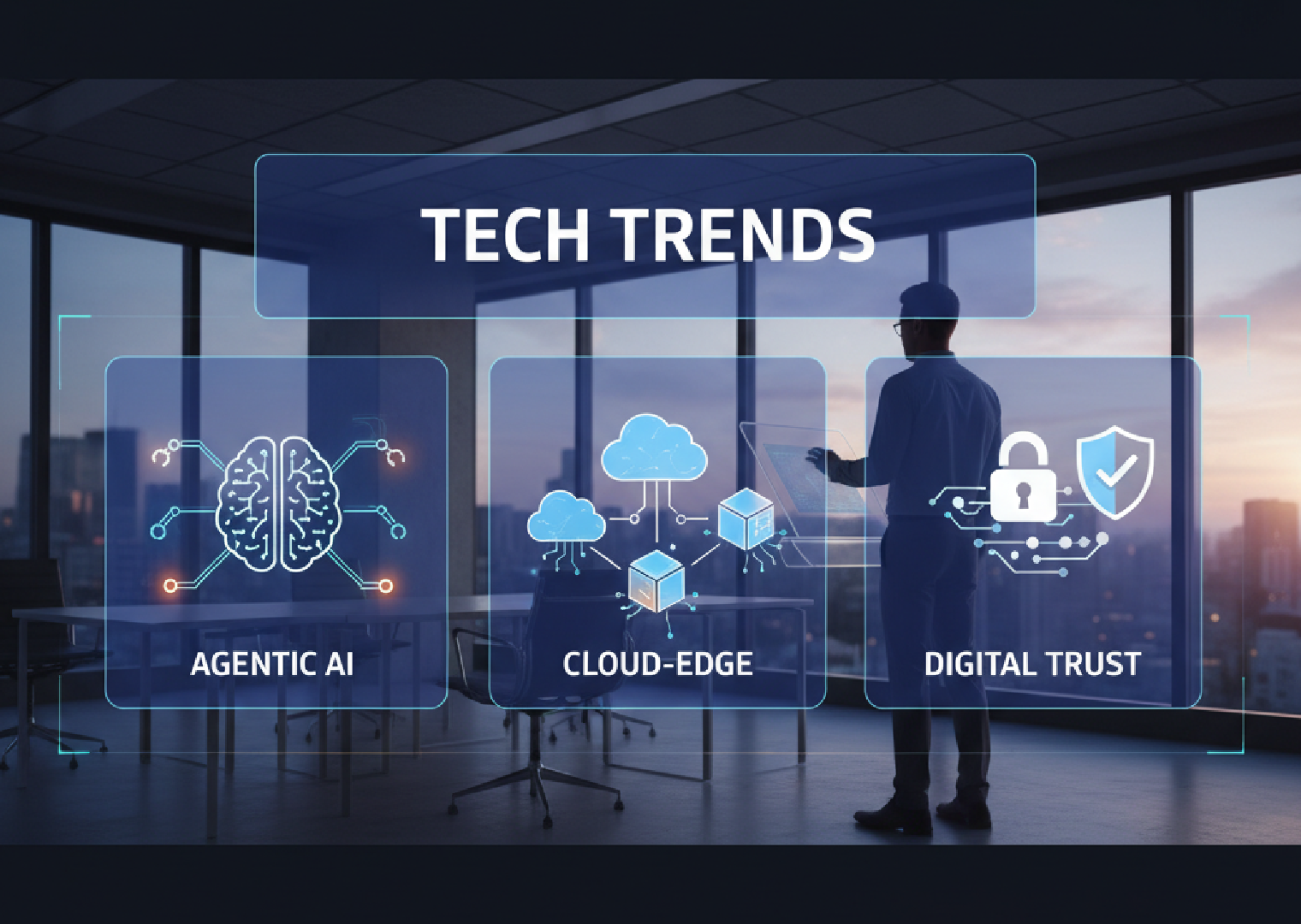
AI’s Next Phase: Agentic Coworkers

Newly elevated in 2025, agentic AI moves beyond chat to plan and execute multi-step workflows, enabling virtual coworkers that coordinate tools, call APIs, and collaborate with other agents to deliver business outcomes autonomously.

Early signals are strong. Job postings in agentic AI spiked from 2023 to 2024, and equity investment surpassed $1.1B. Yet enterprises must pair experimentation with guardrails for reliability, liability, and safe autonomy.

  • Smaller, domain-specific models (≈≤10B parameters) are surging, lowering compute costs and enabling on-device/edge inference across devices, vehicles, and industrial assets.
  • Multimodal and reasoning advances are shifting AI from retrieval to deep planning and code generation, accelerating developer productivity while introducing new needs for quality, observability, and technical debt management.

At ViitorCloud, we build custom AI solutions and automation for real workflows—codifying data pipelines, orchestrating tools, and integrating governance to keep agentic systems auditable and aligned to KPIs.

Lead Innovation with Agentic AI

Transform decisions and automate complex workflows with ViitorCloud’s Agentic AI solutions for future-ready enterprises.

Compute And Connectivity: From Hyperscale to Edge

“Compute and connectivity frontiers” span application-specific semiconductors, advanced connectivity, and cloud/edge computing—areas that are scaling fast as gen AI and autonomy intensify compute demand and strain power, networking, and supply chains.

Purpose-built silicon is accelerating as organizations chase performance-per-watt and cost per inference, while edge architectures reduce latency, enhance privacy, and enable resilient operations in bandwidth-constrained environments.

  • Cloud and edge computing saw renewed investment momentum in 2024 as organizations balanced centralized training with localized inference and control, creating hybrid architectures that are both scalable and sovereign-ready.
  • Adoption success now depends as much on non-technical execution (permits, grid access, skills, and ecosystem alignment) as it does on software architecture and MLOps maturity.

We deliver cloud consulting, migration, hybrid cloud, and DevOps automation to operationalize AI workloads cost-effectively across public, private, and edge footprints.

Trust, Safety, and Cybersecurity

McKinsey flags “digital trust and cybersecurity” as a foundational trend, noting escalating threats to critical infrastructure and the need for AI trust tooling, explainability, resilience, and tokenized trust systems in finance and healthcare.

IBM reports the global average cost of a breach fell to roughly the mid-$4M range, but costs climbed in several regions and industries, underscoring the imperative for AI-enabled detection, faster containment, and strong governance over “shadow AI”.

  • Verizon’s 2025 DBIR notes ransomware links to the majority of system-intrusion breaches, reinforcing the value of hardening identities, patching edge/VPN surfaces, and improving detection/response at machine speed.
  • McKinsey emphasizes that trust, fairness, and accountability will be gatekeepers to AI adoption; leaders are moving from principles to practical platforms for governance, audit, and risk controls across the model lifecycle.

ViitorCloud implements identity-first architectures (EveryCRED), AI-driven automation, and observability that strengthen cyber posture while embedding responsible-AI guardrails into data and model pipelines.

Cutting‑Edge Engineering: Robotics, Mobility, Energy

Robotics, mobility, bioengineering, space, and energy make up the “cutting‑edge engineering” cohort, where AI augments physical systems and supply chains to create new productivity frontiers.

Robotics is moving from pilots to production with humanoids, cobots, and RaaS models, representing a market opportunity approaching hundreds of billions by 2040, though scaling still requires operating models, IT/OT, and capability upgrades.

  • Future of mobility is advancing across AVs, drones, and eVTOL—but unit economics, safety assurance, and regulatory readiness remain pivotal as commercial deployments expand.
  • Energy and sustainability tech is rebounding, with AI and advanced connectivity enabling predictive maintenance and grid optimization, even as power constraints become a first-order challenge for data centers and AI clusters.

Our data engineering in regulated and asset-heavy sectors (e.g., healthcare and logistics) demonstrates the domain integration required to power predictive analytics and real-time intelligence on cloud foundations.

Build Smarter Systems with Cloud-Edge

Accelerate innovation and optimize operations by connecting cloud power with edge computing through ViitorCloud’s expertise.

Where Viitorcloud Fits: From Roadmap to Run

ViitorCloud’s AI-first approach and cloud execution help enterprises translate trend signals into governed, production-grade systems tied to measurable outcomes.

The focus spans discovery to delivery: solution architecture, data engineering, MLOps/DevOps, and the change management needed to realize adoption and ROI at scale.

Trend-to-solution mapping

McKinsey 2025 trendEnterprise pain pointViitorCloud solutionOutcome
Agentic AIManual, multi-step workflows limit throughput and CXAI-driven automation and custom agents integrated with business systemsHigher case throughput, shorter cycle times, auditable agent actions
Cloud & edge computingLatency, cost-to-serve, and data residency constraintsCloud consulting, hybrid architectures, and edge deployment with DevOps automationLower infra cost per transaction, resilient local inference, faster releases
Digital trust & cybersecurityRansomware/system intrusion risk and AI governance gapsIdentity-first design, observability, and responsible-AI controls in pipelinesFaster detection/containment, compliant AI use, lower breach exposure
Future of roboticsSkills/IT‑OT gaps slow deployment at scaleData/AI integration, simulation, and iterative automation playbooksSafer pilots, scalable automation patterns, clearer ROI attribution
Energy & sustainability techMaintenance downtime and power constraintsPredictive analytics pipelines and cloud platforms to optimize assetsReduced unplanned downtime and optimized energy consumption
ViitorCloud’s Trend-to-Solution Mapping

Action Playbook for IT leaders

  • Prioritize “AI + X” combinations: pair AI with robotics, connectivity, and digital twins to unlock step-change productivity—starting with narrow, auditable use cases and expanding with proven playbooks.
  • Design for scale and sovereignty: architect hybrid-cloud and edge patterns, leverage small models where possible, and plan for power/network bottlenecks with FinOps and capacity roadmaps.
  • Operationalize trust: implement AI governance, model observability, and strong identity controls to reduce breach exposure, accelerate incident response, and preserve customer trust.

Strengthen Security with Digital Trust

Ensure data integrity and build customer confidence with ViitorCloud’s Digital Trust frameworks and solutions.

How ViitorCloud Can Partner

As an AI-first engineering partner, ViitorCloud brings custom AI development, automation, and cloud modernization to productionize frontier trends—grounded in industry domains like healthcare, logistics, and energy with the compliance and observability required for scale.

Offerings include AI solution design, agent orchestration, data engineering, cloud migration, hybrid architectures, and DevOps automation to help enterprises move from PoC to durable value creation.

Get started with an AI and cloud readiness assessment to prioritize quick wins, align governance, and chart a 90‑day path from prototype to production with measurable KPIs tied to cost, risk, and revenue.


Microservices Architecture for Retail: How to Build Scalable, API-First E-Commerce Platforms

Microservices architecture for retail has emerged as one of the best solutions for brands struggling with legacy monolithic systems that can’t keep pace with today’s omnichannel demands.  

As the retail industry becomes increasingly complex, mid-to-large retailers and D2C brands are discovering that traditional architectures create more bottlenecks than breakthroughs. 

Modern retail success demands more than just an online presence—it requires seamless orchestration across web platforms, marketplaces, physical stores, mobile apps, and emerging channels.  

Yet 77% of ecommerce professionals consider search accuracy and relevance critical to customer experience, while legacy systems struggle to deliver even basic functionalities efficiently. 

The challenge is strategic. Retailers using outdated monolithic architectures face costly maintenance, slow feature releases, and the constant risk of system-wide failures that can devastate customer trust and revenue. 

Why Legacy Retail Systems Are Failing Modern Brands 

Legacy retail systems, often built 20-30 years ago as monolithic structures, present eight critical challenges that modern retailers can no longer ignore. These systems were designed when retail meant simple point-of-sale transactions, not today’s complex ecosystem of POS, ERP, and CRM integration across multiple touchpoints. 

Architecture limitations represent the most significant barrier. When inventory management, customer relationship systems, and order processing are interwoven into a single codebase, any modification ripples through the entire system. This creates what industry experts call “technical debt”—where simple updates become expensive, time-consuming projects requiring extensive testing and coordination. 

Technology stack obsolescence compounds these issues. Many retailers still rely on outdated languages like COBOL or legacy Java versions, making it increasingly difficult to find developers willing to work with these technologies. The costs of maintaining mainframe systems often exceed potential ROI, while security updates for discontinued software become unavailable. 

Data silos further complicate operations. Customer records, inventory data, and sales transactions exist in separate, disconnected databases, making real-time analytics and personalized experiences nearly impossible to achieve. 

Check: System Integration Services for High‑Velocity Enterprises 

Build Scalable Retail Platforms with Microservices Architecture

Empower your e-commerce with ViitorCloud’s System Integration Services to ensure agility, scalability, and seamless customer experiences.

What Makes API-First E-Commerce Architecture Essential? 

API-first e-commerce platforms for retail solve fundamental integration challenges by treating APIs as the primary interface for all system communications. This approach provides greater control and ownership over individual store components, allowing retailers to choose optimal frontend frameworks and integrate diverse backend systems without vendor lock-in. 

Enhanced security and compliance become natural byproducts of API-first design. Since APIs act as standardized, secure interfaces between systems, retailers can more easily manage access permissions and enforce security protocols like encryption and authentication. This proves especially crucial as regulations like GDPR and PCI DSS 4.0 become increasingly stringent. 

The composable commerce evolution represents the next phase beyond traditional microservices. Rather than building every function from scratch, retailers can now assemble solutions using pre-built, pre-integrated components that reduce complexity while maintaining flexibility. 67% of companies are changing or planning to change their commerce architecture to prepare for future demands. 

Core Components of Microservices Architecture for Retail 

System integration services become the backbone of successful microservices implementations. Each service handles specific business functions—inventory management, payment processing, customer data, order fulfillment—while communicating through well-defined APIs. 

Essential microservices for retail include: 

  • Product Catalog Service: Manages product information, pricing, and availability across channels 
  • Inventory Management Service: Provides real-time stock levels and automated replenishment 
  • Customer Profile Service: Centralizes customer data while maintaining privacy compliance 
  • Order Management Service: Orchestrates complex fulfillment workflows 
  • Payment Gateway Service: Handles secure transaction processing 
  • Personalization Engine: Delivers AI-powered product recommendations 
  • Analytics Service: Provides real-time business intelligence and reporting 

Event-driven architecture enables these services to communicate asynchronously, ensuring that high-traffic events like flash sales or inventory updates don’t create system bottlenecks. 

Read: UI/UX in Retail Apps: Gamified Design That Retains 35% 

Transform E-Commerce with API-First Microservices

Streamline operations and drive innovation with our expert System Integration Services designed for modern retail businesses.

Implementation Blueprint: Your Path to Scalable Commerce 

System integration for retail requires a phased approach that minimizes disruption while maximizing business value. The most successful implementations follow a coexistence model where legacy and modern systems operate simultaneously during transition periods. 

Phase 1: API Layer Introduction: 

Begin by exposing legacy functionality through secure API layers. This creates immediate integration opportunities without requiring a complete system replacement. Container technologies like Docker enable legacy component modernization, while Kubernetes provides orchestration capabilities. 

Phase 2: Service Decomposition: 

Identify high-impact modules for migration to modern languages like Java, .NET, Node.js, or Python. Start with customer-facing services that directly impact experience—search functionality, checkout processes, and personalization engines. 

Phase 3: Data Pipeline Modernization: 

Deploy modern data integration platforms to unify siloed systems. Build ETL/ELT pipelines using tools like Airflow while establishing data warehouses through Snowflake, BigQuery, or AWS Redshift. This enables the real-time analytics essential for competitive retail operations. 

Phase 4: Frontend Modernization: 

Develop Progressive Web Apps (PWAs) using modern frameworks like React, Vue, or Flutter. These provide fast, mobile-friendly experiences while maintaining backend flexibility through API connections. 

Also read: How to Build Data Pipelines for Retail 

How System Integration Services Transform Retail Operations 

Multi-channel integration challenges require sophisticated orchestration capabilities that extend far beyond simple API connections.  

Modern retailers must coordinate inventory management across physical stores, e-commerce platforms, marketplaces, and social commerce channels while maintaining real-time accuracy. 

Infrastructure and fulfillment considerations become critical as retailers expand beyond single-channel operations.  

Same-day delivery expectations require automated tools and streamlined processes that legacy systems simply cannot support. System Integration Services enable retailers to leverage Amazon FBA, third-party logistics, and dropshipping services seamlessly. 

Omnichannel capabilities like click-and-collect, in-store web returns, and cross-channel inventory visibility require careful integration between POS systems, e-commerce platforms, and inventory management services.  

Success demands unified customer profiles that track interactions and preferences regardless of channel. 

Check: AI-First SaaS Engineering: How CTOs Can Launch Products 40% Faster 

Scale Smarter with Microservices Architecture

Future-proof your retail systems by leveraging ViitorCloud’s Digital Transformation Solutions and advanced System Integration Services.

Measurable Business Impact 

Retailers implementing Microservices architecture for retail report significant improvements across key performance indicators. Enhanced scalability and resilience result in faster time-to-market for new offerings while reducing system downtime risks. Personalization at scale becomes achievable through dedicated AI services that analyze customer behavior, purchase history, and browsing patterns.  

41% of retailers plan to improve personalization capabilities in 2025, leveraging microservices to create granular customer segments and deliver hyper-personalized experiences. 

Operational efficiency improves through automated workflows and real-time data synchronization. Retailers can implement complex promotional strategies, dynamic pricing models, and sophisticated loyalty programs without system limitations constraining business innovation. ViitorCloud can help retail businesses with our system integration services. 

The competitive advantage emerges from agility—the ability to rapidly test new features, integrate emerging technologies, and respond to market changes without architectural constraints.  

Modern microservices implementations support AR try-ons, AI-powered chatbots, and real-time inventory visibility that customers now expect as standard retail capabilities. 

System integration services that properly implement microservices architecture transform retail operations from reactive maintenance modes into proactive innovation engines, positioning brands for sustained growth in an increasingly digital marketplace. 

If you are ready to take a step ahead, contact us at [email protected].  

System Integration Services for High‑Velocity Enterprises

Modern enterprises can’t afford glue code, brittle point‑to‑point links, or silos that slow releases and inflate costs.

Studies show that cloud migrations still fail or stall at material rates without the right integration strategy, while tool and data fragmentation drive measurable losses in security, agility, and spend problems that CIOs and CTOs must solve at the integration layer to unlock digital transformation ROI.

ViitorCloud’s system integration services align architecture, data, security, and delivery pipelines so SaaS leaders in fintech, healthcare, and retail can ship reliably, scale predictably, and modernize without disruption.

Why Integration is Now a C‑Suite Priority

Integration demand is surging as app portfolios sprawl across hybrid and multi‑cloud; leaders in iPaaS underscore that integration has become the largest platform market segment because enterprises need consistent connectivity and governance everywhere.

Failed or stalled cloud migrations and fragmented toolchains amplify risk and cost—problems that integrated platforms and operating models directly address.

For security and compliance, integrated controls correlate signals and reduce breach costs versus siloed stacks, making architecture-level integration a board-level control.

Read: Importance of Enterprise System Integration for Business

What Makes a Modern Integration Partner?

ViitorCloud delivers system integration services that unify applications, data, and processes, and couple them with system modernization services for cloud‑native evolution.

Capabilities span API integration, software and data integration, AI/ML infusion, and domain‑specific modernization patterns so programs can balance short‑term wins with long‑term architectural health.

This approach is designed for digital transformation services where legacy constraints and siloed data must be removed without jeopardizing uptime.

Core Capabilities CIOs Expect

  • API‑first integration and event‑driven architectures that decouple services, improve release cadence, and reduce tight coupling that causes change failure.
  • Data integration and observability to break silos, create trusted pipelines, and enable real‑time analytics with proper governance.
  • Domain modernization: re‑platforming and re‑architecting legacy systems to cloud services with staged cutovers, minimizing risk to critical workloads.

Accelerate Growth with System Integration Services

Unify applications, data, and processes to enable seamless operations with ViitorCloud’s expert integration solutions.

The Hidden Cost of Fragmentation

Siloed tools and data drive higher breach impact and operational drag.

Enterprises with integrated security stacks reduce breach costs by over a million dollars on average compared to siloed approaches, and fragmented data quality issues have multi-million‑dollar annual costs.

For transformation leaders, this quantifies the ROI of integrating platforms and governance rather than adding point tools.

  • Stalled migrations and rework: Many programs falter from weak planning and skill gaps, turning integration into a late‑stage blocker and extending timelines.
  • Technical debt interest: Unaddressed integration shortcuts compound, slowing delivery by double‑digit percentages over time and inflating maintenance.
  • Compliance exposure: Disconnected controls hide risk; harmonized APIs, messaging, and identity baselines reduce audit gaps during modernization.

Reference Architectures That Scale

Enterprises benefit from proven integration patterns: API gateways, event buses, workflow orchestration, and data pipelines that work across SaaS, on‑prem, and clouds.

Leading platforms emphasize modular services – API management, serverless workflows, messaging, and data wrangling to meet unique needs without over‑buying.

ViitorCloud implements these patterns with platform choices mapped to domain constraints and team skills.

  • API management to standardize contracts, rate limits, authN/Z, and lifecycle governance across internal and external consumers.
  • Event‑driven messaging to decouple services, smooth bursts, and reduce synchronous failure modes that delay releases.
  • Low‑code/no‑code orchestration for business flows where speed matters, with guardrails for security and compliance.

Check: AI-First Software and Platforms: Transforming Businesses

Where Do Most Programs Slip, and How to Avoid It?

Cloud modernization often underestimates integration complexity, leading to failures or stalls from strategy gaps, security/regulatory missteps, and a lack of in‑house skills.

A structured approach, value‑mapped roadmaps, platform selection, control baselines, and incremental releases reduce risk while keeping stakeholder confidence high.

ViitorCloud’s delivery model addresses these failure modes proactively.

  • Start with an integration runway: reference architecture, platform guardrails, and data governance before workload moves.
  • Establish a security fabric early: identity, secrets, API security policies, and telemetry to contain blast radius.
  • Incremental cutovers: strangler patterns and blue‑green releases minimize downtime and de‑risk legacy retirement.

Unlock Agility with System Integration Services

Break down silos and connect enterprise systems to deliver speed, flexibility, and scalability.

What Do CIOs Measure to Prove ROI?

Decision makers track lead time for changes, integration failure rate, mean time to recovery, and % automated tests at the service boundary—alongside security metrics like API policy coverage and mean time to detect/respond.

Programs that integrate security and operations reduce mean breach costs and cycle time, tying platform decisions directly to financial outcomes.

  • Cycle‑time improvements through decoupling and reuse of canonical APIs.
  • Lower total cost via platform consolidation and governance, replacing ad‑hoc connectors.
  • Audit readiness with consistent controls across clouds and SaaS endpoints.

How ViitorCloud Accelerates Outcomes

ViitorCloud’s system integration services combine architecture, engineering, and modernization to deliver business‑ready platforms faster.

For healthcare and regulated industries, ViitorCloud’s digital transformation services bring data integration and cloud migration experience, aligning clinical and operational systems with secure-by-design patterns.

AI integration services enrich flows with automation, insights, and intelligent routing without creating new silos.

  • System integration services: API, software, and data integration delivered with enterprise patterns and platform governance.
  • IT system modernization: staged re‑platforming, re‑architecting, and refactoring for cloud‑native capabilities and cost control.
  • Digital transformation services: domain solutions for healthcare, fintech, and retail, paired with analytics and experience layers.

Check: Custom AI Solutions for SaaS and SMBs Explained

Selecting the Right Integration Platform

Gartner’s repeated recognition of leading iPaaS providers reflects market maturity and the value of choosing modular services rather than monolithic suites.

Selection criteria should include API lifecycle depth, eventing, workflow, data integration, observability, policy controls, and TCO mapped to team skill profiles and compliance needs.

ViitorCloud helps evaluate and operationalize these platforms with a focus on long‑term maintainability.

  • Fit for hybrid/multi‑cloud and SaaS endpoints common in fintech, healthcare, and retail.
  • Strong governance and developer experience to scale beyond initial pilots.
  • Transparent cost models aligned to usage and growth plans.

Streamline Enterprise Systems with Confidence

Leverage ViitorCloud’s System Integration Services to boost efficiency and drive digital transformation at scale.

Ready to Integrate, Modernize, and Scale?

ViitorCloud aligns architecture with outcomes: faster launches, safer changes, lower operations burden, and measurable ROI from integration and modernization.

The mandate is clear: make integration a product, not a project, then fund it like core infrastructure.

ViitorCloud’s system integration services and system modernization services provide the operating model and engineering muscle to get there.

ViitorCloud Powers Nation-First Digital Solutions Launched by Raigad Police on India’s 79th Independence Day

On the auspicious occasion of India’s 79th Independence Day, Raigad District Police, in collaboration with ViitorCloud Technologies, unveiled two digital initiatives that mark a historic leap in governance, trust, justice, and public service delivery.

These launches position Raigad Police among the first in the country to embrace truly transformative digital solutions, setting a benchmark for innovation-led governance and public service across the nation.

A Milestone in Digital Policing

The event, held on 15th August 2025, was graced by senior dignitaries and police leadership. Against the backdrop of India’s Independence Day celebrations, the announcement carried symbolic weight, reinforcing the idea of freedom, safety, and empowerment through technology.

For years, two persistent challenges have shaped the relationship between citizens and the police:

  1. The difficulty in verifying police officers’ identity – creating gaps in public trust and cases of digital arrests.
  2. The complexities of filing complaints – leaving many citizens hesitant or unable to raise their concerns effectively.

Addressing these challenges head-on, Raigad District Police launched two nation-first digital services powered by ViitorCloud:

  • India’s first DigiLocker-integrated police digital ID – powered by ViitorCloud’s product EveryCRED.
  • ‘Nyaya Sarthi’ – an AI-powered FIR-ready complaint drafting chatbot – developed through ViitorCloud’s AI venture SimplerToday.

These solutions mark the beginning of a new era in how citizens interact with the police, with transparency, efficiency, and confidence.

India’s First DigiLocker-Integrated Police Digital ID

In a first-of-its-kind initiative by any police department in India, Raigad Police introduced digitally verifiable identity credentials for police officers. Built on EveryCRED, ViitorCloud’s secure credentialing platform, the system integrates seamlessly with DigiLocker, the Government of India’s trusted digital document wallet.

This digital ID empowers citizens to instantly verify the authenticity of a police officer and eliminates risks of impersonation, outdated credentials, or forged IDs.

For the public, this means greater trust and confidence in their day-to-day interactions with the police. For the department, it establishes a new culture of accountability, security, and transparency.

Nyaya Sarthi – Justice Made Accessible

The second initiative, Nyaya Sarthi, addresses a long-standing barrier to justice — the difficulty faced by citizens in drafting and filing police complaints.

Powered by SimplerToday, ViitorCloud’s AI venture, Nyaya Sarthi, is an AI-powered chatbot that guides citizens step-by-step in preparing a proper complaint.

In just minutes, a user can:

  • Describe the incident in their own words.
  • Receive a structured complaint draft in Marathi, aligned with relevant legal sections.
  • Present it at the nearest police station.

By simplifying the complaint process, Nyaya Sarthi reduces hesitation, fear, and procedural confusion. For police officers, it saves valuable time by receiving clear, structured, and actionable complaints, allowing them to focus on investigation and resolution rather than paperwork.

This makes Nyaya Sarthi a tool for both citizen empowerment and police efficiency. It ensures that no voice goes unheard and every complaint receives due attention.

A Benchmark for Digital Governance

With these launches, Raigad District Police becomes the first in India to adopt and deploy both a DigiLocker-integrated police identity system and an AI-powered citizen complaint platform.

The dual rollout reflects a progressive vision of governance where technology bridges gaps, builds trust, and empowers citizens. It also serves as a model for other police departments and government bodies across India, demonstrating how innovation can solve real problems of scale and sensitivity.

ViitorCloud’s Role in Nation-Building

For ViitorCloud, this partnership with Raigad Police represents a commitment to nation-building through innovation. By leveraging expertise in digital credentialing (EveryCRED) and artificial intelligence (SimplerToday), ViitorCloud has delivered solutions that align with India’s broader goals of Digital India, transparent governance, and citizen empowerment.

Speaking about the initiative, our CEO, Rohit Purohit, shared his thoughts:

“We are honoured to serve our nation by applying our expertise to real problems that impact millions. These solutions are symbols of a future where technology enables trust, transparency, and justice for all.”

The success of this launch in Raigad sets the stage for wider adoption across Maharashtra and potentially across India. As the first police department to pioneer such solutions, Raigad Police has demonstrated the power of public-private collaboration in driving meaningful change.

For ViitorCloud, this milestone reinforces its mission to harness the potential of digital innovation in creating systems that are inclusive, efficient, and trustworthy.

Final Words

The launch of India’s first DigiLocker-integrated Police Digital ID and the Nyaya Sarthi AI complaint drafting chatbot on Independence Day 2025 stands as a historic moment for Raigad Police, Indian governance, and ViitorCloud.

By solving problems that directly affect citizens and officers alike, these solutions lay the foundation for a more transparent, citizen-friendly, and tech-enabled future.

On this 79th Independence Day, as India celebrates its freedom, Raigad Police and ViitorCloud have together demonstrated what it means to empower that freedom with trust, technology, and justice.

System Integration in Finance: Streamlining Compliance and Risk Management

In 2025, the financial sector is transforming with technological advancement, but the pace of digital transformation has accelerated in the last few years. System integration in finance of the latest tech is transforming not only transactions but also the very frameworks of compliance and risk management.  

Recent benchmarks reveal that 91% of organizations now have centralized teams for governance, risk, and compliance (GRC), the highest ever recorded. The study found that companies using integrated, automated GRC tools are 19% less likely to experience security breaches compared to those using ad-hoc measures. With finance-specific data breaches costing the global sector over $12 billion in the last decade and regulatory fines reducing by 35% in institutions leveraging real-time compliance monitoring, the evidence is that system integration is the backbone of future-proof finance. 

But why has system integration in finance moved from a tech buzzword to a business imperative? The answer lies in the escalating pace of regulatory changes, the proliferation of digital channels, exploding data volumes, and rising customer expectations for transparency and personalization. As leaders in the sector want to embrace the latest technologies, mastering system integration is about unlocking agility, trust, and sustainable competitive advantage for the entire BFSI sector

Digital-First Finance: System Integration at the Core 

Financial institutions (banks, insurers, and asset managers) face over 20,000 cyberattacks a year, pushing security, compliance, and risk to the boardroom agenda. In this hyper-connected setting, legacy silos have become barriers to informed decision-making and operational resilience. System integration in finance now means fusing legacy core processing platforms with everything from AI-powered fraud detection to real-time payment rails and RegTech solutions. 

Compliance in a Fragmented Regulatory World 

One of the greatest challenges for finance leaders is the continuous change of global regulations. In 2025, studies show that only 17% of institutions fully adhere to country-specific privacy laws, largely due to the complexity created by multiple regulatory bodies, with 76% of CISOs stating that regulatory fragmentation drives up compliance costs and delays. 

Yet, businesses that embrace unified compliance frameworks—powered by integrated data, document, and workflow automation—see tangible benefits. Automated compliance tools fueled by system integration reduce compliance breaches by 25%. They also achieve up to 40% cost savings through predictive, real-time monitoring and reporting. System integration and modernization are thus the catalyst for shifting from reactive, after-the-fact compliance to a proactive, prevention-first model. 

Simplify Compliance with System Integration in Finance

Unify financial systems to enhance visibility, reduce errors, and stay audit-ready with ViitorCloud’s integration expertise.

From Manual Burden to Automated Intelligence 

Finance is risk, and risk has grown more intricate in our digital era. According to the 2025 IT Risk and Compliance Benchmark, over 52% of finance professionals’ time goes to manual tasks and fragmented data entry, stifling innovation. However, integrated risk management platforms are turning the tide: companies with centralized, automated risk tools test 59% more controls and experience 19% fewer data breaches than those relying solely on point solutions. 

System integration in finance enables the real-time collation of market data, operational events, regulatory updates, and client activity—transforming risk management from a backward-looking checklist to a dynamic, predictive powerhouse. AI and machine learning now monitor millions of transactions a second, flagging anomalies that would otherwise go unseen. The result? Rapid response, lower operational losses, and, ultimately, strengthened trust with stakeholders and regulators alike. 

Cloud, Open Banking, and the Next Integration Horizon 

The push towards cloud-native architectures and open banking has ushered in a new era of flexibility and scalability. Surveyed firms in 2025 found that cloud-based integration accelerated transaction speeds and made compliance reporting up to 80% faster. Open banking APIs, meanwhile, offer unprecedented opportunities—projected to be used by 65% of consumers this year. 

Integrated digital platforms now allow seamless onboarding, robust KYC (Know Your Customer) processes, and instant, secure cross-border transactions, reducing compliance errors and operational bottlenecks. Forward-thinking CxOs are leveraging these integration points not just for compliance, but to rapidly launch new services that set them apart in the market. 

ViitorCloud Is Your Modernization Partner 

System integration and modernization are not just technical projects—they are business transformations. At ViitorCloud, we specialize in seamlessly connecting IT infrastructure, legacy applications, and modern cloud ecosystems into a unified digital experience for financial institutions. 

Our expert-led approach starts with a risk-based assessment of your current landscape, mapping data flows and compliance touchpoints. We design tailored integration blueprints, focusing on: data security & compliance first, cloud readiness & hybrid solutions, real-time AI automation, and risk-driven modernization roadmaps. Every solution is backed by thorough expertise so that you can embrace digital transformation with confidence.  

From strengthening cyber resilience to powering real-time regulatory reporting, ViitorCloud’s proven strategies help you realize operational excellence without sacrificing agility or transparency. For ongoing trends, industry insights, and integration stories, visit our ViitorCloud Blog

Control Risk with System Integration in Finance

Modernize your infrastructure to manage financial risks proactively and make real-time, data-driven decisions.

Modernization Is a Continuous Process

True system integration in finance is not a one-off project. It’s a roadmap for continuous modernization. As digital tools, regulations, and threats evolve, so too must your integration strategies. The leaders of tomorrow will be those who treat modernization as a mindset—constantly optimizing, simplifying, and securing the entire tech ecosystem. 

To see practical frameworks in action and get started on your finance integration journey, explore our “System Integration Services” and modernization stories on ViitorCloud’s website

Contact ViitorCloud today to schedule a complimentary system assessment and see how we equip your finance business for regulatory readiness, operational efficiency, and the future of financial services. 

With ViitorCloud, you’re not just integrating technology, you are integrating intelligence, resilience, automation, and the foundation for leadership in digital finance.” 

5 Biggest Healthcare Challenges That Azure Can Help You Solve

Whether it was the dot-com boom or the latest AI revolution, the healthcare industry is always trying to adopt digital transformation. However, healthcare organizations face several challenges, including complex data management, compliance, and patient care.

Consider these statistics that highlight the industry’s current difficulty:

  • Healthcare organizations produce more than 50 petabytes of data annually (according to the World Economic Forum’s report from 2019 – consider where it might have reached today)
  • Up to 97% of healthcare data goes unused (missed opportunities for operational excellence)
  • Traditional EHR data queries can take days or even months to fulfill due to fragmented systems
  • Healthcare faces a critical workforce shortage while managing vast amounts of unstructured data

These data show we need more integrated and intelligent healthcare development solutions. Microsoft Cloud for healthcare can address such challenges.

A strong foundation for the digital transformation of the healthcare sector is provided by Azure through built-in compliance, data integration, AI-powered insights, and much more. But knowing where to start can feel overwhelming.

And that’s when experts like ViitorCloud can be your best partner. Here, we are going to discuss the five biggest challenges healthcare organizations face, how Azure healthcare data services and the broader Microsoft ecosystem can transform your operations, and the role of ViitorCloud as a trusted partner.

Solve Healthcare Challenges with Azure

Use Azure Healthcare and Microsoft Cloud for Healthcare to tackle interoperability, security, and data silos—smarter and faster.

Critical Challenges the Healthcare Sector Faces Today

The healthcare industry is facing many challenges as it embarks on its digital transformation journey, such as handling more data, keeping patient information safe, and meeting growing needs without slowing down or making mistakes. Here’s how Azure healthcare solutions can help to address them.

#1. Data Management and Interoperability

Unstructured data in healthcare not only affects the IT operation but also impacts patient care. When clinical teams spend valuable time looking for patient information across multiple disconnected systems, it hampers the care quality and increases operational costs.

The Impact of Data Fragmentation

Traditional healthcare environments typically store different data types in completely separate systems. A simple request like “give me all dental treatment records, prescribed medications, and dental X-rays for patients under 12 diagnosed with early childhood caries in the last 2 years” can take months to fulfil. And our clients have also faced similar challenges within their organizations.

How Azure Health Data Services Solves This

Azure health data services transform this challenge by providing a unified platform built on global open standards like Fast Healthcare Interoperability Resources (FHIR) and Digital Imaging Communications in Medicine (DICOM).

The platform enables healthcare organizations to:

  • Standardize diverse data streams, including clinical, imaging, device, and unstructured data, using FHIR, DICOM, and MedTech services 
  • Query complex datasets in minutes instead of months through a unified data architecture 
  • Connect disparate health datasets and standardize them in the cloud for seamless access 

With our expertise in system integration & modernization and Azure platform services such as Azure SQL Database, Azure Functions, virtual machines, and Azure Storage, we can create and implement unified data platforms that break down silos and enable real-time insights across previously disconnected systems.

#2. Adoption of AI and Advanced Analytics for Clinical Decision Support 

Just like every other industry, healthcare organizations want to leverage AI and analytics capabilities to gain insights from data (as we mentioned, healthcare generates massive amounts of data). This adoption can transform that data into clinical intelligence. 

The AI Implementation Gap 

While healthcare organizations know the potential of AI to revolutionize patient care, integrating AI solutions with existing workflows is still a challenging process. Healthcare providers need AI tools that enhance decision-making without increasing complexity. So, the technical challenge involves creating AI systems that are both powerful and transparent enough for clinical use. 

Azure’s AI-Powered Healthcare Solutions 

Microsoft Azure provides comprehensive AI and analytics capabilities specifically designed for healthcare workflows.

The platform offers:

  • Predictive analytics capabilities that automate clinical tasks and improve patient interactions 
  • Microsoft healthcare AI models available in Azure AI Foundry and GitHub 
  • Medical imaging AI enhancement through partnerships with Nuance, Microsoft, and NVIDIA to simplify AI model integration into existing clinical applications 

The technical architecture employs AI tools like Azure Machine Learning, Cognitive Services, and OpenAI integration to create predictive models with built-in explainability features. 

#3. Meeting Security, Privacy, and Compliance Standards 

Healthcare organizations have to operate under some of the most stringent regulatory requirements in any industry. HIPAA, GDPR, HITECH Act, and similar regulations create complex compliance standards that can impact the digital transformation efforts (if not addressed properly)

The Compliance Complexity Challenge 

IBM reports the global average cost of a data breach is $4.45 million, and that average for healthcare is $10.93 million. So, the challenge is to comply with standards and build dynamic systems that are future-ready. 

Azure’s Comprehensive Compliance Framework 

Microsoft Cloud for healthcare addresses these concerns through a multi-layered security architecture designed specifically for protected health information (PHI).

The platform provides: 

  • Built-in compliance certifications, including HIPAA, GDPR, HITECH, and CCPA, through Business Associate Agreement (BAA) coverage 
  • Advanced threat protection with AI-powered threat detection and monitoring 
  • Layered defense mechanisms with Azure Security Center and Azure Sentinel for real-time threat monitoring 

Technical implementation by ViitorCloud includes customer-managed keys, private link capabilities, and comprehensive logging features that were not available in earlier Azure API for FHIR offerings. With this enhanced security posture, sensitive workloads can be confidently migrated to the cloud by healthcare organizations. 

#4. Legacy System Modernization and EHR Integration 

The obsolescence of tech systems is among the common challenges in the healthcare industry. Such legacy healthcare systems don’t have scalability, security features, and integration capabilities, but organizations are reluctant to modernize them. 

The Issues with the Legacy System 

Healthcare organizations often operate multiple legacy systems that don’t communicate effectively. And, this leads to duplication of work, higher error rates, and frustrated clinical staff. This challenge becomes more complex when considering the need to maintain 24/7 availability for mission-critical healthcare workloads. 

Azure’s Modernization Strategy 

Azure healthcare solutions provide a modernization approach that addresses legacy system challenges without disrupting critical operations.

The platform allows: 

  • EHR integration through SMART on FHIR and deep linking capabilities 
  • Cloud-based infrastructure that ensures real-time data access and robust security for existing EHR investments 
  • High availability and disaster recovery with compliance standards 
  • On-premises data gateway functionality that bridges existing systems with cloud services while maintaining security 

An incremental modernization approach is followed using Azure’s on-premises data gateway, which securely connects legacy systems to cloud services like Power BI, Power Apps, Power Automate, and Azure Logic Apps. 

#5. Scaling Infrastructure for Mission-Critical Healthcare Workloads 

Healthcare organizations cannot afford downtime. Patient safety is at risk when EHR systems or critical monitoring systems fail. So, the challenge lies in building infrastructure that scales dynamically while maintaining absolute reliability and performance. 

The Mission-Critical Performance Challenge 

Healthcare workloads demand 99.9%+ uptime while handling unpredictable demand spikes during emergencies, seasonal variations, or public health events. Traditional on-premises infrastructure is incapable of that. And the challenge becomes more complex when considering the need to process real-time patient data and enable seamless collaboration across distributed healthcare teams. 

Azure’s Enterprise-Scale Healthcare Infrastructure 

Microsoft Cloud for healthcare provides enterprise-grade infrastructure specifically designed for mission-critical healthcare workloads.

It delivers: 

  • High availability and disaster recovery capabilities with built-in redundancy across multiple data centers 
  • Elastic scaling that automatically adjusts resources based on demand 
  • Global infrastructure with Azure regions specifically designed to meet healthcare compliance requirements 
  • Consumption-based pricing that provides cost transparency and allows organizations to pay only for resources used 

Azure’s global network of data centers with built-in disaster recovery capabilities is leveraged in the technical implementation by experts at ViitorCloud. Multi-region deployments can be implemented to ensure continuity even during major outages or natural disasters.  

Streamline Data with Azure Health Services

Modernize patient care with Azure Health Data Services and unlock seamless integration through ViitorCloud’s Digital Transformation expertise.

Transform Your Healthcare Organization with Our Azure Solutions 

This is just the tip of the iceberg as Azure and the Microsoft ecosystem address several challenges when it comes to the digital transformation journey of a healthcare organization. 

You may have heard L’Oreal’s famous tagline – “Five problems, one solution.” In a similar spirit, Microsoft Cloud for healthcare offers a unified approach to solving the aforementioned five challenges, along with multiple challenges faced by modern healthcare systems. 

However, it demands industry expertise and experience. Our industry-specific solutions and expertise in Microsoft Azure show how organizations across sectors achieve transformational results through strategic cloud implementations. Check our case studies to see how we have helped organizations to turn their challenges into opportunities.  

Contact our experts now to learn how your healthcare organization can benefit from Azure and the Microsoft ecosystem. 

How AI MVP Development for Healthcare Leads Digital Transformation

Today, it wouldn’t be an exaggeration to say that AI is reforming every industry, and healthcare is no exception. Healthcare organizations are racing to implement AI solutions. And, that can be done with AI MVP development for healthcare by experts like ViitorCloud.

With healthcare data doubling every two years, the global AI healthcare market is projected to reach $187 billion by 2030.

But should you invest blindly in AI? The answer is NO. AI MVP development helps organizations to find out how the solution will work for healthcare providers, patients, and other stakeholders.

At ViitorCloud, we have mastered the art of transforming healthcare concepts into market-ready solutions through our proven AI MVP development methodology. Our approach combines deep healthcare industry expertise with advanced AI capabilities, enabling healthcare organizations to validate their ideas, reduce risks, and accelerate time-to-market while maintaining the highest standards of compliance and security.

Let’s discuss how AI MVP development is a way to digital transformation for healthcare organizations.

What Makes Healthcare MVP Development Different from Other Industries?

Healthcare MVP development operates in a fundamentally different landscape compared to other sectors. The stakes are significantly higher, as patient safety and regulatory compliance are non-negotiable elements that can make or break a project.

Regulatory Complexity and Compliance Requirements

Healthcare AI solutions must navigate a complex web of regulations, including HIPAA, GDPR, FDA guidelines, and regional compliance requirements. Unlike traditional MVPs that can iterate quickly and fix issues post-launch, healthcare products require extensive compliance validation from day one. Our development process incorporates configurable compliance layers that adapt to region-specific legal requirements while maintaining automated real-time tracking of regulatory updates.

Patient Safety and Risk Management

The healthcare environment demands careful consideration of health risks before approaching certain patient populations. Not all medical situations can be addressed with MVPs, particularly acute medical conditions requiring professional-grade software tested in clinical facilities.

Our approach focuses on identifying appropriate use cases such as:

  • Health, diet, wellness, and fitness management applications
  • Remote health-monitoring solutions
  • Clinical information and medical-reference management systems
  • Chronic care management platforms
  • Medication reminder applications

Data Security and Privacy Standards

Healthcare data requires encryption, protection, and careful handling at every touchpoint. Patient data must be encrypted, protected, and handled with care, as one mistake can destroy trust completely. Our security protocols ensure that compliance isn’t just an afterthought but a fundamental architectural consideration.

Check: AI-Powered Healthcare Transformation: Practical Strategies for Scalable Success

Launch Innovation with AI MVP Development for Healthcare

Turn your digital vision into a working prototype that solves real healthcare challenges—fast and effectively.

How Do We Identify the Right Problem for Your Healthcare AI MVP?

Successful healthcare AI MVP development begins with identifying genuine problems affecting patients, providers, or healthcare systems. Our discovery process leverages AI-powered analytics to eliminate guesswork and base decisions on real data rather than assumptions.

Stakeholder-Driven Problem Validation

We conduct comprehensive stakeholder interviews with healthcare professionals, patients, and administrators to confirm that identified problems are significant.

Our approach involves analyzing:

  • Patient feedback to surface real pain points
  • Industry trends to spot emerging opportunities
  • Competitor data to refine positioning and strategy

Niche Focus Strategy

Rather than attempting to solve everything at once, we focus on niche issues where meaningful value can be delivered. Examples include medication adherence for elderly patients, remote monitoring for specific conditions, or specialized telehealth services for underserved populations.

Market Research and Opportunity Assessment

Our cross-department research teams combine marketing, development, and business specialists to establish consensus on unique selling propositions and kick-off features sufficient for a healthcare MVP. This collaborative approach ensures alignment between technical capabilities and market needs.

What Core Features Should Your Healthcare AI MVP Include?

Defining core functionality requires balancing user needs with feasibility while ensuring the healthcare product delivers value without complicating the initial build. Our feature prioritization methodology focuses on delivering maximum impact with minimal complexity.

Essential MVP Components

Based on our extensive healthcare development experience, core features typically include:

  • Patient data management with encrypted storage and access controls
  • AI-powered analytics for pattern recognition and predictive insights
  • Integration capabilities with existing healthcare systems
  • User-friendly interfaces designed for healthcare professionals and patients
  • Compliance monitoring and audit trail functionality

Feature Prioritization Framework

We employ a systematic approach to feature selection:

  • Brainstorm all potential features, then prioritize the top 2-3 critical ones
  • Consider specific healthcare requirements, such as accessibility and data integration
  • Document scope to prevent feature creep during development

Scalability Considerations

Our MVP architecture ensures that what works initially can evolve as products grow. This scalability focus prevents the need for complete rebuilds as organizations expand their AI capabilities.

Also Read: This is How AI and Automation in Healthcare Heal Medical Systems

How Do We Ensure Compliance and Security in Healthcare AI Development? 

Healthcare compliance represents one of the most challenging aspects of MVP development in this sector. Our approach transforms compliance from a burden into clarity, confidence, and peace of mind.

Multi-Jurisdictional Compliance Strategy

We navigate the fragmented regulatory landscape by implementing:

  • Automated compliance tracking systems that monitor regulatory changes across jurisdictions
  • Configurable compliance layers that adjust to region-specific requirements
  • Audit-ready documentation aligned with multi-jurisdictional scrutiny requirements

Data Protection and Privacy

Our security framework incorporates:

  • End-to-end encryption for all patient data
  • Access controls and authentication systems
  • Regular security audits and penetration testing
  • Compliance monitoring dashboards for real-time oversight

Risk Mitigation Protocols

We implement comprehensive risk assessment procedures that identify potential compliance gaps early in the development process, enabling proactive remediation before deployment.

Validate Ideas with AI MVP Development for Healthcare

Build smart, scalable solutions that transform care—guided by ViitorCloud’s AI development expertise.

What Technologies and Approaches Do We Use for Healthcare AI MVP?

Our technology stack combines proven AI frameworks with healthcare-specific tools and platforms designed for rapid, compliant development.

AI-Powered Development Acceleration

We leverage advanced AI tools that enable:

  • Rapid prototyping capabilities that transform ideas into working models in days, not weeks
  • Intelligent code generation that reduces development time while maintaining quality
  • Automated testing and debugging to identify issues early and accelerate iteration cycles

Cloud-Based Infrastructure

Our cloud solutions provide the backbone for scalable AI implementations:

  • Real-time data sharing across departments to break down silos
  • Cost-efficient scalability that reduces IT infrastructure costs by up to 40%
  • Remote patient management capabilities that extend care beyond traditional settings

Integration Capabilities

We ensure seamless integration with existing healthcare systems through:

  • HL7 FHIR compliance for interoperability
  • API-first architecture for flexible connectivity
  • Legacy system integration protocols

How Do We Validate and Test Your Healthcare AI MVP?

Validation in healthcare requires rigorous testing protocols that ensure both functionality and safety before market introduction.

Multi-Phase Testing Strategy

Our validation process includes:

  • Limited user group testing with target healthcare professionals
  • Performance monitoring under expected clinical conditions
  • Feedback collection and iteration based on real-world usage patterns

Clinical Validation Protocols

We work with healthcare partners to conduct controlled testing in clinical environments, ensuring AI models perform accurately under real-world conditions while maintaining patient safety standards.

Continuous Learning Integration

Our MVP design facilitates feedback loops where AI models continuously learn and evolve, helping build more intelligent, responsive, and scalable products over time.

Also Check: Digital Transformation Roadmap for Healthcare: How to Start and Scale Successfully

What ROI Can You Expect from AI-Powered Healthcare Solutions?

Healthcare AI investments deliver measurable returns across multiple dimensions, from cost reduction to improved patient outcomes.

Cost Reduction Benefits

Our AI solutions typically deliver:

  • 25-30% reduction in administrative workflow costs
  • 30% cost savings through improved patient activation
  • 15% reduction in operational costs through efficiency optimization

Revenue Enhancement

AI implementations can increase health plan revenues by 7% while reducing hospital stays by 25% and nursing facility discharges by 91%.

Operational Efficiency Gains

Healthcare organizations experience:

  • Automated administrative processes that save hours weekly
  • Enhanced diagnostic accuracy and reduced error rates
  • Improved resource allocation and workforce optimization

Drive Digital Change with AI MVP Development for Healthcare

Accelerate your transformation with rapid MVPs that prove impact, reduce risk, and attract investment.

Partner with ViitorCloud for Healthcare AI Transformation

ViitorCloud enhances digital transformation in healthcare by integrating custom AI solutions, IoT, Big Data, and automation technologies to deliver comprehensive healthcare solutions. Our AI healthcare automation services streamline patient consultations, automate emergency care support, and enable continuous monitoring, resulting in exceptional patient care outcomes.

When you partner with ViitorCloud, you gain access to more than a decade of experience in healthcare AI solutions that transform organizations into forward-thinking leaders in patient care. Our solutions are designed to handle everything from everyday patient care to pandemic responses and unexpected healthcare challenges.

Contact us now at [email protected] and schedule a complimentary consultation call with our AI expert.

System Integration for Tech SMBs: Unify Disparate Platforms (Integration Planning Checklist)

The system integration market is booming, with platform unification becoming crucial for small and medium-sized businesses in the technology sector. According to recent market analysis, the system integration market is expanding from $401.8 billion in 2024 to an estimated $2236.6 billion by 2034.

This growth shows how vital platform unification has become for tech SMBs seeking to streamline operations and maintain competitiveness.

As businesses navigate increasingly complex technological environments, the ability to seamlessly connect disparate systems has transformed from a luxury to a necessity for sustainable growth and operational excellence.

Why Is System Integration Critical for Tech SMBs?

Small and medium-sized tech businesses face unique challenges in today’s digital landscape. While large enterprises account for 74.3% of the system integration market share in 2024, SMBs are increasingly recognizing the importance of integrated systems. But why exactly is this integration so crucial?

System integration enables tech SMBs to create a cohesive operational framework that eliminates data silos. With centralized data management, businesses experience improved reporting capabilities, streamlined processes, and significant cost reductions.

The transformation from fragmented operations to unified systems helps SMBs achieve:

  • Enhanced decision-making through consolidated data access
  • Reduced operational costs with streamlined processes
  • Improved scalability to accommodate business growth
  • Better security and compliance management

According to industry analysis, organizations implementing integrated solutions report an average 30-33% reduction in operational costs. For tech companies specifically, infrastructure cost reductions average 22% through better capacity planning and resource allocation. These statistics highlight the tangible benefits of embracing system integration tech strategies.

Unify Your Tech Stack with Confidence

Optimize operations and reduce silos with ViitorCloud’s System Integration for Tech SMBs.

What Are the Key Challenges in Platform Unification for Small Businesses?

While the benefits of system integration are clear, the path to successful platform unification is often fraught with challenges. Understanding these obstacles is the first step toward developing effective integration strategies.

Compatibility and Interoperability Issues

One of the most persistent difficulties in system integration is ensuring compatibility between various technological platforms and systems. When software from different vendors needs to communicate, conflicts can arise due to differences in standards, protocols, or data formats.

Data Migration Complexities

The process of transferring data from one environment to another involves more than just moving raw information. Tech SMBs must ensure data remains accurate, undisturbed, and appropriately organized in the new system. This often requires careful planning and specialized expertise.

Legacy Systems Integration

Many organizations continue to rely on legacy systems that use outdated technology, making them difficult to merge with newer solutions. This creates significant barriers to comprehensive integration.

Resource Limitations

System integration requires proficiency in data management, integration tools, and software development. Many SMBs face a shortage of skilled personnel capable of managing these tasks effectively. According to SMB technology spending forecasts, employee technology ranks highest at 66% adoption, while more advanced business planning software sits at just 35%, indicating a significant gap in technical implementation capabilities.

How Does a Unified Platform Enhance Operational Efficiency?

The transition from an integrated model with multiple systems to a centralized platform delivers transformative benefits for tech system efficiency. Understanding these advantages helps tech SMBs build a compelling business case for integration initiatives.

A centralized platform provides several key advantages over traditional integrated models: 

Centralized Platform Benefits Integrated Model Limitations 
Easy maintenance, including service, upgrades, and security Multiple servers creating complex communication patterns 
Single-source data eliminates duplication Disjointed processes across applications and hardware 
Varied interfaces require more training and create confusion Data duplication across systems 
Shared, common UI/UX presenting a unified experience Varied interfaces require more training and create confusion 
Unified Platform Enhances Operational Efficiency

This unified approach delivers measurable improvements in operational efficiency. Organizations implementing IoT-driven analytics for development operations report a 32% reduction in development cycles and a 27% improvement in code quality metrics. These gains stem from continuous monitoring of application performance, identifying bottlenecks, and optimizing resource allocation in real-time.

Streamline Growth with Expert System Integration

Empower your SMB with scalable, future-ready integrations tailored by ViitorCloud’s experts.

What Should Be Included in Your System Integration Planning Checklist?

Developing a comprehensive integration checklist is essential for successful system integration. This structured approach helps tech SMBs navigate the complex integration journey while minimizing risks and maximizing benefits.

A thorough system integration planning checklist should include:

  • Evaluate the current IT infrastructure across all systems and platforms
  • Analyze available IT resources and talent
  • Create a comprehensive risk assessment
  • Develop a detailed timeline and roadmap
  • Conduct thorough data mapping across all systems
  • Plan for data cleaning and validation processes
  • Establish data consistency standards and protocols
  • Select appropriate data migration tools
  • Identify potential compatibility issues between systems
  • Evaluate API requirements and limitations
  • Assess middleware needs for connecting disparate systems
  • Document integration points and dependencies
  • Develop security protocols for integrated systems
  • Ensure compliance with relevant industry regulations
  • Plan for regular security audits and updates
  • Establish data protection mechanisms

By following this structured approach, tech SMBs can significantly reduce the risks associated with system integration while maximizing the potential benefits of a unified technological ecosystem.

How Can Data Integration Drive Business Growth for Tech SMBs?

Data integration forms the cornerstone of effective system integration tech strategies. When implemented correctly, it delivers substantial benefits that directly impact business growth and competitiveness.

The financial impact of implementing data integration solutions is compelling. According to comprehensive studies, organizations across sectors report an average 30-33% reduction in operational costs after implementing analytics solutions. For software companies specifically, data optimization leads to infrastructure cost reductions averaging 22%.

Beyond cost savings, data integration enables:

  • Improved decision-making through unified business intelligence 
  • Enhanced customer experiences through comprehensive data access 
  • Accelerated product development cycles 
  • More effective resource allocation and planning 

A significant advantage of data integration is the reduction in operational downtime. Organizations implementing predictive maintenance capabilities report an average 36% reduction in unplanned downtime. For technology operations, each percentage point of reduced downtime typically yields a 0.5-1% increase in production output.

Simplify Complexity with Seamless System Integration

Connect your platforms effortlessly and enhance performance with ViitorCloud’s System Integration for Tech SMBs.

Why Is Choosing the Right Technology Stack Essential for Successful Integration?

Selecting the appropriate technology stack is crucial for successful platform unification. The right technologies enable seamless integration while providing the flexibility and scalability needed for future growth.

When evaluating technology options for system integration, tech SMBs should consider:

Cloud-based Solutions

Cloud-based SaaS products leverage versatile services for data management, offering benefits like flexible storage, real-time analytics, and enhanced data access. This approach provides the flexibility and scalability essential for growing tech businesses.

Scalability Capabilities

Integration solutions must easily scale to handle increasing users and requests without performance issues. Scalability influences architectural choices and the technology stack for cost-effective development.

Security and Compliance Features

High security and compliance standards are necessary to protect sensitive data and ensure regulatory adherence. The system integration provider typically maintains cybersecurity, which is an advantage of the model.

As digital transformation accelerates, the choice of integration technologies becomes increasingly important. ViitorCloud’s SaaS product engineering solutions are designed specifically for tech SMBs seeking to achieve seamless system integration with future-proof technologies.

ViitorCloud Can Transform Your System Integration Journey

ViitorCloud delivers comprehensive system integration services that connect business applications and IT infrastructure seamlessly. Our expert integration solutions help organizations simplify operations and achieve digital excellence.

With over 14 years of experience and a talented team of engineers with 5+ years average experience, we transform businesses through expert development services.

Our approach to system integration focuses on:

  • Creating tailored integration strategies aligned with business objectives
  • Implementing cloud-based solutions that enhance scalability and flexibility
  • Ensuring data security and compliance throughout the integration process
  • Providing ongoing support and optimization

ViitorCloud specializes in delivering exceptional system integration solutions that empower businesses across multiple industries to innovate and address real problems effectively. Our AI-powered solutions automate manual tasks, optimize operations, and enhance efficiency, leading to significant cost savings.

For tech companies specifically, our digital product engineering services help create innovative solutions with expertise in generative AI, cloud services, and enterprise integration.

Contact us today for a complimentary consultation and discover how we can transform your system integration journey.

From Legacy to Cloud-Native: How Mid-Size Businesses Are Transforming with Microservices Architecture

Legacy modernization to cloud-native architecture has become a strategic imperative for mid-size businesses seeking to remain competitive. Legacy modernization to microservices-based systems is transforming how companies operate, innovate, and scale their technology infrastructure.

According to McKinsey research, organizations adopting microservices architecture experience a remarkable 40% reduction in deployment lead time and significant improvements in operational efficiency. As we navigate through 2025, the shift from monolithic legacy systems to agile, cloud-native architectures has become not just a technology upgrade but a business survival strategy.

With 78% of organizations planning to integrate artificial intelligence to support their modernization initiatives, legacy modernization to cloud-native architectures is clearly the path forward for businesses aiming to thrive in this digital-first era.

Why is Legacy Modernization to Cloud-Native Architecture Critical for Business Growth in 2025?

The urgency for legacy application modernization has never been more pronounced than in 2025. Outdated systems are increasingly becoming liabilities rather than assets, creating numerous challenges.

Such as: 

  1. Technical Debt Accumulation: Legacy systems accumulate technical debt that impedes swift adaptation to market changes and evolving user needs.
  1. Competitive Disadvantage: Organizations still operating on monolithic architectures risk falling behind competitors who have embraced microservices.
  1. Rising Maintenance Costs: Medium-sized banks alone can potentially save $100 million by modernizing their legacy systems, according to McKinsey data.
  1. Innovation Barriers: Legacy systems often constrain innovation due to their rigid architectures and siloed data structures.

Legacy modernization addresses these challenges by transforming outdated software to meet current technological standards, enabling businesses to adapt quickly to changing market demands while ensuring operational continuity.

Modernize Legacy Systems with Microservices Architecture

Transform your mid-size business by adopting our Legacy Modernization Solutions and Cloud-Native Services, ensuring scalability and innovation.

How Can Microservices Architecture Transform Operational Efficiency?

Microservices architecture offers a revolutionary approach to software development that brings numerous operational advantages: 

Enhanced Scalability

Unlike monolithic systems, where scaling requires replicating the entire application, microservices allow for independent scaling of specific components based on demand, optimizing resource utilization and cost-effectiveness.

Improved Fault Isolation

Microservices provide superior system reliability by isolating failures to specific services without affecting the entire application. This containment allows for faster recovery times and more dependable systems.

Accelerated Innovation Cycles

The independent deployment capability of microservices enables teams to innovate rapidly. Changes can be implemented incrementally, allowing businesses to experiment with new features or business models efficiently.

Operational Agility

The modular nature of microservices simplifies maintenance and troubleshooting. Teams can isolate and address issues within specific services without disrupting the entire system, optimizing resource allocation and operational efficiency.

What Are the Key Challenges in Transitioning from Monolithic to Microservices Architecture?

While the benefits of microservices are substantial, the transition process presents several challenges that mid-size businesses must navigate:

  1. Management Complexity: Handling multiple services can be challenging, particularly for teams new to microservices architecture. Ensuring compatibility and monitoring interactions between services requires significant effort and expertise.
  2. Budget Constraints: Modernizing legacy systems can be financially demanding, creating a significant hurdle for many organizations.
  3. Skill Gaps: The shift to modern technologies often highlights a shortage of skilled professionals proficient in new software languages and systems. Organizations may struggle to find developers skilled in both legacy and modern technologies.
  4. Integration Complexities: Integrating new applications with existing legacy systems is often time-intensive and error-prone, requiring custom development solutions to address compatibility issues.
  5. Data Consistency Challenges: Maintaining data consistency across independent services can be difficult, requiring robust data management strategies.

Read: Cloud-Native Banking: The Strategic Imperative for Financial Innovation in a Digital Era

Accelerate Digital Transformation

Leverage ViitorCloud’s expertise in Legacy Modernization Solutions to transition seamlessly to Cloud-Native Services with Microservices Architecture.

How Does a Step-by-Step Approach Make Legacy Modernization to Microservices Achievable?

ViitorCloud employs a methodical approach to legacy application modernization that ensures a smooth transition to microservices architecture:

We begin with a comprehensive analysis of your existing systems, identifying challenges in integration, user experience, and maintainability. This allows us to craft a tailored modernization strategy aligned with your business goals.

Our experts pinpoint the specific problems within your legacy system that hinder user experience, security, or efficiency, while also identifying strengths worth preserving.

Based on the assessment, we recommend the most suitable modernization approach, whether it’s replatforming, refactoring, or cloud migration.

We help you select a technology stack that aligns with your business needs and objectives, ensuring seamless implementation through expert guidance.

We develop comprehensive strategies for employee training and system adoption, ensuring a smooth transition to the modernized architecture.

Business Benefits SMBs Can Expect from Legacy Application Modernization

The transformation from legacy systems to microservices architecture delivers tangible business outcomes for mid-size businesses:

#1 Rapid Adaptation to Market Changes

Microservices enable businesses to respond swiftly to market trends, customer feedback, or regulatory requirements. Agile teams can iterate on services independently, adapting functionalities to meet evolving business needs.

#2 Better Time-to-Market

Independent deployment and continuous integration practices reduce deployment bottlenecks. Businesses can release updates more frequently, ensuring that new features reach customers faster, driving competitive advantage. 

#3 Customer Experience

The agility provided by microservices allows businesses to deliver personalized and responsive customer experiences. The architecture supports the development of scalable and resilient cloud-native systems and applications.

#4 Cost Efficiency

ViitorCloud’s modernization approaches help businesses optimize costs through scalable engagement models that are both flexible and cost-efficient, increasing ROI while minimizing operational expenses.

#5 Employee Empowerment

Modern systems equipped with intuitive interfaces boost employee productivity and morale, driving better business outcomes overall.

Unlock Agility with Cloud-Native Services

Embrace Microservices Architecture through our Legacy Modernization Solutions to enhance flexibility and drive growth.

How Does ViitorCloud’s Expertise Drive Successful Microservices Transformation?

We bring our expertise to drive successful legacy modernization to microservices architecture:

With over 14 years of experience serving diverse industries, our team applies industry-specific expertise to provide innovative solutions that unlock the full potential of your data and applications.

We help businesses transition seamlessly from on-premise systems to cloud-based platforms using secure methodologies that minimize disruption.

ViitorCloud’s experts help unify fragmented data into consistent repositories, providing robust analytics tools to derive actionable insights that drive better decision-making.

Why Should You Partner with ViitorCloud for Your Legacy Modernization Journey?

Choosing ViitorCloud as your legacy modernization partner offers distinctive advantages as we deliver holistic system integration services that connect your business applications and IT infrastructure seamlessly, helping organizations simplify operations and achieve digital excellence.

We transform legacy applications through proven modernization approaches, including replatforming, refactoring, and cloud migration, ensuring successful outcomes.

Our collaborative process ensures you gain a transformed architecture optimized for speed, reliability, and innovation, accelerating your digital transformation journey. Our modernization approach prioritizes intuitive interfaces that boost user adoption and satisfaction, ensuring your investment delivers maximum value.

Let’s make you future-ready by modernizing your legacy system. Contact our experts now to start your modernization journey.

Seamless System Integration for Energy and Utilities: The Key to Reducing Downtime and Operational Costs

Now, with the advancement of technology, we have realized that system integration for energy and utilities is an operation necessity. The energy sector is experiencing drastic changes, with global renewable power capacity expected to grow by 2,400 GW by 2027—equivalent to China’s entire current power capacity.

As utilities navigate this complex transition, system integration for energy and utilities serves as the foundation for operational excellence, connecting disparate systems to create a cohesive, efficient infrastructure.

The integration of smart meters, renewable energy sources, and distributed energy resources demands a sophisticated approach to system integration that minimizes downtime, reduces costs, and ensures reliability in an increasingly decentralized grid. This strategic imperative is reshaping how energy companies operate, with effective system integration delivering measurable benefits across the entire utility value chain.

Why Is System Integration Important for Today’s Energy and Utilities Sector?

As stated, the energy system is growing increasingly complex, with generation, transmission, and distribution components often owned and operated by different entities. This fragmentation creates significant coordination challenges that only system integration for energy and utilities can effectively address.

The surge in prosumers and distributed energy resources (DERs) has further complicated operations, with DERs projected to account for 40-60% of grid capacity by 2030.

System integration addresses these complexities by:

  • Coordinating complex systems across the energy value chain, enabling utilities to manage electricity flow while maintaining grid stability
  • Increasing operational efficiencies through automation of processes, reducing time-consuming manual tasks
  • Enabling better decision-making by providing an end-to-end, “big picture” view of operations through integrated data
  • Improving customer service by integrating customer data with operational insights
  • Supporting renewable energy integration through advanced forecasting and flexibility services

As the sector transitions from a centralized to a decentralized model, system integration becomes the crucial link that holds the entire ecosystem together.

Read: Blockchain in Energy and Utilities Sector: Benefits, Use Cases, and How it Increases Sustainability

Enhance Operational Efficiency with Expert System Integration​

Discover how our System Integration for Energy and Utilities services streamline your operations, reduce downtime, and lower operational costs.

How Does System Integration Reduce Downtime in Energy and Utilities?

The cost of unplanned downtime in the energy sector has skyrocketed, with an hour’s downtime in oil and gas more than doubling in just two years to almost $500,000. For utilities, every minute of service interruption translates to dissatisfied customers and significant revenue loss. System integration for energy and utilities directly addresses this challenge by creating a more resilient and responsive infrastructure.

Industrial remote access solutions, a key component of system integration, enable faster reaction times when malfunctions occur. Instead of dispatching technicians to physical locations, problems can be diagnosed and often resolved remotely, dramatically reducing response times.

A common integration strategy involves connecting SCADA (Supervisory Control and Data Acquisition) systems with Advanced Distribution Management Systems (ADMS) and Advanced Metering Infrastructure (AMI).

This integration delivers:

  • Improved outage management and fault detection
  • Faster isolation and restoration of service
  • Enhanced grid edge insights that prevent future failures

The results are compelling: digitization can reduce operating expenses by up to 25% and deliver performance gains of 20-40% in safety, reliability, and customer satisfaction.

What Are the Financial Benefits of Seamless Integration in the Energy Sector?

The financial impact of system integration for energy and utilities extends far beyond just reducing downtime costs. The Fortune Global 500 industrial organizations lose an estimated $1.5 trillion annually through unplanned downtime—representing 11% of these firms’ turnover.

By implementing effective system integration strategies, utilities can:

  • Reduce maintenance costs significantly—some utilities have reported savings of $50 million within 18 months of digitization
  • Decrease operational expenses by up to 25% through streamlined workflows and reduced data errors
  • Optimize energy usage through integrated data analytics, leading to additional cost savings
  • Reclassify data centers from capital to operational expenditures through hybrid cloud models, improving financial flexibility

Cloud-based system integration has demonstrated particularly impressive results, with German utility Powercloud’s SaaS solutions slashing billing expenses from €30 to €10 per user annually.

Achieve Seamless Integration for Uninterrupted Energy Services​

Leverage our System Integration for Energy and Utilities expertise to ensure continuous service delivery and operational excellence.

Which Integration Technologies Are Revolutionizing Energy and Utilities Operations?

The technological foundation of system integration for energy and utilities continues to evolve, with several key innovations driving transformation:

Cloud Enablement has become a cornerstone of modern integration strategies. Infrastructure-as-a-Service (IaaS) dominates 43% of cloud spending in the sector, providing scalable storage for the massive data volumes generated by smart meters. Platform-as-a-Service (PaaS) solutions are growing at 11.7% CAGR, supporting custom grid analytics and outage prediction applications.

Smart Grid Optimization through integrated cloud solutions achieves 20-30% faster outage restoration via real-time sensor analytics and 15% efficiency gains in load balancing through AI/ML integration.

IoT and Predictive Maintenance systems are transforming asset management, with the predictive maintenance market projected to reach $47.8 billion by 2029. These systems collect and analyze sensor data in real time to identify potential failures before they occur, substantially reducing unplanned downtime.

System and application integration bridges specialized operational systems such as Automated Metering Infrastructure (AMI), Geospatial Information Systems (GIS), and Work Order Management (WOM) systems. This integration prevents data silos and delivers a more complete operational picture for better decision-making.

Check This Article for More Details: Cloud-Driven Digital Transformation in Energy and Utilities: A Strategic Guide

What Role Does AI Play in Modern System Integration for Energy and Utilities?

Artificial intelligence has become inseparable from advanced system integration for energy and utilities, delivering capabilities that transform how these organizations operate:

Predictive maintenance solutions use AI to anticipate equipment issues before they occur, which minimizes downtime and ensures peak performance. ViitorCloud’s AI solutions can predict transformer failures hours in advance, saving millions in potential downtime costs.

Generative AI models forecast energy demand with 95% accuracy, minimizing waste and optimizing resource allocation in an increasingly complex energy market.

AI-driven grid management systems leverage real-time data and analytics to identify patterns and react to changing conditions at speeds impossible for human operators. This capability is particularly valuable for integrating intermittent renewable energy sources like wind and solar.

Customer experience enhancement through AI-powered analytics provides utilities with deeper insights into customer needs and preferences, enabling more personalized service offerings.

Optimize Your Energy Operations with Tailored Integration Solutions​

Implement our customized System Integration for Energy and Utilities to enhance performance and support your business growth.

How Are Renewable Energy Sources Reshaping Integration Needs?

The renewable energy transition is fundamentally changing system integration for energy and utilities requirements. In 2022, solar and wind generated a fifth of Europe’s electricity, with continued rapid growth expected.

This shift introduces new integration challenges:

Intermittent generation patterns from renewables require sophisticated forecasting and grid-balancing capabilities that only advanced integration can provide.

Distributed energy resources like rooftop solar and home batteries create a more complex network that requires bi-directional communication and coordination.

Peer-to-peer energy trading via blockchain platforms like Brooklyn Microgrid enables direct solar energy exchange between consumers, reducing transmission losses but requiring new integration approaches.

Edge computing deployments near wind farms and solar installations reduce data processing latency by 40%, which is critical for safety systems and real-time grid management.

Research from the Future Fuels CRC indicates that integrated electricity-gas-hydrogen systems offer significant economic and environmental benefits, particularly for developments combining renewable electricity and future fuels.

Also Read: Managed IT Services for Energy and Utilities: Ensuring Reliability and Scalability

Why Choose ViitorCloud as Your System Integration Partner?

ViitorCloud delivers comprehensive system integration for energy and utilities solutions that connect business applications and IT infrastructure seamlessly. Our expert integration services help organizations simplify operations and achieve digital excellence in the energy sector.

Our approach to enterprise system integration is characterized by thorough planning, years of experience, comprehensive post-development support, and flexible hiring models. We focus on delivering seamless, one-step solutions that address each client’s specific needs with bespoke, robust integration strategies.

Contact ViitorCloud for a free consultation and discover how our solutions can help you achieve greater efficiency, reduced downtime, and significant cost savings.

Experience Cost-Effective Innovation through Integrated Energy Systems​

Partner with ViitorCloud to utilize System Integration for Energy and Utilities for sustainable and economical advancements.

Conclusion

System integration for energy and utilities has evolved from a technological nice-to-have into an essential strategic imperative. As the sector navigates increasing complexity, regulatory pressures, and the renewable energy transition, effective integration delivers the operational resilience and efficiency needed to thrive. By partnering with experienced integration experts like ViitorCloud, utilities can transform challenges into opportunities, reducing costly downtime while positioning themselves for success in an increasingly digital energy future.

SO GET IN TOUCH WITH OUR EXPERT NOW AT [email protected].